Start your ghost town road trip at the Haskell County Cemetery, located 5.5 miles north of Sublette on U.S. Highway 83. It’s the only surviving remnant of Santa Fe, a town that once housed 600 residents and served as Haskell County’s county seat for 26 years. Weathered headstones tell the story of families who endured drought and railroad bypasses before scattering. There’s far more to this vanished town‘s dramatic rise and fall than you’d expect.
Key Takeaways
- The only surviving remnant of Santa Fe, Kansas, is the Haskell County Cemetery, located 5.5 miles north of Sublette on U.S. Highway 83.
- Start your route at the cemetery, then drive south to Sublette to trace how railroad access determined each town’s fate.
- Visit during April–May or September–October for mild weather, avoiding extreme summer heat and limited winter daylight.
- Bring water, snacks, paper maps, GPS, sun protection, a camera, and a notebook for documenting your experience.
- Expand your route to include other nearby southwestern Kansas ghost towns, most now farmland with cemeteries as primary landmarks.
The Rise and Fall of Santa Fe, Kansas
Few Kansas towns rose and fell as swiftly as Santa Fe, a frontier settlement platted on July 31, 1886, and named for the historic trail that ran about five miles to its north. Careful town planning placed it near the center of newly formed Haskell County, and that positioning paid off fast.
By July 1887, Santa Fe had claimed the temporary county seat, and local governance became permanent by November of that year. Incorporation followed on January 2, 1888, and the population swelled toward 600–700 residents.
Then the railroads bypassed the town entirely, drought hammered crops in the late 1880s and again in the late 1890s, and residents left in waves. The post office closed July 31, 1925, and Santa Fe was officially abandoned in 1926.
How Santa Fe Became Haskell County’s First County Seat
When you trace Santa Fe’s origins, you’ll find that settlers platted the town on July 31, 1886, naming it after the historic Santa Fe Trail running just five miles north.
The town’s central location within newly formed Haskell County made it a natural candidate for political authority, and by July 1887, it had claimed the role of temporary county seat.
Voters made that status permanent on November 7, 1887, giving Santa Fe the early political weight that briefly turned it into the region’s most important address.
Santa Fe’s Founding Story
How does a town go from bare prairie to county seat in barely a year? Santa Fe’s founding story answers that question fast. Platted on July 31, 1886, and named for the Santa Fe Trail running five miles north, the town replaced an earlier settlement called Star City almost overnight.
It started in Finney County, then shifted into newly formed Haskell County when boundary lines changed in 1887. That geographic repositioning actually worked in Santa Fe’s favor, placing it near the county’s center.
Local legends say the location felt destined for greatness. By July 1887, it held temporary county seat status, and by November, that title was permanent.
No historical architecture survives today, but the ambition those early settlers carried onto that open Kansas plain absolutely did.
Rising To County Seat
Earning county seat status before most towns even finished hammering together their first storefronts, Santa Fe moved fast. By July 1887, it held temporary county seat designation, and by November 7 of that same year, it locked in permanent status. That kind of rapid political rise shaped everything — historical architecture started appearing alongside government functions, giving the town real infrastructure and civic weight.
On January 2, 1888, Santa Fe became an incorporated third-class city, cementing its authority across Haskell County for the next 26 years. Local legends from that era describe a bustling frontier hub where commerce and governance fed each other.
You can almost picture it — a free, ambitious town convinced it had secured its future. That confidence, as you’ll discover, wouldn’t last.
Early Political Importance
Because Haskell County was still taking shape in 1887, Santa Fe had a rare opening — and it moved straight through. The town secured temporary county seat status in July 1887, then locked in permanent designation by November 7 of that same year. That dual recognition fueled rapid urban development, pulling in residents, businesses, and civic infrastructure almost overnight.
Being the political center mattered deeply on the frontier. You’d courts, records, and commerce all anchored in one place — and Santa Fe held that anchor for 26 years.
Historic preservation efforts today recognize this period as critical to understanding Haskell County’s identity.
Santa Fe’s early political importance wasn’t accidental. Geography helped — its location near the county’s center made it a natural hub when the region needed one fast.
Why the Railroad Never Came to Santa Fe
Though Santa Fe had the political clout of a county seat, it never secured the one thing that could’ve guaranteed its survival: a railroad.
Historical transportation routes shaped regional development across frontier Kansas, and Santa Fe simply lost that battle.
Two rail lines — the Kansas, Texas and Southwestern Railroad and the Dodge City, Montezuma and Trinidad Railroad — chose paths south of town.
A third option, the Wichita Falls Railroad, also bypassed Santa Fe entirely.
When the railroad finally arrived in the region, it stopped in Sublette instead.
Without rail access, you couldn’t move crops, attract merchants, or draw settlers looking for connected communities.
Businesses dried up, residents left, and the town that once held real frontier promise started its slow, inevitable fade into the Kansas prairie.
Drought, Desertion, and the Town’s Final Years
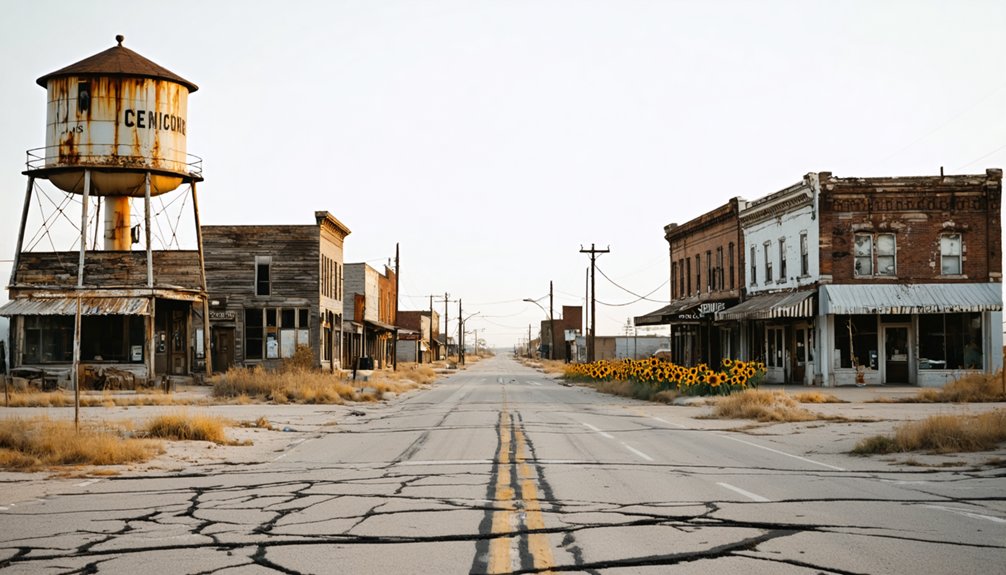
The railroad wasn’t Santa Fe’s only enemy. Drought hammered the region in the late 1880s, disrupting early settlement patterns that settlers had built along historical trade routes.
The 1890s offered brief relief, but another severe drought in the late 1890s broke the community for good. Between 40% and 60% of county residents simply packed up and left, leaving Santa Fe hollowed out.
Without rail access, the town couldn’t recover economically or attract new residents. The post office—often the last institution standing in a dying town—finally closed on July 31, 1925.
What’s Left at the Santa Fe Townsite Today?
If you’re hoping to walk the streets of old Santa Fe, you’ll find nothing left to walk — by 1988, every building had vanished and the townsite had been converted to farmland. The land gives no hint that a county seat once stood there, home to hundreds of residents with a post office, businesses, and political clout.
Your only tangible connection to the town’s past is the Haskell County Cemetery, sitting about 5.5 miles north of Sublette along U.S. Highway 83.
No Buildings Remain
When you arrive at the former townsite of Santa Fe, Kansas, you won’t find a single standing building — by 1988, the land had been completely converted to farmland, erasing every last structure that once made up this busy frontier county seat.
The combination of failed historical transportation routes and relentless agricultural hardships stripped the town of its residents and, eventually, its physical identity. What was once a thriving hub of nearly 600–700 people simply vanished beneath cultivated fields.
No foundations, no walls, no markers greet you at the site itself. The land offers no visual clues about the community that once stood there.
If you’re road-tripping through Haskell County expecting dramatic ruins, Santa Fe will remind you that abandonment can be quietly absolute.
Cemetery Still Stands
One quiet exception breaks that blank agricultural landscape: the Haskell County Cemetery still stands about 5.5 miles north of Sublette on U.S. Highway 83. It’s the sole surviving physical remnant of everything Santa Fe once represented — county-seat ambition, frontier optimism, and a community that drought and railroad decisions ultimately erased.
You won’t find historical architecture here, no courthouse ruins or crumbling storefronts. What you’ll find instead are weathered grave markers carrying the names of people who genuinely believed Santa Fe would last. That quiet weight carries its own power.
Local legends tied to the town’s rapid rise and collapse make the cemetery feel less like an endpoint and more like a conversation. Walk through it slowly — the stones have more to say than any remaining building could.
The Haskell County Cemetery: Santa Fe’s Only Surviving Landmark
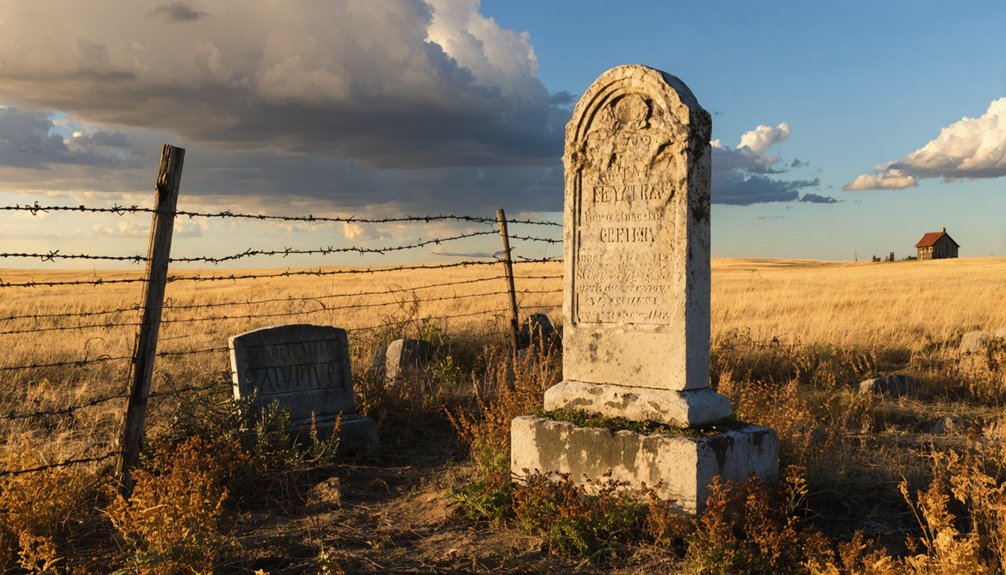
Though Santa Fe itself has vanished beneath farmland, the Haskell County Cemetery survives as the town’s only physical remnant. You’ll find it roughly 5.5 miles north of Sublette along U.S. Highway 83, making it one of the most accessible historic landmarks connected to this lost community.
The Haskell County Cemetery is Santa Fe’s only surviving remnant, sitting just 5.5 miles north of Sublette off U.S. Highway 83.
Standing among the weathered headstones, you’re essentially reading local folklore carved in stone — names and dates that trace back to Santa Fe’s brief but ambitious run as a county seat.
The graves reflect families who arrived chasing opportunity, endured droughts, and ultimately scattered when the town collapsed.
If you’re building a ghost-town road trip, this cemetery is your anchor point. The original townsite offers nothing visible, but here, Santa Fe’s human story remains quietly intact.
Three Ghost Towns Worth Adding to Your Haskell County Route
Once you’ve paid your respects at the Haskell County Cemetery, you can easily extend your route to explore other ghost towns scattered across southwestern Kansas.
Santa Fe fits naturally into a broader circuit because the same forces that killed it—railroad bypasses, drought, and population flight—erased dozens of other frontier settlements nearby.
Pack a detailed county map, note that most former townsites are now farmland with no standing structures, and plan your stops around any surviving landmarks like cemeteries or historical markers.
Nearby Abandoned Kansas Towns
Why stop at just one ghost town when Haskell County and its surrounding area offer several more abandoned sites worth folding into your route? The region’s boom-and-bust history left behind a scattered collection of forgotten communities, each carrying its own local legends and, in some cases, architectural remnants still visible from the road.
Sublette, which replaced Santa Fe as the county seat after the railroad shifted priorities, gives you useful context for understanding why some towns survived and others didn’t.
Pushing further into southwest Kansas, you’ll find additional extinct communities that share Santa Fe’s story — railroad bypasses, brutal droughts, and mass departures.
Linking these stops together transforms a single cemetery visit into a full-day route through one of Kansas’s most overlooked frontier landscapes.
Planning Your Ghost Town Route
Anchoring your route around the Haskell County Cemetery gives you a reliable starting point, since it sits roughly 5.5 miles north of Sublette on U.S. Highway 83.
From there, you can trace Santa Fe’s collapse through two lenses: historical transportation failures and agricultural hardships that stripped the population bare.
Drive south into Sublette to understand why the railroad’s arrival there sealed Santa Fe’s fate.
Then expand your loop toward other Haskell County ghost towns that share the same story — promising starts, bypassed rail lines, and droughts that emptied entire communities.
Connecting these stops transforms a casual drive into a clear narrative.
You’ll see how quickly frontier towns rose, and how decisively weather and railroad decisions could erase them from the map entirely.
Why Sublette Replaced Santa Fe as the County Seat
Because Santa Fe never secured a railroad connection, it couldn’t hold onto the economic momentum it had built as Haskell County’s seat of government. Historical transportation decisions shaped everything — when rail lines pushed through the region and stopped at Sublette instead of Santa Fe, businesses and residents followed the tracks.
That’s how local economic shifts happen on the frontier: commerce moves toward access, not legacy.
Sublette offered what Santa Fe couldn’t — a direct connection to regional markets and reliable freight movement. Once that advantage became clear, the county seat transfer was practically inevitable.
Santa Fe had served its role for 26 years, but without rail infrastructure, it couldn’t compete. You’re fundamentally looking at a town that did everything right politically and still lost because geography and steel won.
Best Time of Year to Visit the Santa Fe Townsite
Planning a visit to the Santa Fe townsite means working around the Kansas climate, and spring or early fall gives you the best conditions. April through May offers mild temperatures, manageable winds, and enough light to walk the farmland that once held a thriving county seat.
Spring and early fall offer the best conditions for exploring the Kansas farmland where Santa Fe once stood.
September and October deliver similar comfort without summer’s brutal heat.
Avoid midsummer if you can. The open plains offer no shade, and triple-digit temperatures make exploring miserable.
Winter brings frozen ground and limited daylight.
The Haskell County Cemetery, your anchor stop for tracing local legends and absorbing the site’s layered history, is accessible year-round, but dry-season visits let you move freely across the terrain.
You won’t find historical artifacts above ground, so your experience depends entirely on conditions you can actually control.
What to Bring for a Haskell County Ghost Town Drive

Packing light won’t serve you well on a Haskell County ghost town drive, where the flat, open terrain offers no services, no shade, and no buildings to duck into if conditions turn.
Before chasing urban legends across these forgotten plains, load up deliberately.
- Water and snacks – Local cuisine options are nonexistent near the Santa Fe townsite, so carry more than you think you’ll need.
- Paper maps or downloaded GPS – Cell coverage is unreliable across western Kansas.
- Sun protection – A hat, sunscreen, and sunglasses are non-negotiable under the open Kansas sky.
- Camera and notebook – You’ll want to document the cemetery and capture the eerie stillness of converted farmland where a county seat once stood.
Freedom out here means self-sufficiency. Don’t leave Sublette unprepared.
Frequently Asked Questions
Is There an Entrance Fee to Visit the Haskell County Cemetery?
Like pioneers arriving at the frontier, you’ll find no gates blocking your way. You won’t pay an entrance fee — historical preservation keeps this cemetery openly accessible, though respectful cemetery maintenance guarantees it remains a dignified, welcoming landmark.
Are There Any Guided Ghost Town Tours Available in Haskell County?
The knowledge doesn’t confirm guided ghost town tours in Haskell County, but you’ll uncover local legends and historical preservation stories on your own terms—explore freely, visit the cemetery, and let Santa Fe’s haunting past speak for itself.
Can Visitors Legally Access the Former Santa Fe Townsite Farmland?
Like a fence post marking a boundary, land ownership stops you here — you can’t freely access the former Santa Fe townsite. It’s private farmland, so historical preservation means respecting those boundaries and sticking to the nearby public cemetery instead.
Are There Nearby Restaurants or Gas Stations Along U.S. Highway 83?
You’ll find local dining options and roadside gas stations in nearby Sublette, just 5.5 miles south along U.S. Highway 83—it’s your best bet for fueling up before exploring Santa Fe’s ghostly, windswept history.
Is the Cemetery Road Accessible by Standard Vehicles or Only Four-Wheel Drive?
Like pioneers who blazed the Santa Fe Trail, you’ll find vehicle accessibility here straightforward—road conditions along U.S. Highway 83 to the cemetery accommodate standard vehicles, so you won’t need four-wheel drive to explore freely.
References
- https://digging-history.com/2015/02/18/ghost-town-wednesday-santa-fe-kansas/
- https://www.youtube.com/watch?v=dy7nLwjHkbY
- https://legendsofkansas.com/santa-fe-kansas/
- https://thewanderingpigeon.com/2015/10/03/day-of-kansas-ghost-towns/
- https://johnsoncoks.cottonhills.net/historic-records/old-towns.html
- https://en.wikipedia.org/wiki/Santa_Fe
- http://kansasoakland.blogspot.com/2011/08/santa-fe-kansas.html
- https://fhsuguides.fhsu.edu/kansasheritage/haskellcounty
- https://legendsofkansas.com/haskell-county-extinct-towns/