Planning a ghost town road trip to Telico, Texas means heading northeast of Ennis along Highway 34, then onto the old farm road once called Rexall Highway. You won’t find tourist signs or historic markers — just quiet rural roads, open sky, and layered history waiting beneath the surface. Spring and fall offer the best conditions for exploring. Stick around, because Telico’s story runs deeper than its silence suggests.
Key Takeaways
- Telico is located in Ellis County northeast of Ennis, Texas, accessible via Highway 34 and a paved farm road year-round.
- The Kirkpatrick Presbyterian Church, built in 1867, is the area’s key surviving landmark and worth including in your visit.
- Spring and fall offer the best conditions; summer visitors should arrive early and carry sufficient water.
- Telico thrived before the Civil War as a river landing and manufacturing hub before declining by 1905.
- Combine your trip with nearby ghost towns Bardwell and Avalon for a broader frontier Texas road trip experience.
What’s Left of Telico, Texas Today
When you roll down the farm road once known as the Rexall Highway, you’ll find that Telico has quietly faded into a rural residential neighborhood with little to show for its ambitious past.
Few original buildings remain, and the old riverfront landing at Grassy Bank has long since surrendered to time and floodwaters.
Historical preservation never gained much traction here, leaving the community’s remarkable story mostly in archives rather than on signage.
Still, the landscape itself carries a quiet weight. Community engagement keeps a thread of local memory alive, particularly around the restored church that survived a 1960 tornado.
You won’t find dramatic ruins, but you’ll find open roads, honest rural scenery, and enough history beneath the surface to make the drive genuinely worthwhile.
How to Find Telico on Your Road Trip Route
Tucked into Ellis County northeast of Ennis, Telico sits along Highway 34 before you turn onto the farm road that locals once called the Rexall Highway. You won’t find dramatic ruins or historical artifacts lining the roadside, so knowing your route matters.
Access is straightforward on 2WD roads, making it an easy detour whether you’re heading through the Dallas area or cruising south toward Ennis. The summer heat is real, but you can visit anytime.
Local legends follow you through this stretch of rural Texas, especially those tied to Clyde Barrow, who was reportedly born here in 1909. Keep your eyes open for the quiet residential landscape that replaced the old river landing town, and let the road tell the rest of the story.
What to Expect When You Arrive in Telico
When you pull into Telico today, you’ll find a quiet rural residential neighborhood where the original buildings have largely vanished into memory. The old riverfront settlement that once buzzed with a manufacturing boom and river trade has given way to a modest stretch of farm road and scattered homes.
Yet if you look closely, you’ll still catch traces of the community that survived — a church with its own dramatic history standing as one of the few tangible links to Telico’s past.
The Rural Landscape Today
What greets you in Telico today isn’t a crumbling ghost town frozen in time — it’s a quiet rural residential neighborhood, its past almost entirely absorbed by the surrounding Ellis County farmland. Don’t expect historic landmarks around every bend. Original buildings are practically gone, replaced by modest homes and open land stretched beneath a wide Texas sky.
You’ll travel in on a farm road once known as the Rexall Highway, the kind of unhurried backroad that rewards curious, independent travelers. There’s no local cuisine scene here, no tourist infrastructure pulling you in a particular direction — just space, silence, and the freedom to imagine what once stood along the old Trinity River landing.
Bring your own provisions and let the landscape tell its story.
Surviving Community Traces
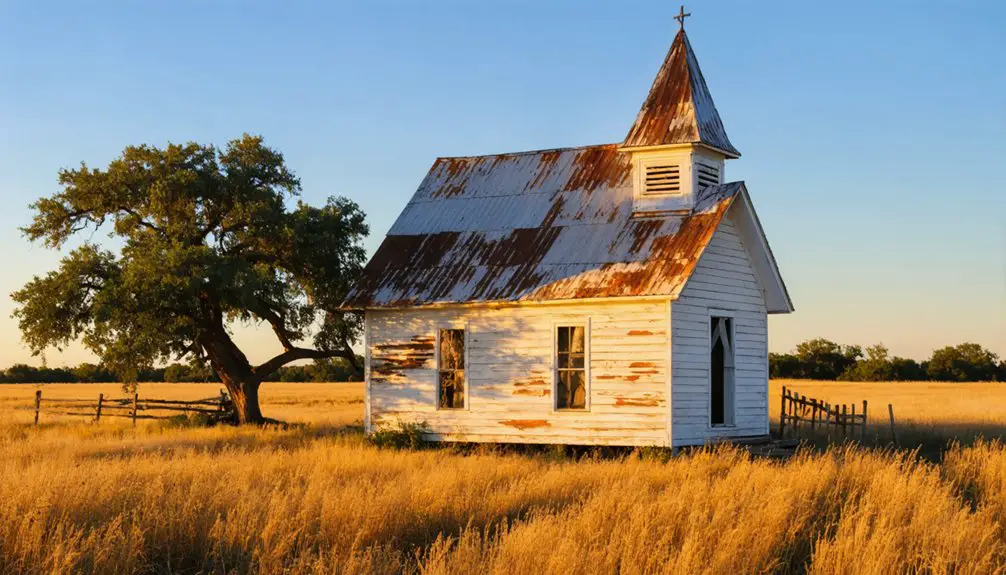
Though little of old Telico has survived the decades, a few quiet traces of community life still anchor the landscape and give the place meaning beyond its ghost-town label. The Kirkpatrick Presbyterian Church, built near the original village site in 1867, stands as one of the area’s most telling historical landmarks.
A tornado struck it in October 1960, yet community preservation efforts restored it during the 1980s, and it remains a tangible connection to Telico’s past.
You’ll also find that the surrounding rural neighborhood retains a lived-in character, with farm roads tracing old routes through the countryside. These traces won’t overwhelm you with spectacle, but they reward the attentive traveler who values authentic history over polished tourist destinations.
How Telico Went From Busy River Landing to Forgotten Town
Before the Civil War reshaped the South, Telico hummed with real economic energy — boats docking at Grassy Bank on the Trinity River’s west bank, Thomas A. McCray’s manufacturing plant running four engines across 100 by 200 feet, and a hotel anchoring a growing community.
Then everything unraveled fast:
- The Civil War shut down McCray’s cotton, wool, and lumber operation after just four or five years.
- Flooding destroyed the river landing infrastructure that made Telico’s location valuable.
- The post office in the relocated inland settlement closed in 1905, signaling the final fade.
Architectural remnants are scarce today, and historical preservation efforts remain minimal. You’re fundamentally visiting memory more than structure — but that’s exactly what makes Telico worth the detour.
The Rise and Fall of Telico’s Manufacturing Empire
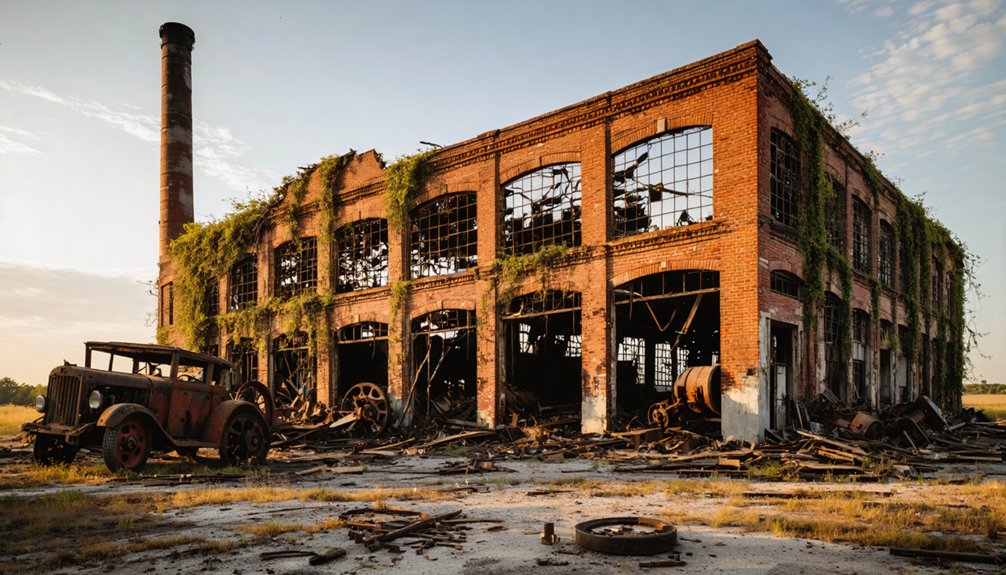
When Thomas A. McCray founded the Telico Manufacturing Company in 1854, he transformed a quiet river community into an industrial hub. You’d have witnessed a massive facility stretching 100 by 200 feet, powered by four large engines producing cotton cloth, wool, lumber, and furniture. Investment reached upward of $200,000, remarkable for a small Texas settlement.
The historical architecture of that era reflected genuine ambition — this wasn’t a modest frontier operation but a serious manufacturing empire. Local legends suggest the plant’s scale rivaled larger city operations of the time.
Then the Civil War hit, and everything unraveled within four to five years. The boom collapsed, the river flooded the landing, and Telico’s industrial dream quietly dissolved into the Texas countryside, leaving only stories behind.
Clyde Barrow, Church Shootouts, and the Legends Locals Still Tell
Telico’s story didn’t end with collapsed factories and flooded riverbanks — it kept layering on legends that locals still pass around today. These community memories give the place a pulse that empty lots and overgrown roads can’t erase.
When you dig into Telico’s local legends, three stories rise to the surface:
- Clyde Barrow, one half of the infamous Bonnie and Clyde duo, was reportedly born here in 1909
- A shootout inside the church during services left a mark on the town’s collective memory that no one’s forgotten
- A tornado struck the Telico church on October 13, 1960, though the congregation restored it decades later
These aren’t just footnotes — they’re the kind of raw, untamed history that makes a back-road detour feel absolutely worth it.
When to Go and What the Roads Are Actually Like

You can visit Telico any time of year, but spring and fall offer the most comfortable temperatures before the brutal Texas summer heat sets in.
The roads into the community are standard 2WD-accessible, so you won’t need a truck or an off-road vehicle to make the trip.
Pack water if you’re heading out between June and August, because that hot, open Ellis County sun doesn’t forgive an unprepared traveler.
Best Time To Visit
Though Telico welcomes visitors year-round, the roads into this quiet Ellis County community are accessible by standard two-wheel-drive vehicle, so you won’t need anything more rugged than the family car. That said, timing your visit smartly makes a real difference when you’re chasing local legends and traces of historical architecture.
- Spring and fall offer mild temperatures ideal for walking the rural landscape and soaking in the scenery.
- Summer brings intense heat, so arrive early morning and carry plenty of water if you’re exploring on foot.
- Winter visits are quieter and surprisingly rewarding, with bare trees opening sightlines across the old settlement grounds.
Whenever you go, you’re stepping into a place that traded riverboat commerce for quiet back roads and stubborn memory.
Road Conditions And Access
Getting to Telico doesn’t require anything beyond a standard two-wheel-drive vehicle — the farm road into this old Ellis County community is paved and navigable year-round without special equipment. The route follows what locals once called the Rexall Highway, a quiet stretch that replaced the original riverfront path after floods reclaimed the old Trinity River landing.
You won’t find much historical architecture standing when you arrive — this is a rural residential neighborhood now, not a preserved district. But local legends about Clyde Barrow’s birthplace and a Wild West-style church shootout give the landscape a weight that plain fields don’t suggest.
Roll through slowly, read the terrain, and let the absence of ruins tell its own story about what this place once was.
Climate And Seasonal Considerations
Telico sits under a Texas summer sky that doesn’t negotiate — heat settles hard over Ellis County by June and stays through September, making an early morning departure worth planning if you’re visiting during those months.
Cooler seasons open the landscape differently, letting you move freely through what remains of this community tied to local legends and faded historical architecture.
- Fall and spring offer the most comfortable exploring weather
- Winter visits stay mild enough for walking the farm road without much gear
- Summer mornings before 9 a.m. give you the light and the temperature you want
You can visit anytime, but the land rewards patience — arrive when the air cooperates, and Telico’s quiet, layered history meets you on its own terms.
Ghost Towns Near Telico to Add to Your Route
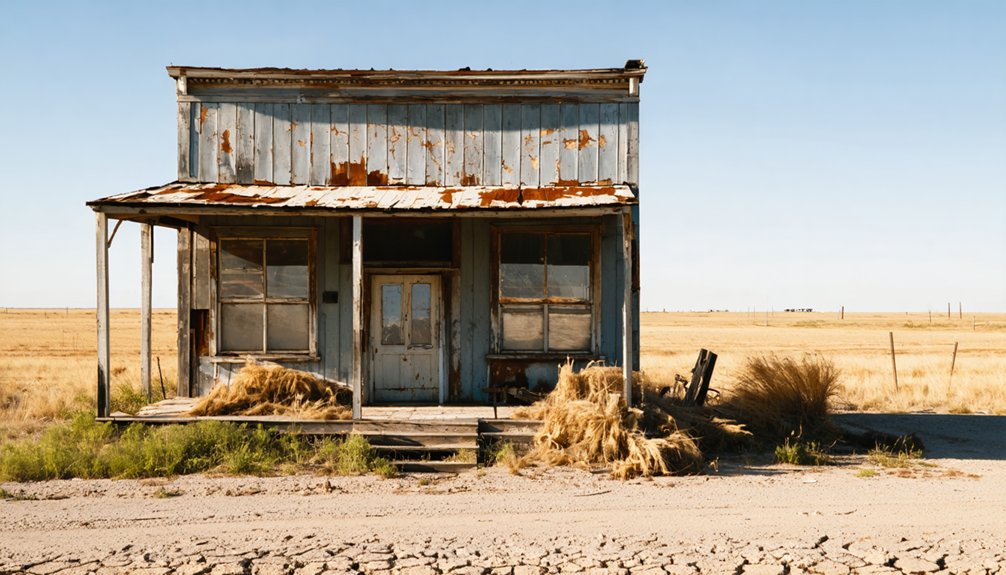
Since you’re already making the drive out to Ellis County, it’s worth plotting a few more ghost towns into your route. Texas Hill Country and North Texas are scattered with forgotten communities that share Telico’s story of rise, struggle, and quiet disappearance.
Towns like Bardwell and Avalon sit nearby, each carrying their own local legends of pioneer families, lost industries, and vanished dreams. You’ll find remnants of historic architecture—old stone storefronts, weathered church frames, and crumbling foundations—that tell stories no textbook fully captures.
Linking these stops together turns a single destination drive into a fuller portrait of how frontier Texas lived and faded. Pack a state map, keep your tank full, and let the back roads guide you through history hiding in plain sight.
Frequently Asked Questions
What Was Telico Originally Called Before It Got Its Current Name?
Sure, it’s just “Trinity City” — nothing fancy! You’ll uncover rich ghost town history and local legends when you discover Telico’s nostalgic roots, originally bearing this ambitious name before transforming into the free-spirited community you’re exploring today.
Where Exactly Did the Telico Name Come From Geographically?
You’ll find Telico’s name rooted in either Tellico, North Carolina, or Tellico Plains, Tennessee — both carrying their own local legends and ghost stories that echo nostalgically through this freedom-loving Texas community’s storied, wandering past.
How Much Was Invested in the Telico Manufacturing Company?
Investment reached a staggering $200,000, rivaling historic architecture of the era. You’d feel the local legends surrounding Thomas McCray’s ambitious Telico Manufacturing Company, a bold 1854 dream that four mighty engines once powerfully drove forward.
When Did Telico’s Post Office Operate in the Later Inland Settlement?
You’ll find that Telico’s historical postal services ran from 1894 to 1905, marking a nostalgic chapter in inland settlement development — a time when free spirits carved out community life far from the old riverfront.
What Was Telico’s Reported Population During the 1990S and 2000S?
Tiny Telico tallied around 95 residents in both 1990 and 2000. You’ll find these historical population trends fascinating for ghost town tourism, as they reveal a quietly persisting community holding onto its nostalgic past with enduring freedom.
References
- https://www.txgenwebcounties.com/ellis/_ghost_towns/Telico_Texas.html
- https://www.ghosttowns.com/states/tx/tx_ghst_twns_sect1345.doc
- https://texashistory.unt.edu/ark:/67531/metapth61101/m1/171/
- https://www.txgenwebcounties.com/ellis/_newspapers/The_Dallas_Morning_News_1936_Jan_6_Telico.html
- https://en.wikipedia.org/wiki/Telico
- https://en.wikipedia.org/wiki/List_of_ghost_towns_in_Texas
- https://de.wikipedia.org/wiki/Telico
- https://texashistory.unt.edu/ark:/67531/metapth117140/m1/471/
- https://authentictexas.com/texas-ghost-towns/
- https://www.texasescapes.com/TOWNS/Texas_ghost_towns.htm