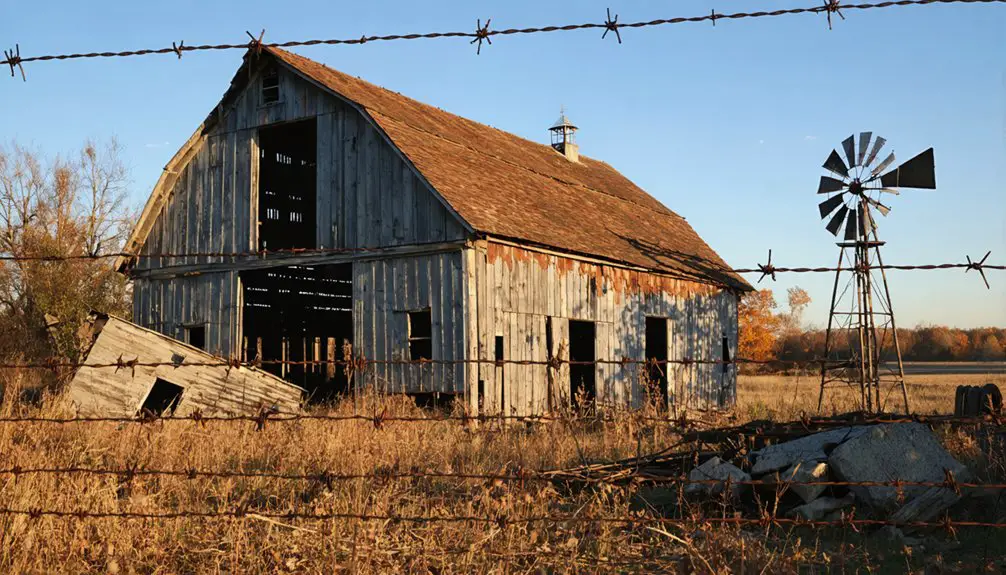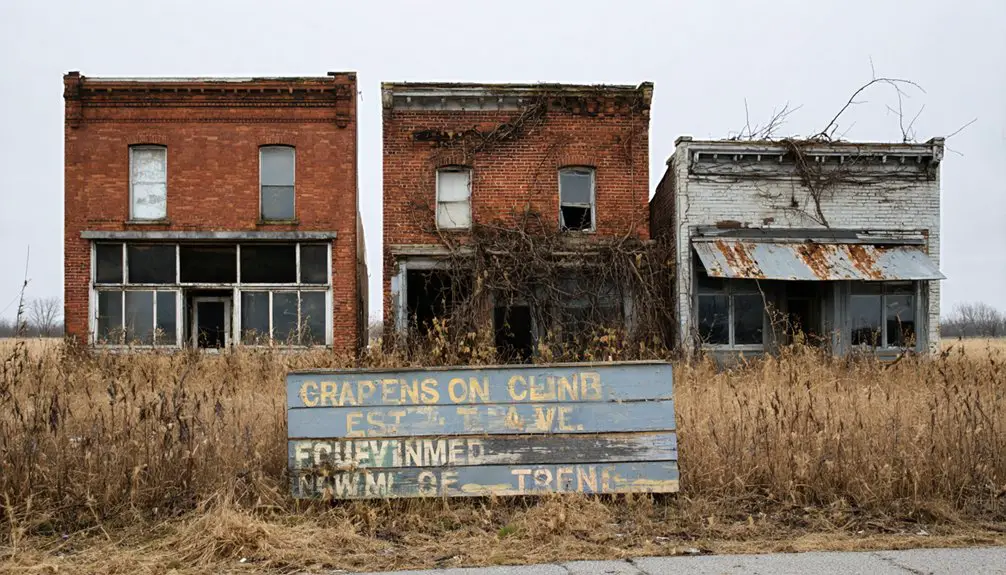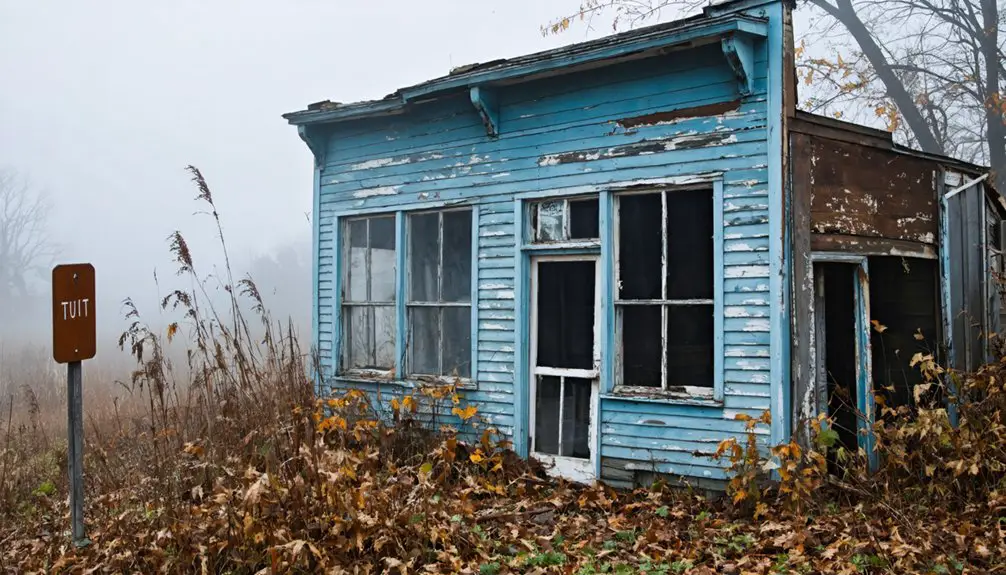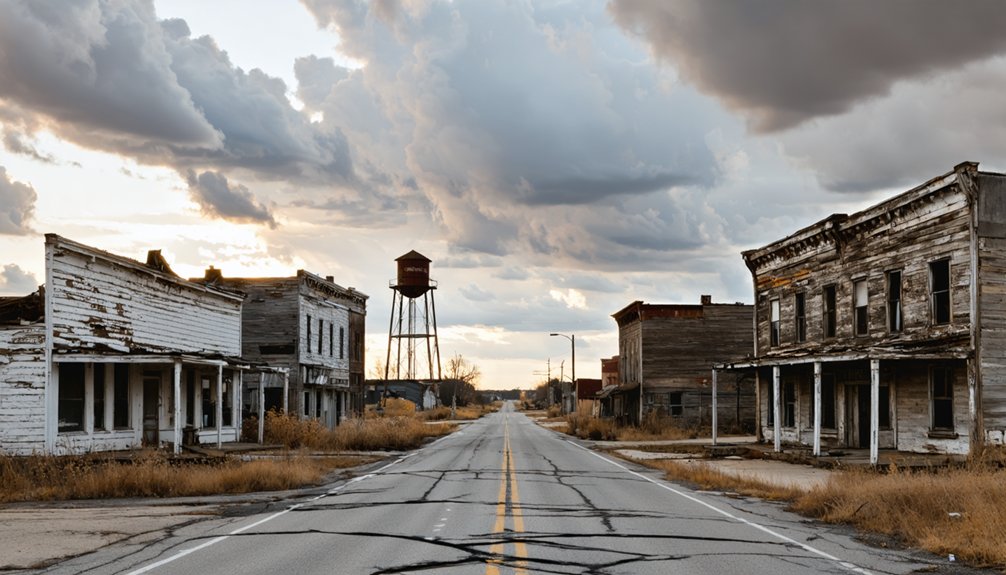
Planning a ghost town road trip to Utopia, Ohio means stepping into a haunting chapter of American history. You’ll find this quiet semi-ghost town tucked along US Route 52 near the Ohio River in Clermont County. Founded in 1844 as a utopian experiment, it was nearly wiped out by a devastating 1847 flood that killed around 150 residents. Come curious, come reflective—there’s far more to Utopia’s story than its eerie silence suggests.
Key Takeaways
- Utopia, Ohio, sits along US Route 52 near the Ohio River in Clermont County, making it an accessible road trip destination.
- The most notable site is a stone underground chamber, possibly a church or cellar, offering a rare physical link to the past.
- A historical marker erected in 2003 along US Route 52 provides essential context about Utopia’s fascinating and tragic history.
- Nearby towns like Ripley, Manchester, and Maysville, Kentucky enhance your trip with additional historical and cultural experiences.
- Expect a quiet, reflective atmosphere with few remaining structures, ideal for a brief but impactful ghost town visit.
The Failed Utopia That Became a Ghost Town
Before it became a curiosity on the ghost-town road-trip circuit, Utopia, Ohio had a bold ambition: to prove that communal living could work. In 1844, followers of French utopian socialist Charles Fourier founded the settlement after their earlier Clermont Phalanx community collapsed. They envisioned shared labor, collective harmony, and true social freedom.
Utopia, Ohio wasn’t just a town — it was a declaration that communal living could actually work.
It didn’t last. Within two to three years, financial strain and ideological fractures dissolved the experiment. By 1847, Spiritualists led by John O. Wattles moved in, hoping to resurrect the dream.
Then a devastating December flood killed most of the new settlers and effectively erased the town.
Local folklore and historical myths now surround the tragedy, but the core story is straightforward: Utopia tried, failed, and left behind little more than echoes.
The 1847 Flood That Erased Utopia, Ohio
On the night of December 13, 1847, a flash flood tore through Utopia and wiped out nearly everyone who’d stayed. The flood aftermath was devastating — community reconstruction never truly happened.
Here’s what the flood took:
- 150 of 156 residents attending a gathering perished
- John O. Wattles’ Spiritualist vision drowned with his followers
- Structures, dreams, and a second chance at communal freedom — all gone
- Survivors scattered, leaving no foundation for rebuilding
- The town’s identity shifted permanently from hopeful experiment to haunted memory
You’re visiting a place where two failed communities collided with one catastrophic night. The flood didn’t just erase buildings — it erased belief. What remains today are scattered remnants and a story that still demands to be told.
What’s Left to See in Utopia Today?
When you pull off U.S. Route 52 today, you’ll find Utopia is more impression than infrastructure—a quiet river community where most of the original settlement has been swallowed by time and floodwater.
Your best tangible stop is the underground chamber, once described as a church or cellar, which stands as one of the few surviving remnants of the ill-fated settlement.
You can also locate the historical marker erected in 2003, which gives you the clearest on-site anchor for piecing together Utopia’s layered, tragic past.
Underground Chamber Remnants
Though Utopia’s historic settlement has largely faded into the riverbank, one remnant stands out as the most compelling reason to stop: an underground chamber that locals variously describe as a church, a cellar, or a wine storage space. This hidden history survives where almost nothing else has, making the underground chambers a rare, tangible connection to the people who once believed they could build something better here.
When you visit, let these realities sink in:
- Survivors of the 1847 flood once walked these same grounds
- The chamber’s exact purpose remains historically debated
- Its stone construction outlasted an entire community
- Few tourists ever find it
- Standing inside means touching 180 years of forgotten dreams
That kind of freedom — discovering what others overlook — is exactly why you came.
Historical Marker Location
Beyond the underground chamber, the most reliable landmark you’ll find in Utopia today is the historical marker erected in 2003. It stands along US Route 52, marking the spot where utopian dreams and devastating floodwaters collided in the mid-1800s. You don’t need a guided tour or admission fee — just pull over, read the marker, and let the story sink in.
The marker serves as the community’s anchor for historic preservation, giving travelers a concrete connection to Utopia’s layered past. Local folklore about the 1847 flood, the Fourierist settlers, and the scattered survivors all come alive when you’re standing on that riverbank.
It’s a small but meaningful stop — proof that even a few words cast in metal can keep a forgotten place breathing.
How to Get to Utopia, Ohio
Tucked along the northern bank of the Ohio River, Utopia sits about 30–40 miles southeast of Cincinnati in Clermont County, making it an easy detour if you’re already exploring southwest Ohio. Follow US Route 52 directly into this quiet river community, where local folklore and community stories still echo through the landscape.
- Feel the pull of history as Cincinnati’s skyline fades behind you
- Wind along the Ohio River corridor on scenic US Route 52
- Pinpoint Utopia near coordinates 38.77611°N, 84.05722°W
- Combine your stop with other southern Ohio river towns
- Arrive ready to explore — parking is simple in this small community
It’s a short drive with a surprisingly deep historical reward waiting at the end.
Ohio River Towns Worth Pairing With This Stop
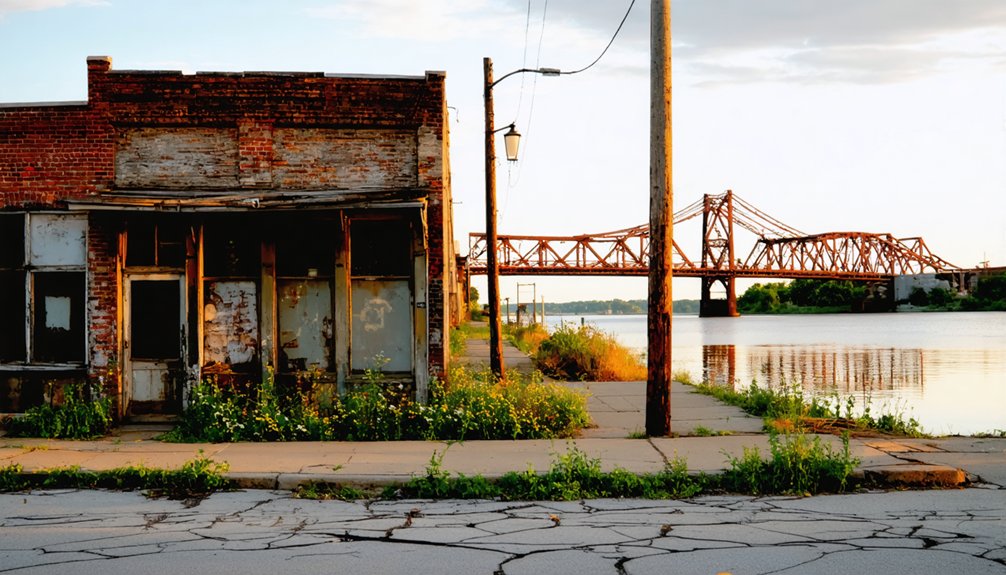
Since Utopia sits along US 52 on the Ohio River corridor, you can easily string together several nearby river towns into a single day trip.
Communities like Ripley and Manchester lie within a reasonable driving distance and offer their own slices of Ohio River history, from abolitionist landmarks to quiet riverside architecture.
Combining these stops with Utopia gives your road trip more depth without demanding much extra mileage.
Nearby River Towns
Utopia sits along US 52, a river road that connects a string of small Ohio River towns worth folding into your itinerary. Each stop carries its own cultural heritage and local legends, giving your road trip real depth beyond a single ghost town.
Consider pairing Utopia with these nearby river communities:
- Ripley, Ohio – A freedom trail stronghold with Underground Railroad history woven into every brick
- Manchester, Ohio – A quietly fading river town with deep frontier roots
- Aberdeen, Ohio – A small crossing point rich with Civil War-era memory
- Maysville, Kentucky – Just across the river, offering Southern character and historic architecture
- New Richmond, Ohio – A riverside village balancing preservation with a living community
Together, these towns transform a single stop into a full river corridor experience.
Combining Multiple Stops
Because Utopia sits directly on US 52, you’re already positioned to run the full length of Ohio’s southern river corridor without backtracking. String together Ripley, known for its Underground Railroad history, with Point Pleasant, Grant’s birthplace, and Augusta, Kentucky, just across the river.
Each stop adds texture to the broader story of communities shaped by the Ohio River’s power and promise.
Utopia’s utopian ideals and flood aftermath make it the emotional anchor of this stretch — a place that tried boldly and lost dramatically. The surrounding towns complement that weight with their own layered histories.
You’re not just collecting ghost towns; you’re tracing an entire region’s ambitions, failures, and resilience. Keep your driving route tight along US 52, and you’ll cover everything efficiently in a single day.
What to Know Before You Visit Utopia, Ohio
Before you load up the car and head down US 52, there are a few things worth knowing about Utopia, Ohio. It’s not fully abandoned — a handful of residents still call it home. Modern remnants are scarce, and local folklore fills many gaps left by history.
- Utopia is a semi-ghost town, not a fully deserted place
- Visible structures are extremely limited — manage your expectations
- The 1847 flood wiped out most of the original settlement
- An historical marker erected in 2003 anchors the site’s story
- Local folklore ties the area to haunting claims and Underground Railroad history
Plan this as a short stop rather than a full-day destination. Come curious, come prepared, and let the silence speak for itself.
Frequently Asked Questions
Is Utopia, Ohio Considered a True Ghost Town or Semi-Ghost Town?
Utopia’s got a thousand stories to tell, but it’s technically a semi-ghost town. You’ll find a handful of residents still living there, where historical preservation efforts and fascinating local legends keep its haunted past alive.
Who Was Charles Fourier, and Why Did His Followers Choose Ohio?
Charles Fourier was a French utopian socialist whose philosophical influence shaped communal living ideals. His followers chose Ohio for its historical origins as frontier land, where you’d find affordable space to build their dream society freely.
Are There Any Ghost Tours or Organized Events Held in Utopia?
With only a handful of residents remaining, you won’t find organized ghost tours here, but Utopia’s haunted legends and ghost stories make it a hauntingly personal discovery you’ll experience entirely on your own terms.
Can Visitors Access the Underground Chamber or Church Remnant Safely?
You’ll want to approach the underground chamber cautiously, as underground safety isn’t guaranteed in aging structures. Respect church preservation efforts by staying alert to restricted areas, honoring the site’s fragile history while freely exploring Utopia’s haunting, storied past.
What Is the Best Time of Year to Visit Utopia, Ohio?
Hit the road when fall’s crisp air arrives — September and October offer you the best experience exploring Utopia’s historical significance and cultural preservation, as cooler temperatures make walking remnants and river scenery genuinely comfortable and unforgettable.
References
- https://en.wikipedia.org/wiki/Utopia
- https://www.facebook.com/groups/Old.Cincinnati/posts/2642562319119534/
- https://www.youtube.com/watch?v=8imWf4vkOCQ
- https://creepycincinnati.com/2016/07/18/utopia/
- https://digging-history.com/2014/09/03/ghost-town-wednesday-utopia-ohio/
- https://ohioghosttowns.org/top-10-town-tales/
- https://www.onlyinyourstate.com/trip-ideas/ohio/spooky-small-town-oh
- https://kids.kiddle.co/Utopia
- https://www.youtube.com/watch?v=QWTtG6njIDs
- https://spectrumlocalnews.com/tx/south-texas-el-paso/untangled-with-josh-robin/2019/04/26/what-happened-to-utopia–tx