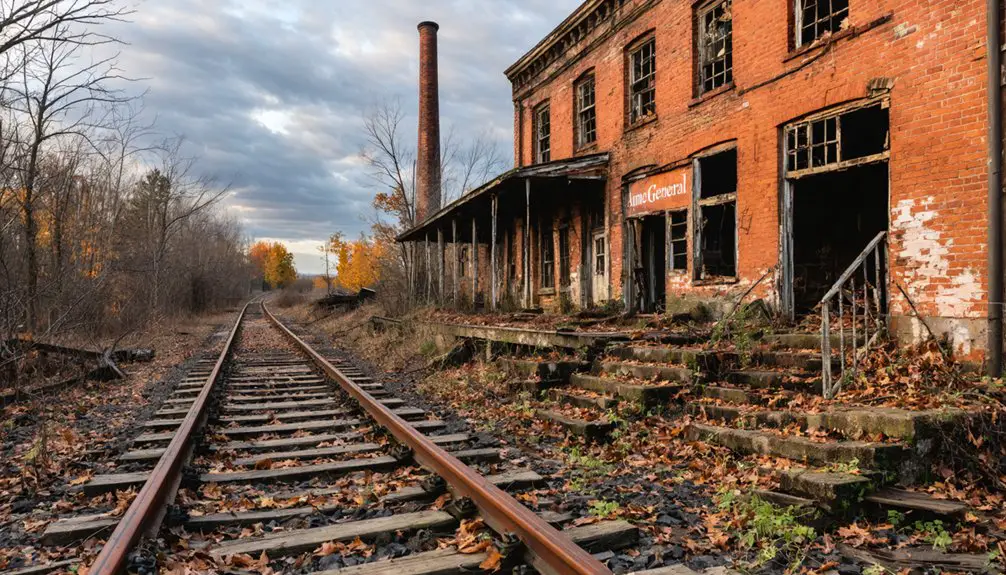
Planning a ghost town road trip to Aqueduct, Pennsylvania means stepping into a place frozen in time since 1885. You’ll find an unincorporated Indiana County settlement built around a railroad that never operated, anchored by a stunning 199-foot stone aqueduct crafted by Sicilian masons without a single drop of mortar. Access it via the Ghost Town Trail, ideal for hiking or biking. There’s far more to this forgotten corner of Pennsylvania’s industrial past than you’d expect.
Key Takeaways
- Aqueduct, Pennsylvania, is an unincorporated ghost town in Indiana County, originating from the abandoned South Penn Railroad project in the 1880s.
- The town’s centerpiece is a 199-foot mortarless stone aqueduct, remarkably preserved and built by Sicilian masons without binding agents.
- Access Aqueduct via the Ghost Town Trail, which offers multiple trailheads suitable for hiking or biking on relatively flat terrain.
- Visit in late fall or early spring for the best visibility of the aqueduct and surrounding historical sites along the trail.
- Plan a full morning to explore, as nearby ghost towns and coal- and rail-era landmarks enrich the overall road trip experience.
What Is Aqueduct, Pennsylvania?
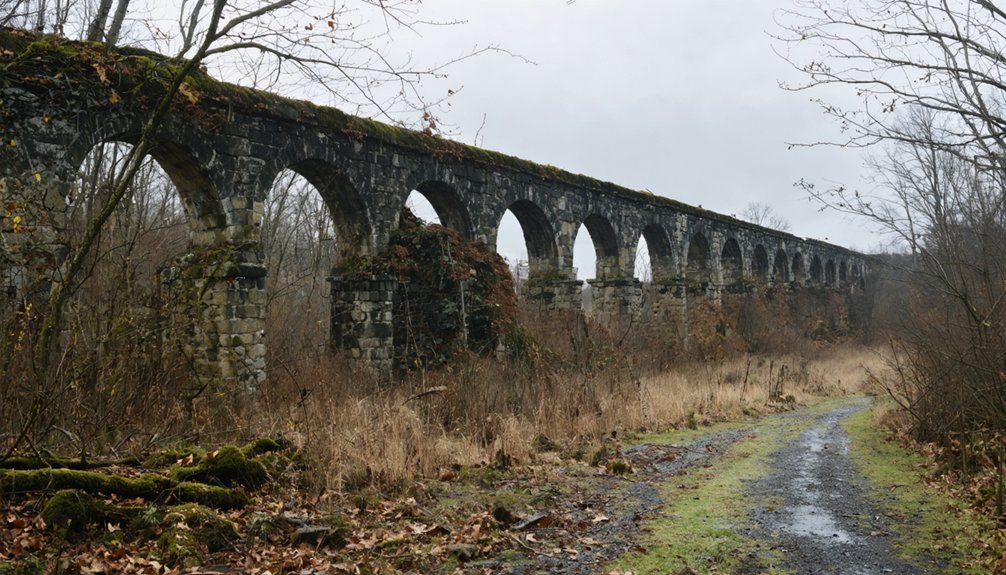
Tucked into Indiana County, Pennsylvania, Aqueduct is an unincorporated ghost town that owes its entire identity to a railroad that never ran. The settlement took its name from a stone aqueduct built for the South Penn Railroad, an ambitious 1880s project that industrialists William Vanderbilt and Andrew Carnegie designed to break the Pennsylvania Railroad’s grip on the region.
A ghost town named for a railroad that never ran — Aqueduct exists because of ambition, not arrival.
When that project collapsed in 1885, Aqueduct fundamentally froze in time.
Today, you’ll find it listed among Pennsylvania’s documented ghost towns, a quiet roadside remnant rather than a sprawling townsite. It’s a place where railroad history literally shaped the landscape and then abandoned it.
If you’re drawn to forgotten infrastructure and open road freedom, Aqueduct rewards the curious traveler willing to seek it out.
The Stone Aqueduct: What You’ll Actually See
When you arrive at the aqueduct, you’ll find a stone structure that has defied time remarkably well for something built in the late 1800s.
Sicilian masons constructed it without a drop of mortar, stacking stone against stone in a technique that has held together for over a century.
At 199 feet long, 15 feet high, and 10 feet wide, the structure is far more substantial than you might expect from a ghost-town roadside stop.
Aqueduct’s Remarkable Preservation
Although it’s easy to underestimate a structure hiding along a quiet rail corridor, the stone aqueduct at Aqueduct, Pennsylvania will genuinely stop you in your tracks. Standing 15 feet high, stretching 10 feet wide, and running 199 feet long, this structure commands respect the moment you see it.
Its historical significance becomes immediately clear when you learn that Sicilian masons assembled every stone without mortar, relying entirely on precise architectural techniques to hold the structure together. That craftsmanship, dating to the late 1800s, has kept the aqueduct remarkably intact despite over a century of exposure.
You’re fundamentally standing beside a surviving monument to an abandoned railroad dream. Few structures along the Ghost Town Trail deliver this kind of tangible, unfiltered connection to western Pennsylvania’s industrial past.
Stone Construction Without Mortar
What you’ll notice first, standing close to the aqueduct, is how tight and deliberate each stone placement looks—no mortar filling gaps, no binding agent hiding imprecise work.
Sicilian masons built this structure using mortarless masonry, relying entirely on precise cuts, careful weight distribution, and skilled hands. Every stone holds because its neighbors force it to.
This historical construction technique demands far more skill than mortar-dependent methods. There’s no paste to compensate for sloppy cuts or misaligned courses. The masons had to get it right the first time, and clearly they did—this structure has stood since the 1880s without chemical bonding.
Walk the full 199-foot length and you’ll feel the quiet confidence embedded in every course.
That’s craftsmanship, not coincidence.
Aqueduct Dimensions And Scale
Three numbers define the aqueduct before you even step close: 15 feet high, 10 feet wide, and 199 feet long. Those dimensions don’t sound massive on paper, but standing beside the structure changes your perspective entirely.
The aqueduct engineering here represents a serious commitment of labor and stone. Sicilian masons cut and stacked every block without mortar, trusting friction and precision over adhesive. That choice gives the structure its historical significance — it shouldn’t have survived this long, yet it did.
Walk the full length and you’ll appreciate both the scale and the silence. No interpretive center greets you, no gift shop crowds the view.
Just 199 feet of dry-laid stone proving that 19th-century builders knew exactly what they were doing.
Why the South Penn Railroad Left Aqueduct Behind
The stone aqueduct standing quietly in Indiana County didn’t get abandoned because it failed — it got abandoned because a backroom deal killed the entire railroad.
William Vanderbilt and Andrew Carnegie had serious railroad ambitions when they launched the South Penn Railroad in the 1880s. Their goal was simple: break the Pennsylvania Railroad‘s stranglehold on freight movement across the state. Workers blasted tunnels, raised bridges, and cut grades through rugged terrain.
Then in 1885, Vanderbilt quietly negotiated a settlement with the Pennsylvania Railroad, and project abandonment followed almost immediately.
Every tunnel, every bridge, every stone structure — including your aqueduct — got left exactly where it stood. You’re not looking at failure when you visit. You’re looking at a power move that erased an entire railroad overnight.
Getting to Aqueduct on the Ghost Town Trail
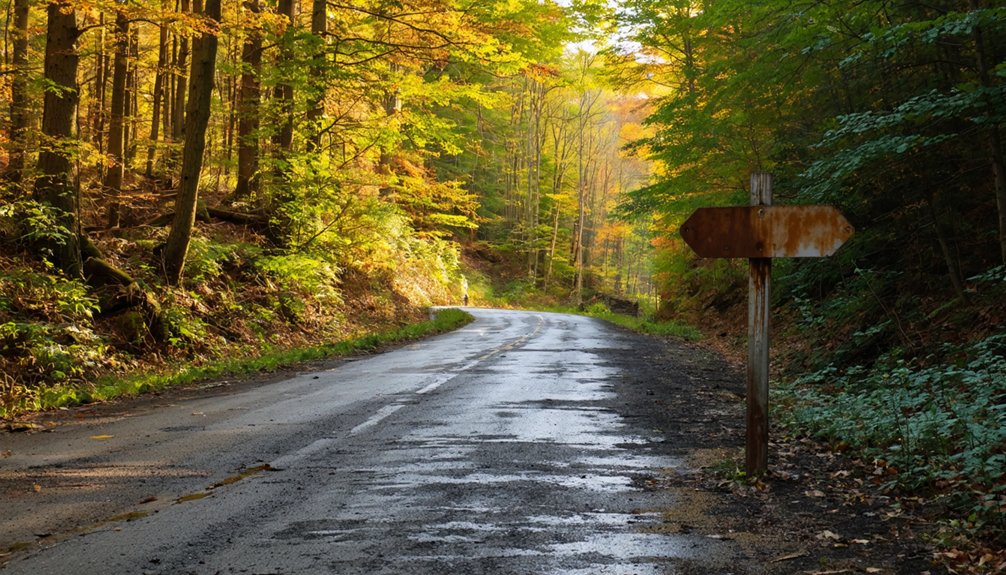
Once you’ve set your sights on Aqueduct, the Ghost Town Trail becomes your primary corridor into Indiana County’s rail history.
Trail accessibility is straightforward, with multiple trailheads anchoring the system at Blacklick, Twin Rocks, Nanty Glo, and Ebensburg. You’ll find route options depending on how far you want to travel and whether you’re biking or hiking.
The trail follows former rail grades, keeping terrain relatively flat and manageable.
Park at the Blacklick trailhead if you’re approaching from the western end, or use Nanty Glo for a shorter eastern approach. Whichever entry point you choose, watch for ghost-town markers along the corridor.
Foliage-sparse seasons reveal ruins more clearly, making late fall or early spring ideal for spotting the aqueduct structure before it disappears into the tree line.
Nearby Ghost Town Stops Worth Adding to Your Route
Reaching Aqueduct puts you squarely in one of western Pennsylvania’s richest corridors for coal- and rail-era ruins, and it’d be a shame to stop at just one stop.
Aqueduct is your gateway into western Pennsylvania’s coal- and rail-era past — don’t stop here.
The Ghost Town Trail connects you to old furnaces, wetlands, murals, and memorials that collectively deepen the ghost town history you’re already chasing. Corbett and related stone ruins sit within reasonable striking distance, rewarding explorers who push a little further down the corridor.
You’ll find that regional attractions here aren’t polished tourist destinations — they’re raw, weathered remnants that reward curiosity.
Plan your visit during late fall or early spring, when sparse foliage pulls back the curtain on structures that summer vegetation quietly swallows.
String several stops together, and you’ve built a genuinely memorable day.
Best Time of Year to Visit Aqueduct, PA
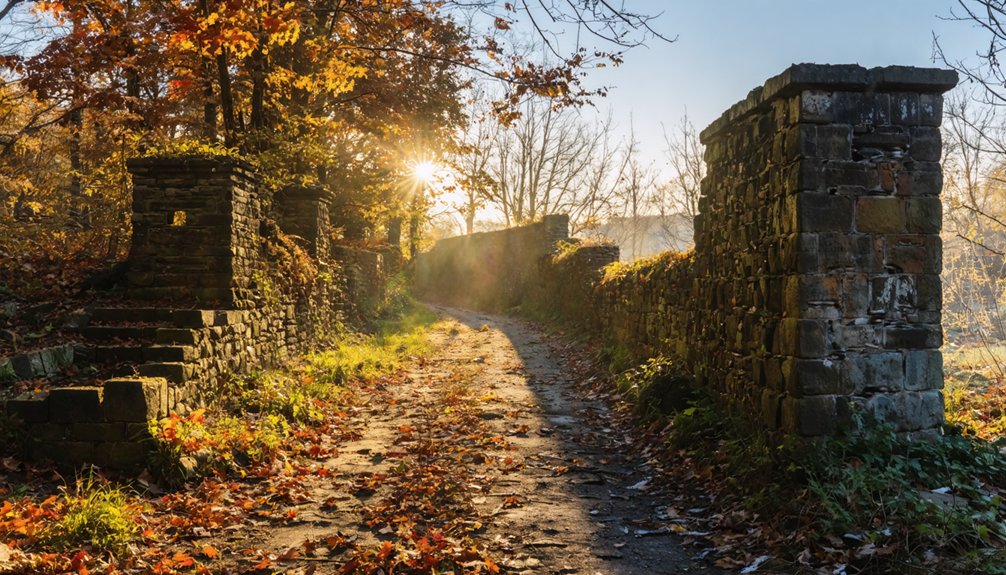
If you want the clearest views of the old stone aqueduct and surrounding ruins, visit in fall after the leaves drop, since sparse foliage exposes details you’d otherwise miss.
Winter brings a quieter trail experience, but check conditions first, as ice and snow can make the rail corridor slippery and less accessible.
Come in spring if you’d rather trade sharp sightlines for a wildflower bloom that softens the ghost-town atmosphere with color along the trail corridor.
Fall For Clearer Views
Though Aqueduct, Pennsylvania holds its quiet charm year-round, fall strips the surrounding woodland down to its bones—and that’s exactly what you want when you’re hunting stone ruins.
Peak fall foliage runs mid-October through early November, briefly painting the trail corridor in amber and rust before the leaves drop entirely. Once they’re gone, you’ll have unobstructed sightlines to the aqueduct’s mortarless stonework—details that dense summer canopy easily swallows.
That open visibility makes late fall the strongest window for scenic photography, letting you frame the structure cleanly without fighting shadows or overgrowth. Temperatures stay cool but manageable, the trail stays quiet, and the light stays low and golden.
Pack layers, bring a wide-angle lens, and give yourself a full morning to explore without rushing.
Winter Trail Conditions
Winter flips the script on everything fall sets up. Snow and ice transform the Ghost Town Trail into something rawer and more demanding, so pack your winter gear before you head out.
Frozen ground can make the trail surface unpredictable, and the aqueduct’s stone pathway gets slick fast. Trail safety isn’t optional here — traction devices for your boots and layered clothing aren’t suggestions, they’re necessities.
That said, winter delivers a stripped-down beauty that other seasons can’t match. The aqueduct’s 199-foot stone frame stands stark and dramatic against a snow-covered corridor, with zero visual competition from foliage.
Crowds disappear almost entirely, giving you genuine solitude among the ruins. If you’re comfortable pushing through cold conditions, winter rewards you with an experience that feels completely your own.
Spring Wildflower Bloom
Spring transforms the Ghost Town Trail corridor into something that feels almost impossibly alive after winter’s stark emptiness.
The stone aqueduct becomes a stunning backdrop for seasonal photography as wildflowers carpet the surrounding woodland floor.
Three wildflower bloom highlights worth timing your visit around:
- Trout lilies emerge first along shaded trail edges in early April.
- Wild blue phlox clusters near the aqueduct’s stone walls through May.
- Virginia bluebells colonize moist lowland sections in spectacular drifts.
You’ll want a wildflower identification app loaded before you arrive — dozens of species appear within a short stretch.
Morning light hits the aqueduct’s mossy stonework beautifully, giving you ideal conditions for capturing compelling images.
Visit between mid-April and late May for peak color.
Frequently Asked Questions
Is There an Admission Fee or Parking Cost at Aqueduct?
Like explorers of old, you’ll roam freely here — there’s no admission fee or parking cost at Aqueduct. You can discover its ghost town history and local attractions without spending a dime.
Are Pets Allowed on the Ghost Town Trail Near Aqueduct?
You’ll find the Ghost Town Trail is pet-friendly! Bring your dog along, but follow ghost town etiquette — keep pets leashed, pack out waste, and respect the historic ruins near Aqueduct for everyone’s enjoyment.
Is the Aqueduct Structure Safe to Walk on or Through?
You shouldn’t walk on it without caution—while its structural integrity has held impressively, it’s aged stone. Respect its historical significance, admire it up close, but let your adventurous freedom stop short of risking personal safety atop it.
Are There Restroom Facilities Available Near the Aqueduct Stop?
Don’t let restroom concerns hold you back — nearby Ghost Town Trail trailheads offer restroom locations you’ll appreciate. Facility cleanliness varies seasonally, so plan ahead, pack supplies, and roam freely through this rugged, historic landscape.
Can You Camp Overnight Anywhere Along the Ghost Town Trail?
You’ll want to check local camping regulations before pitching a tent along the Ghost Town Trail. Designated sites aren’t confirmed, so prioritize trail safety by contacting Indiana County trail authorities for current overnight options.
References
- https://pabucketlist.com/exploring-the-abandoned-south-penn-railroad-aqueduct-in-fulton-county/
- https://www.onlyinyourstate.com/trip-ideas/pennsylvania/ghost-town-road-trip-pa
- https://www.discovertheburgh.com/ghost-town-trail/
- https://www.facebook.com/PALumberMuseum/posts/corbett-a-logging-ghost-townthe-hammond-and-fish-chemical-wood-factory-built-in-/3463310040367992/
- https://en.wikipedia.org/wiki/List_of_ghost_towns_in_Pennsylvania
- https://www.cambriaconservationrecreation.com/ghost-town-trail/
- https://www.youtube.com/watch?v=_u5MUuwynhw
- https://www.bayjournal.com/travel/once-a-year-take-the-road-not-traveled-to-find-ghosts-of-pennsylvanias-past/article_748dfe08-0761-11ec-863d-fb6b0a79222e.html
- https://www.facebook.com/groups/696810550497012/posts/3507631582748214/
- https://www.facebook.com/LordExplores/videos/exploring-pennsylvanias-ghost-highway-the-abandoned-pa-turnpike-/2219329702161050/