Planning a ghost town road trip to Belle Plain, Texas starts with heading ten miles south of Baird in Callahan County. You’ll navigate county roads with minimal signage, so keep a map handy and fuel up before you leave town. Once there, you’ll find limestone ruins, a historic cemetery dating to 1878, and the remains of Belle Plain College. Stick to public vantage points since much of the site is private property. There’s far more to this fascinating story than meets the eye.
Key Takeaways
- Belle Plain is located in Callahan County, ten miles south of Baird, Texas, making it an accessible day trip from Abilene.
- Navigation requires county roads with minimal signage, so keeping a map and a full tank of fuel is essential.
- Key attractions include limestone ruins of Belle Plain College and a historic cemetery established in 1878.
- Much of the ruins sit on private property, requiring visitors to respect boundaries and use public vantage points for photography.
- Nearby sites like Fort Griffin State Historic Site and Baird’s preserved downtown enhance the overall road trip experience.
Where Is Belle Plain, and How Do You Get There?
Belle Plain sits in Callahan County, about ten miles south of Baird in West Central Texas — close enough to Abilene to make it a reasonable day trip, but far enough off the beaten path that you’ll want to plan ahead.
No major highway drops you at the door. You’ll navigate county roads through open ranch land, so pull up a detailed map before you leave. Services along the way are sparse, signage is minimal, and it’s easy to miss what you’re looking for.
That’s part of the appeal — this ghost town rewards the traveler willing to do the work. Build some flexibility into your road trip schedule, because the remains are spread out and the rural terrain demands patience over speed.
The Rise and Fall of Belle Plain’s West Texas Boom Town Era
When Callahan County organized in 1877, Belle Plain beat out its rivals to claim the county seat, and that victory set off a genuine boom — stone buildings went up, civic institutions took root, and the population swelled to somewhere between 400 and 1,000 residents by the mid-1880s.
Then the railroad came through and didn’t stop, bypassing Belle Plain entirely and redirecting commerce, settlers, and ambition toward towns along the tracks.
You can trace the town’s arc from that single turning point, watching how quickly a thriving county seat unraveled once the economic lifeline it needed most passed it by.
County Seat Victory
Winning the county-seat election after Callahan County’s organization in 1877 put Belle Plain on the map in a way that few frontier towns ever managed.
That county significance drove real civic development fast.
You’ll notice the evidence in what got built:
- A courthouse and jail gave residents official infrastructure worth trusting.
- Saloons, merchants, and frontier businesses followed the population surge.
- Stone construction replaced temporary structures, signaling long-term commitment.
Railroad Bypass Decline
Everything Belle Plain built during its county-seat years came undone the moment rail construction bypassed the town. The railroad impact was devastating and swift. Without tracks running through, merchants relocated, settlers followed the line elsewhere, and economic momentum collapsed almost overnight.
Then the drought of 1886–1887 hammered what little remained. Crops failed, residents left, and Belle Plain College shuttered in 1892 after years of struggle. What once featured twelve grand pianos fell silent.
Community resilience kept a few families holding on into the late 1890s, but by 1897 only four households remained. The post office closed in 1909, officially ending Belle Plain’s story as a living community.
You’re now walking through what ambition and bad geography left behind.
Belle Plain College: Grand Pianos in the Wilderness
As you walk the quiet grounds, it’s hard to picture what once stood here: Belle Plain College, one of West Texas’s first institutions of higher learning, rising improbably from the surrounding scrubland.
At its peak, the college boasted twelve grand pianos in its music department, a staggering cultural statement for such a remote frontier setting.
Then the drought of 1886–1887 hit hard, gutting enrollment and finances until the college finally closed its doors in 1892, leaving only crumbling stone walls behind.
College Rises In Wilderness
When Belle Plain secured its county-seat status, ambitious residents didn’t stop at courthouses and saloons—they built a college. Belle Plain College became a symbol of cultural significance on the raw West Texas frontier, proving this town had bigger dreams than survival.
The college’s legacy stood on three remarkable pillars:
- It ranked among West Texas’s earliest institutions of higher learning.
- Its music department boasted twelve grand pianos—an extraordinary luxury in the wilderness.
- It positioned Belle Plain as a regional cultural center, not just a frontier outpost.
You can almost hear those pianos echoing across the open plains when you visit today. The ruins still carry that ambition, quietly reminding you that the people here refused to let geography limit their vision.
Twelve Grand Pianos Featured
Twelve grand pianos sat inside Belle Plain College—a detail so improbable it almost sounds invented. Yet that musical legacy was real, and it tells you something important about what settlers were building out here. They weren’t simply surviving the frontier; they were pushing culture into raw West Texas soil.
The music department’s piano history stands as one of the most striking symbols of Belle Plain’s ambition. Think about hauling twelve grand pianos across open plains, far from railroads, far from everything. Someone believed deeply enough to make it happen.
When you stand among the college ruins today, that image hits differently. The silence around you feels heavier knowing what once filled these walls—music, students, and a community betting everything on a future that never came.
Drought Ends College Dreams
The drought of 1886–1887 didn’t just parch the land—it broke Belle Plain’s momentum beyond recovery. The drought impact hit hard and fast, stripping away the town’s carefully built future.
Three blows sealed the college’s fate:
- Crops failed, draining the financial support that kept the institution running.
- Families abandoned the region, shrinking enrollment and community investment overnight.
- The college closure followed in 1892, silencing those twelve grand pianos permanently.
You can almost feel the weight of that silence walking the ruins today. What once represented West Texas ambition—a college, a cultural center, a beacon—simply collapsed under the pressure of an unforgiving climate.
Belle Plain never recovered its stride, and the college closure marked the beginning of the end.
The Stone Ruins Still Standing at Belle Plain
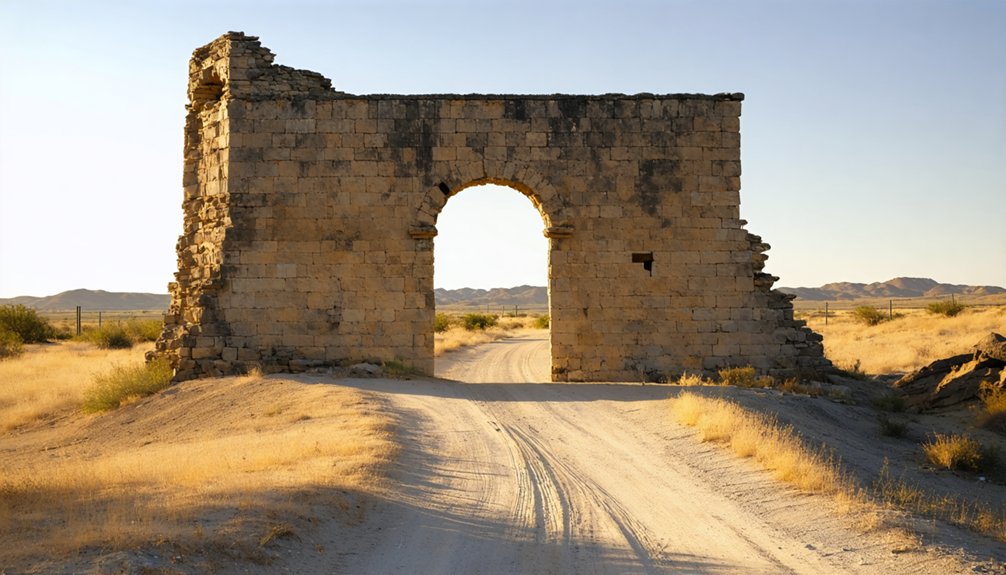
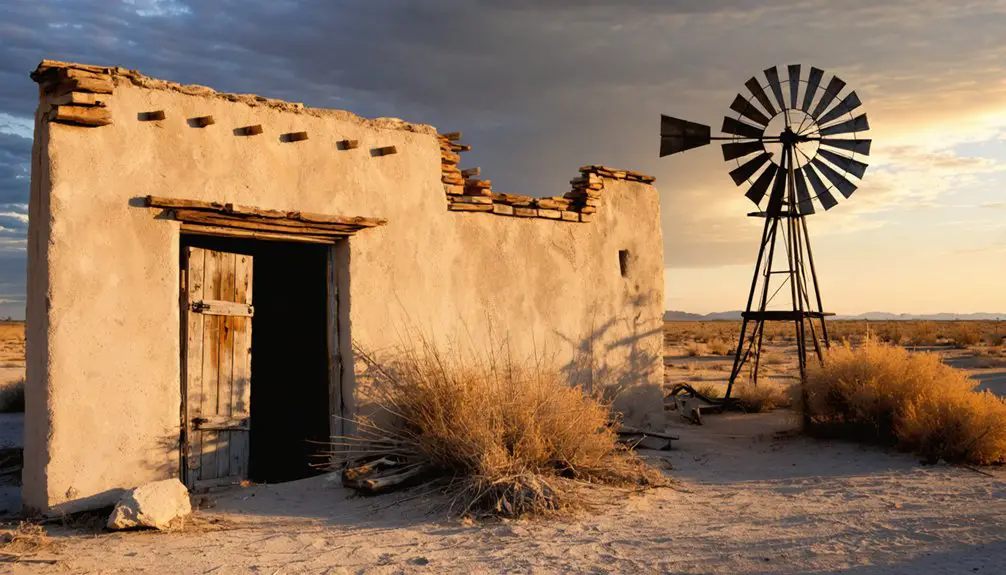
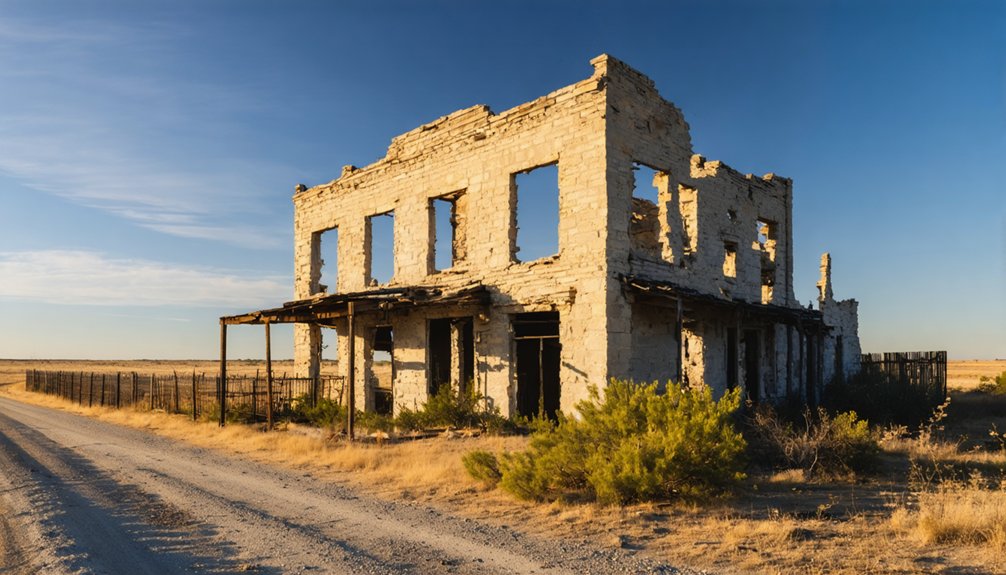
Standing quietly against the West Texas sky, Belle Plain’s stone ruins are among the most striking remnants you’ll find at any ghost town in the region. The college building’s remaining walls showcase the craftsmanship behind the town’s ambitious stone architecture, giving you a tangible sense of what Belle Plain once hoped to become.
Historical preservation efforts have kept the site meaningful for visitors willing to make the drive out on rough county roads.
The site endures because people cared enough to protect it — and that effort rewards every visitor who makes the journey.
You’ll want to bring a camera, because the weathered limestone catches light beautifully, especially in the early morning or late afternoon.
Keep in mind that much of the ruins sit on private land, so respect boundaries and observe from permitted areas. The quiet landscape does the storytelling, and it does it well.
Belle Plain Cemetery: Pioneers Worth Remembering
Just a short distance from the stone ruins, Belle Plain Cemetery pulls you into a different kind of history—one measured not in crumbling walls but in names carved into weathered markers.
Cemetery stories here stretch back to 1878, connecting you directly to the town’s earliest settlers.
Walk through and you’ll encounter:
- Pioneer legacies — graves of original founders and homesteaders who built something from nothing
- Veterans — markers honoring those who served long before West Texas had paved roads
- Descendants — evidence that families stayed connected to this land even after the town disappeared
The cemetery remains an active cultural resource, so treat it respectfully.
Bring water, wear boots, and check your map before heading out—it’s easy to miss on rural county roads.
How to Visit Belle Plain Without Trespassing on Private Land
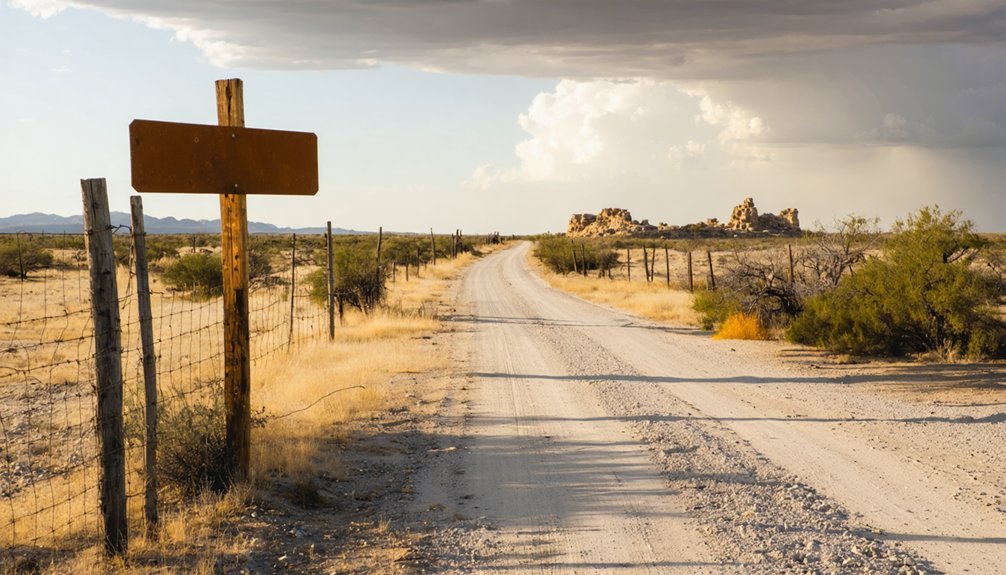
Leaving the cemetery behind, you’ll quickly realize that traversing Belle Plain’s remaining ruins requires some awareness of land ownership. Much of the site sits on private property, so practicing solid ghost town etiquette isn’t optional — it’s essential.
Traversing Belle Plain’s ruins means navigating private property — solid ghost town etiquette isn’t optional here, it’s essential.
Before heading out, research current access conditions and respect any posted signage you encounter.
Rural exploration here rewards the prepared traveler. Stick to county roads and publicly accessible vantage points where you can photograph the crumbling stone ruins without crossing property lines.
Some visitors contact local landowners in advance for permission, which occasionally opens doors that would otherwise stay closed.
Don’t let restrictions discourage you. The atmospheric landscape, scattered stonework, and open West Texas sky deliver a genuinely powerful experience — even when you’re admiring it respectfully from the road.
Nearby Historical Sites Worth Adding to Your Route
Once you’ve thoroughly explored Belle Plain, the surrounding stretch of West Central Texas offers several historical sites worth folding into your route.
Callahan and surrounding counties hold ghost towns, historical landmarks, and quiet landscapes that reward curious travelers willing to navigate rural roads.
Consider adding these stops:
- Baird, Texas – The current Callahan County seat features a preserved downtown and courthouse worth walking.
- Fort Griffin State Historic Site – A frontier-era military post with striking ruins and free-roaming longhorns nearby.
- Camp Colorado ruins – A pre-Civil War military site sitting on open terrain with real frontier character.
Keep your map handy, fuel your tank before leaving town, and embrace the unscripted detours.
That’s exactly where the best discoveries happen.
Frequently Asked Questions
Who Founded Belle Plain, and What Year Was the Town Established?
Like settlers answering the frontier’s call, Nelson M. Smith founded Belle Plain in 1876. You’ll find this town’s founding history rooted in pioneer families who carved civilization from Texas wildness on state school land.
Was Belle Plain Ever the Official County Seat of Callahan County?
Yes, Belle Plain won the county seat election after Callahan County’s organization in 1877, giving it real historical significance! You’ll find that county seat status fueled rapid growth, civic development, and ambitious stone construction throughout the town.
How Many Residents Did Belle Plain Have During Its Peak Population?
At its peak, you’ll find Belle Plain boasted nearly 1,000 residents, surrounded by historic landmarks and fueled by local legends. This thriving frontier town once buzzed with ambitious settlers chasing freedom on West Texas plains.
What Caused Belle Plain’s Post Office to Permanently Close Down?
Once vibrant, Belle Plain’s post office closure reasons unfolded slowly—you’ll find the railroad’s bypass, a crippling drought, and dwindling residents sealed its fate. By 1909, the post office permanently shut its doors forever.
Is Belle Plain Street in Brownwood Connected to the Ghost Town?
You’ll find Belle Plain Street in Brownwood shares a historical name link to the ghost town, connecting you to Belle Plain history and honoring the Ghost town significance, though they’re separate locations entirely.
References
- https://www.texasescapes.com/TexasTowns/BellePlainTexas/BellePlainTexas.htm
- https://www.facebook.com/TexasInspiration/posts/-ever-heard-of-belle-plain-texas-this-callahan-county-ghost-town-was-once-a-risi/966286165710056/
- https://fridaycemeterysociety.wordpress.com/2012/09/17/the-ghost-town-of-belle-plain-texas/
- https://www.youtube.com/watch?v=gj5oGkywuoU
- https://www.tshaonline.org/handbook/entries/belle-plain-tx-callahan-county
- https://www.brownwoodnews.com/2024/10/31/diane-adams-the-road-to-belle-plains-ghostly-ruins/
- https://koolfmabilene.com/belle-plain-a-ghost-town-near-abilene/
- https://www.dumasmuseumandartcenter.org/belle_plain.html
- https://en.wikipedia.org/wiki/Belle_Plain
- https://www.facebook.com/groups/2713517748825101/posts/3298065460370324/