Planning a ghost town road trip to Glenrio, New Mexico means stepping into a frozen slice of Route 66 history straddling the Texas-New Mexico border. You’ll wander past crumbling motels, rusted Texaco pumps, and darkened diners without paying a single admission fee. Take Exit 0 off Interstate 40 to reach this hauntingly beautiful historic district, listed on the National Register in 2007. Visit during spring or fall for the best experience, and there’s even more to discover ahead.
Key Takeaways
- Glenrio sits on Route 66 at the Texas-New Mexico border, accessible via Exit 0 off Interstate 40, with no admission fees required.
- Key attractions include the State Line Motel, abandoned Texaco station, derelict diner, and State Line Bar, all frozen in time since the town’s decline.
- Interstate 40’s bypass in the 1950s-1970s redirected traffic away from Glenrio, causing business closures and reducing the population to nearly zero.
- Spring and fall offer the best visiting conditions, with mild temperatures, wildflowers, dramatic sunsets, and ideal lighting for photography.
- Listed on the National Register of Historic Places in 2007, Glenrio offers an authentic, unfiltered glimpse into Route 66 history.
Glenrio: The Route 66 Ghost Town Straddling Texas and New Mexico
Perched on the forgotten stretch of Route 66 where Texas bleeds into New Mexico, Glenrio is a ghost town that’s equal parts haunting and fascinating. Its Glenrio history stretches back to 1901, when railroads carved a path through this high desert landscape, drawing settlers hungry for open land and opportunity.
At its peak, you’d have found motels, diners, and gas stations buzzing with Route 66 nostalgia-fueled travelers cutting across America’s heartland.
Today, crumbling structures straddle the state line like frozen relics of mid-century freedom. The State Line Motel still stands, its faded sign declaring “First in Texas” depending on your direction.
With barely one full-time resident remaining, Glenrio offers you something rare — unfiltered American history without the crowds, the ropes, or the admission fees.
How Glenrio Became a Route 66 Ghost Town
Glenrio’s story begins in 1901, when railroad companies laid tracks through the Texas-New Mexico borderlands and sparked a small but scrappy settlement that would eventually take its name from the Scottish word for “glen” and the Spanish word for “river.”
For decades, you’d have found the town thriving as a natural pit stop on Route 66, with motels, diners, and gas stations serving travelers rolling between Amarillo and Tucumcari.
But when Interstate 40 bypassed the old highway corridor, it strangled Glenrio’s lifeblood, sending businesses into decline and leaving behind little more than sun-bleached signs and empty buildings.
Railroad Roots and Settlement
Before Route 66 ever carved its way through the desert, the railroads laid the groundwork for what would become one of the American Southwest’s most haunting ghost towns.
In 1901, crossing rail lines sparked Glenrio’s railroad history, drawing settlers who shaped early settlement patterns across the Texas-New Mexico border.
Here’s what built this forgotten community:
- Railroads crossed here first, making Glenrio a strategic junction before cars dominated travel.
- The name blends two languages — Scottish “glen” and Spanish “rio” — reflecting the region’s cultural crossroads.
- A post office anchored New Mexico’s side, while Texas hosted the depot.
- Wheat fields and cattle ranches sustained families on vast, windswept plots, never exceeding 30-40 souls at peak.
Interstate Bypass Kills Traffic
Once Route 66 traffic kept Glenrio alive, the Interstate 40 bypass delivered its death blow. When highway planners rerouted traffic patterns away from town during the 1950s through 1970s, travelers stopped stopping. Motels emptied. Diners went dark. Gas stations locked their pumps for the last time.
You can still see how ghost town dynamics unfolded here — it wasn’t sudden but a slow bleed. Each business closure pushed out another family until only two residents remained by the 1980s.
The Rock Island Railroad depot had already shuttered in 1955, weakening the economic foundation before the interstate even arrived.
Interstate 40 hums just 1,000 feet away today, carrying millions of travelers who never exit. Their loss, honestly — and your gain if you do.
What’s Left to See in Glenrio Today?
Despite decades of neglect, a handful of crumbling structures still stand in Glenrio, each one frozen in a different moment of the town’s mid-century heyday.
Historic preservation efforts landed the Glenrio Historic District on the National Register in 2007, protecting these weathered landmarks tied to local legends.
Here’s what you’ll find when you arrive:
- State Line Motel – Its iconic sign still reads “First in Texas” or “Last in Texas,” depending on your direction.
- Abandoned Texaco Station – Rusted pumps stand silent where road-weary travelers once filled up.
- Derelict Diner – Cracked windows and peeling paint tell stories no menu ever could.
- State Line Bar (built 1935) – Dark past, darker corners, undeniable atmosphere.
How to Reach Glenrio off Interstate 40
Getting to Glenrio is invigoratingly simple: take Exit 0 off Interstate 40 right at the Texas-New Mexico border, and you’re already there—about 1,000 feet from the highway’s steady hum. That exit number isn’t coincidence; it marks the literal edge of Texas, where ghost town history quietly waits beneath an open desert sky.
Once you’re off the ramp, park your car and explore on foot or cruise slowly by vehicle along the old alignment.
Park the car, stretch your legs, and wander the old alignment—or simply cruise its crumbling edges slowly.
You’ll straddle two states simultaneously, spotting crumbling motels and abandoned diners that once fueled Route 66 nostalgia for mid-century travelers heading between Amarillo and Tucumcari.
No complicated navigation required—just peel off the interstate, step into another era, and let Glenrio’s eerie stillness do the rest.
Walk Glenrio’s Route 66 State Line on Foot
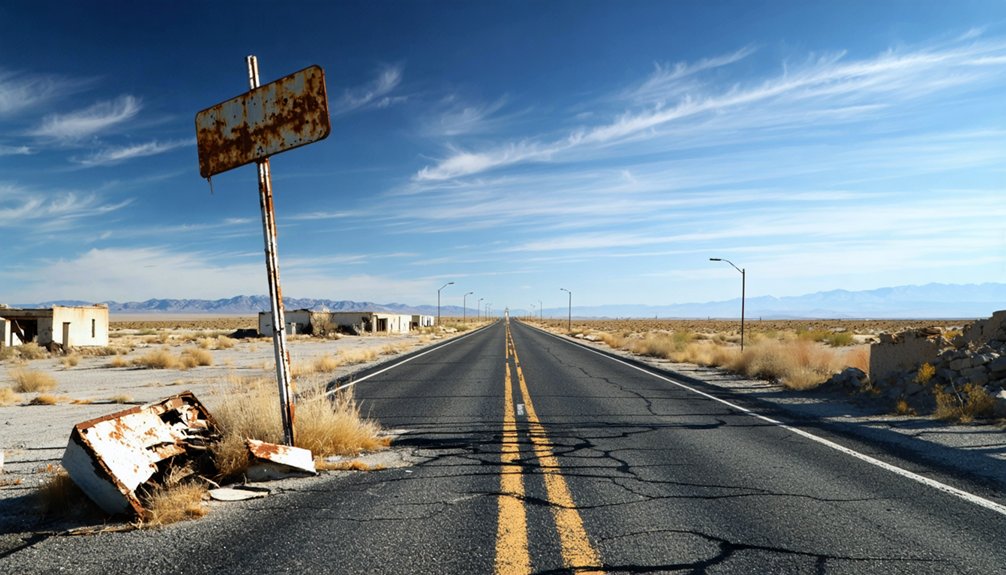
Stepping out of your car at Glenrio, you’ll feel the weight of decades pressing against the desert silence.
Route 66 nostalgia hits hard here — crumbling facades, rusted signs, and windswept emptiness tell stories no museum can replicate. Ghost town legends linger around every abandoned doorway.
Walk the state line and explore:
- State Line Motel — Read “First in Texas” facing east, “Last in Texas” facing west
- Derelict Texaco Station — Frozen mid-century architecture beneath an open sky
- Abandoned Diner — Imagine waitresses serving truckers heading toward Amarillo
- State Line Bar (1935) — Dark histories whisper through broken windows
You’re walking freely through living history here — no fences, no admission fees, just raw American independence etched in desert dust.
The Route 66 Ruins in Glenrio Worth Photographing
As you wander Glenrio’s crumbling streetscape, three ruins demand your camera’s attention: the weathered State Line Motel, its faded sign still proclaiming “First in Texas,” an abandoned Texaco station frozen in mid-century decay, and a derelict diner whose collapsed interior tells the story of Route 66’s slow death.
You’ll find the motel’s peeling paint and broken windows frame shots that capture the town’s ghostly dignity, while the Texaco’s rusted pumps evoke a time when cross-country travelers stopped here for fuel and relief from the desert sun.
The diner’s gutted remains round out a photographic trifecta that makes Glenrio one of the most hauntingly photogenic ghost towns on the entire Mother Road.
State Line Motel Decay
The State Line Motel is the crown jewel of Glenrio’s decay, its weathered sign still boldly declaring “First in Texas” or “Last in Texas” depending on which direction you’re headed.
This motel history stretches back to Route 66’s golden era, when weary travelers desperately needed rest between Amarillo and Tucumcari. Now urban decay has claimed every room.
Walk the crumbling property and you’ll feel:
- Abandonment — shattered windows staring like hollow eyes
- Freedom — no velvet ropes, no tour guides, just raw history
- Nostalgia — ghost echoes of 1950s road warriors who slept here
- Impermanence — nature slowly reclaiming what humans built
The vandalized Texas Longhorn Motel nearby amplifies that haunting atmosphere, reminding you that nothing built on a highway lasts forever.
Abandoned Texaco Station
Just a short walk from the State Line Motel’s hollow rooms, you’ll spot the abandoned Texaco station standing like a rusted monument to Route 66’s commercial heyday.
Its weathered canopy still stretches overhead, casting dramatic shadows that make it a prime target for ghost town photography. Cracked concrete, faded signage, and empty pump islands tell the story of thousands of road-weary travelers who once pulled in for fuel and cold drinks.
These abandoned structures carry a raw, unfiltered energy that modern travel plazas simply can’t replicate.
You’re free to wander close, frame your shots against the vast desert sky, and feel the weight of decades pressing down on rusted metal.
Bring a wide-angle lens — the open landscape surrounding this station demands it.
Derelict Diner Remains
Across a cracked stretch of asphalt from the Texaco station, Glenrio’s derelict diner crouches like a sun-bleached skeleton, its collapsed ceiling and shattered windows frozen in mid-decay.
This diner history stretches back to Route 66’s heyday, when truckers and road-trippers fueled their freedom here between Amarillo and Tucumcari.
Its architectural features—wide plate-glass window frames, a low-pitched roof, and exposed timber beams—still whisper of mid-century Americana.
Stand inside and feel:
- Silence where fry cooks once shouted orders
- Wind threading through glassless frames like forgotten conversations
- Weight of decades pressing down through splintered rafters
- Freedom only abandoned places can honestly offer
Bring your camera. These ruins photograph beautifully under desert light.
Glenrio’s Strangest Attraction: A Cannabis Dispensary Among the Ruins
Among the crumbling relics of Route 66’s golden age, you’ll find Glenrio’s most unexpected modern surprise: a fully operational cannabis dispensary.
Sitting on the New Mexico side of the state line, it’s the ghost town‘s only active business — and honestly, it fits the rebellious spirit of the place perfectly.
Cannabis culture has carved out a strange, fascinating niche among these desert ruins.
Where travelers once stopped for gas and pie, you can now browse legal products before continuing your journey west toward Tucumcari.
The contrast couldn’t be sharper: crumbling motels behind you, a modern dispensary ahead.
It’s a living reminder that Glenrio refuses to fully disappear.
Even a ghost town can reinvent itself — just on its own eccentric, sun-bleached, tumbleweed-scattered terms.
Spring and Fall Are the Best Seasons to Drive Through Glenrio
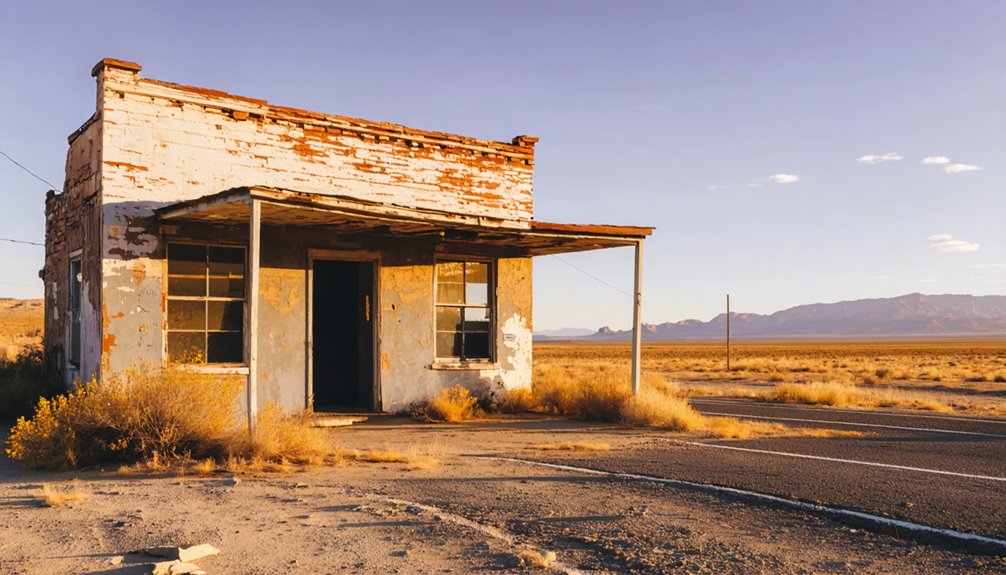
When you’re planning a ghost town detour, timing matters more than you’d think. Glenrio hits differently under mild temperatures and open skies.
Best Seasons to Visit:
- Spring colors paint the surrounding high desert in soft wildflowers, making abandoned structures feel strangely alive.
- Fall foliage along the Texas-New Mexico border transforms the landscape into warm amber tones perfect for photography.
- Spring mornings offer cool, crisp air that makes walking the crumbling Route 66 stretch genuinely peaceful.
- Fall evenings deliver dramatic sunsets behind the derelict State Line Motel, rewarding every traveler who arrives at golden hour.
Summer heat pushes past brutal, and winter winds make exploration uncomfortable.
Spring and fall give you freedom to roam Glenrio exactly the way it deserves.
Frequently Asked Questions
Is It Legal to Enter and Explore Glenrio’s Abandoned Buildings Safely?
You’ll want to check local building regulations before entering Glenrio’s structures—ghost town safety is serious. Many abandoned buildings are unstable and potentially off-limits, so explore responsibly, respect boundaries, and prioritize your safety while enjoying this historic freedom.
Are There Any Overnight Camping Options Near Glenrio for Road Trippers?
No official campsite exists in Glenrio, but you’ll find freedom under vast desert skies at nearby campgrounds. Check camping regulations at Ute Lake State Park, a nearby attraction perfect for overnight road trippers craving adventure.
Does Glenrio Have Cell Phone Coverage or Emergency Services Nearby?
Cell service is spotty in Glenrio, so you’ll want to save emergency contacts before arriving. Download offline maps, charge your devices fully, and note that Tucumcari’s services sit just 41 miles west for any urgent needs.
What Year Was Glenrio Added to the National Register of Historic Places?
You’ll love knowing that Glenrio’s historical significance earned it a spot on the National Register of Historic Places in 2007, celebrating preservation efforts that protect its mid-century structures, keeping this fascinating ghost town’s freedom-loving spirit beautifully alive.
Are Pets Allowed When Exploring Glenrio’s Historic Ghost Town Ruins?
Tumbleweeds roam freely, and so can your pets! No official pet-friendly policies restrict ghost town etiquette here, so you’re welcome to explore Glenrio’s haunting ruins with your furry companions trotting beside you.
References
- https://en.wikipedia.org/wiki/Glenrio
- https://www.youtube.com/watch?v=LiS5UTVrzlQ
- https://www.atlasobscura.com/places/glenrio-ghost-town
- https://www.gonewiththewynns.com/glenrio-ghost-town-route-66/
- https://kathleenmaca.com/index.php/2019/07/20/glenrio-ghost-town-exit-0-on-route-66/
- https://www.islands.com/1912942/glenrio-new-mexico-abandoned-town-historic-snapshot-route-sixty-six/
- https://icatchshadows.com/a-visit-to-the-glenrio-ghost-town-on-old-route-66/
- https://www.nps.gov/places/glenrio-historic-district.htm