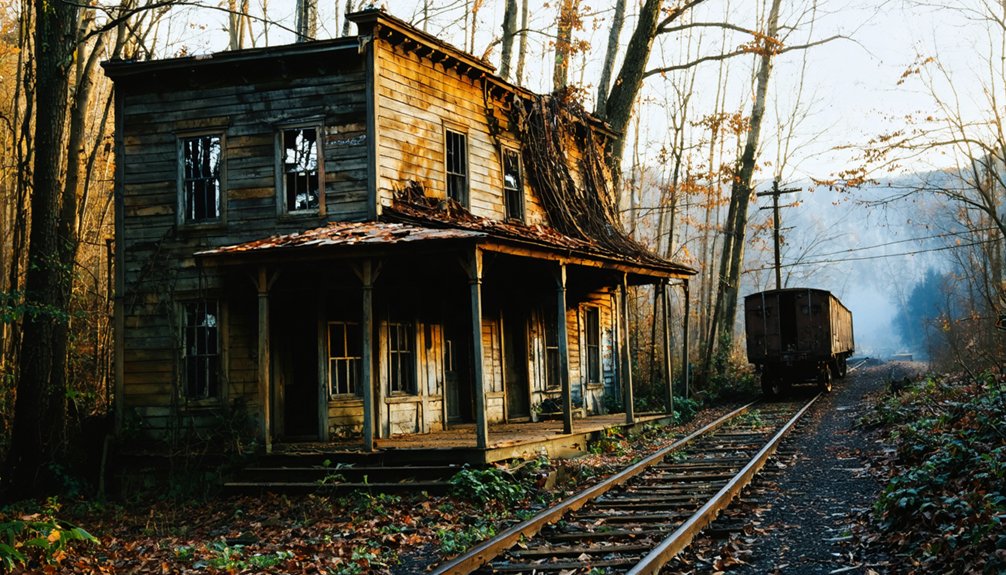
Highland Park, Kentucky, is a ghost town with no crumbling ruins to explore — just a historical marker standing at the southeast corner of Park Boulevard and Crittenden Drive where a working-class railroad community once thrived. Founded in 1890 and bulldozed for Louisville International Airport’s expansion, it’s vanished entirely. You can visit by car or on foot, staying on public roads and respecting airport security boundaries. There’s more to this fascinating story worth uncovering.
Key Takeaways
- Highland Park, Kentucky, is a vanished railroad town near Louisville International Airport, recognized as a ghost town despite lacking traditional crumbling structures.
- The only physical remnant is a 2019 historical marker at the southeast corner of Park Boulevard and Crittenden Drive.
- Visitors must stay on public roads and sidewalks, avoiding fenced airport property monitored by security cameras to prevent federal trespassing violations.
- Enhance your itinerary by pairing Highland Park with nearby ghost towns like Worthville and Ghent, Kentucky, for a comprehensive experience.
- Visit during spring or fall for ideal conditions, bringing a camera, printed map, and curiosity to appreciate the site.
What Was Highland Park, Kentucky?
Highland Park was a working-class railroad town tucked into Jefferson County, Kentucky, that lived and died by the Louisville & Nashville Railroad. Founded in 1890 as a planned railroad community, it drew working families away from rural areas and into a tight-knit neighborhood built around industrial labor.
The Highland Park history is straightforward: the L&N Railroad needed workers, so a town appeared. Residents worked the rail lines, the Louisville Fire Brick Works, and nearby factories, building a self-sufficient community centered on churches and schools rather than commercial strips.
Louisville annexed it in 1922, despite fierce resistance. For another seven decades, this railroad community quietly survived before city officials declared it blighted and bulldozed it entirely to expand Louisville International Airport.
Today, nothing stands.
Where Highland Park Stood in Louisville
Knowing what Highland Park was only gets you so far — to really understand what was lost, you need to picture exactly where it sat on the map.
Highland Park’s geography placed it in Jefferson County‘s southern reach, tucked close to active railroad lines and what eventually became Louisville International Airport. That proximity defined its community evolution — a working-class settlement born from industrial necessity, absorbed into Louisville proper in 1922, and ultimately erased to make room for runway expansion.
Today you won’t find streets or structures. The land belongs to the airport corridor now. When you visit, you’re standing at the edge of a vanished world, somewhere between Park Boulevard and Crittenden Drive, where a self-sufficient little city once pushed back against annexation and fought for its independence.
Is Highland Park Really Considered a Ghost Town?
Whether Highland Park qualifies as a true ghost town depends on how loosely you’re willing to stretch the definition.
Traditional ghost towns leave behind crumbling buildings, overgrown streets, and rusted relics you can actually explore. Highland Park offers none of that. Urban decay didn’t slowly swallow this neighborhood — the city deliberately bulldozed it to expand Louisville International Airport.
Highland Park left no ruins to wander — the city razed it deliberately, not decay.
What remains is fundamentally invisible: buried foundations beneath airport tarmac and industrial fringe land. No streets, no structures, no atmosphere.
Yet historians and ghost town enthusiasts still classify it as one because the community genuinely vanished. If you crave the freedom to define a ghost town broadly — as any place where a real community once thrived and no longer exists — Highland Park absolutely qualifies.
What’s Left to See at the Site Today?
When you visit the site of Highland Park today, you’ll find that the 2019 historical marker at the southeast corner of Park Blvd., Old Park Blvd., and Crittenden Drive is fundamentally your only tangible connection to the neighborhood’s past.
The marker commemorates the community’s 1890 founding as a railroad-worker settlement and gives you a brief but meaningful pause point on your road trip.
Beyond that, the airport boundary cuts off access to much of the original footprint, so you’ll need to respect security perimeters and stick to the public-access areas surrounding the marker.
Historical Marker Location
Highland Park has all but vanished from the physical landscape, but a single historical marker gives you a tangible reason to make the trip. Installed in 2019, the marker stands at the southeast corner of Park Boulevard, Old Park Boulevard, and Crittenden Drive — a precise, accessible stop you can reach without crossing airport security boundaries.
The marker acknowledges Highland Park‘s historical significance as a railroad-worker community founded in 1890, honoring the community impact of hundreds of working-class families who built their lives here.
It’s modest, but it’s real — a fixed point where history briefly surfaces above the asphalt and chain-link.
Park your car, read the marker, take your photos, and respect the surrounding private property. That corner is your gateway into a neighborhood that officially no longer exists.
Airport Boundary Restrictions
Beyond the historical marker, there’s almost nothing left to see — and airport security guarantees it stays that way.
Louisville International Airport’s expansion consumed every street, home, and gathering place Highland Park once held. What was a living, breathing working-class community now sits behind restricted boundaries you can’t legally cross.
Don’t attempt to wander past public access points. The land is either active airport property or industrial fringe, and trespassing violations apply firmly here.
Your freedom to explore has real limits at this site.
What you can do is stand at that marker, absorb the weight of community resilience it represents, and photograph the open land beyond the fence line.
Sometimes the absence itself tells the most powerful story.
The Highland Park Historical Marker on Crittenden Drive
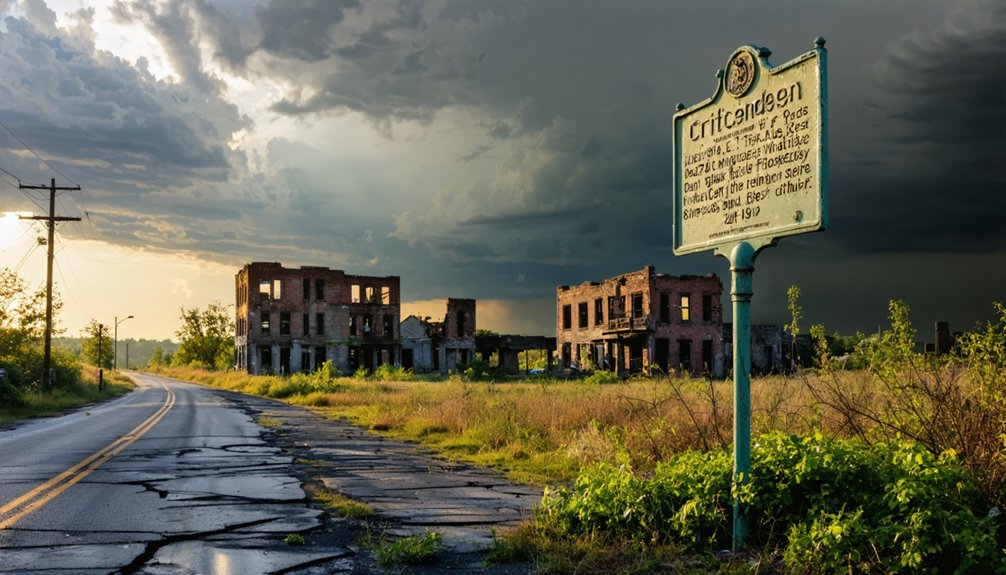
Installed in 2019, a single historical marker on Crittenden Drive stands as the only tangible reminder that Highland Park ever existed.
You’ll find it near the southeast corner of Park Boulevard and Old Park Boulevard, a quiet spot that belies the neighborhood’s historical significance. The marker tells the story of Highland Park’s founding in 1890 as a planned community built specifically for Louisville & Nashville Railroad workers.
It’s a simple but powerful stop — one sign carrying the entire weight of a vanished community. Snap your photos, read every word, and take a moment to picture the streets, homes, and families that once filled this now-empty landscape.
It won’t take long, but you’ll leave with a deeper respect for what Highland Park once meant to working-class Louisville.
Airport Security Boundaries and Access Rules at the Site
When you visit the Highland Park site, you’ll need to stay alert to airport security boundaries, since much of the former neighborhood now sits within or immediately adjacent to Louisville International Airport’s operational zone.
You can access the historical marker and nearby public roadways, but you shouldn’t cross into restricted areas marked by fencing, signage, or posted warnings.
Respect every private property and no-trespassing sign you encounter, as violations can carry serious federal and local consequences.
Respecting Airport Security Boundaries
Because the former Highland Park site sits directly adjacent to Louisville Muhammad Ali International Airport‘s operational grounds, you’ll need to stay alert to posted security boundaries and private-property signage before exploring the area.
Airport security here isn’t optional—federal regulations govern the perimeter, and crossing restricted zones carries serious legal consequences.
This ghost town offers no standing structures to wander through anyway, so your best strategy is staying on public-access roads and focusing on the 2019 historical marker near Crittenden Drive.
Respect fencing, heed posted warnings, and keep your vehicle on designated public roadways.
You’ll still absorb the history and atmosphere without risking a confrontation with law enforcement.
Smart boundaries make for a better road trip and a story worth telling.
Permitted Public Access Areas
Everything worth seeing at the former Highland Park site sits outside the airport’s secured perimeter, so you’ll focus your visit on the publicly accessible corridor along Crittenden Drive.
Public access here centers on the historical marker installed in 2019 near the southeast corner of Park Boulevard, Old Park Boulevard, and Crittenden Drive — a spot you can reach by car or on foot without crossing any restricted boundary.
Visitor guidelines are straightforward: stay on public roads and sidewalks, avoid fenced airport property, and don’t photograph secured infrastructure.
You’re free to park along Crittenden Drive, read the marker, and absorb the flat, eerily open landscape where homes and streets once stood. That openness itself tells the story better than any standing structure could.
Private Property Warning Signs
As you move beyond the historical marker and closer to the airport’s edge, you’ll notice a clear line where public access ends and restricted property begins — marked by chain-link fencing, posted signage, and the occasional security camera mounted on perimeter poles.
This is private property, and the warnings are serious. Unlike many ghost town destinations where you can wander freely through ruins, Highland Park offers no such liberty. The site sits within or directly adjacent to Louisville International Airport’s secure perimeter.
Trespassing here doesn’t just mean a fine — it can trigger federal security responses. Respect the posted boundaries, stay on public roads, and keep your exploration focused on the historical marker and designated access points.
The ghost town’s story is worth discovering; crossing restricted lines isn’t.
How to Plan Your Highland Park Road Trip
Planning a road trip to Highland Park requires a bit of creative thinking, since there’s nothing left standing to walk through or photograph.
You’re chasing history here, not architecture. Start by locating the 2019 historical marker at the southeast corner of Park Blvd., Old Park Blvd., and Crittenden Drive — it’s your primary anchor point.
From there, build your itinerary around Highland Park’s railroad heritage by researching nearby L&N Railroad landmarks. Pair the stop with other Jefferson County ghost towns to make the drive worthwhile.
Respect airport security boundaries, since much of the former neighborhood sits within a restricted zone.
Bring a camera, a printed map, and genuine curiosity — that’s all you need to connect meaningfully with one of Kentucky’s most overlooked ghost towns.
Other Ghost Towns and Railroad Sites Worth Adding to Your Route

Highland Park works best as one stop on a longer route, and Kentucky rewards that kind of thinking — the state’s railroad and industrial past left ghost towns scattered across Jefferson County and beyond.
Highland Park is one stop on a longer story Kentucky tells about industry, railroads, and the towns they left behind.
Pair your visit with these nearby stops to build a full day around railroad history:
- Worthville, Kentucky – A Carroll County river town that railroad bypasses quietly hollowed out over generations.
- Ghent, Kentucky – Sits along the Ohio River corridor where rail and water transport once competed fiercely for freight dominance.
- L&N Railroad historical markers across Louisville – Several surviving markers trace the rail network that built communities like Highland Park from the ground up.
Each stop adds context, turning one ghost town into a connected story about how industry shapes and abandons places.
Best Time of Year to Visit Highland Park’s Historical Marker
Timing your visit to Highland Park’s historical marker can make the difference between a rewarding stop and a frustrating one.
Spring and fall offer the best visiting seasons, giving you mild temperatures and clear skies that make reading the marker and photographing the site genuinely pleasant. Summer works too, though Louisville’s humid heat can make standing roadside feel punishing.
Winter visits are possible but occasional ice and gray skies flatten the mood.
The marker itself stands year-round at the southeast corner of Park Blvd., Old Park Blvd., and Crittenden Drive, quietly preserving the historical significance of a working-class community that railroads built and airport expansion erased.
Arrive during daylight, respect airport security boundaries, and you’ll leave with a real sense of what once stood here.
Before You Go: Safety at Abandoned Sites
Ghost town structures have stood without maintenance for decades. Floors, stairs and roof timbers fail without warning, and a building that looks solid from outside may not hold your weight. Stay out of standing structures unless the site is actively maintained and open to visitors.
Mine workings are the more serious hazard. Vertical shafts can be hundreds of feet deep, are often unfenced, and may be hidden by brush or capped with rotted boards. Never enter an adit, tunnel or shaft: abandoned workings can hold oxygen-poor or toxic air that gives no warning before you lose consciousness.
Enclosed spaces with rodent droppings carry a risk of hantavirus, which is contracted by breathing contaminated dust. Do not sweep or stir up dust inside old cabins and outbuildings.
Cell coverage at these sites is usually poor or absent. Tell someone your route and expected return time, and carry more water than you think you need.
Frequently Asked Questions
Did Any Highland Park Residents Protest or Resist the Demolition of Their Homes?
The knowledge base doesn’t detail specific community protests or resident resistance during demolition. You’ll find that Highland Park’s tight-knit community had historically fought annexation, suggesting they’d have valued their freedom against forced displacement.
What Happened to the Churches and Schools When Highland Park Was Demolished?
Like sand castles swallowed by the tide, Highland Park’s churches and schools vanished completely during demolition. You’ll find no standing walls left—their church history and community impact erased, cleared entirely for Louisville International Airport’s expansion.
Were Residents Compensated When Highland Park Was Cleared for Airport Expansion?
The records don’t fully detail compensation specifics, but you’ll find resident experiences reflect deep loss. Compensation details remain unclear, yet displaced families faced painful uprooting as city officials cleared their beloved Highland Park community for airport expansion.
Can You Find Any Buried Foundations or Artifacts at the Highland Park Site?
You won’t access buried artifacts or foundation exploration easily here—the site’s airport-adjacent, meaning security and private property restrict entry. Possible foundations lie beneath the surface, but you’ll focus on public historical markers instead.
Did the L&N Railroad Closure Directly Cause Highland Park’s Population Decline?
While it’s tempting to blame one cause, the L&N Railroad’s decline didn’t solely drive population shifts — you’ll find that broader industrial collapse and airport expansion combined to accelerate Highland Park’s railroad impact and ultimate disappearance.
References
- https://www.ghosttowns.com/states/ky/highlandpark.html
- https://en.wikipedia.org/wiki/List_of_ghost_towns_in_Kentucky
- https://www.ghosttowns.com/states/ky/ky.html
- https://www.facebook.com/groups/727273197843494/posts/1549432805627525/
- https://wikipedia.nucleos.com/viewer/wikipedia_en_all/A/List_of_ghost_towns_in_Kentucky
- https://en.wikipedia.org/wiki/Highland_Park
- https://www.onlyinyourstate.com/experiences/kentucky/12-ghost-towns-in-ky
- https://www.lpm.org/news/2023-10-30/kentucky-is-exorcizing-another-jefferson-county-ghost-city-haunting-the-states-books
- https://www.youtube.com/watch?v=D9gOmfCuKLs
- http://solomonjparker.blogspot.com/2011/06/ghost-towns-in-kentucky-vol-1.html