Planning a ghost town road trip to Meridian, Kansas means trading paved comforts for open prairie, gravel roads, and the quiet ruins of a railroad-era community. You’ll find scattered foundations, old fence lines, and cemetery markers where a once-active town used to stand. Pair it with nearby ghost towns for a fuller loop route, pack emergency supplies, and check road conditions before you go. There’s far more to uncover about making this trip worthwhile.
Key Takeaways
- Meridian, Kansas, is a ghost town with scattered foundations, cemetery markers, and old fence lines that reveal its once-active past.
- The town declined due to railroad abandonment, falling crop prices, drought, and commerce shifting to larger, better-infrastructure towns.
- Build a loop route using Meridian as an anchor, clustering nearby ghost towns along shared highway corridors to minimize backtracking.
- Use US-50 as a navigation backbone, expect gravel roads and sparse signage, and always check road conditions before departing.
- Pack water, offline maps, a tire repair kit, sunscreen, and a power bank, as fuel stops and cell service are limited.
What Is Meridian, Kansas and Why Visit Today?
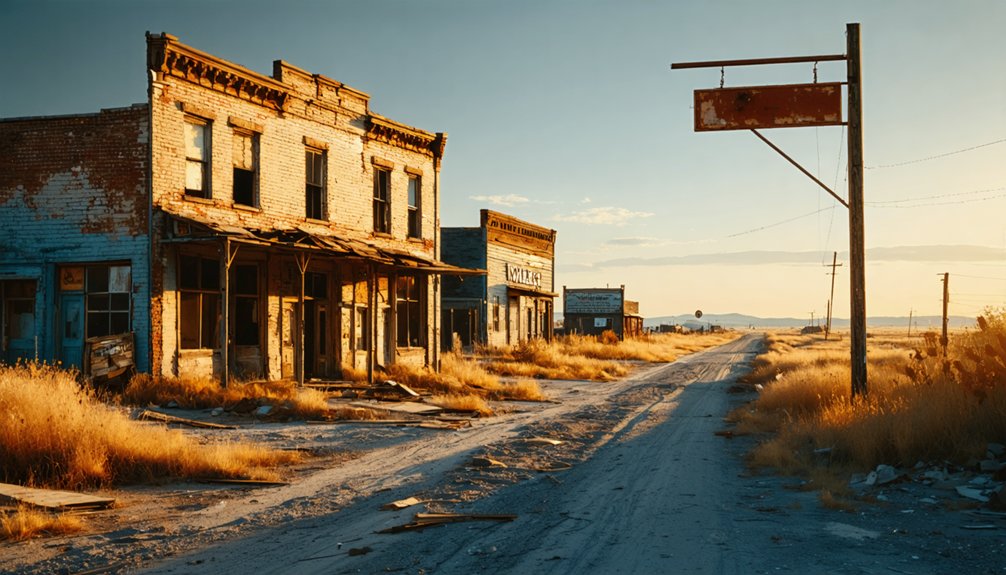
Tucked into the rural backroads of Kansas, Meridian is a ghost town that’s traded its former bustle for open prairie silence and scattered remnants of a life that once was.
Meridian history follows a familiar Kansas pattern — a community that grew around transportation and commerce, then quietly faded when both shifted elsewhere.
What’s left tells a story worth chasing.
The ghost town significance here isn’t about grand ruins or tourist infrastructure. It’s about standing where a community once functioned and reading the landscape for clues — foundation stones, old fence lines, cemetery markers.
You’re not following a guided tour; you’re piecing together history on your own terms.
For travelers who value discovery over convenience, Meridian delivers exactly that kind of unscripted, wide-open experience.
Why Meridian Became a Kansas Ghost Town
When you pull up to what’s left of Meridian, you’re looking at the aftermath of three hard hits that erased it from the map.
The railroad abandoned the region, stripping the town of its economic lifeline almost overnight. Agricultural decline and the permanent shift of commerce to larger centers finished the job, leaving nothing but silence and scattered remnants behind.
Railroad Abandonment Sealed Fate
Like so many small Kansas towns, Meridian didn’t fade quietly on its own—the railroad made that decision for it. When rail lines shifted routes or shut down entirely, the towns they once sustained lost their economic lifelines almost overnight.
Meridian’s railroad history follows that same brutal pattern—without reliable freight and passenger access, local businesses couldn’t survive, families relocated, and community decline became inevitable rather than gradual.
You can still read that story in the landscape if you know what to look for. The absence of a depot, the silence where commerce once moved, the overgrown right-of-way cutting through open prairie—these details tell you exactly how Meridian unraveled.
The railroad built it, and when it left, there wasn’t much reason to stay.
Agricultural Decline Hit Hard
Even before the railroad pulled out, Meridian’s agricultural foundation was already cracking under the weight of economic shifts that hit small Kansas farming communities especially hard.
Falling crop prices, prolonged drought cycles, and shrinking profit margins forced families off their land and out of rural communities like Meridian with little reason to stay. You can trace this pattern across Kansas’s agricultural history and see the same story repeated across dozens of counties.
When farming stopped supporting a local population, the businesses serving those farmers disappeared next. Schools closed. Churches emptied.
What you’re left with today is a quiet landscape that carries the weight of that collapse without explanation. Meridian’s decline wasn’t sudden — it was a slow unraveling driven by forces that reshaped rural communities across the entire Great Plains.
Commerce Shifted Away Permanently
Once the railroad bypassed Meridian and farm income dried up, commerce didn’t just slow down — it packed up and relocated permanently to towns with better infrastructure and stronger economic pull.
Those economic shifts weren’t reversible. Businesses followed customers, customers followed opportunity, and Meridian got left behind.
Walking the site today, you’re seeing what rural nostalgia actually looks like in physical form — not a romanticized postcard, but real absence:
- General stores and post offices closed as residents stopped needing local services
- Trade corridors redirected toward towns with active rail lines and growing populations
- Community anchors like banks and feed suppliers vanished without replacement
What remains isn’t failure — it’s evidence. Meridian tells you exactly how permanent those shifts really were.
What Can You Still See at the Meridian Site?
When you arrive at the Meridian site, you’ll find scattered foundations and remnants that hint at the community that once stood here.
Walk the grounds carefully and you’ll likely spot cemetery markers and gravestones, which remain the clearest evidence of the families who called this place home.
Keep an eye out for railroad traces nearby, since those right-of-way cuts and grade lines explain both why Meridian existed and why it ultimately faded.
Foundations And Scattered Remnants
Pulling into the Meridian site, you’ll notice the landscape does most of the talking. Foundational remnants break the flat Kansas horizon, and scattered debris hints at what once stood here.
There’s no visitor center, no signage — just open prairie and quiet evidence of a community that didn’t survive.
Look closely and you’ll spot:
- Crumbling foundation stones outlining where homes, businesses, or civic buildings once stood
- Scattered debris fields including weathered wood, rusted metal, and broken material half-swallowed by grass
- Old fence lines tracing property boundaries that families once maintained daily
These details reward patient observers. Walk the perimeter slowly, watch where the earth shifts, and let the site’s layout tell its story.
Freedom-seekers and history hunters both leave with something real here.
Cemetery Markers And Gravestones
Beyond the foundations, the cemetery often holds the clearest record of who actually lived here. You’ll find weathered headstones carrying family names, birth years, and death dates that no highway marker bothers to preserve. That cemetery symbolism runs deep — each stone represents a household, a season, a decision to settle this stretch of Kansas prairie.
Walk slowly and you’ll notice the historical significance embedded in the spacing of graves, the carved motifs, and the family clusters that reveal entire generational arcs. Some markers have tilted or cracked under decades of frost and wind, but the inscriptions frequently remain legible.
Bring a notebook, photograph every readable stone, and cross-reference names later. The cemetery often tells Meridian’s truest story long after the buildings disappeared.
Railroad Traces Nearby
The cemetery hands you names and dates, but the railroad traces explain why Meridian existed at all.
Walk the surrounding land and you’ll spot ghostly remnants that tell the railroad history better than any textbook.
Look for these features near the site:
- Grade cuts — slight rises or depressions where track beds once ran across the flat prairie
- Right-of-way corridors — long, narrow strips of cleared land stretching toward the horizon, still visible from county roads
- Bridge remnants or creek crossings — weathered timber or stone foundations marking where trains once crossed
These traces confirm that Meridian didn’t appear randomly.
It grew because rails brought commerce, then faded when those rails disappeared.
You’re standing on the evidence.
Ghost Towns Worth Pairing With Meridian
Since Meridian works best as part of a longer route, pairing it with nearby ghost towns keeps your mileage efficient and your itinerary compelling. Kansas holds dozens of forgotten communities scattered across central and western counties, many sharing Meridian’s pattern of railroad decline and gradual abandonment.
Look for stops where abandoned structures still mark the landscape — old foundations, collapsed outbuildings, or cemetery fences breaking the prairie skyline. Each site carries its own historical significance, adding depth to your understanding of how entire communities once rose and vanished along forgotten corridors.
Clustering stops by county or highway corridor cuts backtracking and stretches your driving time further. Build your loop around two or three ghost towns, and you’ll leave with a richer, more complete picture of Kansas’s buried rural history.
How to Build a Kansas Ghost Town Loop Route
Building a solid loop route starts with picking one anchor town — Meridian works well here — then identifying two or three ghost towns within the same county or along a shared highway corridor.
Clustering your stops this way cuts backtracking and keeps your day moving efficiently.
Clustering your stops cuts backtracking, keeps momentum, and makes the most of every mile on the road.
When you’re mapping your route, keep these priorities in mind:
- Link ghost town attractions along one highway corridor to minimize gravel road mileage
- Schedule slower segments mid-day when light is strongest for photography and navigation
- Budget extra time between stops for unmarked turns and unpaved stretches
This approach lets you experience Kansas’s rural heritage without burning half your day on detours.
You stay in control of your schedule, your mileage, and your experience.
How to Reach Meridian on Rural Kansas Roads
Once your loop route is mapped, getting to Meridian itself means shifting off the main highway corridors and onto rural county roads where signage gets sparse and gravel replaces pavement.
US-50 gives you a reliable backbone, but the final approach pulls you deeper into open Kansas terrain where rural exploration becomes part of the experience.
Check road conditions before you leave. Rain turns gravel into a challenge fast, and some stretches offer zero cell service.
Drive slower than you think you need to, watch for unmarked turns, and give yourself extra time.
Meridian’s historical significance makes the effort worthwhile.
The landscape itself tells the story, and reaching it on your own terms, through backroads and wide prairie skies, is exactly the point.
What to Pack for Unpaved Kansas Ghost Town Roads?
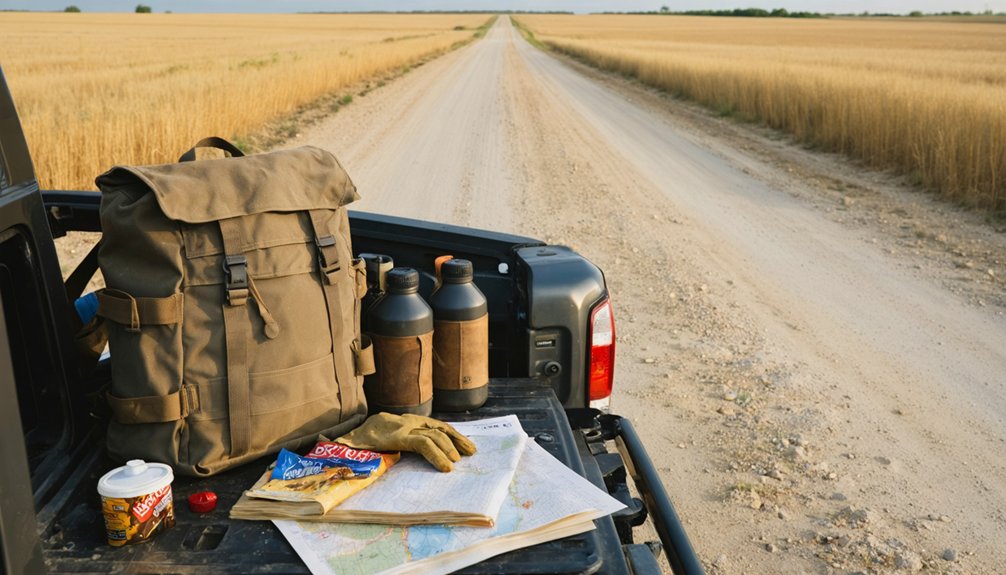
Packing smart for unpaved Kansas roads means covering five practical categories before you leave the driveway: water, route planning, vehicle gear, personal supplies, and a basic first-aid kit.
Before leaving the driveway, smart packing covers five categories: water, route planning, vehicle gear, personal supplies, and a first-aid kit.
Ghost towns like Meridian sit far from fuel stops, cell service, and restrooms, so your essential gear determines how confidently you explore.
Pack these three items without compromise:
- Extra water and snacks — rural Kansas offers no convenience stops once you’re on gravel
- Offline maps or a downloaded GPS route — cell signals drop fast on unpaved roads
- Tire repair kit and jumper cables — sharp gravel and long distances make breakdowns costlier
Toss in sunscreen, sturdy shoes, and a charged power bank.
Daylight hours go quickly when you’re traversing unmarked turns across open prairie.
Kansas Road Conditions That Can Strand You Mid-Route
Kansas roads can flip from drivable to impassable faster than most out-of-state travelers expect. A dry gravel county road turns slick and rutted after a single afternoon storm, and mud in rural Kansas isn’t just messy — it’ll swallow a tire and strand you miles from help.
Wind is another quiet threat, pushing loose soil across roadways and cutting visibility to almost nothing.
Before you head toward Meridian, run weather checks for every county along your planned route, not just your starting point. Road safety out here means more than buckled seatbelts — it means knowing which segments wash out first and having an alternate path ready.
Cell service drops fast on backroads, so download offline maps and check conditions the morning you leave, not the night before.
Private Land and Trespass Risks at Kansas Ghost Town Sites
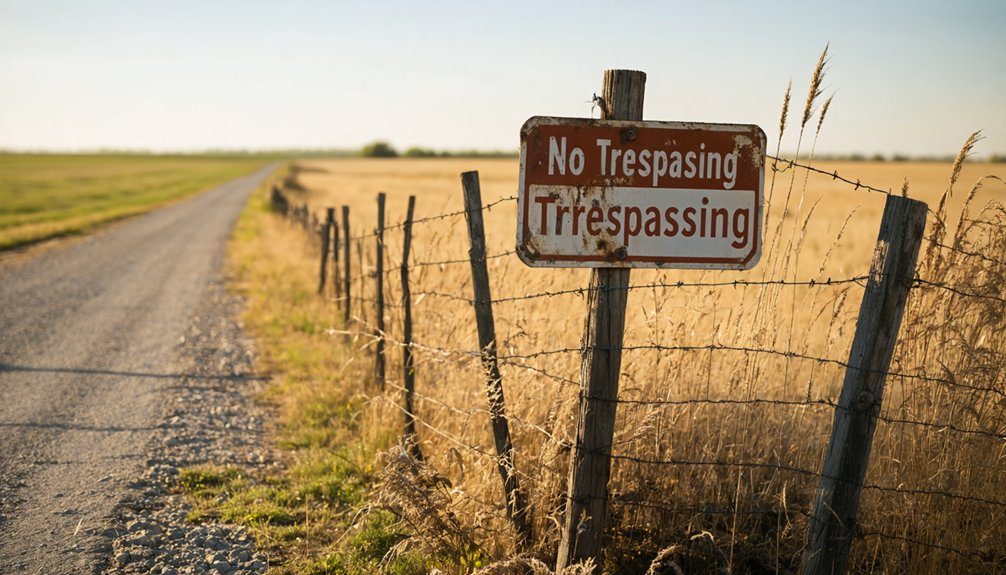
What looks like an open field from the road may sit squarely on private property, and at Kansas ghost-town sites, that line isn’t always posted or fenced.
Kansas trespass laws apply whether or not you see a sign, so assuming access is a mistake that can cost you real consequences.
Before you step off the shoulder, check land boundaries using a county map or a property-lookup app.
Before stepping off the road shoulder, verify land boundaries with a county map or property-lookup app.
- Old foundations and cemetery plots frequently sit on privately held ground
- Unfenced pasture doesn’t mean public access under Kansas trespass laws
- Owners near active farmland are more likely to monitor their land boundaries
Stick to road-accessible views when you can’t confirm permission.
You’ll still capture the story without risking a confrontation that ends your trip early.
Frequently Asked Questions
Is There a Best Time of Year to Visit Meridian, Kansas?
Spring and fall are your golden windows — mild weather keeps gravel roads passable. You’ll dodge seasonal activities crowding summer and winter’s harsh grip, and local festivals in nearby towns pair perfectly with your ghost-town adventure.
Are There Any Entrance Fees or Permits Required to Visit Ghost Towns?
Most ghost towns don’t require entrance fees, but you’ll want to respect ghost town regulations carefully. Always check entrance policies beforehand, since some sites sit on private land where you’d need permission before exploring.
Can I Bring My Dog Along on a Kansas Ghost Town Road Trip?
You can absolutely bring your dog along! These wide-open Kansas backroads are perfect for dog-friendly activities. Follow basic pet travel tips: bring water, keep your pup leashed near private land, and enjoy the freedom together!
How Long Should I Budget for a Full Meridian Ghost Town Visit?
Like a whisper from the past, Meridian rewards patience—budget 30–60 minutes to soak in the ghost town history. Pack your road trip essentials, explore foundations and horizons freely, and you’ll leave satisfied without feeling rushed.
Is Cell Phone Service Reliable Near Meridian and Surrounding Ghost Towns?
Don’t count on cell service reliability near Meridian — ghost town connectivity is spotty at best. You’ll want downloaded maps, a paper backup, and a full tank before you venture into Kansas’s beautifully remote, signal-free backroads.
References
- https://www.youtube.com/watch?v=LNAm0sZuNyw
- https://www.wheatstateinsurance.com/haunted-kansas-road-trip-13-spooky-locations-to-make-your-blood-run-cold
- https://www.youtube.com/watch?v=YQHVP21sYC8&vl=en-US
- https://www.travelks.com/kansas-magazine/articles/post/exploring-kansas-forgotten-roads/
- https://www.youtube.com/watch?v=_DLl0NgdIPo
- https://www.onlyinyourstate.com/trip-ideas/kansas/haunted-kansas-road-trip
- https://www.kwalmag.com/post/ultimate-guide-to-the-most-haunted-roads-in-kansas
- https://www.onlyinyourstate.com/kansas/abandoned-kansas-road-trip/
- https://www.youtube.com/watch?v=KBXINX0xqnU
- https://www.youtube.com/watch?v=5hDJVlbTVs8