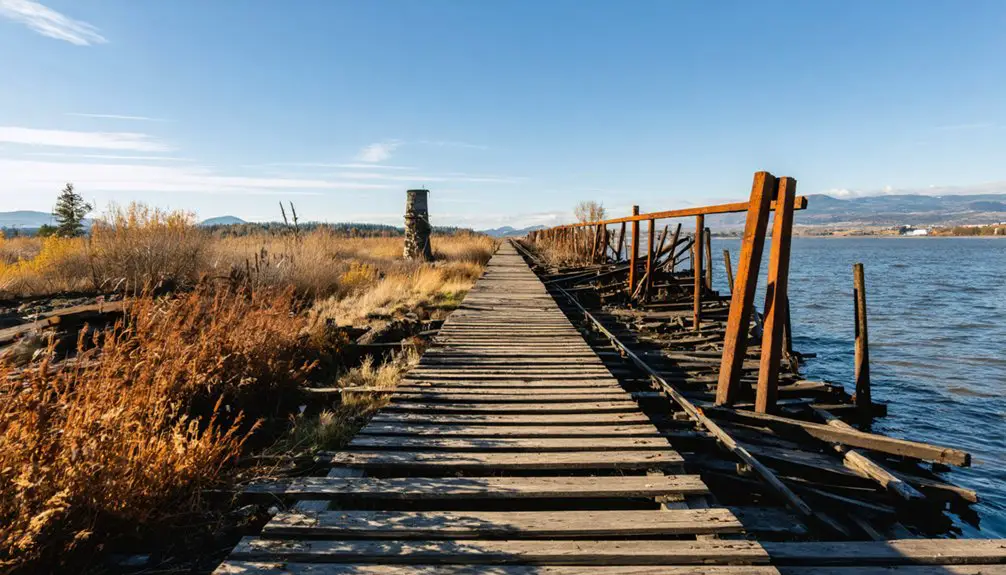
Planning a ghost town road trip to Port Discovery, Washington means exploring one of the Pacific Northwest’s most fascinating forgotten communities. Base yourself in Port Townsend, just 8 miles north, and work your way south along Highway 101. You’ll uncover the remnants of a once-thriving sawmill settlement that supported over 300 residents before timber’s collapse silenced it forever. Pair it with nearby Irondale and Port Hadlock for a full Jefferson County ghost town experience — and there’s still much more to discover.
Key Takeaways
- Base your trip in Port Townsend, 8 miles north of Port Discovery, which offers rich history and diverse accommodations including Manresa Castle.
- Visit the pioneer cemetery and explore underwater by diving near the sunken clipper ship *War Hawk* at low tide.
- Plan an efficient route along Highway 101, connecting Port Discovery, Irondale, and Port Hadlock for a full day of exploration.
- No standing structures remain at the original site, but low tide reveals subtle traces of the former lumber mill community.
- Local legends surrounding workers and dreamers, combined with scenic ghost town routes, create an immersive Jefferson County exploration experience.
What Was Port Discovery, Washington?
Port Discovery, Washington was once a thriving coastal boomtown that sprang up around a lumber mill on the west shore of Discovery Bay in Jefferson County. Its historical significance stretches back to 1792, when Captain George Vancouver first recorded activity at a nearby Indigenous village.
By 1858, the lumber mill sparked rapid growth, eventually supporting over 300 residents, fifty buildings, a hotel, saloons, a general store, and even a Chinatown. The mill’s coastal heritage shaped the region, producing massive lumber quantities for dozens of vessels by 1885.
But when the sawmill closed, the town faded. The timber industry’s collapse erased what remained, and today nothing stands at the original site. You’re fundamentally visiting a vanished world tucked along a quiet Washington shoreline.
How Port Discovery Went From Sawmill Town to Ghost Town
When a lumber mill opened at Mill Point in 1858, it sparked the rapid growth of Port Discovery into a bustling coastal boomtown with over 300 residents, fifty buildings, and even a Chinatown.
For roughly thirty years, the sawmill drove the town’s prosperity, supplying lumber to dozens of vessels by 1885.
However, its eventual closure sent Port Discovery into a steady decline.
The local timber industry’s final collapse in the late 20th century finished what the mill’s closure started, leaving nothing behind but a ghost town and scattered memories.
Sawmill Sparks Town Growth
Once a thriving coastal boomtown, Port Discovery’s rise and fall traces directly back to a single sawmill established in 1858 on Mill Point. That mill transformed a quiet coastal community into a bustling hub almost overnight.
At its peak, the lumber industry powered a town of 300 residents and fifty buildings, including a lively Chinatown.
Here’s what made Port Discovery boom:
- The sawmill supplied lumber to 54 vessels by 1885, driving massive economic growth.
- Infrastructure exploded, giving residents a hotel, general store, and saloons along the bluff and beach.
- Pacific ships regularly called at this port near the Strait of Juan de Fuca, connecting the town to global trade.
You can almost hear the saws humming when you visit today.
Mill Closure Brings Decline
What the sawmill built, its silence tore down. Once the mill shuttered, Port Discovery’s sawmill impact reversed dramatically, stripping the town of its only reason to exist. Residents left, businesses closed, and buildings emptied one by one. The community decline wasn’t slow — it was inevitable.
By the late 20th century, the timber industry’s regional collapse delivered the final blow. The town didn’t just shrink; it vanished entirely.
Even the mill’s physical remnants, visible until 2008, were removed by 2010 to restore salmon and shellfish habitat in Discovery Bay.
You’ll find no structures standing today. What once housed 300 residents and fifty buildings is now silent shoreline.
Port Discovery traded its boomtown energy for ghost town stillness — and nature is steadily reclaiming what’s left.
Timber Industry’s Final Collapse
The timber industry’s collapse didn’t just slow Port Discovery — it erased it. Once the sawmill shuttered, the economic impact hit fast and hard. Businesses closed, residents scattered, and buildings disappeared. By the late 20th century, nothing remained.
Here’s what that collapse ultimately left behind:
- A ghost town — Mill Point stands completely empty today, with zero visible structures remaining.
- An erased economy — The timber industry’s fall stripped away every business, home, and community anchor that once thrived here.
- A restored shoreline — The economic impact cleared the way for habitat restoration, removing mill remnants around 2010 to revive salmon and shellfish populations in Discovery Bay.
You’re now visiting a place where an entire world once stood.
What Still Exists at the Port Discovery Ghost Town Site
Although Port Discovery’s bustling boomtown has completely vanished, a few intriguing remnants and points of interest still reward curious visitors who make the trip to Mill Point. You won’t find standing structures among these ghost town remnants, but the nearby pioneer cemetery preserves the stories of sailors and settlers who once shaped this community.
Beneath the bay’s surface, the 1883 clipper ship *War Hawk* rests as one of the region’s most fascinating historical landmarks, drawing divers enthusiastic to explore its sunken hull. The shoreline itself tells a quieter story — post-2010 habitat restoration has transformed the old mill site into recovering salmon and shellfish grounds.
Visit during low tide, and you might still glimpse subtle traces of the community that timber once built.
The War Hawk Wreck: Diving Discovery Bay’s Sunken Clipper Ship
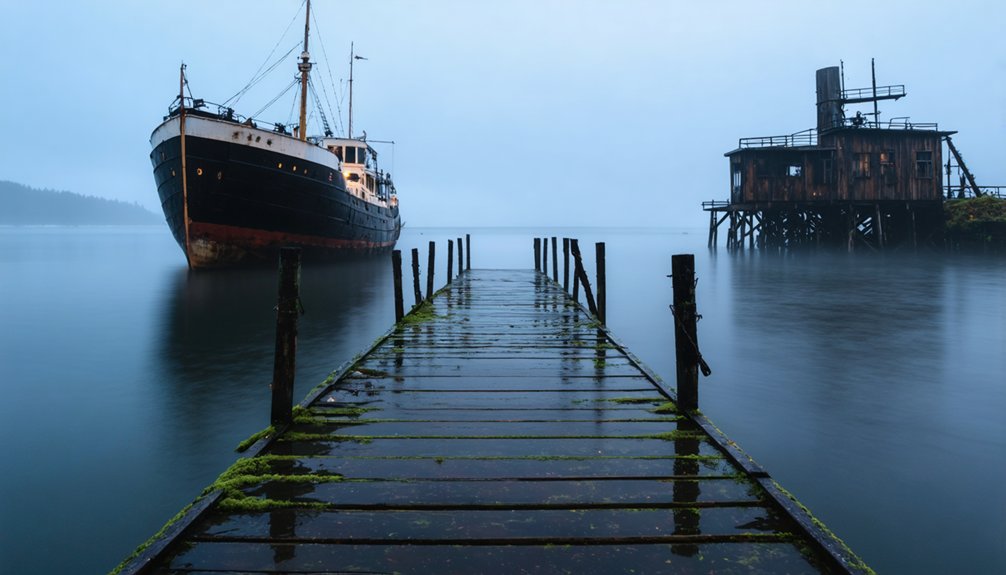
Follow these diving tips to maximize your experience:
- Time your dive during slack tide for clearest visibility and safest currents.
- Research the wreck’s layout beforehand — knowing the ship’s structure helps you navigate confidently.
- Bring an underwater camera to capture the encrusted hull and artifacts frozen in time.
You’re not just diving a wreck — you’re exploring a ghost town’s final chapter.
How to Get to Port Discovery Today
Getting to Port Discovery takes just a few simple turns off U.S. Highway 101. Head east onto Broders Road, and you’ll find yourself approaching Mill Point on Discovery Bay’s west shore.
It’s one of those road trip tips worth remembering — simple directions, big historical payoff.
From Port Townsend, you’re only 8 miles away, making this an easy addition to your scenic routes along Jefferson County’s coastline. The drive rewards you with views near the Strait of Juan de Fuca, where Pacific ships once docked regularly.
Combine Port Discovery with nearby ghost towns like Irondale and Port Hadlock for a full day of exploration.
Plan your visit around low tide to catch any remaining shore remnants, and bring dive gear for the War Hawk wreck just offshore.
Other Ghost Towns Near Port Discovery Worth the Detour
While you’re in the area, you don’t have to stop at Port Discovery — two nearby ghost towns make the detour well worth it.
Irondale, once a bustling industrial town with dreams of becoming the “Pittsburgh of the West,” sits just a short drive away and offers its own haunting glimpse into Jefferson County’s forgotten past.
Port Hadlock, another nearby community that rose and fell with the region’s timber industry, rounds out a compelling ghost town trifecta you won’t want to miss.
Irondale Ghost Town Nearby
Since you’re already exploring the ghost towns of Jefferson County, Irondale makes for a natural detour just a few miles from Port Discovery.
Irondale history centers on a failed steel mill that briefly promised industrial greatness before collapsing in the early 1900s, leaving behind a haunting silence.
Irondale landmarks still whisper that story if you know where to look.
Here’s how to make the most of your stop:
- Walk the old mill site where rusted echoes of ambition remain scattered across the landscape.
- Explore the waterfront overlooking Port Townsend Bay for stunning views and quiet reflection.
- Check the cemetery for pioneer graves connecting Irondale’s brief, intense history to the wider Jefferson County story.
You’ll leave understanding exactly why this detour earns its place on your route.
Port Hadlock’s Forgotten Past
Port Hadlock carries its own brand of forgotten ambition just a short drive from Irondale, and it rounds out Jefferson County’s ghost town circuit beautifully.
Once a thriving mill town, it shared Port Discovery’s industrial DNA before timber’s collapse hollowed it out. Today, forgotten landmarks dot the landscape, quietly marking where ambition once ran high.
You’ll find weathered remnants that spark curiosity and fuel local legends about the workers, merchants, and dreamers who built something real here before it all unraveled.
Walking through Port Hadlock feels less like tourism and more like reclaiming a story that history nearly buried.
Pair it with Port Discovery and Irondale, and you’ve built a road trip that moves freely through Washington’s raw, unfiltered past without a museum in sight.
Where to Base Yourself for a Port Discovery Road Trip
Nestled 8 miles north of Port Discovery, Port Townsend makes an ideal base for your ghost town road trip. This Victorian seaport delivers rich history, diverse accommodation options, and local attractions that’ll keep you exploring well beyond Mill Point.
- Stay at Manresa Castle – This haunted landmark offers atmospheric lodging that matches your ghost town adventure perfectly.
- Explore Downtown Port Townsend – Browse local shops, restaurants, and historic sites before heading south on Highway 101 toward Broders Road.
- Plan Your Route – From Port Townsend, you can efficiently hit Port Discovery, Irondale, and Port Hadlock in a single day, maximizing your freedom to roam Jefferson County’s forgotten landscapes.
Pack light, drive east toward Mill Point, and let Port Townsend’s energy fuel your journey.
Frequently Asked Questions
What Time of Year Is Best to Visit Port Discovery Ghost Town?
With 54 vessels once loading lumber here, you’ll love visiting during summer’s best seasons. Warm weather conditions reveal shore remnants at low tide, letting you explore freely and dive the historic War Hawk wreck beautifully.
Are There Guided Tours Available at the Port Discovery Ghost Town Site?
No formal guided tours exist, but you’re free to explore Port Discovery’s historical significance independently. Embrace guided exploration by visiting the pioneer cemetery, diving the War Hawk wreck, and uncovering this hauntingly beautiful ghost town on your own terms.
Is the Port Discovery Cemetery Open to the Public Year-Round?
You’ll find the cemetery open year-round, inviting you to explore its rich cemetery history and ghost town legends. Walk among pioneer and sailor graves, connecting freely with Port Discovery’s haunting past whenever adventure calls you.
What Permits Are Required for Diving the War Hawk Wreck?
The knowledge base doesn’t specify wreck diving permit requirements for the War Hawk. You’ll want to contact Washington State Parks or local dive shops near Port Townsend to clarify current permit requirements before diving this historic 1883 wreck.
Are There Any Local Museums Dedicated to Port Discovery’s History?
Ironically, you won’t find a dedicated museum here — Port Discovery’s vanished! However, you’ll uncover local artifacts and historical significance at nearby Port Townsend’s museums, where pioneer stories and maritime heritage breathe life into this forgotten ghost town’s legacy.
References
- https://www.therockerbox.com/jefferson_county_wa_ghost_towns.htm
- https://en.wikipedia.org/wiki/Port_Discovery
- https://www.ghosttowns.com/states/wa/portdiscovery.html
- https://www.nwnewsnetwork.org/history-and-culture/2023-10-26/washingtons-only-living-ghost-town-is-full-of-history-and-a-few-lingering-residents
- https://wonderlusttravel.com/port-townsend-washington/
- https://www.whatcomtalk.com/2020/06/05/the-ghost-towns-of-whatcom-forgotten-but-not-gone/
- https://www.youtube.com/watch?v=PO7B-vvx9WE