Rock Springs is actually in Wyoming, not California, but don’t let that stop you — this ghost town destination earns its place on any dark history road trip. You’re walking ground where a Chinatown was burned to ash in 1885, where at least 28 Chinese miners were killed, and where demolition crews later erased what the mob left behind. Artifacts still surface beneath modern streets. There’s far more buried here than the ground suggests.
Key Takeaways
- Rock Springs, Wyoming (not California) offers a ghost town experience rooted in labor history, racial violence, and the 1885 Chinese miners massacre.
- The destroyed Chinatown site is bounded by Elk Street, M Street, Bridger Avenue, and Railroad Avenue, with few visible surface traces remaining.
- Archaeological excavations continue uncovering artifacts like tools, ceramics, and personal objects, revealing daily life within the erased immigrant community.
- The *Requiem* statue and commemorative landscape provide visitors meaningful opportunities to reflect on immigrant resilience and historical erasure.
- Key road trip stops include South Pass City, Carbon, Diamond City, and Corinne, each highlighting interconnected mining, railroad, and labor histories.
Why Rock Springs Belongs on Your Ghost Town Road Trip
When most people picture a ghost town, they imagine weathered saloons and collapsed mineshafts baking under an open sky—but Rock Springs, Wyoming, offers something rarer and more unsettling.
This isn’t a town frozen in amber—it’s a place where labor history and cultural memory collide violently beneath an ordinary modern streetscape. You’ll walk streets built over a destroyed Chinatown, near where 28 Chinese miners died in an 1885 massacre fueled by racial hatred and wage conflict.
Union Pacific’s grip, the Knights of Labor’s resentment, and unchecked mob violence erased an entire community. Yet archaeology keeps pulling evidence back to the surface.
Mob violence erased an entire community—but archaeology keeps pulling the truth back to the surface.
If you value honest reckoning with America’s westward expansion, Rock Springs belongs on your road trip.
The 1885 Massacre That Erased a Chinatown
On September 2, 1885, white miners armed with rifles and torches turned on Rock Springs’ Chinatown, killing at least 28 Chinese workers and wounding 15 more.
You can picture the scale of it when you consider that rioters looted and burned roughly 79 homes and buildings in a single afternoon, reducing an entire neighborhood to ash.
Violence Erupts In September
September 2, 1885, started like any other shift change at the Union Pacific mines—until it didn’t. Labor disputes had been simmering for months, and racial tensions between white miners and Chinese workers finally ignited into something catastrophic.
Armed white miners descended on Chinatown, torching homes, looting buildings, and driving residents into the surrounding desert at gunpoint. You’re looking at 28 people killed, 15 wounded, and 79 structures burned to ash.
The violence wasn’t random—it was organized, deliberate, and fueled by years of resentment over wages and job competition. Chinese miners who escaped fled with nothing.
What had been a functioning neighborhood vanished in a single afternoon, erased not just by flames, but by the calculated fury of a mob that faced almost no legal consequences.
Chinatown Burns And Disappears
By the time the fires burned out, Rock Springs’ Chinatown no longer existed. Mobs had looted and torched roughly 79 homes and buildings, leaving almost nothing standing. At least 28 Chinese miners were killed, and around 15 more were wounded.
What the flames didn’t consume, demolition crews eventually did. New housing replaced the destroyed neighborhood, and redevelopment erased the physical footprint almost entirely.
Yet Chinatown resilience persists in unexpected ways. Archaeological excavations have uncovered artifacts beneath the soil near Elk Street and Bridger Avenue, offering fragments of daily life that survived the erasure.
Memory recovery has become an active pursuit here, driven by scholars, descendants, and community advocates who refuse to let the site stay invisible. You’re visiting a place where destruction and remembrance exist on the same ground.
What Survives at the Rock Springs Chinatown Site Today
Few visible traces remain where Rock Springs’ Chinatown once stood, and that absence is itself part of the story. Bulldozers erased the neighborhood after the massacre, and new housing buried what remained.
Yet the ground holds memory. Archaeological teams have recovered Chinatown artifacts that reconstruct daily life — tools, ceramics, personal objects — proving memory recovery is possible even where visible history was deliberately erased.
The ground holds memory. Artifacts recovered from Chinatown’s soil reconstruct lives that history tried to erase.
You’re standing near a site bounded by:
- Elk Street to M Street
- Bridger Avenue to Railroad Avenue
- Destroyed homes once numbering around 79
- No identified burial ground
- Material evidence still embedded in the earth
That grid of streets marks where a community lived, worked, and was violently erased. The land remembers what the architecture no longer shows.
Visit the *Requiem* Statue and the Commemoration Landscape
The statue’s commemorative significance lies in what it refuses to let disappear. It anchors immigrant resilience into physical form, forcing the town’s “56 Nationalities” identity to reckon honestly with its bloodiest chapter.
Stand here long enough and you’ll feel the weight of what was erased and what’s finally being reclaimed. For freedom-minded travelers, that tension is the whole point of the stop.
Walk the Ghost Town Footprint From Elk Street to Railroad Avenue
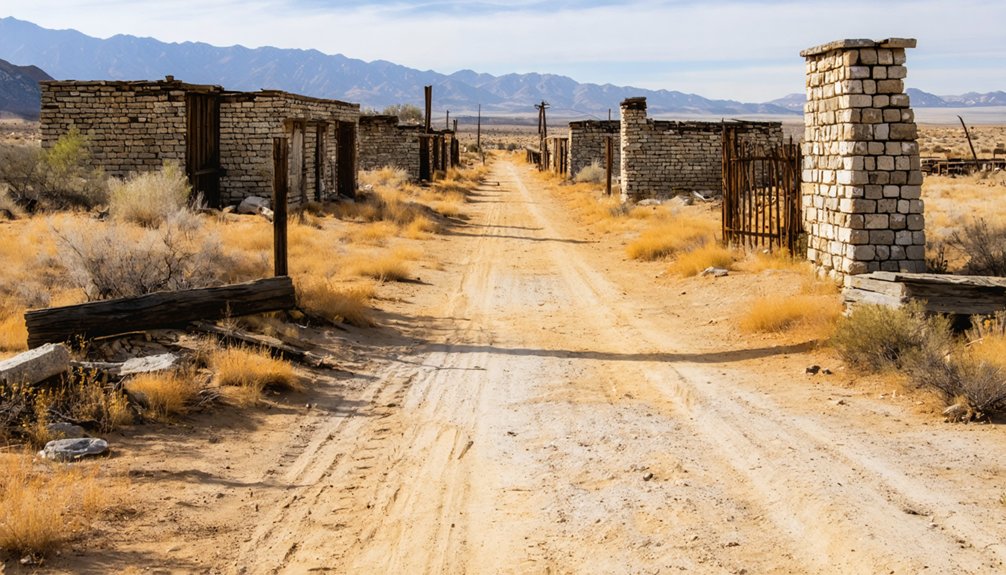
When you walk the blocks between Elk Street and Railroad Avenue today, you’re crossing ground where roughly 79 homes and buildings once stood before the mob burned and looted them on September 2, 1885.
The neighborhood’s physical outline is gone, replaced by later housing and infrastructure, but archaeologists working along Bridger Avenue have recovered artifacts that restore texture to daily life in that vanished community.
You can trace the massacre’s footprint with a map in hand, matching modern street coordinates to the historical record of where Chinese miners lived, worked, and died.
Mapping The Vanished Chinatown
Walking Elk Street today, you’d never guess that an entire neighborhood once stood here — a grid of homes, shops, and communal spaces that housed hundreds of Chinese miners before a single September night in 1885 erased it from the map.
Urban erasure was thorough and deliberate, but archaeology is recovering what redevelopment buried.
Trace the vanished legacy across these boundaries:
- Elk Street to M Street — the neighborhood’s eastern and western edges
- Bridger Avenue to Railroad Avenue — northern and southern borders
- 79 structures looted and burned in one night
- No identified burial ground — but material artifacts survive underground
- New housing replaced Chinatown without marker or memorial
Walk this grid with intention. The streets still hold the shape of what was taken.
Archaeology Along Bridger Avenue
Beneath the pavement of Bridger Avenue, history hasn’t disappeared — it’s just waiting to be excavated.
Walk the corridor stretching from Elk Street to Railroad Avenue, and you’re tracing the ghost footprint of Rock Springs’ obliterated Chinatown. Archaeological findings recovered from this zone — ceramic fragments, personal objects, structural remnants — reconstruct daily lives that official records ignored.
These artifacts don’t just confirm the neighborhood existed; they challenge the erasure. Community engagement has driven much of this recovery work, pushing researchers and local historians to treat the ground itself as testimony.
As you move through this seemingly ordinary stretch of Wyoming streets, recognize what’s buried beneath ordinary-looking asphalt: evidence of immigrant labor, survival, and systematic destruction that no amount of redevelopment has fully erased.
Tracing The Massacre Footprint
Stretching from Elk Street to Railroad Avenue, the ghost footprint of Rock Springs’ Chinatown demands more than a casual glance — it demands a reckoning.
Walk these blocks and you’re tracing a massacre legacy written in absence — demolished homes, erased streets, buried artifacts.
The massacre footprint reveals immigrant resilience hidden beneath ordinary pavement:
- Elk Street to M Street marks the neighborhood’s eastern boundary
- Bridger Avenue to Railroad Avenue defines the southern corridor
- At least 79 structures were looted and burned here
- Redevelopment buried rather than honored this ground
- Archaeological fragments still surface, quietly testifying
You won’t find markers on every corner.
You’ll find silence instead — a silence that carries weight.
Let that weight redirect your attention toward what was deliberately unmade and why it matters.
Pair Rock Springs With Nearby Wyoming Mining and Railroad Towns
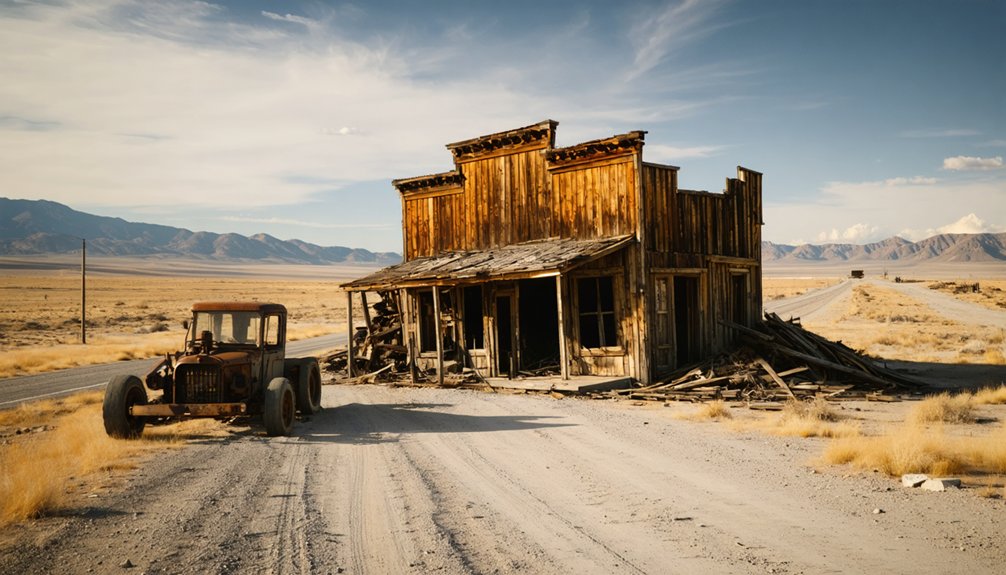
Once you’ve absorbed Rock Springs’ layered history of coal dust, railroad politics, and racial violence, the surrounding Wyoming landscape pulls you deeper into the same story.
Head east toward Carbon County, where Hanna and Carbon preserve traces of mining heritage that shaped entire immigrant communities.
Drive north to Rawlins, a Union Pacific depot town where railroad expansion carved both commerce and conflict into the high desert.
Rawlins rose where Union Pacific pushed its rails — a depot town shaped equally by commerce and high desert conflict.
South Pass City offers a different angle — a gold-rush ghost town frozen mid-collapse, its weathered structures standing against open sky.
Each stop adds texture to Rock Springs’ narrative, connecting labor struggles, company towns, and forgotten workers across a single corridor of western history.
Together, these sites transform a single-stop visit into a full reckoning with the American West’s complicated foundation.
Plan Your Route Through the Rocky Mountain Dark History Corridor
The Rocky Mountain dark history corridor doesn’t announce itself with markers or welcome signs — you piece it together through crumbling mine shafts, archaeological dig sites, and towns that outlived their worst moments without ever fully recovering.
Build your ghost town route around these dark history anchors:
- Rock Springs, Wyoming — labor violence, Chinese massacre site, vanished Chinatown
- South Pass City, Wyoming — gold rush collapse, early suffrage history
- Carbon, Wyoming — abandoned Union Pacific coal camp, visible ruins
- Diamond City, Montana — boom-and-bust gold settlement, nearly erased
- Corinne, Utah — transcontinental railroad junction, forgotten immigrant labor history
Move west to east or reverse it. Each stop adds a layer — mining, railroads, displacement, survival.
You’re not sightseeing. You’re reconstructing a buried chapter of Western expansion mile by mile.
Frequently Asked Questions
Is Rock Springs, Wyoming, or Rock Springs, California?
Ironically, California’s got nothing on this one—Rock Springs history places it firmly in Wyoming. You’ll find the ghost town attractions rooted in coal, railroads, and the haunting legacy of the 1885 Chinese Massacre.
Were Any White Miners Ever Prosecuted for the 1885 Massacre?
No white miners faced legal ramifications for the 1885 massacre. You’ll find that historical context reveals a grand jury convened but never indicted anyone, leaving 28 murdered Chinese miners without justice.
How Long Does a Full Visit to Rock Springs Typically Take?
You’ll spend a full day uncovering Rock Springs’ historical significance. Explore local attractions, walk massacre sites, and absorb the weight of immigrant memory — it’s more than a quick stop; it demands your time and attention.
Are There Guided Tours Specifically Focused on the Massacre History?
You won’t find dedicated ghost town tours yet, but the site’s historical significance runs deep. Seek out local guides, the recent *Requiem* statue, and archaeological landmarks to uncover the 1885 massacre’s haunting, freedom-denying story yourself.
What Is the Best Time of Year to Visit Rock Springs?
Late summer’s your best bet—you’ll catch milder weather considerations and seasonal attractions like anniversary commemorations marking the 1885 massacre. September connects you directly to the history you’re chasing across Wyoming’s wide, unforgiving high desert.
References
- https://californiathroughmylens.com/calico-ghost-town/
- https://www.fi2w.org/the-ghosts-of-rock-springs/
- https://www.westernwyoming.edu/blogs/learning/general-learning/unearthing-history-rock-springs-chinatown.php
- https://parks.sbcounty.gov/park/calico-ghost-town-regional-park/
- https://www.youtube.com/watch?v=Zee5aoB6B7s
- https://sgphotos.com/photostories/inyos/
- https://www.facebook.com/groups/desertmagazine/posts/3870323829764732/
- https://www.vvdailypress.com/press-release/story/34091/19th-century-ghost-town-brought-back-to-life/
- https://en.wikipedia.org/wiki/List_of_ghost_towns_in_California
- https://desertgazette.com/blog/tag/ghost-town/