Planning a ghost town road trip to Somerset, Vermont means exploring one of New England’s most haunting destinations. You’ll find scattered stone foundations, collapsed chimneys, and a weathered hillside cemetery near the Somerset Reservoir, where submerged structures rest beneath the water’s surface. Take Route 9 and local logging roads to get there, and visit in summer or fall for the best trail conditions. There’s far more to Somerset’s mysterious past than you’d expect.
Key Takeaways
- Somerset, Vermont, was a logging settlement established in 1761, abandoned in 1937 after the Somerset Dam created a reservoir submerging much of the town.
- Visible remnants include stone foundations, collapsed chimneys, and a hillside cemetery with weathered headstones dating to the 1850s near the reservoir.
- Reach Somerset via Route 9 and local logging roads; nearby ghost towns include Glastenbury, Woodford, Searsburg, and Readsboro for an extended road trip.
- Summer and fall are the best visiting seasons, offering stable trails, longer daylight, and stunning foliage framing the historic ruins.
- Pack sturdy hiking boots, water, insect repellent, a first aid kit, flashlight, and a wide-angle camera lens for exploring the ruins.
How Somerset, Vermont Went From Boomtown to Ghost Town
Once a thriving logging and trading settlement, Somerset, Vermont rose quickly after its 1761 charter, peaking at around 300 residents by the 1850s. The logging industry fueled this growth, drawing workers deep into the Vermont wilderness and shaping the town’s heritage around timber and trade.
But the boom didn’t last. The Somerset Dam‘s construction submerged prime land beneath what’s now the Somerset Reservoir, swallowing much of the original town grid.
As resources dwindled and the economy shifted, residents left for better opportunities. By 1937, Somerset officially became unincorporated, effectively abandoned.
Today, you’re visiting a place where nature has quietly reclaimed what industry once dominated. The forest holds the town’s story, and exploring it means stepping into a past most people never knew existed.
The Somerset Reservoir: What’s Submerged Beneath the Water
Beneath the still surface of the Somerset Reservoir lies what was once the beating heart of a small Vermont town. The dam’s construction didn’t just reshape the landscape — it swallowed it.
When you visit, you’re standing above genuine submerged structures frozen in reservoir history.
The water currently preserves:
- Stone foundations from homes and businesses
- Remnants of the original street grid
- Artifacts tied to the 1850s logging settlement era
- Structural remains from the town’s trading post period
You won’t see these submerged structures directly, but knowing they exist below transforms your experience. The reservoir stops feeling like a peaceful body of water and starts feeling like a flooded memory.
That quiet surface holds an entire community underneath it.
Stone Foundations and the Cemetery You Can Still See Today
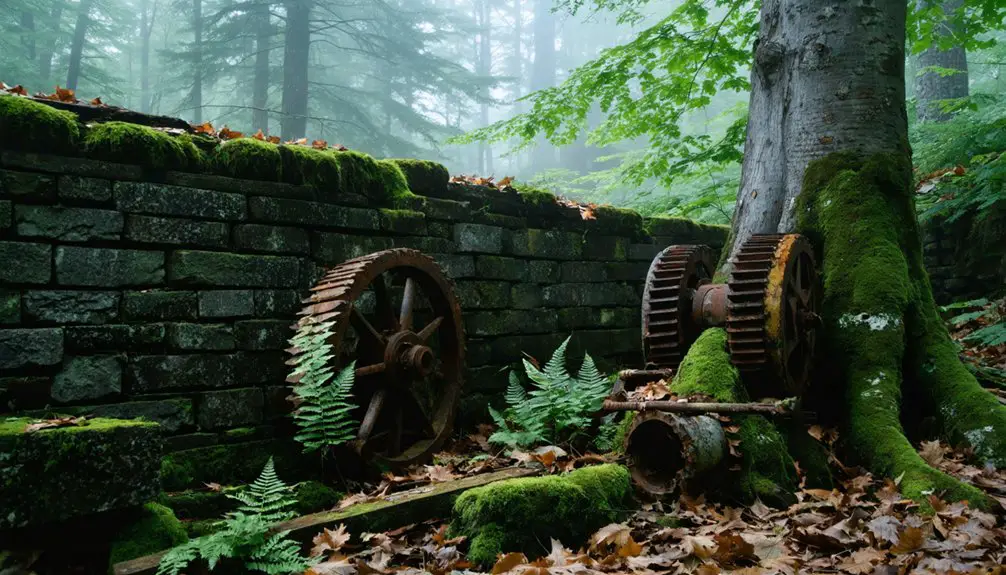
As you wander through the woods surrounding the Somerset Reservoir, you’ll spot scattered stone foundations half-swallowed by moss and tree roots, silent remnants of the town’s 1850s peak population of around 300 residents.
A small hillside cemetery remains visible near the reservoir’s edge, where weathered headstones still mark the graves of Somerset’s former settlers.
Keep your eyes on the forest floor, too, because rare artifacts from the old logging and trading settlement occasionally surface, offering tangible connections to the town’s vanished past.
Hidden Stone Foundations Remain
Though nature has largely reclaimed Somerset, you’ll still find tangible remnants of the town’s past hiding in plain sight. Exploring ruins here reveals a hidden history written in stone.
Watch for these key features:
- Stone foundations — Partially buried beneath forest debris, these structural outlines mark where homes and buildings once stood.
- Hillside cemetery — A small graveyard near the reservoir remains visible, offering a sobering connection to Somerset’s former residents.
- Street grid remnants — Beneath the reservoir’s surface, submerged foundations preserve the town’s original layout.
- Scattered logging artifacts — Forest floors occasionally yield remnants from the 1850s logging era.
Move carefully through the woods, and you’ll discover that Somerset hasn’t completely surrendered its past to time.
The Hillside Cemetery Today
Of all the remnants scattered across Somerset’s forest floor, the hillside cemetery stands out as the most striking and accessible landmark you’ll encounter.
Tucked near the Somerset Reservoir, it offers a rare, tangible connection to the town’s living past. You don’t need specialized hiking equipment to reach it — standard trail shoes and a water bottle will get you there comfortably.
Once you arrive, weathered headstones rise quietly among the trees, marking lives lived during Somerset’s logging peak in the 1850s.
The historical significance here is undeniable. This cemetery survived disincorporation, rising reservoir waters, and decades of forest growth.
It’s one of the few features that lets you stand directly inside Somerset’s story, no imagination required. Explore it respectfully and take nothing but photographs.
Artifacts On The Forest Floor
While the cemetery draws most visitors in, the stone foundations scattered across Somerset’s forest floor tell an equally compelling story.
During your forest exploration, you’ll discover remnants of a once-thriving logging community hiding beneath decades of overgrowth. Keep your eyes low — historical artifacts and structural ghosts appear when you slow down and look carefully.
Here’s what you might encounter:
- Stone foundations outlining former homes and outbuildings
- Collapsed chimney remnants barely visible beneath forest debris
- Scattered hardware fragments from the trading settlement era
- Sunken depressions marking cellar holes of long-vanished structures
You’re fundamentally walking through an open-air archive. The forest hasn’t erased Somerset — it’s preserved it.
Every mossy rock formation you step around could be a piece of 1850s Vermont history.
Somerset, the Bennington Triangle, and the Disappearances
Somerset’s eerie abandonment takes on an even darker dimension when you consider its place within the infamous Bennington Triangle. Author Joseph A. Citro coined this term to describe the surrounding wilderness, a region tied to a series of mysterious disappearances between 1945 and 1950. Several people vanished without explanation in this dense, unforgiving landscape, and investigators never found satisfying answers.
Somerset shares this unsettling legacy with nearby Glastenbury, another ghost town that became unincorporated in the same year, 1937.
When you walk these woods, you’re stepping through terrain that has swallowed both history and people whole. The Bennington Triangle continues drawing paranormal investigators and curious travelers alike. Whether you believe the folklore or not, the atmosphere here commands genuine respect.
Other Ghost Towns Near Somerset Worth Visiting
The Bennington Triangle doesn’t begin and end with Somerset. This haunted wilderness hides other forgotten communities worth adding to your road trip itinerary. Each site offers abandoned structures, local legends, and untamed atmosphere that rewards curious explorers.
- Glastenbury, Vermont – Disincorporated the same year as Somerset (1937), this ghost town shares identical eerie circumstances and forest isolation.
- Woodford, Vermont – A nearby settlement with deep historical roots and scenic access points into the surrounding wilderness.
- Searsburg, Vermont – A small, fading community tucked into Windham County’s rugged terrain.
- Readsboro, Vermont – Once a thriving mill town, now a quiet reminder of Vermont’s industrial past.
Exploring these surrounding areas transforms your Somerset visit into a full regional adventure through Vermont’s forgotten history.
How to Get to Somerset, Vermont
Reaching Somerset, Vermont takes some navigation, but that’s half the adventure. Start by taking Route 9 east toward Woodford, then turn onto local roads that wind deeper into the Green Mountain National Forest.
No paved roads lead directly to the site, so you’ll rely on logging roads and forest trails to get there.
For solid hiking tips, wear sturdy footwear and bring a trail map since signage is minimal out here. Summer and fall offer the clearest conditions for exploring.
Once you arrive, you’ll uncover ghost town history firsthand — stone foundations tucked into the woods, a hillside cemetery near the reservoir, and the quiet weight of a place that once housed 300 residents.
Give yourself one to two hours to take it all in properly.
Best Time to Visit Somerset’s Ghost Town
You’ll find Somerset’s ghost town most rewarding during summer or fall, when clear weather keeps the logging roads passable and the forest trails easy to navigate.
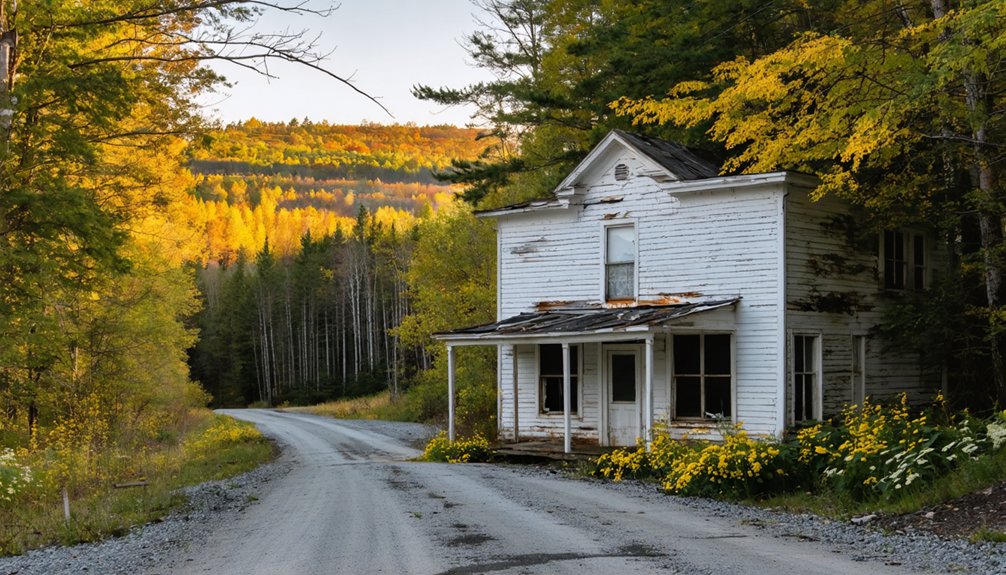
Fall offers stunning foliage that frames the stone foundations dramatically, while summer gives you longer daylight hours to explore the reservoir’s edge.
Since Somerset draws only a modest number of visitors year-round, you won’t battle heavy crowds in either season, though fall weekends can attract more hikers passing through the Green Mountain National Forest.
Summer Versus Fall Visits
Whether you’re planning a summer hike or a fall foliage detour, Somerset’s ghost town rewards visitors differently depending on the season. Each visit offers its own distinct experience.
- Summer activities keep the forest trails accessible and visibility high for spotting stone foundations.
- Fall foliage transforms the Green Mountain National Forest into a vivid backdrop for exploration.
- Summer offers longer daylight hours, giving you more time to locate scattered remnants and the hillside cemetery.
- Fall delivers cooler temperatures and thinner foliage, making hidden ruins easier to identify through bare branches.
Both seasons suit hikers of all experience levels, and the reservoir looks striking year-round.
Choose summer for lush immersion or fall for dramatic color and clearer sightlines into the woods.
Weather And Trail Conditions
Planning your visit around Somerset’s weather and trail conditions can make the difference between a rewarding exploration and a frustrating slog through muddy, overgrown terrain. Vermont’s weather patterns shift dramatically between seasons, so you’ll want to time your trip carefully.
Spring thaws leave logging roads waterlogged and nearly impassable, while winter snowfall cuts off access entirely.
Summer and fall offer your best windows. Summer delivers stable conditions and longer daylight hours, giving you maximum freedom to explore stone foundations and the hillside cemetery.
Fall brings drier, firmer trails with the added bonus of spectacular foliage.
Since Somerset sits within the Green Mountain National Forest, trail maintenance is minimal, so expect raw, natural conditions regardless of season.
Wear sturdy footwear and check Vermont road condition reports before heading out.
Peak Seasonal Crowd Levels
Somerset’s status as a ghost town keeps crowds thin year-round, but timing your visit still matters. Seasonal visitors and crowd management aren’t major concerns here, but knowing peak periods helps you plan a quieter, more immersive experience.
- Summer (June–August): Highest foot traffic from hikers and curiosity seekers; trails stay accessible but expect occasional company.
- Fall (September–October): Foliage draws leaf-peepers, creating moderate crowd levels with stunning scenery as your backdrop.
- Spring (April–May): Muddy trails deter most visitors, giving you near-total solitude.
- Winter (November–March): Snowfall limits access considerably, reserving the site for only the most determined explorers.
You’ll rarely feel crowded here, but arriving early on fall weekends guarantees the ghost town’s eerie silence remains fully yours.
What to Bring to Explore Somerset’s Ruins
Packing smart makes all the difference when you’re heading into Somerset’s forested ruins.
You’ll want sturdy hiking boots since the terrain involves uneven forest floors and overgrown trails. Bring enough water for a comfortable two-hour exploration, and pack a light snack to keep your energy up.
For ghost town photography, a wide-angle lens captures the eerie stone foundations beautifully against the dense Green Mountain backdrop. A printed map or downloaded offline GPS route is essential since cell service is unreliable here.
Hiking safety demands you carry a basic first aid kit, insect repellent, and a charged flashlight, even during daylight visits. Dress in layers, particularly in fall, when temperatures shift quickly.
You’re entering genuine wilderness, so respect it and come prepared.
Frequently Asked Questions
What Are the Geographic Coordinates of the Somerset Ghost Town Site?
Like a hidden gem waiting to be unearthed, Somerset’s ghost town history sits at 42.9731° N, 72.9631° W. You’ll discover these coordinates lead you straight to incredible hiking trails through Vermont’s haunting wilderness.
How Many Residents Were Recorded in Somerset During the 2000 Census?
You’ll find that census data reveals only two residents remained in Somerset during the 2000 count — a haunting reflection of this ghost town history that once sheltered a thriving 300-person logging community.
Is the Difficulty Level at Somerset Suitable for Beginner Hikers?
Ready to explore without worry? You’ll find Somerset’s beginner trails perfectly suit your skill level. It’s rated easy, so hiking safety isn’t a concern — you can freely discover stone foundations and forest remnants with confidence!
How Long Should Visitors Plan to Spend Exploring Somerset’s Ruins?
You’ll want to set aside 1 to 2 hours to fully uncover Somerset’s ghost town history. Follow these exploration tips: wander stone foundations, discover the hillside cemetery, and soak in every hauntingly beautiful, freedom-filled moment.
Was Somerset Originally Founded as a Logging and Trading Settlement?
Yes, you’ll discover that Somerset’s logging history and trading significance shaped its founding in 1761! It originally thrived as a bustling logging and trading settlement, drawing hundreds of ambitious pioneers seeking opportunity in Vermont’s rich, untamed wilderness.
References
- https://www.youtube.com/watch?v=fz5A3KcRwic
- https://obscurevermont.com/tag/ghost-town/
- https://www.youtube.com/watch?v=2fvPo9iQC-w
- https://www.facebook.com/groups/BenningtonBlotter/posts/2084150884950089/
- https://www.thetravel.com/glastenbury-mountain-ghost-town-history-vermont/
- https://talestrailsandtaverns.com/?p=423
- https://happyvermont.com/2014/10/23/glastenbury-ghost-town/
- https://ghost-towns.close-to-me.com/states/vermont/somerset-vt/
- https://www.tripadvisor.com/Attractions-g28966-Activities-c47-t14-Vermont.html
- https://en.wikipedia.org/wiki/List_of_ghost_towns_in_Vermont