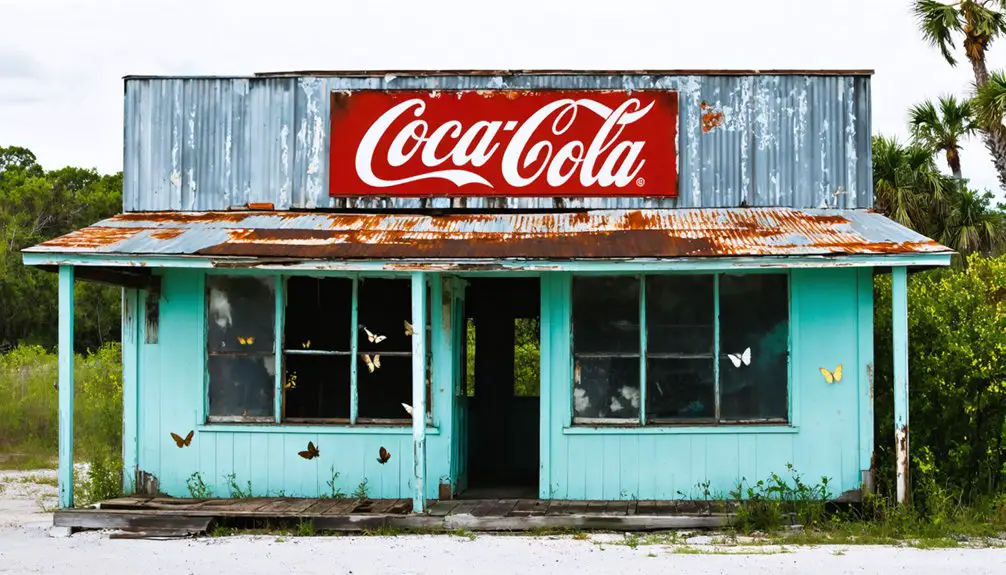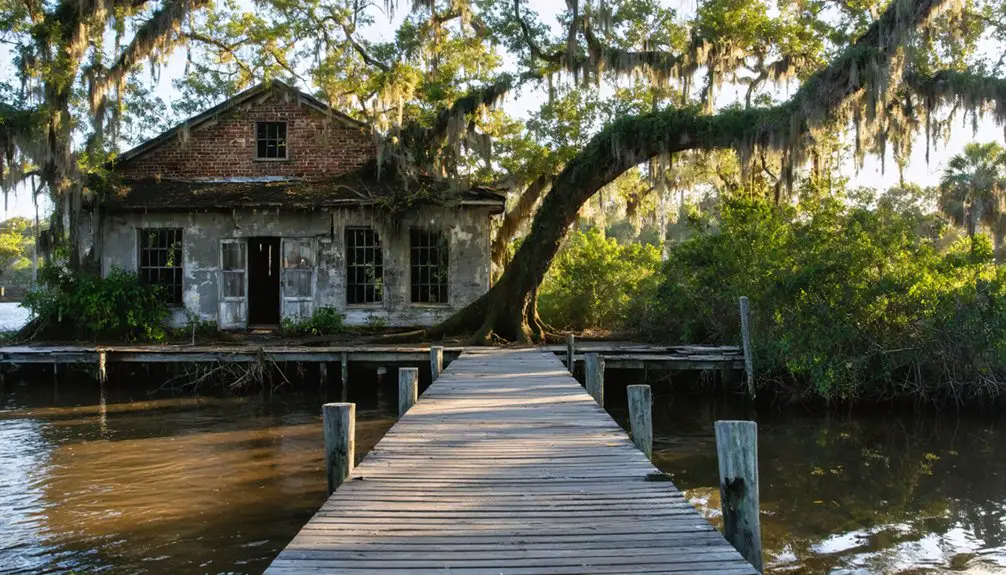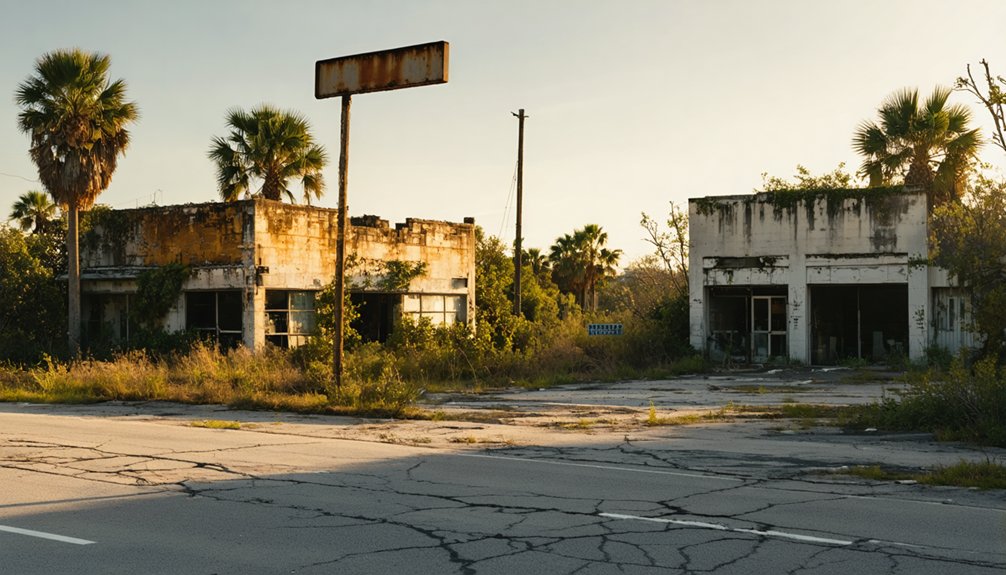
Planning a ghost town road trip to Tillman means heading south on US 1 into Palm Bay, where a forgotten Florida community hides in plain sight. Once a thriving agricultural hub built on banana and citrus groves in the 1880s, Tillman vanished after a devastating 1928 hurricane and economic collapse. Today, St. Joseph’s Church and scattered street intersections are nearly all that remain. Stick around, because Tillman’s full story is far more fascinating than its quiet streets suggest.
Key Takeaways
- Tillman, founded in the 1880s, is a ghost town in Palm Bay, Florida, accessible via US 1 south, then Palm Bay Road.
- The 1928 hurricane destroyed infrastructure and citrus groves, triggering economic collapse and the official revocation of Tillman’s town charter.
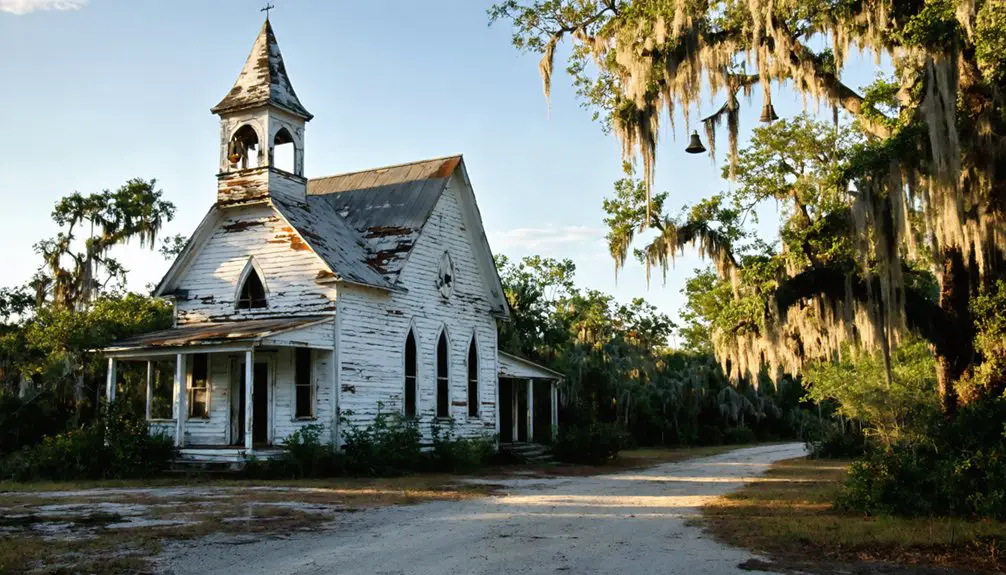
- St. Joseph’s Roman Catholic Church, built in 1913, is Brevard County’s oldest Catholic church in continuous use and a must-visit landmark.
- Located on Miller Street and Pollack Avenue, the Stick-style St. Joseph’s Church is accessible via 2WD roads, ideal for most visitors.
- Canal names and street intersections throughout the area offer subtle historical clues about Tillman’s former significance as a steamboat community.
What Was Tillman Before It Became Palm Bay?
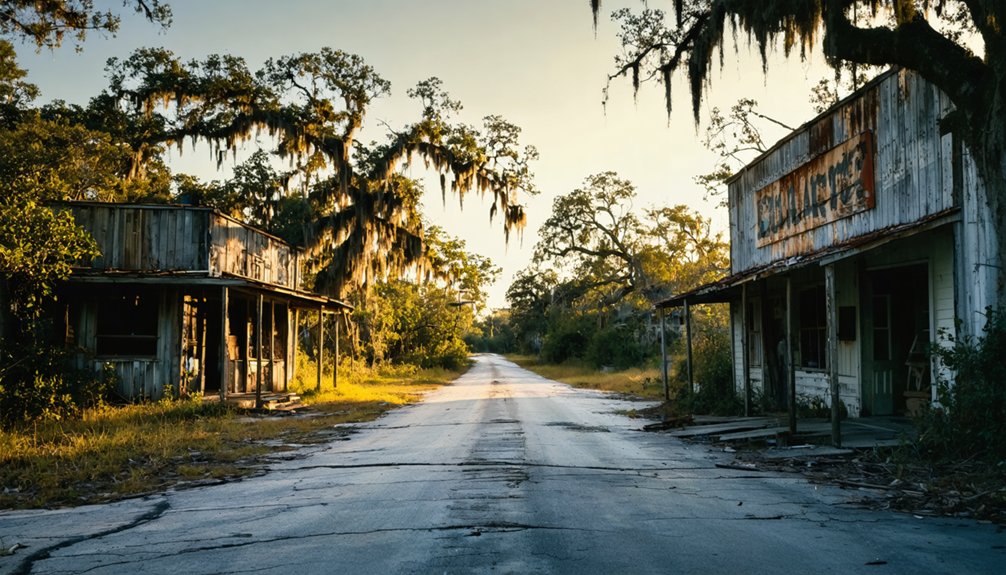
Before Palm Bay became the bustling city it’s today, it was a thriving 19th-century settlement called Tillman, founded in the 1880s by a man named John Tillman who established banana and citrus groves along the shore of Turkey Creek.
Understanding Tillman’s origins reveals a community built on agricultural ambition and strategic geography.
Tillman’s roots tell the story of a people who saw fertile land and flowing water as opportunity waiting to be claimed.
John Tillman’s wharf at the creek’s mouth became a major stop for Indian River steamboats, connecting the settlement to broader trade networks.
Its historic significance grew further when the Florida East Coast Railway extended to the area in 1894, fueling regional economic expansion.
Tillman wasn’t just a quiet farming outpost — it was a dynamic, self-sustaining community that laid the foundation for everything you’ll explore on your road trip today.
How Did Tillman Grow Into a Real Florida Town?
You’ll find that Tillman’s growth was no accident—John Tillman’s banana and citrus groves laid the economic groundwork that made the community worth building around.
When the Florida East Coast Railway extended to the area in 1894, it supercharged development, connecting Tillman to regional markets and drawing new settlers enthusiastic to stake their claim.
The Melbourne-Tillman Drainage District, formed in 1922, pushed the town further by cutting canals through marshland, transforming raw Florida wilderness into productive, livable space.
Early Agricultural Foundations
When John Tillman carved his banana and citrus groves out of the Turkey Creek shoreline in the 1880s, he laid the groundwork for what would become a surprisingly ambitious Florida community.
His citrus cultivation transformed raw Florida wilderness into productive land, attracting settlers who recognized the region’s agricultural potential. That agricultural history shaped everything that followed, drawing investors, settlers, and eventually an entire Catholic colony from North Dakota seeking fresh opportunity.
You can still feel that pioneering energy when you visit the area today.
Tillman’s wharf at Turkey Creek’s mouth became a crucial Indian River steamboat stop, connecting this remote agricultural outpost to broader Florida commerce.
The land fed the town’s ambitions, and those ambitions built something worth remembering and worth exploring on your road trip.
Infrastructure And Community Growth
Agricultural roots fed Tillman’s early ambitions, but it took real infrastructure to transform scattered groves into a functioning town. In 1922, the Melbourne-Tillman Drainage District tackled the marshlands by constructing canals, a critical community infrastructure move that made development actually viable. That urban planning effort opened land previously too wet for settlement or commerce.
Religious life anchored the community’s identity when Father Gabriel Ruppert celebrated the first mass at Joseph Slama’s General Store in 1913. Citizens, unwilling to wait on outside investors, built St. Joseph’s Roman Catholic Church themselves.
How the 1928 Hurricane Erased a Florida Boom Town
When you piece together Tillman’s final chapter, you see a perfect storm of disasters that wiped it off the map.
The 1928 hurricane struck the already-struggling community like a killing blow, following hard on the heels of the 1926 Florida Land Boom collapse, a devastating wildfire, and years of economic decay.
Hurricane’s Devastating Community Impact
The 1928 hurricane didn’t just damage Tillman — it erased it. When the storm struck, it dismantled what little hurricane recovery momentum remained after the 1926 land boom collapse. Community resilience could only stretch so far against compounding disasters.
The hurricane delivered four crushing blows:
- Destroyed infrastructure connecting Tillman to regional trade routes
- Wiped out remaining citrus groves that sustained the local economy
- Displaced residents who never returned to rebuild
- Accelerated charter abandonment, finalizing the town’s political death by 1928
Walking these grounds today, you’re standing where an entire community fought and ultimately surrendered. The storm didn’t arrive alone — it joined a wildfire and the Great Depression in finishing what the land boom’s collapse started.
Tillman never stood a chance.
Economic Collapse Follows Storm
After the 1928 hurricane tore through Tillman, the economy didn’t stumble — it collapsed. The Florida Land Boom had already cracked in 1926, leaving residents scrambling for economic recovery before the storm even struck. When the hurricane hit, it shattered what little remained.
You’d have watched a tight-knit community fight for resilience — rebuilding homes, replanting groves, pushing forward. But nature wasn’t finished. A devastating town wildfire followed, draining whatever resources survivors had managed to reclaim.
Then the Great Depression arrived, delivering the final blow. Businesses shuttered. Families scattered. The town charter, granted just three years earlier in 1925, became meaningless.
Community resilience could only stretch so far against compounding disasters. Tillman didn’t fade — it was systematically erased by forces no frontier spirit could outrun.
Ghost Town’s Final Days
By 1928, Tillman had already been fighting a losing battle — the Land Boom’s collapse in 1926 had gutted the economy, and residents were barely holding on when the hurricane made landfall. The storm didn’t just damage Tillman; it dismantled it.
These final days unfolded through a brutal sequence of events:
- The 1928 hurricane devastated structures and infrastructure
- A town wildfire consumed what remained
- The Great Depression eliminated any recovery capital
- The state revoked Tillman’s town charter entirely
What you’re exploring today as a ghost town wasn’t abandoned overnight — it was systematically stripped of everything that made it viable.
Palm Bay eventually expanded over the ruins, erasing nearly every physical trace. Tillman’s story is a sobering reminder of how quickly freedom, prosperity, and community can vanish.
Is the Tillman Ghost Town Worth Visiting Today?
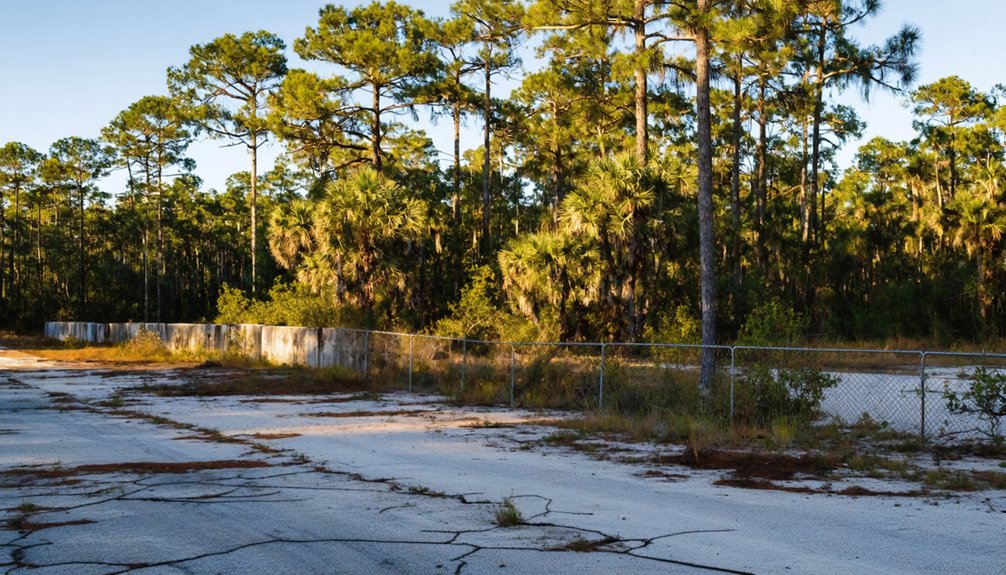
What remains of Tillman today won’t wow you with crumbling ruins or dramatic ghost town scenery, but it still offers a quiet, rewarding experience for history enthusiasts and road trippers.
The ghost town allure here lies beneath the surface, woven into canal names, street intersections, and a surviving church. You’ll find St. Joseph’s Roman Catholic Church at Miller Street and Pollack Avenue, a striking Stick-style structure holding genuine historical significance as Brevard County’s oldest Catholic church in continuous use.
Standing near the Palm Bay Road and US 1 intersection, you can feel the echoes of a once-thriving steamboat community.
If you crave open roads, forgotten stories, and off-the-beaten-path discoveries, Tillman delivers exactly that kind of quiet, meaningful freedom.
How to Reach the Tillman Ghost Town in Palm Bay
Getting to Tillman is straightforward, and that’s part of what makes this ghost town road trip so accessible. Travel US 1 south into Palm Bay, then turn onto Palm Bay Road — your primary access route to the former town center. From there, you’re free to explore at your own pace.
Key stops along your route include:
- Turkey Creek shoreline — where Tillman’s original wharf once stood
- Palm Bay Road and US 1 intersection — the ghost town’s former heart
- Melbourne-Tillman Canal — evidence of Tillman’s drainage history
- St. Joseph’s Roman Catholic Church on Miller Street — one of the area’s most remarkable local attractions
Roads are 2WD accessible, so no special vehicle’s required. Pack your curiosity and claim this forgotten piece of Florida history.
Is St. Joseph’s Church the Last Real Piece of Tillman Still Standing?
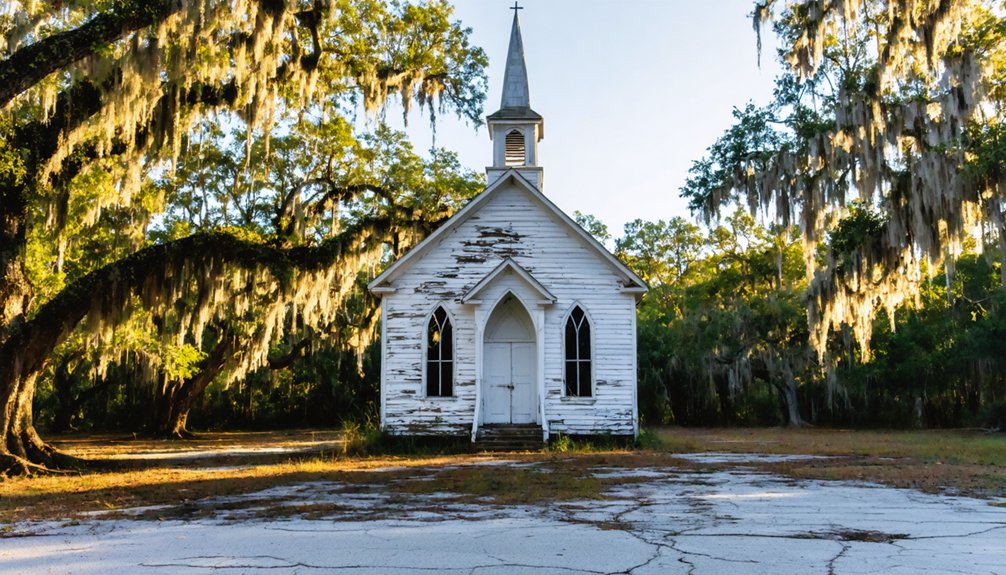
When you stand in front of St. Joseph’s Roman Catholic Church on Miller Street and Pollack Avenue, you’re facing Tillman’s most authentic surviving landmark. Its church history stretches back to 1913, when citizens — not the failed Florida Indian River Catholic Colony — built it themselves. That independence makes it even more meaningful.
The architectural significance here is impossible to miss. The Stick style design stands as a rare, tangible connection to a community that modern Palm Bay fundamentally paved over. It’s the oldest Catholic church in continuous use in all of Brevard County.
While canal names like Melbourne-Tillman Canal offer linguistic echoes of the past, St. Joseph’s gives you something physical to touch, photograph, and experience. It’s not just a remnant — it’s proof Tillman actually existed.
Frequently Asked Questions
What Architectural Style Defines St. Joseph’s Roman Catholic Church in Palm Bay?
You’ll find St. Joseph’s Roman Catholic Church defined by Stick style architecture, carrying immense historical significance as Brevard County’s oldest continuously active Catholic church — a striking landmark that rivals even Gothic Revival grandeur in its timeless, community-built character.
Which North Dakota Colony Attempted to Develop the Tillman Townsite?
Imagine chasing history’s echoes! You’ll discover the Florida Indian River Catholic Colony, hailing from North Dakota, attempted this bold Colony Development by purchasing Tillman’s townsite and groves, though their ambitious venture ultimately failed to flourish.
Who Celebrated the Very First Catholic Mass in Tillman, Florida?
You’ll discover that Father Gabriel Ruppert celebrated the very first Catholic mass in 1913, marking a pivotal moment in Tillman’s significance. He held this historic Catholic history milestone inside Joseph Slama’s General Store.
What Year Did the Melbourne-Tillman Drainage District Form Its Canal System?
Like veins carrying life to dry land, the Melbourne-Tillman Drainage District formed in 1922, shaping drainage history forever. You’ll find its canal significance etched into the landscape, transforming marshlands into something extraordinary for those craving freedom’s open road.
Can Visitors Access the Tillman Ghost Town Site Using a Regular Vehicle?
You’ll love knowing that ghost town accessibility here is hassle-free! Vehicle recommendations confirm you can reach Tillman’s historic site in a regular 2WD car, cruising Palm Bay Road straight to the US 1 intersection without any off-road adventures.
References
- https://www.ghosttowns.com/states/fl/tillman.html
- https://en.wikipedia.org/wiki/List_of_ghost_towns_in_Florida
- https://frontier-florida.blogspot.com/2014/11/utopia-it-wasnt.html
- https://www.youtube.com/shorts/zxthn2tKIOQ
- https://npgallery.nps.gov/GetAsset/79290839-3333-4b55-b786-cc12b3cbb6b2