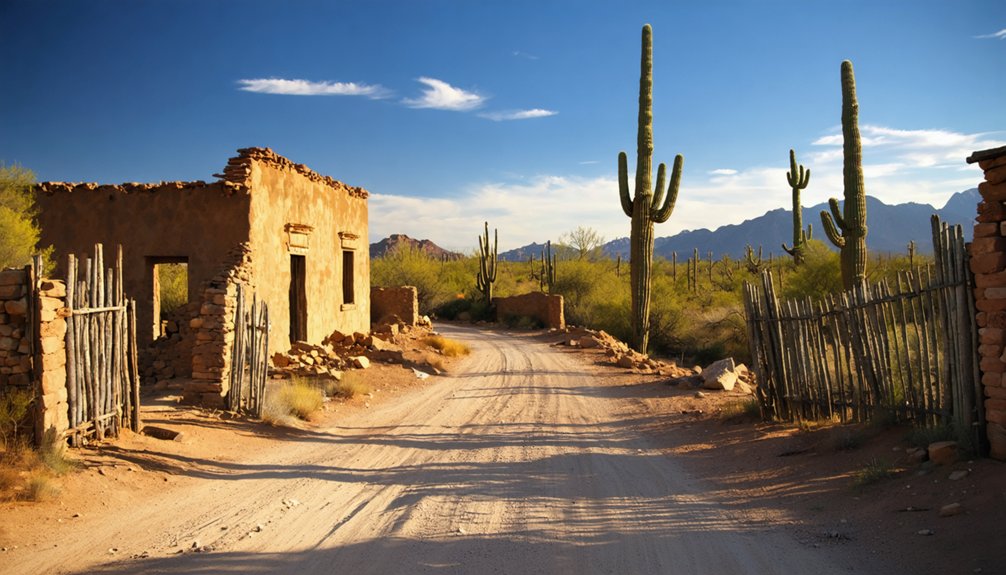
Planning a ghost town road trip to Adamsville, Arizona means heading to Pinal County’s Gila River valley, between Florence and Coolidge. Fred Adams founded this frontier settlement in 1866, and nearly 400 residents once called it home before a catastrophic 1900 flood wiped it off the map. Today, you’ll explore open desert terrain, scattered artifacts, and the haunting A.O.U.W. Cemetery. Visit between October and April for the best experience, and stick around to uncover everything this forgotten town still has to offer.
Key Takeaways
- Adamsville sits along the Gila River’s south bank between Florence and Coolidge in Pinal County, accessible via central Arizona highways.
- The A.O.U.W. Cemetery, containing Fred Adams’ grave and pioneer headstones, is the most identifiable landmark remaining at the site.
- No standing buildings remain; expect open desert terrain, scattered artifacts, and historic markers indicating former structures.
- Visit between October and April to avoid extreme desert heat, which regularly exceeds 100°F from May through September.
- Bring water, offline GPS, sturdy shoes, sun protection, and a first-aid kit, as the remote site offers no services.
What Was Adamsville, Arizona?
Tucked along the south bank of the Gila River in Pinal County, Arizona, Adamsville was one of the region’s earliest pioneer settlements, founded in 1866 by Fred A. Adams. It quickly grew into a rough frontier community, boasting stores, a flour mill, a schoolhouse, and nearly 400 residents at its peak.
You’d have found this place alive with independent settlers carving farmland from the desert using irrigation ditches fed by the Gila. But freedom on the frontier came with danger — shootings and knifings were common.
A devastating 1900 flood wiped out most of the town, scattering survivors to Florence. Today, ghost stories and urban legends surround this forgotten settlement, making it a compelling stop for anyone drawn to Arizona’s untamed, abandoned past.
Where Is Adamsville Located in Pinal County?
Once you know what Adamsville was, finding it on a map becomes the next step in planning your visit. You’ll locate the site in Pinal County, Arizona, on the south bank of the Gila River, sitting at roughly 1,450 feet elevation. It rests between Coolidge and Florence, making it an easy detour if you’re already exploring central Arizona’s open highways.
The surrounding Gila River valley shaped everything about this place — its farming roots, its flood-driven collapse, and the local legends that still draw curious travelers today. Though historical artifacts are scarce after the 1900 flood swept most structures away, the general landscape remains evocative.
Position yourself near Florence, head west, and you’ll find the ghost town’s cemetery marking where this frontier community once stood.
How Did Adamsville Go From Boomtown to Ghost Town?
At its peak in the 1870s, Adamsville bustled with around 400 residents, stores, a flour mill, and a schoolhouse.
But a catastrophic Gila River flood in 1900 wiped out most of the town almost overnight. You can imagine the scene: adobe homes dissolving into muddy water, leaving survivors with little choice but to pack up and relocate to nearby Florence.
The last commercial holdout, the general store, finally closed around 1911, and by 1920, Adamsville existed in name only.
Gila River Flood
How does a thriving frontier town with 400 residents, a flour mill, and a bustling general store vanish from the map? River flooding. In 1900, the Gila River’s devastating town destruction left Adamsville in ruins, washing away the adobe homes and businesses residents had spent decades building.
Here’s what the flood meant for Adamsville:
- Most structures, built from vulnerable adobe, dissolved in the floodwaters
- Surviving residents packed up and relocated to nearby Florence
- The commercial backbone never recovered, with the last general store closing around 1911
- By 1920, the settlement had fundamentally ceased to exist
One flood erased what took a generation to build. That’s the brutal reality of frontier life — nature doesn’t negotiate, and the Gila River proved it decisively.
Residents Flee To Florence
When the Gila River finally receded, Adamsville’s survivors faced a stark choice: rebuild on unstable, flood-prone ground or start fresh somewhere safer. Most chose Florence, the nearby county seat offering stability and opportunity.
The exodus wasn’t immediate, but it was inevitable. The flood had erased adobe homes, buried historical artifacts beneath silt, and shattered the community’s economic foundation. Without residents, businesses couldn’t survive.
The general store held on until around 1911, but by 1920, Adamsville existed only in local legends and fading memories.
Florence absorbed the displaced families, carrying forward stories of frontier life, shootings, and mill days. Today, those local legends draw curious travelers like you to the site, where only a cemetery remains to tell Adamsville’s remarkable, turbulent story.
How to Get to Adamsville From Florence or Coolidge
Adamsville sits between Florence and Coolidge along the south bank of the Gila River, making it an easy detour from either town. You’ll find the site at roughly 1,450 feet elevation, tucked into Arizona’s Pinal County frontier landscape where local legends and traces of pioneer architecture still stir the imagination.
- From Florence, head west along the Gila River’s south bank toward Coolidge.
- From Coolidge, travel east along the same route until you reach the site.
- Watch for the A.O.U.W. Cemetery, your clearest landmark on the ground.
- Bring water, a map, and expect unpaved or rural road conditions near the site.
The drive is short, the history is deep, and the ghost-town atmosphere rewards every curious traveler willing to explore.
What You’ll Actually Find at the Adamsville Site Today?
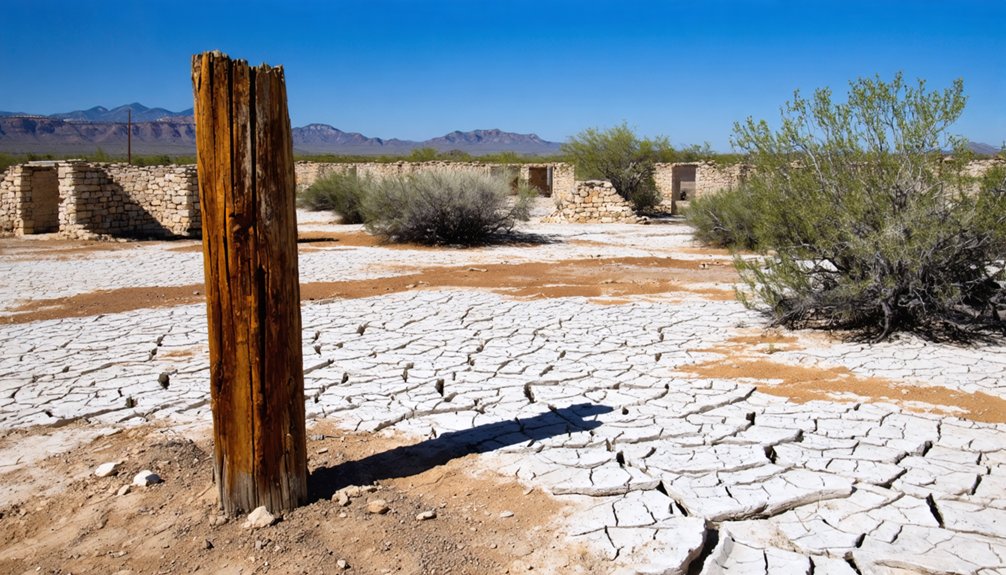
Once you arrive at the Adamsville site, don’t expect standing buildings or a preserved frontier streetscape — the 1900 Gila River flood wiped most of that away long ago. What you’ll find instead is open desert terrain, scattered historical artifacts, and a quiet that speaks louder than most museums.
The A.O.U.W. Cemetery stands as the most tangible remnant, preserving the grave of founder Fred A. Adams himself. Historic markers guide you through where the flour mill, general store, and adobe homes once stood before the river reclaimed them.
Local legends about frontier shootings, early irrigation pioneers, and a rough-and-tumble community add depth to what feels like an empty landscape. For independent travelers, Adamsville rewards curiosity — you’re reading the land itself as the historical record.
The A.O.U.W. Cemetery and Fred Adams’ Grave
When you visit the Adamsville site, the A.O.U.W. Cemetery stands as one of the most tangible connections to the town’s past, with ownership formally deeded to the Ancient Order of United Workmen on May 31, 1894.
You’ll find the grave of Fred Adams himself here, the man who founded Adamsville in 1866, who died in 1910 and was buried in the community he built.
Walking among the pioneer graves, you’re stepping through a rare surviving fragment of a town that a Gila River flood fundamentally erased by 1900.
Cemetery’s Historical Ownership Transfer
Though little remains of Adamsville today, the A.O.U.W. Cemetery stands as a rare, tangible connection to the town’s frontier past. On May 31, 1894, residents officially deeded this burial ground to the Ancient Order of United Workmen, preserving it against the floods and time that erased nearly everything else.
Local legends surrounding this transfer reflect the community’s determination to protect what mattered most.
Here’s what makes this site worth your stop:
- The deed transfer predates the devastating 1900 Gila River flood
- Historic architecture clues survive only through cemetery records and markers
- Fred Adams, the town’s founder, rests here after dying in 1910
- The cemetery remains one of Adamsville’s only authenticated original landmarks
Fred Adams’ Final Resting Place
Nestled within one of Adamsville‘s last surviving landmarks, Fred Adams’ grave in the A.O.U.W. Cemetery marks the final resting place of the man who built this frontier settlement from nothing.
You’ll find his burial site among historical artifacts and weathered headstones that quietly tell the story of Arizona’s territorial past.
Adams founded Adamsville in 1866, shaped its early agricultural identity, and watched it grow to nearly 400 residents before floods and time erased it.
He died in 1910, just years before the town completely vanished.
Local legends surrounding his life and the community he created make visiting his grave feel genuinely meaningful rather than just another roadside stop.
Standing there, you’re connecting directly with the raw, independent spirit that defined early Arizona frontier life.
Visiting The Pioneer Graves
Among the few tangible remnants of Adamsville that survived time and floodwaters, the A.O.U.W. Cemetery stands as your most rewarding stop. Deeded to the Ancient Order of United Workmen on May 31, 1894, it preserves historical artifacts and local legends carved into stone.
Here’s what you’ll find worth exploring:
- Fred Adams’ grave, marking the founder who died in 1910
- Pioneer headstones reflecting Adamsville’s rough frontier identity
- Weathered inscriptions connecting you directly to the 1870s settlement era
- A quiet, open setting between Coolidge and Florence at roughly 1,450 feet elevation
You don’t need a guided tour — just drive out, walk the grounds, and let the silence do the storytelling. This cemetery is Adamsville’s most honest historical artifact.
Pinal County Ghost Towns Near Adamsville Worth Combining
Pinal County hides several ghost town sites worth pairing with an Adamsville visit, and planning them together saves time while deepening your sense of Arizona’s territorial past.
Florence itself sits nearby and offers territorial-era architecture that survived where Adamsville didn’t.
Venture further and you’ll find scattered sites with abandoned buildings that echo the same frontier struggles Adamsville faced along the Gila River valley.
Local legends follow these roads, describing floods, shootings, and stubborn settlers who refused to leave until the land forced them out.
Coolidge sits between Adamsville and Casa Grande, putting you within reach of multiple stops in a single day.
String these destinations together on a flexible route, and you’ll experience Pinal County’s layered pioneer history rather than just one isolated chapter.
Best Time of Year to Visit Adamsville
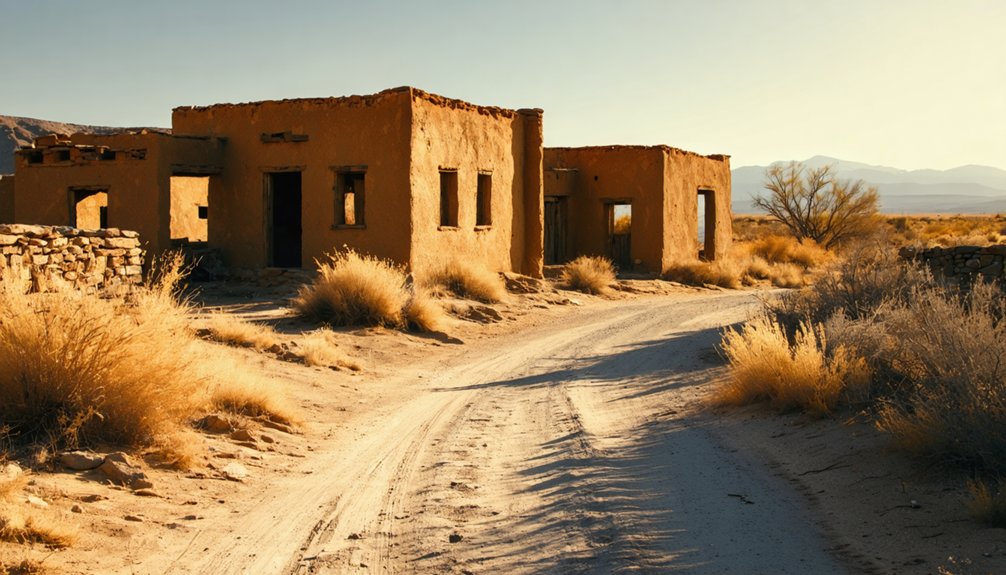
Once you’ve mapped out your Pinal County ghost town route, timing your visit to Adamsville becomes just as important as the route itself. Arizona’s desert heat makes fall through spring your best window for exploring historic architecture remnants and chasing local legends without suffering triple-digit temperatures.
Timing your Adamsville visit matters as much as the route—Arizona’s desert heat makes cooler months non-negotiable.
- October through November offers mild days, low crowds, and golden light perfect for cemetery photography.
- December through February brings cool, crisp air ideal for walking the site comfortably.
- March through April balances warm temperatures with blooming desert landscapes.
- Avoid May through September when Gila River valley heat becomes brutal and potentially dangerous.
You’ll move freely, explore longer, and absorb the frontier atmosphere far better when you’re not battling the sun. Plan your departure from Florence early morning regardless of season.
What to Bring on Your Adamsville Day Trip
Preparing the right gear can make or break your Adamsville day trip, especially since this remote Gila River valley site offers no services, shade structures, or paved paths. Pack plenty of water, sun protection, and sturdy closed-toe shoes for uneven desert terrain.
Visitor safety depends on your preparation, particularly during Arizona’s brutal summer months when temperatures regularly exceed 100°F. Bring a printed map or downloaded offline GPS route, since cell service is unreliable near Coolidge and Florence’s surrounding rural corridors.
Carry a basic first-aid kit and let someone know your itinerary. A camera helps document the A.O.U.W. Cemetery and surrounding landscape without disturbing historical artifacts or grave markers.
Leave everything exactly as you find it — responsible exploration preserves what little remains of this 1866 frontier settlement.
Frequently Asked Questions
Was Adamsville Ever Considered for Pinal County’s Official Seat?
Sadly, no—ghost town legends don’t crown Adamsville as Pinal County’s seat. Yet its historical significance runs deep; you’ll find it was one of the county’s first two towns, shaping Arizona’s frontier forever.
Why Did Residents Keep Using Adamsville’s Name Despite the Sanford Post Office?
Residents kept using “Adamsville” because it’s the name Fred Adams built into the town’s identity. You’ll find that pride in local roots outweighed official labels, shaping the historical landmarks and ghost town attractions you can still explore today.
Did Adamsville Have Any Law Enforcement or Formal Government Structure?
Ironically, you won’t find much Historical law enforcement or Government organization here—Adamsville ran wild with shootings and knifings as frontier “law.” It’s the kind of freedom-loving chaos you’d expect from Arizona’s untamed 1870s pioneers.
What Crops Did Adamsville’s Early Farmers Grow Along the Gila River?
The knowledge doesn’t specify exact crops, but you’d find ancient irrigation systems fueling crop diversity along the Gila River. Early farmers actively harnessed those fertile, free-flowing waters to sustain Adamsville’s growing frontier community through the 1870s.
Are Any Descendants of Fred Adams Still Living in Pinal County Today?
No records confirm Fred Adams’ descendants in Pinal County today. Fire up your laptop for genealogical research—historical family ties to this frontier founder remain untraced, but you might uncover living relatives yourself!
References
- https://en.wikipedia.org/wiki/Adamsville
- https://www.youtube.com/watch?v=0zhxVC9HLw4
- https://www.youtube.com/watch?v=JFS9CsUKpn8
- https://en.wikipedia.org/wiki/List_of_ghost_towns_in_Arizona
- https://www.arizonan.com/ghost-towns/butte-view-adamsville/
- http://www.ghosttownaz.info/adamsville-ghost-town.php
- https://www.youtube.com/watch?v=ddzIlqhVWEA