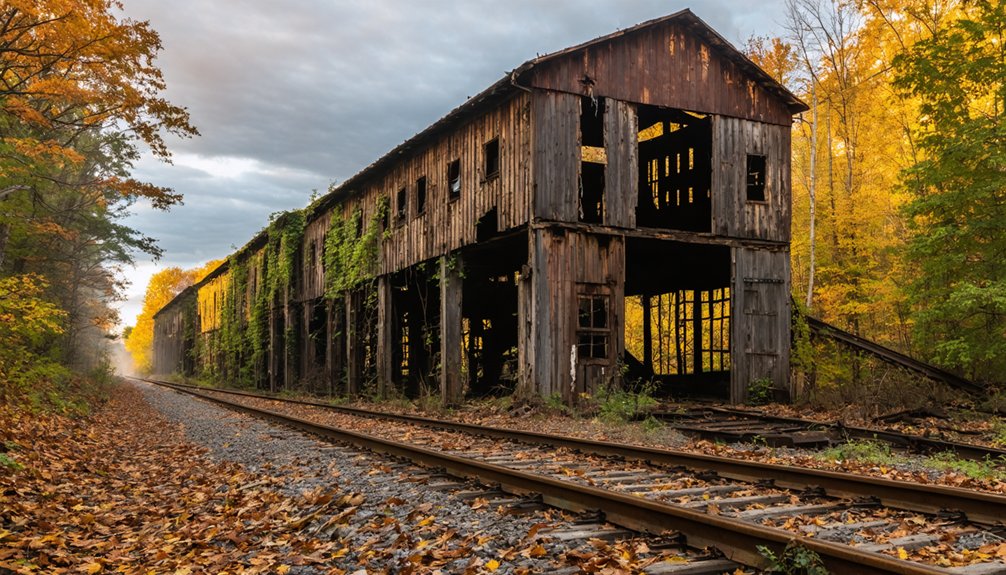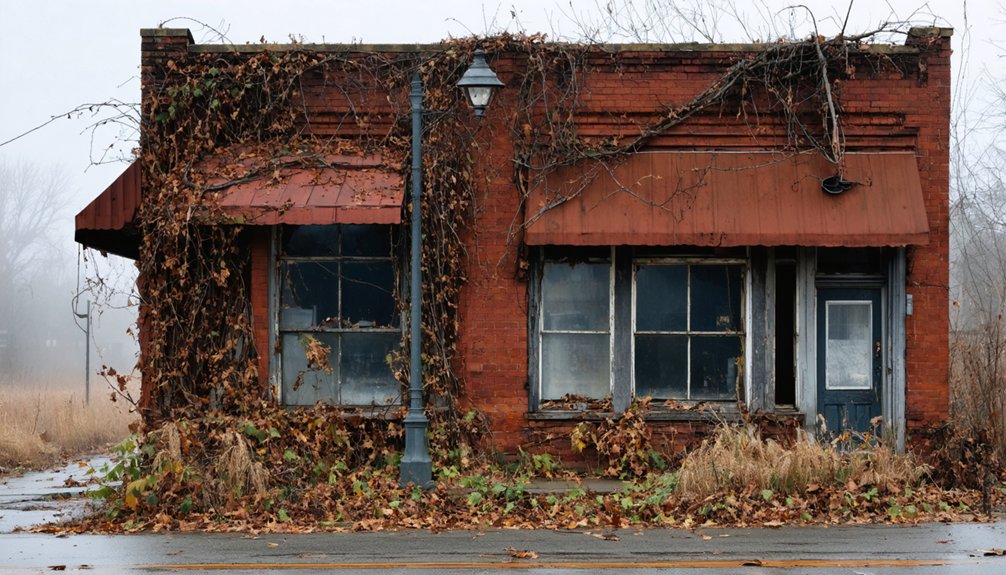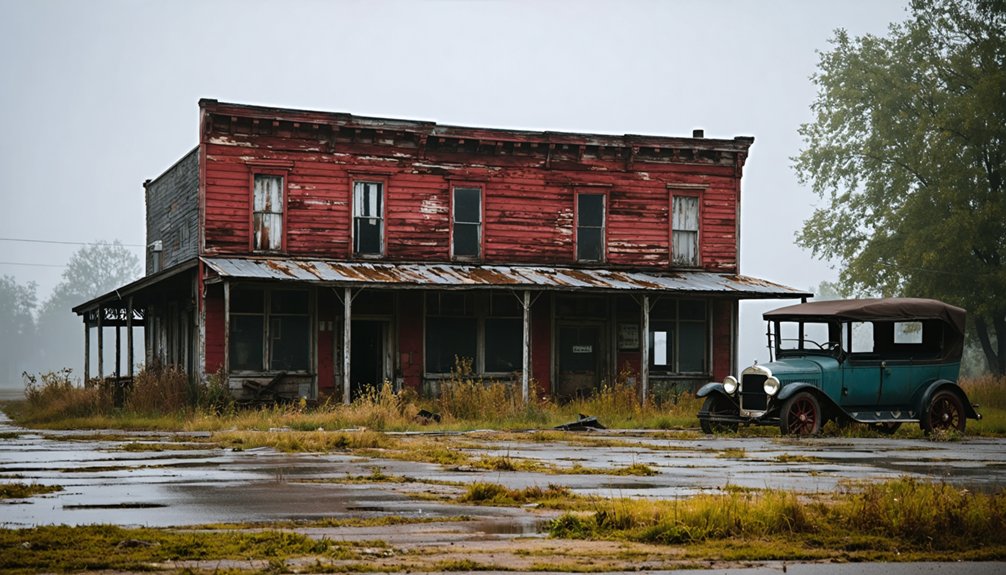
You’ll find Baltimore along State Road 263 in Warren County, where a solitary 1880s brick house and crumbling cemetery headstones are all that remain of Samuel Hill’s once-prosperous river settlement. The town thrived on Wabash River flatboat trade until the 1840s canal opening rerouted commerce and left Baltimore to fade into silence. Plan your visit for October’s golden light, respect the cemetery grounds, and pack sturdy boots for exploring the original 1829 town plat that reveals fascinating stories of frontier ambition and abandonment.
Key Takeaways
- Baltimore is located at coordinates 40°09′57″N 87°26′31″W along State Road 263 near the Wabash River.
- Visit the 1880s brick house and historic cemeteries including Baltimore Cemetery to see founding families’ graves.
- October offers ideal conditions with crisp weather and golden light for photography and exploration.
- Samuel Hill’s 1835 general store and post office thrived until the Wabash and Erie Canal redirected trade routes.
- Plan visits mid-week and follow rural cemetery etiquette when exploring the abandoned town’s remaining landmarks.
Getting to Baltimore: Routes and Directions Along the Wabash River
The ghost town of Baltimore emerges from Indiana’s river-carved landscape at coordinates 40°09′57″N 87°26′31″W, where the western banks of the Wabash River meet the quiet intersection of State Road 263 and County Road 1025 South in Mound Township, Warren County. You’ll find State Road 263 tracing the Wabash’s curves—your main artery to this forgotten settlement.
The river itself stretches 503 miles through Indiana’s heartland, offering river access points from Huntington downstream to the Ohio River confluence. Check seasonal water levels before exploring; the Wabash runs shallow south of Terre Haute due to erosion and silt, with median discharge at 464 cubic feet per second near Wabash.
Baltimore Cemetery and Rodgers Cemetery mark the landscape a quarter mile west, silent witnesses to this vanished community.
What Remains: The 1880s Brick House and Historic Cemeteries
Standing sentinel along State Road 263, a solitary brick house from the 1880s watches over what once thrived as Baltimore, Indiana—a settlement of 70 souls that Samuel Hill and William Willmeth platted in November 1829.
A lone 1880s brick sentinel guards the memory of Baltimore, Indiana—once home to 70 pioneers who shaped Warren County’s forgotten frontier.
You’ll find this two-story survivor embodying architectural significance that transcends its simple construction. While oral history accounts remain sparse, the structure speaks through its endurance:
- Federal-era influences evident in proportions dating 1800-1840
- Brick durability outlasting countless log cabins from the settlement period
- Cemetery grounds preserving faded graves of Baltimore’s founding families
- Samuel Hill’s legacy—his $2,500 merchandise empire reduced to recollection
- Weathered headstones marking the shift from bustling commerce to silence
This tangible connection to Warren County’s vanished past offers you unmediated exploration—no guided tours, just honest remnants revealing their stories on your terms.
Best Time to Visit This Warren County Ghost Town
You’ll want to plan your Baltimore ghost town visit for autumn, when crisp October days bring stable roads and golden light that transforms the 1880s brick house into a photographer’s dream.
Spring’s unpredictable rain can turn County Road 1025 South into a muddy challenge, while summer’s humidity makes cemetery exploration uncomfortably sticky by mid-afternoon.
Check ahead for cemetery access—these rural burial grounds don’t keep formal hours, but locals appreciate visitors who arrive during daylight and respect the quiet dignity of Warren County’s forgotten residents.
Seasonal Weather Considerations
- Spring storms arrive with 50% rain chances and occasional severe weather
- Summer afternoons threaten thunderstorms reaching 60% precipitation likelihood
- Fall delivers the sweet spot: 20-40% rain chance with crisp 62-69°F days
- Winter precipitation turns to ice, restricting access extensively
- Mid-week visits dodge weekend storm peaks
Your best window? Late May through June, or September’s golden foliage season when Baltimore’s abandoned structures glow against autumn skies.
Cemetery Visitation Hours
The crumbling headstones of Baltimore Cemetery wait between dawn and dusk—no formal gates lock you out, but rural cemetery etiquette suggests sunrise to sunset visits. You’ll find no posted hours at this abandoned gravesite on West Baltimore Hill Road, unlike maintained cemeteries nearby that operate 7am–8pm schedules. Cemetery access requirements here are nonexistent; you’re trusted to respect the dead without enforcement.
I’ve wandered these grounds at golden hour when shadows stretch across 1800s markers, feeling that perfect blend of solitude and history. Grave decoration policies? There aren’t any—nature’s reclaimed most plots already. Just park respectfully along the roadside, tread carefully around weathered stones, and leave before darkness falls.
This isn’t Spring Grove’s manicured paths; it’s genuine frontier history.
Photography Lighting Conditions
Why does Baltimore’s abandoned Main Street look most haunted during golden hour? That low-angle sunlight transforms weathered storefronts into cinematic masterpieces, casting dramatic shadows across crumbling facades. You’ll capture the best natural light exposures during those fleeting minutes when warm tones illuminate decay without harsh contrasts.
Consider these lighting strategies for your Warren County expedition:
- Overcast days eliminate shadows, revealing subtle textures in peeling paint and rusted metal
- Blue hour twilight delivers eerie atmosphere with deep sky contrasts
- Spring visits offer balanced day-night progression and vibrant foliage backdrops
- Winter frost enhances compositions during subzero conditions
- Midweek timing guarantees visitor-free shots during ideal windows
Your low light equipment requirements expand after sunset—pack Coast flashlights for light painting and Luxli LEDs to selectively illuminate forgotten doorways and weathered headstones.
The Rise and Fall: From Bustling River Town to Abandoned Settlement
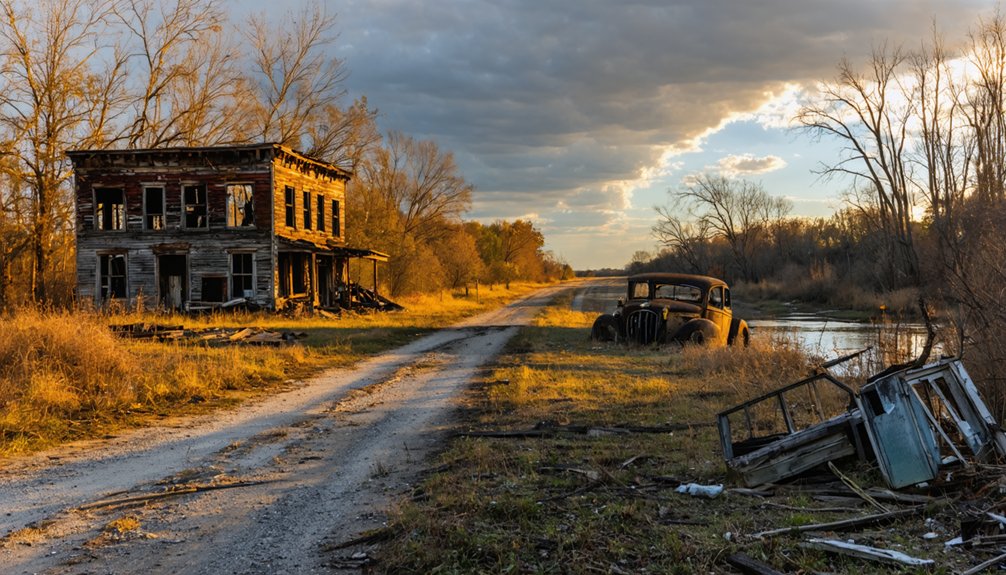
Standing on the Wabash’s western bank in 1835, you’d have witnessed Samuel Hill’s thriving general store—stocked with $2,500 worth of merchandise—serving seventy residents who’d bet their futures on river commerce.
The post office buzzed with activity as flatboats docked regularly, unloading goods that would travel inland along muddy wagon tracks.
Then the Wabash and Erie Canal opened across the river in the 1840s, and everything changed—trade routes shifted, neighbors packed their belongings, and Baltimore’s brief moment of prosperity slipped away like water through a millrace.
Early Prosperity and Growth
Along the banks of the White River in the 1830s, Baltimore, Indiana emerged as one of Hamilton County’s most promising settlements. You’d have witnessed a frontier community capitalizing on its strategic river location, where steamboats carried goods and dreams alike.
The town’s agricultural developments transformed surrounding wilderness into productive farmland, attracting settlers seeking independence from eastern constraints.
Population growth reflected Baltimore’s magnetic pull on pioneers:
- River access enabled direct trade routes to Indianapolis and beyond
- Mill operations processed local grain into marketable commodities
- Taverns and general stores served travelers traversing Indiana’s interior
- Land speculation drew entrepreneurs betting on westward expansion
- Ferry services connected isolated homesteads to emerging markets
This wasn’t just survival—it was calculated prosperity built on transportation, agriculture, and unbridled ambition.
Canal’s Economic Impact
Baltimore’s fortunes seemed unstoppable until 1836, when Indiana’s legislature gambled everything on an audacious infrastructure dream. The Mammoth Internal Improvement Act promised canals connecting every corner of the state, but financial sustainability was pure fantasy.
Construction crews dug frantically—over 10,000 workers at peak—before the money vanished in 1839.
You’ll understand Baltimore’s ghost-town status when you learn about muskrats. Yes, muskrats. They burrowed through the Whitewater Canal‘s earthen walls, causing hundreds of thousands in damages nobody could afford. By July 1841, Indiana declared bankruptcy, crushing international investors who’d bought the bonds.
Despite this spectacular failure, the gamble sparked 400% increases in land values and unexpected economic development. Railroads eventually completed what canals couldn’t, rendering Baltimore obsolete—just another casualty of America’s infrastructure experimentation.
Walking the Original 1829 Plat: Exploring the Town Layout
When you trace the footsteps of Baltimore’s earliest settlers, the 1829 plat serves as your blueprint to a town that once hummed with frontier ambition. James Cunningham’s survey, recorded by proprietors William Willmeth and Samuel Hill, reveals architectural features and town planning influences that defined Indiana’s westward expansion.
Baltimore’s 1829 plat captures frontier ambition frozen in time, where Cunningham’s precise surveying mapped dreams of westward expansion onto Indiana wilderness.
You’ll discover a grid system designed for commerce and community, now reclaimed by nature.
Essential elements to explore:
- Original lot boundaries marking where homes and businesses once stood
- Street alignments following the township and range survey system
- Section numbers guiding you through the General Land Office’s cartographic vision
- Designated commercial zones revealing economic priorities of 1829
- Precise town limits defining Baltimore’s ambitious footprint
Digital archives through Wikimedia Commons let you overlay history onto present-day wilderness, transforming your visit into genuine time travel.
Photography Tips for Capturing Ghost Town Atmosphere

You’ll want to arrive at Baltimore during the golden hours—that magic window when dawn or dusk light rakes across weathered wood and crumbling brick, creating shadows that tell stories the midday sun would flatten into obscurity.
I’ve found that positioning myself low, below eye level, transforms ordinary doorways and sagging rooflines into dramatic compositions that pull viewers into the frame rather than letting them observe from a safe distance. Frame your shots through broken windows or use the remnants of fences as leading lines, curating each scene by shifting just a few feet to eliminate modern distractions like power lines or distant traffic.
Golden Hour Lighting Techniques
The magic of photographing abandoned places lives in those fleeting minutes when golden light transforms decay into art. You’ll want to arrive at Baltimore’s forgotten structures before dawn breaks, giving yourself time to scout compositions without rushed compromises.
As sunset golden hour approaches, watch how warm light cuts through broken windows, illuminating rust and peeling paint with theatrical intensity. The pink hour effects at dusk add surreal color gradients to your sky, contrasting beautifully against skeletal building silhouettes.
Essential techniques for capturing Baltimore’s abandoned essence:
- Bracket your exposures 1 stop apart, combining 3-7 images for balanced HDR results
- Position yourself to create depth using doorways, interior rooms, and distant elements
- Use tripods during low-light phases for sharp details in decaying textures
- Seek vegetation pushing through structures—nature’s reclamation tells powerful stories
- Remove modern distractions from your frame to preserve authentic abandonment
Composition and Framing Elements
Because Baltimore’s crumbling structures offer countless compositional opportunities, mastering how you frame these decaying scenes separates memorable images from forgettable snapshots.
Shoot through broken windows or overgrown vegetation to create partial obscurity—revealing just enough to spark curiosity while maintaining atmospheric tension. Position Baltimore’s isolated buildings using negative space principles, placing structures along rule-of-thirds intersections against vast empty skies to amplify desolation.
Use architectural remnants as natural frames: doorways leading to collapsed interiors, rusted metal fragments bordering forgotten facades. Search for leading lines where cracked sidewalks and sagging rooflines guide viewers deeper into your composition.
Experiment with extreme perspectives—shoot low to exaggerate a building’s haunting scale, or capture reflections in rain-soaked glass. Remove distractions ruthlessly. Each element should intensify Baltimore’s abandoned narrative, not dilute it.
Nearby Attractions and Other Indiana Ghost Towns Worth Visiting
Once you’ve explored Baltimore’s abandoned streets, Southern Indiana beckons with thirteen visitable ghost towns that transform a single-stop curiosity into a full-fledged adventure. You’ll discover Youngs Creek’s haunting footage-worthy ruins, Tunnelton’s eerie remnants, and Aberdeen’s meteorite-marked cemetery where fewer than fifty souls remain. Each location weaves local folklore and legends into crumbling architecture, while nearby hiking trails connect these forgotten settlements.
Must-Visit Ghost Towns Near Baltimore:
- English – Deteriorating structures with accessible pathways
- Greenville – Fascinating pioneer stories embedded in foundations
- Marengo – Strategic roadmap location for multi-town routes
- Borden – Photographic opportunities among decay
- Campbellsburg – Off-the-beaten-path exploration potential
Monument City and Elkinsville represent Indiana’s drowned towns—communities sacrificed to reservoirs, their streets now submerged beneath dark waters.
Respectful Exploration: Cemetery Etiquette and Private Property Guidelines
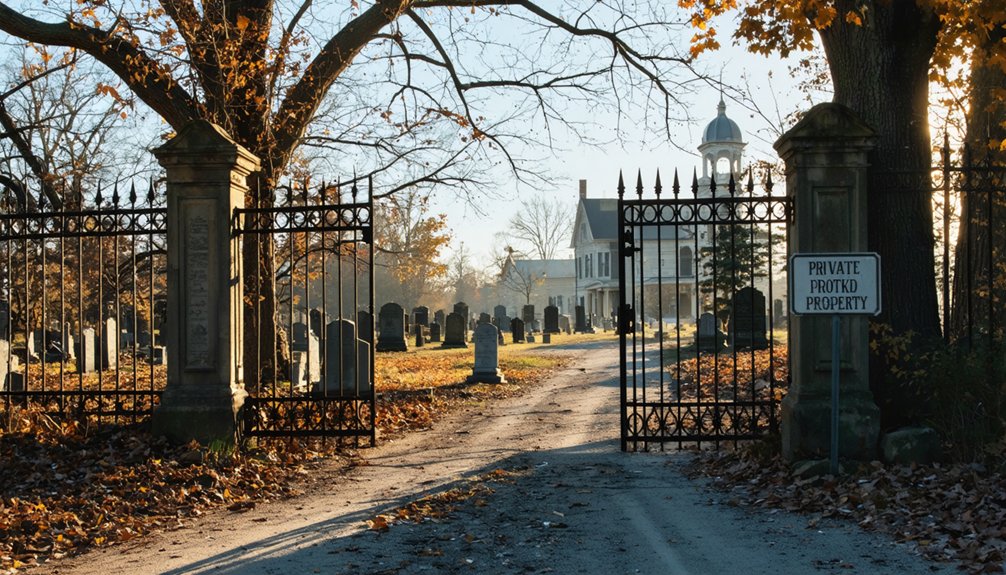
When stepping onto hallowed ground in Baltimore and surrounding ghost towns, you’re entering spaces where Indiana’s forgotten residents rest alongside living memories. Silence your phone and speak softly—funeral etiquette expectations apply even in abandoned places. Stick to pathways between weathered headstones rather than treading directly over graves.
Local archaeological preservation laws protect these sites. You’ll need DHPA approval before removing artifacts, and disturbing human remains requires immediate law enforcement notification. Private family cemeteries demand explicit permission before entry.
Pack out everything you bring in, plus any litter you encounter. If you’re visiting after dusk, secure permission first. Leave decorations and memorials untouched—your curiosity shouldn’t compromise these sacred spaces. Document what you discover through photographs, preserving history without disturbing its physical presence.
Packing Essentials for Your Rural Ghost Town Adventure
After you’ve paid your respects at Baltimore’s weathered cemeteries, your attention shifts from sacred ground to practical matters—namely, what you’ll need to survive Indiana’s backcountry. Rural ghost towns don’t forgive poor planning.
Indiana’s forgotten places demand respect—bring the right gear or risk becoming part of the ghost town’s collection.
Vehicle breakdown kits become lifelines when cell service vanishes—jumper cables, tire gauges, and AAA cards earn their keep on forgotten roads.
Essential gear for Baltimore’s isolation:
- Layered clothing system: Rain jacket, fleece, and hiking shoes for unpredictable terrain
- First aid supplies: Medications, hand sanitizer, and bug spray
- Hydration setup: Reusable bottle plus backup water reserves
- Trail snacks: Nuts, granola bars, and energy-dense foods
- Trunk organizer: Keeps personal comfort items accessible without chaos
Pack like you’re answering to no one but yourself and the open road.
Tracing Baltimore’s History Through County Records and Archives
Baltimore’s paper trail runs cold faster than you’d expect for a town that once mattered. You’ll need to determine which county claims this ghost town first—Indiana’s boundaries shifted, and record-keeping wasn’t anyone’s priority when communities vanished.
The Indiana State Archives in Indianapolis holds scattered references, though fire and flood claimed many county archives repository collections statewide. Your best bet? Contact the Indiana Historical Society before making the trip. They’ll point you toward surviving family genealogy records and land abstracts.
Don’t expect digital databases—much of Baltimore’s story exists only in crumbling ledgers and handwritten deeds, if it exists at all. Sometimes the absence of records tells its own story about places the world forgot.
Frequently Asked Questions
Are There Any Restrooms or Facilities Available Near the Baltimore Ghost Town Site?
You’ll find limited facilities at Baltimore’s ruins, so plan ahead. Pack essentials and scout parking options beforehand. Nearby dining establishments in larger towns offer restrooms—think roadside diners where locals gather. Embrace the adventure; self-sufficiency defines true exploration.
Is Overnight Camping Permitted Near the Historic Baltimore Town Location?
Overnight camping isn’t permitted at Baltimore’s historic site itself, but you’ll find designated campgrounds along nearby hiking trails. Check with local historical societies—they’ll point you toward legal spots where you can pitch your tent freely and explore independently.
Can Visitors Enter the 1880S Brick House or Is It Privately Owned?
The 1769 Funk House remains Baltimore’s oldest dwelling with historical significance as the town founder’s home. Unfortunately, you can’t explore its Colonial-era architectural features inside—it’s privately owned, though you’ll appreciate its exterior brick craftsmanship from the street.
Are There Any Guided Tours Available for Baltimore and Surrounding Ghost Towns?
No formal guided tours exist for Baltimore, Indiana’s ghost towns. You’ll explore through self-guided tours, following historical markers that dot the landscape. It’s raw, unscripted freedom—just you, crumbling foundations, and stories waiting to be discovered independently.
What Cellular Reception Should I Expect in This Rural Warren County Area?
You’ll find spotty cell tower coverage in rural Warren County, with AT&T offering the most reliable data speeds at 45.6 Mbps. Expect service gaps between towns—I’d recommend downloading maps offline before exploring these remote ghost town routes.