Planning a ghost town road trip to Blaine, Kansas means discovering a place that refuses to fully disappear. Founded by Irish Catholic settlers in 1873 along the Oregon Trail, Blaine once thrived as a railroad boomtown before rail abandonment and a post office closure in 1976 sealed its fate. Today, around 30 descendants still call it home. Take Route 99 north from Westmoreland, and you’ll find a town with far more stories left to tell.
Key Takeaways
- Blaine, Kansas, founded in 1873 by Irish Catholic settlers, offers a unique ghost town experience along the historic Oregon Trail.
- Take Route 99 from Westmoreland for a scenic, accessible drive requiring no special vehicle equipment or off-road capability.
- St. Columbkille Catholic Church, built in 1908, remains an active landmark, hosting weekly mass and symbolizing the town’s enduring community spirit.
- Plan a full day to explore Blaine and nearby ghost towns like Duluth, Flush, and Fostoria using a county map.
- Blaine has limited services, so prepare accordingly, respect the local community, and prioritize independent travel over packaged tourism options.
Why Blaine, Kansas Is Worth the Ghost Town Drive?
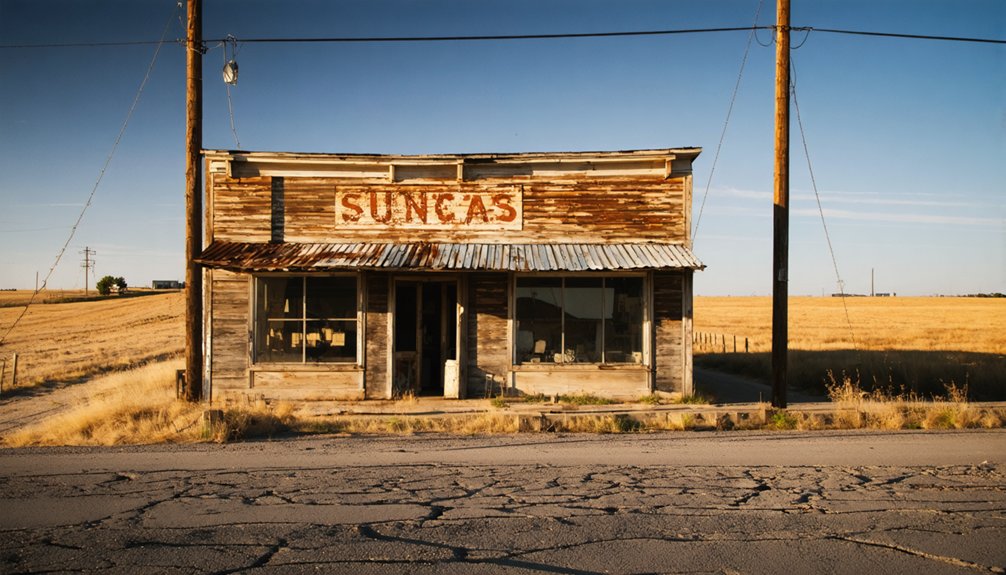
When most ghost towns offer little more than a crumbling foundation and a weathered historical marker, Blaine, Kansas delivers something far more compelling.
You’ll find a living thread of Blaine Heritage woven through a striking Gothic-style Catholic church that still holds weekly mass, original homesteads that remain standing, and descendants of the town’s founding Irish settlers who never left.
The Historical Significance here runs deep. Irish Catholic families carved this community from the Kansas prairie in 1873, building something lasting along the Oregon Trail.
Irish Catholic settlers didn’t just survive the Kansas prairie in 1873 — they built something that still endures.
Railroads, stagecoaches, and frontier commerce once pulsed through this small town.
Blaine isn’t just abandoned — it’s quietly surviving. For road trippers who value authentic history over staged experiences, that distinction makes every mile up Route 99 genuinely worthwhile.
How Blaine Went From Railroad Boomtown to Forgotten Prairie
When you look at Blaine’s early years, you see a town that once hummed with real railroad energy — the Kansas Central Railway and the Kansas, Southern & Gulf Railway both ran through, pushing the population toward 200 residents and supporting a daily stagecoach to Louisville.
Then the lines went quiet: the interurban tore up its tracks in 1915, and the Kansas Central folded entirely by 1934, stripping away the economic backbone that had kept the town alive.
Today, roughly 30 descendants of those original Irish Catholic settlers remain, holding the line against a prairie silence that’s swallowed nearly everything else.
Railroad Boom Days
Once the railroad arrived, Blaine buzzed with the kind of raw, ambitious energy that only a frontier boomtown could generate. The Kansas Central Railway’s narrow-gauge line threaded through town, and Union Pacific’s station put Blaine on the map.
That railroad history translated directly into economic impact — merchants, settlers, and stagecoach routes all converged here, pushing the population toward 200 residents.
You’d have witnessed daily stagecoaches rolling toward Louisville in 1885, goods moving freely, and a community believing it had a permanent future. The Kansas, Southern & Gulf Railway even connected Blaine to nearby Westmoreland.
But railroads that build towns can also abandon them. Lines were standard-gauged, sold, and eventually torn up by 1915 and 1934, stripping Blaine of the lifeblood that once made it thrive.
Population Decline Begins
As the rails fell silent and the stagecoaches stopped rolling, Blaine’s population began bleeding out slowly but steadily. You can trace these population shifts through hard numbers: from a peak of roughly 200 residents down to today’s 30 or so souls, mostly descendants of those original Irish Catholic families.
When the Kansas Central Railway abandoned its line in 1934, it effectively severed Blaine’s economic lifeline. The post office held on until 1976, but its closure marked the town’s quiet surrender to time.
What survives is community legacy — families who refused to leave, homes still standing on the Kansas prairie, and St. Columbkille Catholic Church still holding weekly mass.
Blaine didn’t vanish completely; it simply downsized into history.
Prairie Silence Remains
Blaine’s transformation from railroad boomtown to prairie ghost town didn’t happen overnight — it unraveled thread by thread across several decades. The Kansas Central Railway abandoned its line in 1934, and the interurban railway had already been torn up by 1915.
Without reliable rail service, commerce dried up and residents drifted toward larger towns. The post office closed in 1976, effectively severing Blaine’s last institutional lifeline.
What you’ll find today are prairie echoes of a once-thriving community — roughly 30 descendants of original Irish Catholic settlers still call it home. The historical remnants include several standing homes and the striking 1908 St. Columbkille Catholic Church, still holding weekly mass.
Blaine technically exists on Kansas maps, but the railroad energy that once defined it’s long gone.
Getting to Blaine, Kansas via Route 99 North
To find Blaine, you’ll head north on Route 99 out of Westmoreland, a straightforward drive through the rolling Kansas prairie of northern Pottawatomie County.
The route traces the same general corridor as the historic Oregon Trail, adding a layer of frontier history to your windshield views.
Keep your eyes sharp — Blaine’s small cluster of remaining homes and the striking red brick St. Columbkille Catholic Church appear before you know it.
Route 99 North Directions
Getting to Blaine takes just one simple turn: head north on Route 99 from Westmoreland, and you’ll find yourself rolling through the quiet, windswept landscape of northern Pottawatomie County.
The road cuts through open farmland, offering scenic views that stretch endlessly toward the horizon — the kind of wide-open freedom that makes you glad you left the city behind. You’ll travel roads accessible by standard 2WD vehicle, so no special equipment is necessary.
Keep your eyes open as you drive; this stretch of Kansas countryside follows the historic Oregon Trail corridor, layering your journey with genuine historical weight.
Blaine sits quietly just north of Westmoreland, easy to reach yet feeling like a world apart — a forgotten pocket of American history waiting for you to discover it.
Nearest Towns Along Route
As you head north on Route 99, Westmoreland serves as your natural launching point — a small but functioning town where you can fuel up, grab supplies, and get your bearings before venturing into the quieter countryside ahead.
From there, the landscape opens up, guiding you deeper into Pottawatomie County’s rural heart.
Along the way, keep an eye out for scenic detours that connect you to other extinct communities like Duluth, Flush, and Fostoria — each worth a quick exploration.
These nearby attractions add real depth to your road trip, turning a simple drive into a layered journey through Kansas’s forgotten past.
The Oregon Trail also cuts through this northern stretch of the county, offering natural historic stops between towns.
St. Columbkille Church: The Red Brick Heart of a Vanished Town
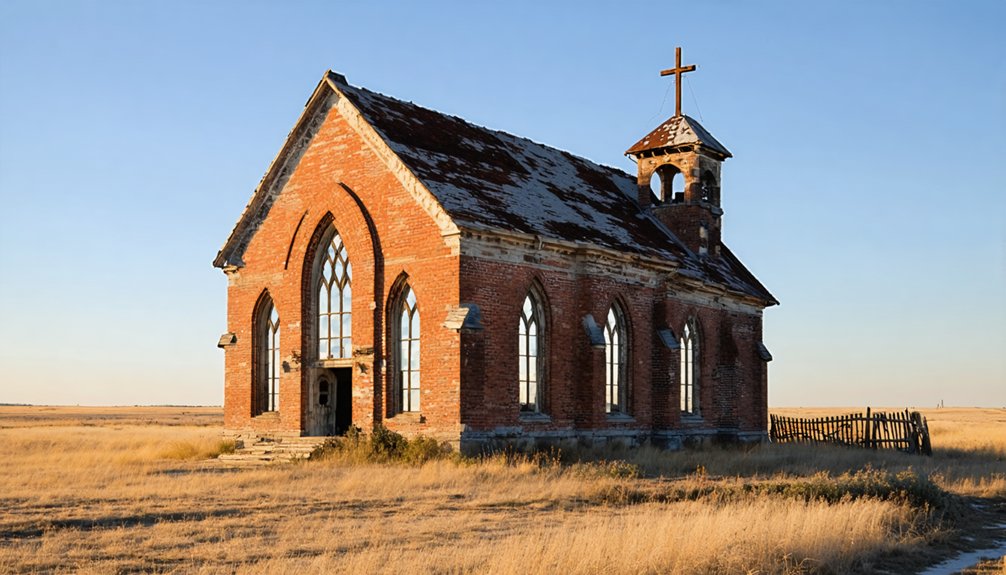
Standing along Route 99 in what remains of Blaine, Kansas, St. Columbkille Catholic Church commands your attention immediately. Built in 1908, this red brick gothic-style landmark replaced the original 1881 structure, anchoring St. Columbkille History to the 60 Irish Catholic families who settled here in 1873.
Its Architectural Significance goes beyond aesthetics. In a town where the post office closed in 1976 and the population dwindled to roughly 30 residents, this church still holds weekly mass.
It’s a living monument refusing to surrender to time. You’ll find it’s more than a building — it’s proof that community endures even when everything else fades.
Explore it freely, photograph it honestly, and respect the small but dedicated congregation still calling Blaine home.
What’s Left to See in Blaine Today?
Beyond the church’s red brick walls, Blaine still offers a handful of quiet discoveries worth your time. Several original homes remain standing, giving you a tangible sense of Blaine History that most ghost towns can’t provide.
You’re walking through living community heritage here — descendants of those original 60 Irish Catholic families still call this place home.
Blaine still appears on Kansas maps, so finding it isn’t a treasure hunt. Travel north on Route 99 from Westmoreland, and you’ll spot it easily.
While you’re exploring, connect your visit to nearby Oregon Trail historic sites scattered throughout Pottawatomie County. You can also hit other extinct towns like Duluth, Flush, and Fostoria nearby, making this a full day of authentic, off-the-beaten-path Kansas exploration.
Ghost Towns Near Blaine, Kansas Worth the Detour
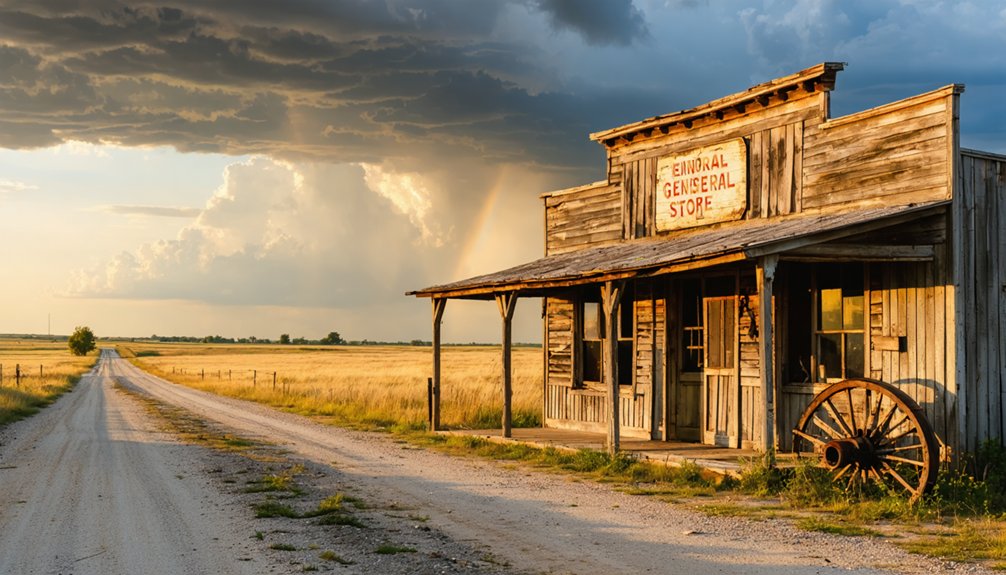
Once you’ve soaked in everything Blaine has to offer, the surrounding Pottawatomie County countryside rewards curious travelers with more ghost town discoveries just a short drive away.
Duluth, Flush, and Fostoria each carry their own ghost stories and scattered historical artifacts waiting for you to uncover. These forgotten settlements share Blaine’s railroad-era roots, giving you a richer picture of how ambition and geography shaped — then abandoned — entire communities.
Duluth, Flush, and Fostoria — forgotten settlements where railroad-era ambition quietly collapsed, leaving only ghost stories and scattered artifacts behind.
You won’t need anything beyond a reliable 2WD vehicle and a solid map to reach them. Pair these stops with the Oregon Trail historic sites threading through northern Pottawatomie County, and you’ve built yourself a full day of authentic exploration.
This region rewards the independently minded traveler who prefers discovery over packaged tourism.
Follow the Oregon Trail Through Pottawatomie County While You’re Here
Blaine’s position along the Oregon Trail means you’re already standing on ground that pioneers crossed long before Irish Catholic settlers arrived in 1873.
That historical layering makes Pottawatomie County worth exploring beyond Blaine itself. The Oregon Trail cuts through northern Pottawatomie County, leaving behind historic landmarks and documented routes you can still trace today.
You’re not just visiting a ghost town — you’re moving through one of America’s most significant migration corridors. Pack a county map, identify the marked trail segments, and drive the stretches where wagon ruts once carved the landscape.
Combine this with your stops at extinct towns like Duluth, Flush, and Fostoria for a road trip that connects railroad history, immigrant settlement, and westward expansion into one coherent, deeply American journey.
What to Know Before You Drive Out to Blaine
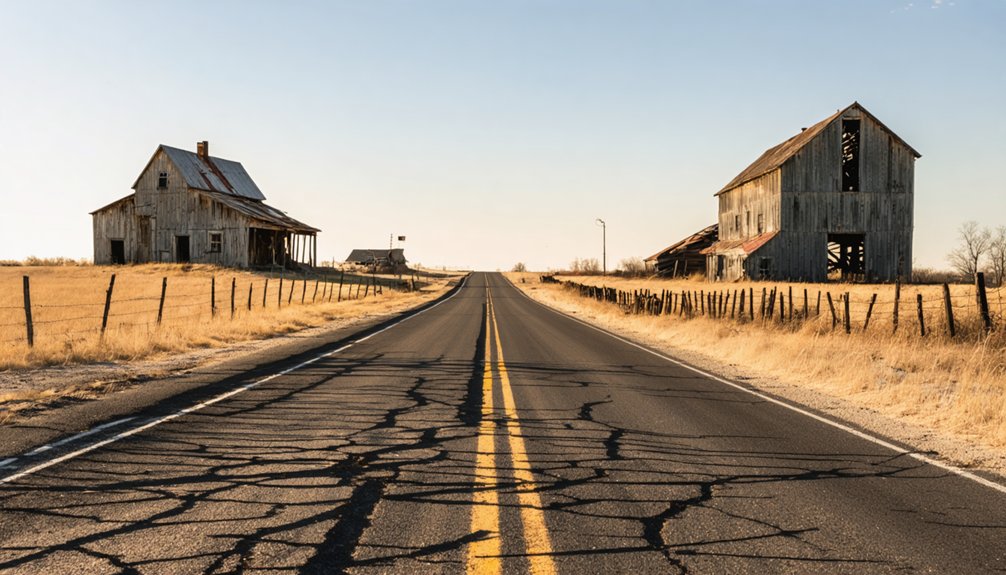
Before you load up the car and head north on Route 99, there are a few practical things worth knowing about Blaine. The roads are accessible by standard 2WD vehicles, so no off-road rig is necessary for your prairie exploration.
About 30 residents still call Blaine home, mostly descendants of the original Irish Catholic settlers, so treat the area respectfully. St. Columbkille Catholic Church still holds weekly mass, meaning Blaine’s heritage remains genuinely alive rather than purely historical.
The post office closed in 1976, and the town is unincorporated, so don’t expect services or facilities.
While you’re in northern Pottawatomie County, nearby extinct towns like Duluth, Flush, and Fostoria make excellent additions to your route, stretching your adventure further across the open Kansas landscape.
Frequently Asked Questions
Who Was Father Thomas Ambrose Butler, Blaine’s Original Namesake?
Ever wondered about Butler’s Legacy? Father Thomas Ambrose Butler was a Catholic priest whose Historical Influence shaped Blaine’s roots — you’ll find his name honored the town’s Irish Catholic founding community in 1873.
Why Did Blaine’s Post Office Close After Operating for Over 100 Years?
The post office history mirrors Blaine’s community decline — you’ll find it closed in 1976 as the population dwindled to around 30 residents, leaving this once-thriving railroad town a fascinating ghost town worth exploring.
Are the 30 Remaining Residents Descendants of the Original Irish Settlers?
You’ll find that most of Blaine’s roughly 30 remaining residents carry deep Irish heritage and strong community ties, descending from those original 60 Catholic families who settled, survived, and shaped this enduring Kansas ghost town together.
What Happened to the Kansas, Southern & Gulf Railway Infrastructure After 1915?
After 1915, you’ll find the railway decline left little behind—workers tore up the Kansas, Southern & Gulf Railway’s tracks, erasing its infrastructure legacy and freeing the land back to the open, untamed Kansas countryside you can still explore today.
Was Blaine Ever Considered for Incorporation as an Official Kansas City?
While records don’t confirm formal incorporation attempts, Blaine’s historical significance and peak population of 200 suggests you’ll find a town that carried real community legacy, even if it never officially pursued city status.
References
- https://www.ghosttowns.com/states/ks/blaine.html
- https://legendsofkansas.com/blaine-kansas/
- https://en.wikipedia.org/wiki/Blaine
- https://legendsofkansas.com/pottawatomie-county-extinct-towns/