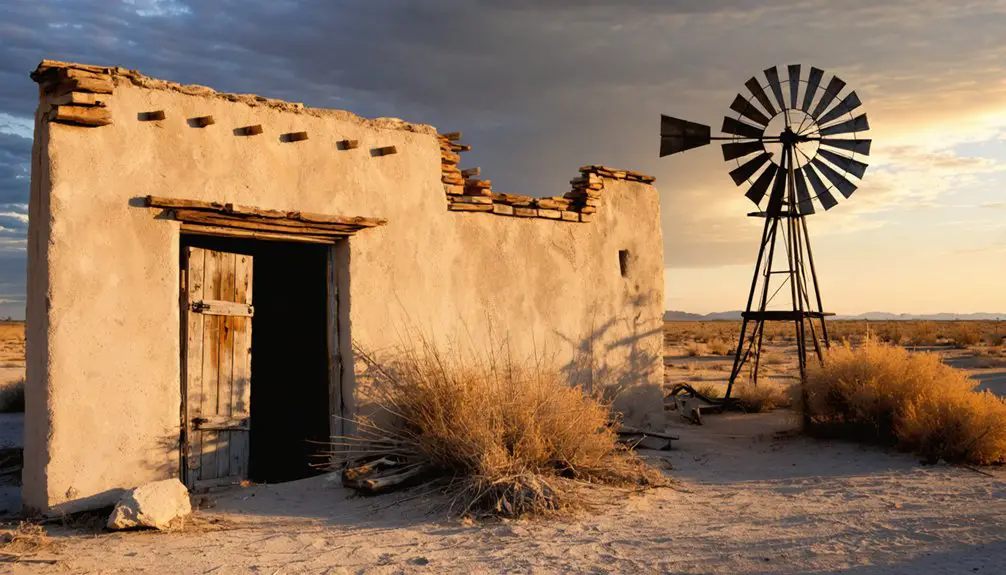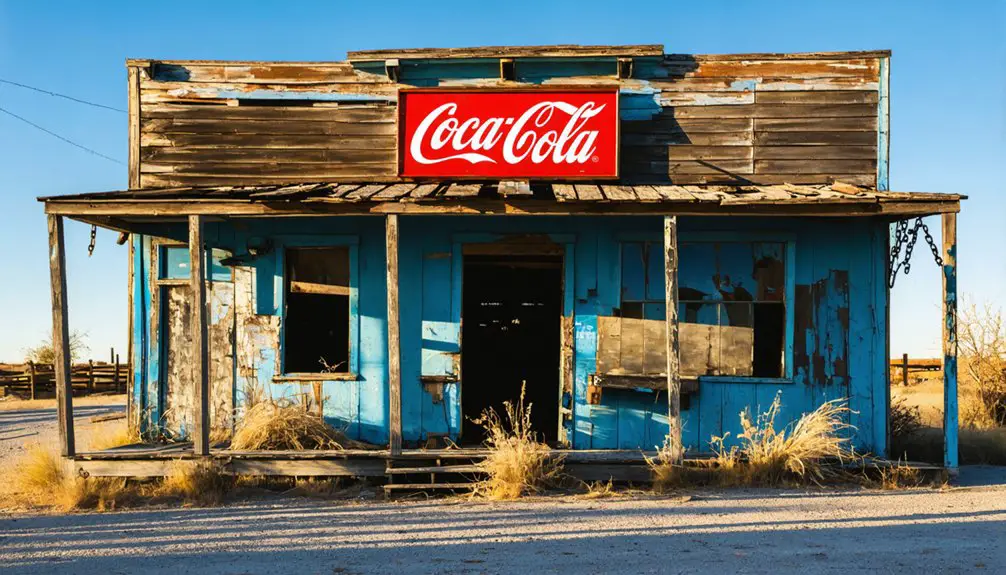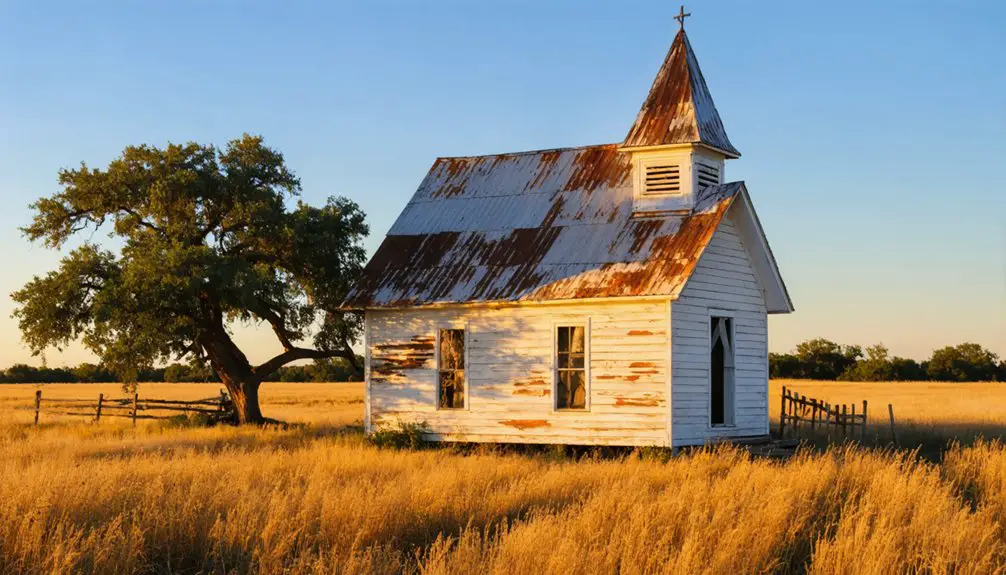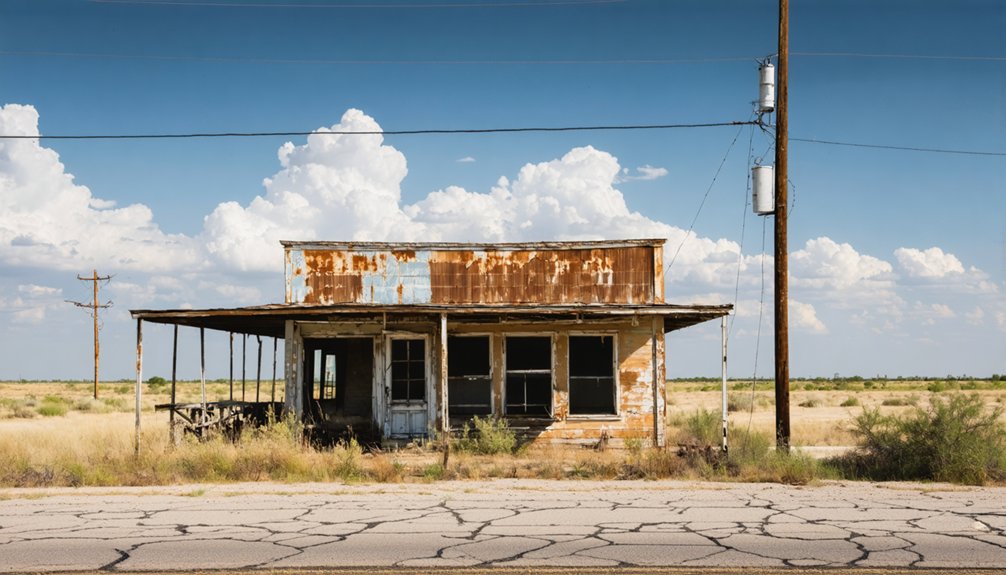
Carlton, Texas sits about 85 miles southwest of Fort Worth, and it’s the kind of ghost town that still breathes. Around 70 residents share space with a crumbling abandoned bank, a decaying cotton gin, and a single blinking red traffic light that feels frozen in time. Take US-281 South through Stephenville, then shift onto FM 219 toward Hamilton. Plan your visit in October for the best atmosphere, and there’s far more to this haunted stretch of Central Texas than you’d expect.
Key Takeaways
- Carlton, Texas, lies roughly 85 miles southwest of Fort Worth; take US-281 South through Stephenville, then FM 219 toward Carlton.
- Visit in October for cooler temperatures, atmospheric lighting, and a genuinely eerie ghost town experience without summer heat.
- Key highlights include an abandoned bank with original vault, crumbling cotton gin ruins, and historic stone storefronts.
- Carlton has 70 residents; respect private property, obtain permission before accessing structures, and observe from public roads.
- Pack sturdy boots, a wide-angle camera, water, snacks, a flashlight, and download offline maps before departing.
What Makes Carlton, Texas a True Ghost Town?
Carlton, Texas checks nearly every box for ghost town characteristics — a dwindling population of around 70 residents, crumbling storefronts, and a single blinking red traffic light that seems more like a warning than a welcome.
You’ll find an abandoned bank still housing its original vault, a decaying cotton gin, and stone-and-mortar stores frozen mid-collapse near the crossroads.
Carlton’s historical significance runs deep. Founded in the 1870s alongside a railway boom, it once thrived as a cotton outpost before the boll weevil, the Great Depression, and railway abandonment stripped it bare.
By 1980, the population had fallen to 70 and never recovered. One post office, a repurposed church, and a handful of sagging homes are all that remain.
This place isn’t performing abandonment — it’s living it.
How to Get to Carlton From Fort Worth
If you’re starting your ghost town road trip from Fort Worth, you’ll head southwest on US-67, covering roughly 85 miles through the heart of Central Texas.
Follow the highway through Comanche County until you pick up Texas FM Roads 219 and 1744, which intersect at Carlton’s crossroads.
Once you spot the single flashing red traffic light, you’ve arrived at what little remains of this faded cotton town.
Starting Point: Fort Worth
About 85 miles southwest of Fort Worth, Carlton sits frozen in time, and getting there’s half the adventure. You’ll head out on US-281 South, cutting through the rolling Central Texas landscape before turning onto FM 219.
The drive itself carries a quiet, open-road freedom that sets the tone for what’s ahead.
You’re not just chasing ghostly encounters — you’re tracing a route through genuine historical significance, passing through small towns that tell their own stories of boom and bust.
The roads grow narrower, the towns sparser, and the horizon wider the closer you get.
Plan roughly two hours from Fort Worth, fuel up before leaving Stephenville, and bring a camera.
Carlton won’t advertise itself — you’ll simply arrive at a crossroads and know you’ve found it.
Key Highways To Take
From Fort Worth, you’ll take US-281 South as your primary artery, threading through Stephenville before the landscape opens into Hamilton County‘s quieter stretches.
This highway route carries you roughly 85 miles southwest, where rolling plains replace urban sprawl and the road feels genuinely yours.
Near Hamilton, shift onto FM 219 heading west. This two-lane stretch delivers you directly to Carlton’s crossroads at the junction of FM 219 and FM 1744.
Keep your tank full before leaving Stephenville — gas stations thin out considerably along these final miles.
A few travel tips worth noting: download offline maps before departing, since cell coverage becomes unreliable past Hamilton.
Morning departures work best, giving you maximum daylight to explore the abandoned structures safely and photograph the ghost town’s haunting, sepia-toned atmosphere.
Arriving At Carlton
Once you’ve left Fort Worth behind, the roughly 85-mile drive southwest to Carlton unfolds in three distinct stages — urban sprawl giving way to open highway, then open highway surrendering to quiet backroads.
You’ll merge onto US-67 South, cutting through Granbury before picking up TX-144 toward Hamilton County. Eventually, FM 219 and FM 1744 converge at Carlton’s crossroads — that’s your destination.
You’ll know you’ve arrived when a single flashing red traffic light greets you like a sentinel guarding a forgotten era.
The historical significance of this intersection runs deep; it once anchored a thriving cotton economy. Today, it sets the stage for ghostly encounters among crumbling storefronts and silent ruins.
Park near the crossroads, step out, and let Carlton’s unsettling atmosphere wash over you.
The Abandoned Buildings Worth Seeing in Carlton
When you reach Carlton’s crossroads, you’ll find an abandoned bank building still housing its original vault, now oddly sharing space with a part-time upholstery shop.
Just beyond it, the old cotton gin‘s skeletal frame leans under its own weight, stripped of machinery but still telling its story.
Stone and mortar storefronts line the intersection in various stages of collapse, their crumbling facades offering a raw, unfiltered glimpse into Carlton’s once-thriving commercial past.
The Abandoned Bank Building
Standing at the heart of Carlton’s crossroads, the abandoned bank building is easily the most striking relic you’ll encounter on your visit. This piece of abandoned architecture tells Carlton’s story better than any history book could. The vault still stands intact, a steel monument to the prosperity that once defined this cotton outpost.
What makes this stop particularly fascinating is its unexpected transformation — someone converted part of the structure into a part-time upholstery shop, blending commerce with decay in a distinctly Texan way.
As you wander through, don’t be surprised if you experience a few ghostly encounters; local folklore warns of unexplained presences throughout Carlton. Whether you believe the stories or not, the building’s atmosphere makes you feel like you’ve genuinely stepped back in time.
Former Cotton Gin Ruins
Just a short walk from the bank building, the former cotton gin ruins offer a haunting glimpse into Carlton’s agricultural past. Once the beating heart of the town’s cotton history, this structure processed the crops that drove Carlton’s early prosperity.
Now, stripped of its machinery, the hollow shell stands as a raw monument to industrial decline.
You’ll notice the building’s bones — weathered timber, crumbling walls, and open gaps where heavy equipment once roared. Nothing inside suggests its former purpose except the structure itself. That absence hits differently than a museum ever could.
Wander through carefully, taking in how completely time has reclaimed this place. Carlton’s rise and fall played out right here, and standing inside these ruins, you’ll feel every decade of it.
Historic Stone Storefronts
Near the crossroads of FM 219 and FM 1744, a cluster of stone and mortar storefronts lean against time like tired old men refusing to sit down. Their architectural significance speaks volumes about Carlton’s cotton-boom prosperity.
You’ll feel history pressing against you as you walk past these crumbling facades.
Each structure tells a different story:
- Collapsed rooflines reveal hand-cut limestone blocks that workers stacked without modern machinery.
- Faded merchant signage hints at bustling trade days long silenced.
- Doorways opening to nowhere frame empty lots where families once gathered.
- Deteriorating mortar joints mark decades of neglect that no historic preservation effort has reversed.
Photograph everything. These storefronts won’t stand forever, and witnessing their stubborn resistance to total collapse feels like catching history mid-breath.
What’s Still Standing and Functional in Carlton?
Despite its near-total abandonment, Carlton still holds a few functional remnants that’ll surprise you. A single post office anchors the community, serving ZIP code 76436 and the roughly 70 current residents who refuse to let Carlton vanish entirely.
One traffic light still blinks red at the crossroads of FM 219 and FM 1744, casting an eerie glow over the surrounding decay.
A single blinking red light haunts Carlton’s crossroads, the last pulse of a town refusing to flatline.
A repurposed church offers a quiet spiritual anchor amid the ruins, while a converted upholstery shop operates part-time inside the old bank building — vault still intact.
Local folklore adds another layer to Carlton’s living identity, with stories of ageless residents appearing in century-old photographs.
Carlton isn’t completely dead; it’s suspended somewhere between past and present, and that tension is exactly what draws you here.
Carlton’s Creepiest Local Legends and Ghost Stories
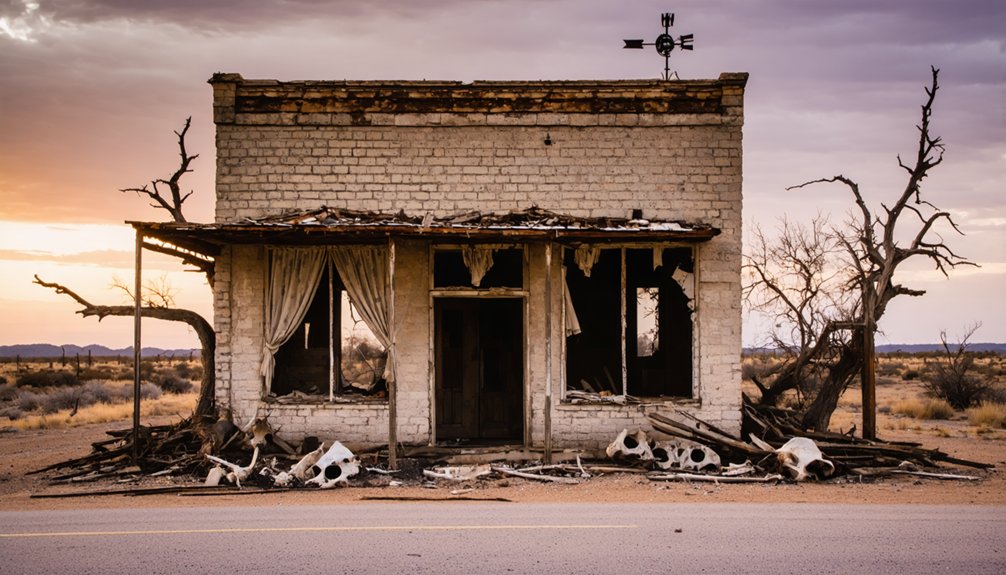
Carlton’s legends don’t ease you in gently — they grab you by the ankle before you even step out of the car.
Locals whisper about ghostly encounters that aren’t subtle. You’ll want to know what you’re walking into.
Reported spectral sightings and unexplained experiences include:
- Ghosts that yank visitors’ hair without warning near the abandoned structures
- Unseen hands grabbing ankles and heels as you explore the crossroads
- Current residents who allegedly appear unchanged in photographs over 100 years old
- Figures photographed near the crumbling buildings that nobody remembers seeing
Carlton doesn’t perform its strangeness — it just exists in it.
Whether you’re a skeptic or a true believer, something about this forgotten crossroads makes you second-guess every shadow.
When to Visit Carlton: Weather, Light, and Crowds
Once you’ve talked yourself into actually visiting Carlton — ghosts and all — timing your trip makes a real difference.
Central Texas weather patterns mean brutal summers, so skip July and August unless heat exhaustion sounds appealing. Spring and fall offer mild temperatures, golden light, and manageable driving conditions on FM 219 and 1744.
October hits the sweet spot. The air cools, shadows stretch long across abandoned storefronts, and the atmosphere leans naturally eerie without any manufactured drama.
October is the sweet spot — cool air, long shadows, and atmosphere that turns eerie all on its own.
You won’t battle crowds — Carlton draws curious wanderers, not tour buses — but weekday visits guarantee you’ll have the crossroads entirely to yourself.
There aren’t local festivals pulling traffic through town, which actually works in your favor.
You’ll move freely, photograph without interruption, and absorb the silence Carlton does best.
Where to Stop Before or After Carlton
Pair your Carlton visit with a stop in nearby Hico, a charming Old West town that offers local shops, a small museum, and a few good spots to grab a bite before you head into the emptiness.
From Hico, you can take FM 219 through rolling Central Texas ranchland, letting the scenery ease you into Carlton’s stark, time-capsule atmosphere.
After you’ve walked Carlton’s crumbling crossroads, the drive back through Hamilton County’s cedar-dotted hills gives you a quiet way to decompress from the experience.
Nearby Towns Worth Visiting
Three nearby towns make Carlton’s ghost town experience even richer if you’ve got time to explore beyond the crossroads.
- Hico, Texas – A historic site with deep community heritage, local history museums, and unique experiences tied to Billy the Kid folklore.
- Hamilton, Texas – Offers scenic views, cultural insights into Central Texas court square architecture, and hidden gems worth photographing.
- Comanche, Texas – Delivers ghostly encounters through its frontier-era landmarks, nearby attractions, and authentic road trip character.
- Stephenville, Texas – Known as the “Cowboy Capital of the World,” it rounds out your journey with cultural depth, historic sites, and a lively Main Street that contrasts beautifully with Carlton’s silence.
Each town adds layers you won’t want to miss.
Scenic Routes Between Stops
Driving between Carlton and its neighboring towns isn’t just transit—it’s part of the experience. Central Texas rewards drivers who slow down and pay attention.
Along FM 219 and FM 1744, you’ll pass through rolling Hill Country terrain where scenic landscapes stretch far beyond any guardrail. Pull over when something catches your eye—hidden treasures here aren’t always marked.
Heading toward Hico, watch for limestone outcroppings and weathered ranch gates that hint at generations of working land.
These back roads carry you past cattle pastures, creek crossings, and abandoned homesteads that rival Carlton’s own ruins. You’re not just connecting dots on a map—you’re reading a landscape shaped by boom, bust, and stubborn survival.
Keep your camera ready and your schedule loose.
What to Pack for a Carlton Ghost Town Visit
Packing smart for Carlton means preparing for both the physical demands of exploring crumbling structures and the eerie atmosphere that’s made this ghost town legendary.
Your packing essentials should balance safety with curiosity.
Your essentials aren’t just gear — they’re the bridge between reckless wandering and meaningful discovery.
- Sturdy boots — Uneven rubble around the abandoned bank and cotton gin demands ankle support.
- Camera with wide-angle lens — Camera tips matter here; capture the vault’s shadows and sagging doorframes in their full haunting glory.
- Water and snacks — Carlton’s lone post office won’t stock supplies, so bring your own freedom provisions.
- Flashlight — Darker interior spaces hold secrets that daylight can’t fully reveal.
You’re stepping into a living sepia photograph, so dress the part and document everything.
Carlton rewards the prepared explorer.
Carlton Visiting Etiquette: Private Property and Living Residents
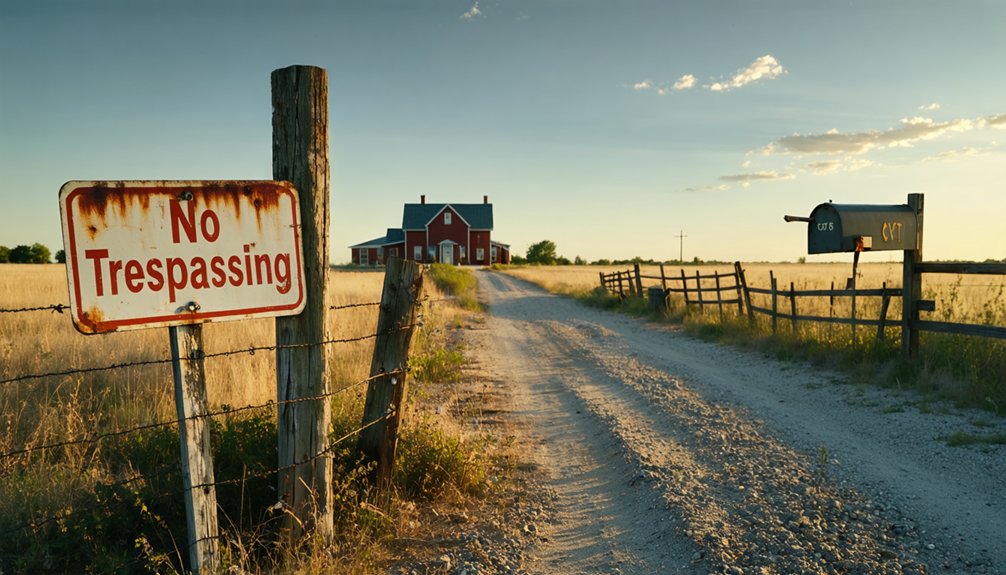
Although Carlton feels frozen in time, it’s not a museum — roughly 70 real people call this quiet crossroads home, and you’re a guest in their community. Treat it accordingly.
Respectful exploration means recognizing boundaries. Many of the crumbling storefronts, the abandoned bank, and the decaying cotton gin sit on private property. Don’t assume vacancy equals access. If a structure looks untouched for decades, that doesn’t grant you permission to enter or photograph interiors without consent.
Stay on public roads and observe from a distance when residents are present. Don’t block driveways, disturb the cemetery, or remove anything — even a loose brick carries history.
Carlton’s residents chose this quiet life deliberately. Honor that choice, move through thoughtfully, and you’ll leave having respected both the living and the long gone.
Day Trips From Carlton: Hico and Beyond
Carlton’s crossroads make a natural launching point for the broader Central Texas landscape, and Hico sits just a short drive away as your most obvious first stop.
Hico history runs deep, with its Billy the Kid lore and charming downtown inviting genuine exploration. Fuel up on local cuisine at one of Hico’s beloved spots before pushing further into Hamilton County’s open roads.
Consider building your day around these experiences:
- Walk Hico’s historic downtown and its storied Billy the Kid Museum
- Sample local cuisine at a family-owned diner serving authentic Texas comfort food
- Explore Hamilton County’s courthouse square and surrounding limestone architecture
- Drive FM 219’s sweeping rural corridors connecting forgotten communities
You’re not just sightseeing — you’re reclaiming landscapes most travelers never bother to find.
Frequently Asked Questions
What Railway Line Originally Helped Establish Carlton as a Cotton Hub?
The Stephenville North and South Texas Railway kickstarted Carlton’s railway history, fueling its cotton production boom. You’d have witnessed a thriving hub where trains hauled bales, transforming this small Central Texas crossroads into a bustling economic powerhouse.
What ZIP Code Should I Use When Mailing Postcards From Carlton?
When mailing your ghost town postcards, you’ll use ZIP code 76436! For standout postcard design and smart mailing tips, drop them at Carlton’s lone post office — it’s the town’s only active business keeping spirits alive!
How Long Has Carlton’s Population Remained Stable at Around 70 Residents?
You’ve held your breath through decades of ghost town history… Carlton’s population dynamics haven’t budged since 1980. That’s over 40 years with roughly 70 resilient souls refusing to let this Texas community vanish completely.
Was Carlton Ever Officially Incorporated as a Texas Municipality?
Carlton’s never been officially incorporated as a Texas municipality — it’s always remained an unincorporated community. You’ll find its ghost town history and local legends thriving without formal civic structure, giving you that raw, untamed freedom to explore.
What Two FM Roads Intersect at the Center of Carlton, Texas?
Like two forgotten rivers merging, FM 219 and FM 1744 cross at Carlton’s heart, where you’ll feel ghost town history wash over you — a Texas travel crossroads frozen in time, waiting for your arrival.
References
- https://www.youtube.com/watch?v=VmSmXw12XCs
- https://www.youtube.com/watch?v=LB75k_yCwrM
- https://www.allacrosstexas.com/texas-ghost-town.php?city=Carlton
- https://www.texasescapes.com/CentralTexasTownsNorth/CarltonTexas.htm
- https://www.facebook.com/TexasInspiration/posts/carlton-texas-is-a-hushed-remnant-in-hamilton-county-a-near-ghost-town-fading-in/966981498973856/
- https://fwtx.com/culture/travel/where-the-streets-have-no-names/
- https://livefromthesouthside.com/10-texas-ghost-towns-to-visit/
- https://www.ghosttowns.com/states/tx/carlton.html
- https://www.facebook.com/TexasInspiration/posts/once-upon-a-time-carlton-texas-was-a-thriving-little-town-in-central-texasfounde/1241816234823713/
- https://www.youtube.com/watch?v=jfgIqR14JcQ