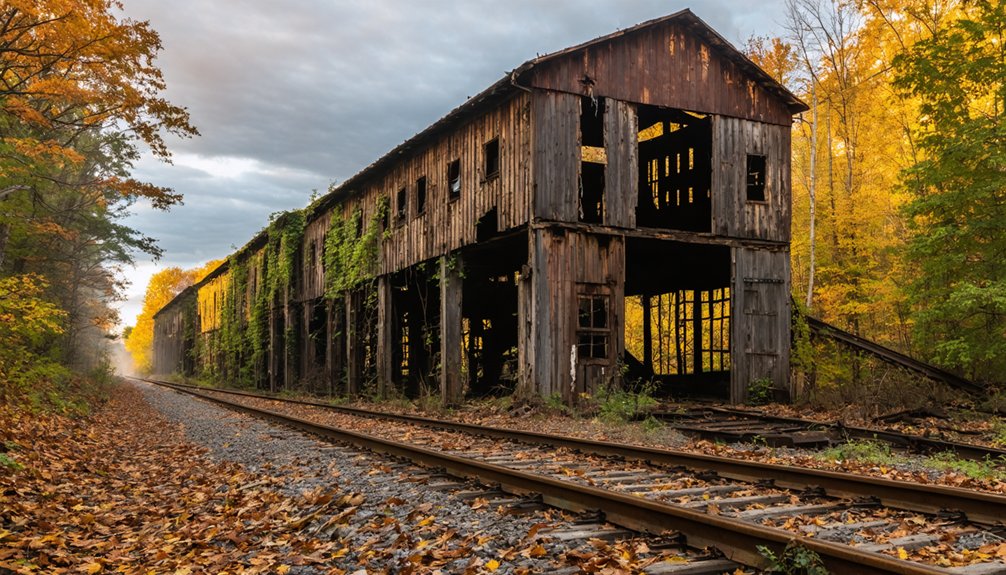
You’ll find City West’s haunting remains at Indiana Dunes National Park, where a 1930s bathhouse stands sentinel over 25 sand-buried blocks from an 1837 settlement that collapsed within two years. Drive Interstate 94 to exit 26, then follow State Road 49 to coordinates 41.633349, -87.053762, arriving during shoulder seasons when September’s winds expose archaeological hints beneath your boots. The article ahead reveals what lies hidden in these wind-sculpted dunes and how to capture this ambitious failure’s whispered story.
Key Takeaways
- City West, founded in 1836, was abandoned within two years and now lies beneath sand dunes at Indiana Dunes National Park.
- Fly into Chicago O’Hare, Midway, or South Bend, then drive Interstate 94 to exit 26 north toward the Visitor Center.
- Visit mid-September through October for fewer crowds and exposed archaeological features, avoiding July’s peak summer traffic.
- The 1930s bathhouse near the park entrance remains the only visible structure connected to the original settlement.
- Traces of 25 original blocks emerge through shifting sands, with documented excavation sites marking the ghost town’s footprint.
The Rise and Fall of a Forgotten Dream City
In the fall of 1836, four ambitious men stood on the windswept shores of Lake Michigan and saw what Chicago would become—except they planned to build it here first. Jacob Bigelow, William Morse, Jacob Hobart, and Leverett Bradley christened their settlement City West, envisioning a metropolis that’d eclipse their rival across the lake.
By 1837, surveyor Hervey Ball had mapped twenty-five blocks around Fort Creek, where engineers found deeper waters than neighboring Michigan City. The speculative real estate fever drew forty buildings and three grand hotels. Railroad expansion dreams centered on connecting the Great Lakes to interior waterways. The original plat was officially recorded on July 14, 1837, making City West the first platted town in Porter County.
Then the Panic of 1837 struck. Banks called loans. The promised federal port funds never arrived. No railroad came. Within two years, you’d find only empty buildings swaying in the lake breeze—a dream abandoned to the wilderness. Like Berlin’s Charlottenburg and Wilmersdorf, City West began as an independent town with metropolitan ambitions.
What Remains at the City West Site Today
Standing where forty buildings once promised greatness, you’ll find yourself surrounded by rolling sand dunes and rustling beach grasses instead. The 1930s bathhouse near the park entrance stands as your only tangible connection to this vanished settlement.
Where ambition once erected forty buildings, only sand dunes and beach grasses remain to mark this vanished dream.
Limited historical artifacts make the site feel more myth than reality—Lake Michigan reclaimed the pier, forest fires consumed the 22-room hotel, and shifting sands buried everything else.
You’re free to explore Waverly Beach’s trails, searching for sawmill foundation traces hidden beneath the dunes. Minor traces of the original 25 blocks and homes still peek through the sand, offering ghostly glimpses into the settlement’s layout. Archaeologists worked for nearly a year to carefully document what lies beneath similar forgotten grounds, ensuring every detail is preserved before it vanishes completely. Sparse park infrastructure means no formal markers guide your journey, just your imagination reconstructing what dreamers envisioned in the 1830s.
The landscape’s natural takeover tells its own story: sometimes wilderness refuses to surrender, no matter how grand human ambitions become.
Getting to Indiana Dunes National Park
Your journey to this Lake Michigan ghost town begins along the industrial corridor of northwest Indiana, where steel mills give way to unexpected wilderness. Airport transportation options include flights into Chicago O’Hare or Midway (90 minutes away) or South Bend (under an hour).
From Chicago, driving routes from major cities converge on Interstate 94—take exit 26 north toward the Indiana Dunes Visitor Center at 1100 N. Mineral Springs Road. You’ll follow brown directional signs through Porter County, where State Road 49 cuts straight to your destination. The coordinates 41.633349, -87.053762 mark your starting point for exploring City West’s remnants.
U.S. Highway 12 parallels the lakeshore, accessing trailheads and forgotten settlements. Half the country’s population lives within a day’s drive of these haunted dunes. The Chicago and South Shore Train stops within the park, offering an alternative to driving through the industrial landscape. Once you arrive, more than 15,000 acres of diverse terrain await your exploration, from windswept beaches to mysterious wooded hollows.
Best Times to Visit the Historic Location
The ghost of City West reveals itself most generously during shoulder seasons—late April through early June, then September through October—when you’ll walk these haunted shorelines without battling summer’s Memorial Day to Labor Day crowds. These perfect visitation windows grant you the freedom to explore dune-buried foundations in solitude while benefiting from extended Visitor Center access (9:00 am to 4:00 pm).
The best season for Indiana ghost towns offers a similar charm, with the cooler months providing an eerie yet captivating atmosphere. As the leaves change color, the remnants of once-thriving communities can be explored without interruption, revealing stories from the past. This time of year draws enthusiasts and the curious alike, eager to experience the haunting beauty that only the fall can provide.
I’ve found prime exploration timing hits its sweet spot mid-September, when Lake Michigan’s shifting sands expose archaeological hints without mid-summer’s peak traffic. You’ll navigate the ghost town remnants from 6:00 am until 11:00 pm, capturing golden-hour light across coastal dunes. The site now hosts a large parking lot and a 1930s bathing pavilion at what’s officially called Waverly Beach. Winter’s shortened hours restrict your wandering, while July’s crowds obscure the contemplative atmosphere this abandoned 1830s settlement deserves. Tours continue rain or shine, so pack weather-appropriate gear regardless of forecast conditions.
Exploring the Sand Dunes That Buried City West
Walking across these perpetually shifting sand mountains, you’ll discover how City West disappeared beneath what became Indiana’s most restless landscape. Lake Michigan’s proximity created unique sand accumulation patterns that consumed the 1837 settlement within two years, burying structures, streets, and even the shoreline cemetery.
Understanding the dunes’ relentless transformation:
- Wind driven movement effects constantly reshape these formations, uncovering artifacts before reburying them seasons later
- Six documented mound sites once existed here—all vanished by 1931 beneath migrating sand
- The Hoosier Slide, Indiana’s largest dune, stood as an enduring record of this landscape’s power until commercial mining leveled it in 1920
- Archaeological excavations revealed burial sites with ancient weapons, though preservation proved impossible against nature’s ferocity
- The Wark Mounds once dominated the Porter Township landscape, with the largest measuring over 100 feet in diameter and originally standing 16 feet high before erosion diminished them
- Near Hebron, excavators discovered a skeleton with a round stone positioned under its head alongside a clay pipe, demonstrating burial customs that varied throughout the region
You’re witnessing geological forces that erase entire communities from existence.
Nearby Attractions and Historic Sites
Beyond City West’s buried foundations, northern Indiana’s shoreline preserves dozens of haunting landmarks where industrial ambition collided with Lake Michigan’s temperamental geography.
You’ll discover abandoned quarries where limestone blocks still wait for ships that never returned, and weathered piers extending into waters that swallowed entire warehouses during November gales. The dune country holds forgotten railway grades cutting through ghost forests—trees buried centuries ago, now exposed by shifting sands.
Drive east to find crumbling breakwaters marking vanished harbors, their rusted bollards evidence of ports that couldn’t survive the lake’s fury. Local museums display salvaged artifacts: ship wheels, factory equipment, and photographs of communities that thrived briefly before nature reclaimed them.
These sites aren’t manicured attractions—you’ll navigate unmarked trails and interpret your own stories from scattered foundations.
What to Bring for Your Ghost Town Adventure

Since City West’s remnants lie scattered across unforgiving terrain where cell signals fade and the nearest gas station sits twenty miles back, you’ll need more than enthusiasm to explore safely. Emergency preparedness transforms potential disasters into minor inconveniences when you’re miles from civilization.
Your ghost town essentials:
- Vehicle backup items: jumper cables, spare tire, and basic tools—because AAA won’t find you here
- Navigation gear: physical maps and a headlamp for exploring abandoned structures after sunset
- First aid supplies: bandages, antibiotic ointment, and moleskin for those inevitable scrapes and blisters
- Sustenance: water bottles, trail mix, and energy bars to fuel your adventure
Pack sturdy hiking boots, weather-appropriate layers, and a blanket for stargazing among the ruins. Freedom means self-reliance.
Accommodations Near Porter County
After hours tracing City West’s faded foundations and crumbling chimneys, you’ll crave a hot shower and actual walls around you—luxuries the ghost town abandoned a century ago.
Porter County delivers. Spring House Inn’s woodland views feel worlds away from civilization, while Comfort Inn & Suites Porter plants you near Indiana Dunes for tomorrow’s explorations. Need family friendly accommodations? Country Inn & Suites Portage features an onsite Aquatic Center—perfect for dust-covered kids. Hampton Inn Portage welcomes your road-tripping dog with pet friendly hotel options.
Chesterton’s Best Western Indian Oak and Valparaiso’s charming bed-and-breakfast offer different flavors of comfort. Most properties include free WiFi, breakfast, and fitness centers. You’ve spent the day with ghosts; tonight, choose living amenities that match your wandering spirit.
Capturing the Story: Photography and Documentation Tips

The camera becomes your time machine at City West, translating ruin into remembrance one frame at a time. You’ll want to arrive during golden hour when natural light transforms decaying facades into haunting silhouettes. Your freedom to explore demands proper preparation and technique.
Essential camera settings and lighting techniques for City West:
- Long exposures (13-30 seconds) capture the stillness of abandonment while your flashlight paints selective illumination across forgotten doorways and weathered signs
- Wide-angle lens establishes the vast emptiness of main street before switching to prime glass for intimate artifact details
- Manual exposure control tames the extreme contrast between shadow-filled interiors and bright window light
- HDR processing recovers detail in both highlights and shadows without sacrificing authenticity
Your tripod becomes non-negotiable here—handheld shots can’t capture this depth of story.
Frequently Asked Questions
Were Any Human Remains or Artifacts Recovered From the City West Site?
No human remains found or artifacts discovered survive from City West’s sandy grave. The dunes consumed everything—gravestones, timber, dreams. Nature reclaimed her territory completely, leaving you only shifting sand and whispered stories of vanished pioneers beneath your feet.
Can Visitors Access the Exact Location Where the Hotels Once Stood?
No, you can’t reach the exact hotel locations—they’ve vanished like footprints in shifting sand. Preservation of historical structures failed here; accessibility to hotel sites remains impossible since dunes buried everything and fires destroyed what remained above ground.
Are There Any Descendants of the Original Founders Still Living Today?
Tracking down generational histories proves challenging, as records of familial connections have scattered like prairie dust over time. You’ll need to dig through county genealogical societies and historical archives to uncover whether any descendants remain in the area today.
What Happened to Residents Who Left Before the Town Was Abandoned?
Early departing residents faced uncertain fates and relocation challenges as they scattered across Indiana’s frontier. You’d find them rebuilding in nearby Chesterton, establishing New City West’s cooperage, or pushing westward—pioneers seeking fresh starts after financial devastation crushed their dreams.
Did City West Have Any Government Officials or Formal Legal Structure?
No, you won’t find any formal legal institutions or local governance structure here—City West existed as a speculative dream without mayors, councils, or administrators. Just ambitious railroad promoters selling lots before vanishing into financial ruin.
References
- http://www.gribblenation.org/2019/05/ghost-town-tuesday-ghost-towns-of.html
- https://www.atlasobscura.com/places/city-west-ghost-town
- https://stephenjessetaylor.wordpress.com/2013/07/27/city-west-lost-metropolis-of-the-indiana-dunes/
- https://gregandbirds.wordpress.com/2017/11/21/lost-to-nature-1-city-west-and-tremont-indiana/
- https://en.wikipedia.org/wiki/City_West
- https://www.youtube.com/watch?v=Lf2AQ6YfwxE
- http://www.porterhistory.org/2017/01/lost-porter-county-city-west.html
- https://www.islands.com/1754423/city-west-ghost-town-abandoned-buildings-once-dreamy-town-indiana-coastal-eerie-dune-beach/
- https://www.inportercounty.org/Data/Misc/DreamCitiesOfTheCalumet-1929.html
- https://www.wfyi.org/news/articles/greenlawn-cemetery-city-finishes-excavation-of-more-than-1700-graves