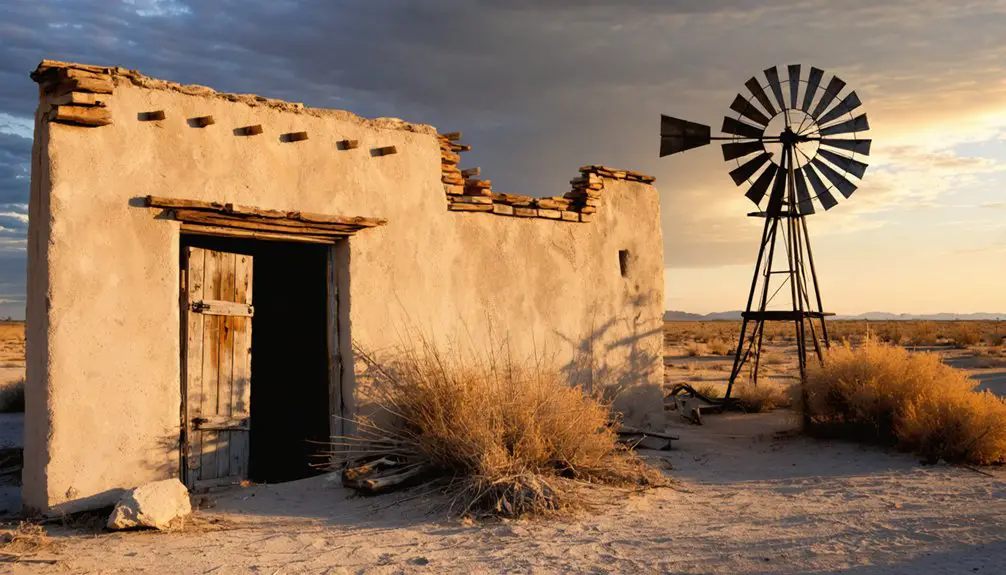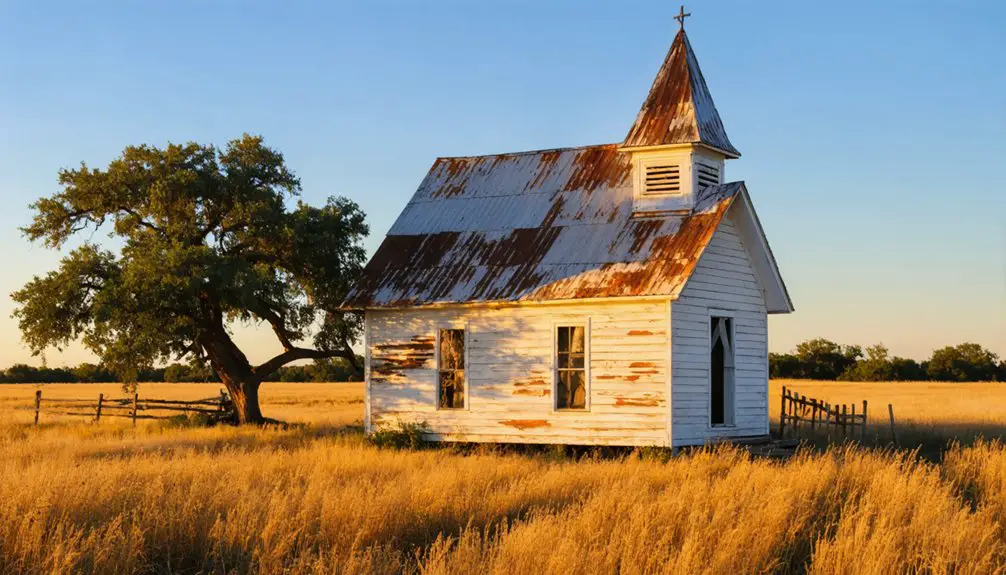
You’ll reach Clara’s windswept remnants by heading northwest from Wichita Falls on US 287 toward Burkburnett, then veering west onto FM 1813 for seven miles until you hit State Highway 240. What awaits is Herman Specht’s vanished German farming colony—weathered limestone headstones dating to 1888, the skeletal Trinity Lutheran Church, and prairie reclaiming what drought destroyed. Visit between October and March when temperatures won’t punish your exploration, fuel up in Burkburnett beforehand, and prepare for genuine backcountry solitude where this ambitious settlement’s complete story still whispers through abandoned fields.
Key Takeaways
- Drive northwest on US 287 toward Burkburnett, then west on FM 1813 for seven miles to Highway 240.
- Visit during October through March to avoid brutal summer heat and enjoy safer road conditions.
- Explore the Old Clara Cemetery with headstones from 1888-1935 and the weathered Trinity Lutheran Church ruins.
- Fuel up in Burkburnett before departure and carry water, as Clara is genuine backcountry with limited services.
- Check rural road conditions after storms, respect cemetery gates, and avoid entering deteriorating historic structures.
The Story Behind Clara’s Founding and Early Settlement
When Herman Specht arrived in Wichita County with dreams of establishing a farming community, he carried more than just his belongings—he brought a vision that would transform empty Texas prairie into a thriving German settlement. This civilian founder, nicknamed “military” despite never serving, officially platted the town in 1888 and named it after his wife, Clara Vogel Lange.
You’ll discover Specht’s genius lay in his recruiting strategy. He sent letters to German newspapers across Missouri and Minnesota, calling fellow immigrants to build something beyond government reach. These weren’t just any settlers—they were experienced Midwestern farmers with German immigrant backgrounds ready to establish an agricultural hub development.
Getting There: Directions and Route Planning
Your journey to Clara begins on the windswept highways of north-central Texas, where the Panhandle’s vast horizons meet Wichita County’s patchwork of farmland and prairie. From Wichita Falls, you’ll navigate northwest on US 287 toward Burkburnett, then veer west onto FM 1813 for seven liberating miles.
The intersection with State Highway 240 marks your destination—no crowds, no commercialization, just open space.
Before departing, fuel up in Burkburnett; you’re entering genuine backcountry. Check rural roads condition beforehand, especially after storms when gravel sections become treacherous. Nearby resident perspectives suggest carrying water and allowing flexibility in your schedule. GPS coordinates prove essential since Clara lacks modern signage. The thirty-minute drive rewards those seeking authentic exploration, far from interstate monotony and tourist traps.
What Remains: Cemetery and Historic Structures
When you arrive at Clara, you’ll find the Old Clara Cemetery as the heart of what’s left—a solemn collection of limestone headstones dating from 1888 to 1935 that tells the story of the settlement’s rise and fall.
The Lutheran Church still stands nearby, its weathered walls and accompanying rectory serving as silent witnesses to Sunday services long forgotten. Beyond these structures, you might spot the faint traces of the old schoolhouse site, though little more than foundation stones remain to mark where Clara’s children once learned their lessons.
Old Clara Cemetery Grounds
The Clara Cemetery sits exposed on a windswept hilltop, marking the final footprint of a town that’s otherwise vanished from the Texas landscape. You’ll find no gate blocking your entrance—just an open road leading to scattered graves dating back to the 1880s.
The wind tears across this unprotected ground, whistling through weathered markers that lean at odd angles. Some stones still gleam with brass maintenance, while others succumb to time’s relentless march. You’ll notice abandoned gravesites showing wildlife impact, where animals have rooted through the earth, disturbing what should rest undisturbed.
Sheep-topped children’s markers from 1907-1911 pierce your heart. Charles Engelmann‘s stone celebrates an extraordinary life spanning 1833 to 1935—102 years witnessed from this lonely hill.
1900 Lutheran Church Ruins
Beyond those weathered graves stands what brought this hilltop community together for over a century—the Trinity Lutheran Church ruins. Founded in 1900 on donated land, this structure served Clara’s faithful until the town faded into memory. You’ll find the old Lutheran walls still standing, defiant against Texas winds that sweep this exposed hilltop.
The occupied rectory remains nearby, a monument to someone’s dedication despite the absence of formal cemetery maintenance or historical restoration efforts.
What you won’t find is a gate—access stays open for explorers like you. Walk freely among the iris-filled grounds where dates spanning 1833 to 1935 tell stories of German settlers who planted roots here. Small sheep markers dot children’s graves, while animal tracks remind you nature’s reclaiming what civilization left behind.
Historic Schoolhouse Site Remains
Just downhill from those Lutheran ruins, Clara’s 1912 schoolhouse stands as the town’s architectural crown jewel—a two-story native stone structure that replaced the humble log cabin where frontier children first gathered in 1871. You’ll notice the architectural features immediately: weathered Tuscan columns frame the one-story porch, their classical lines defying decades of abandonment.
The building served rural students until 1949, when consolidation trends shuttered its doors. Community preservation efforts saved it from demolition, transforming it into a gathering space that retained its original character:
- Built one year after Clairette Independent School District formed
- Constructed from locally-quarried native stone
- Original columns and porch intact
- Marked by Texas Historical Landmark plaque #901
- Located at coordinates 32.041134, -98.119598
It’s your tangible connection to frontier education, standing defiant against time.
The Rise and Fall of a German Farming Community
When Herman Specht arrived in Galveston in 1870, he carried the dreams of countless German immigrants seeking prosperity in Texas’s wide-open spaces. After marrying wealthy widow Clara Lange in 1884, he acquired 21,000 acres in northern Wichita County and platted a town bearing her name.
The town promoter’s impact was immediate—he advertised in German-language newspapers across Missouri and Minnesota, attracting stable Lutheran families to his vision of a thriving settlement.
Specht’s agricultural experiments included an innovative nursery for unusual plants and extensive grain crops. The community flourished with schools, churches, and businesses. But nature proved merciless. The 1891 drought decimated his crops, and the devastating 1900 Galveston Storm destroyed his remaining holdings. Clara’s promise withered alongside its fields.
Best Time to Visit and Safety Considerations
Planning your journey to Clara’s windswept remnants demands careful attention to North Texas’s mercurial climate and the practical realities of visiting a remote ghost town. Seasonal weather variations dramatically affect your experience—summer’s relentless heat exceeding 90°F makes exploration punishing, while winter’s mild temperatures create ideal conditions for wandering abandoned homesteads.
As you explore, consider the unique ghost town attractions near Winkleman that offer a glimpse into the area’s storied past. Each location provides a different perspective on life in these forgotten places, from the remnants of old storefronts to crumbling historic structures. Engaging with these sites can turn a simple visit into an adventure filled with history and mystery.
Choose winter’s gentle embrace over summer’s brutal anvil when exploring Clara’s abandoned streets and crumbling stone foundations.
Off-peak visitation windows offering maximum solitude:
October through early November delivers comfortable hiking weather with minimal crowds
December to February provides crystal-clear stargazing skies and zero tourism
Late February to March balances pleasant conditions with serene access
Mid-September beats the fall festival rush
Mid-week visits eliminate weekend traffic entirely
Prepare for gravel roads along FM 1813, respect cemetery gates, and avoid entering deteriorating structures. Dawn and dusk demand cautious driving—deer frequent these forgotten crossroads where German settlers once built their dreams.
The Historic Marker and Notable Landmarks
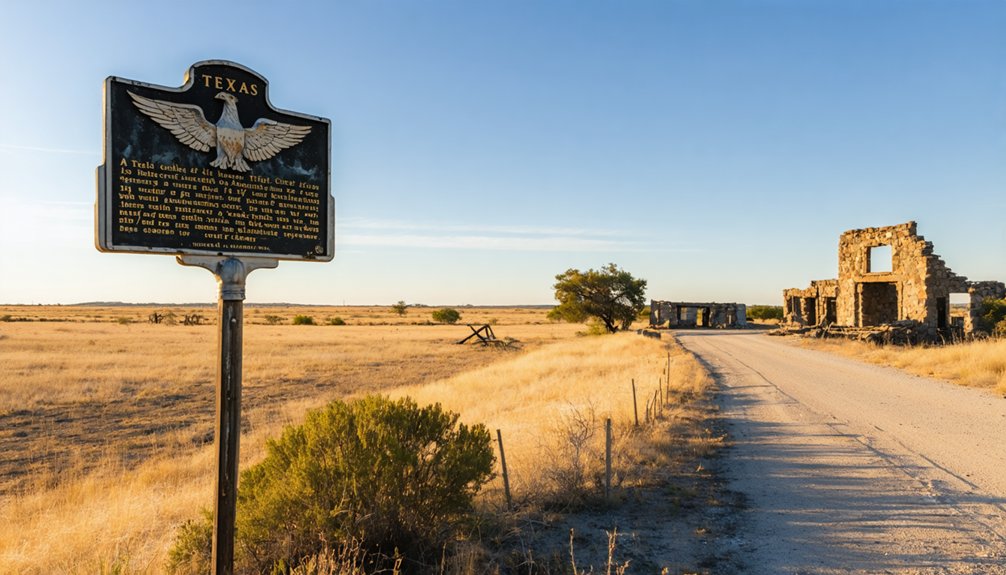
You’ll find Clara’s story preserved in three distinct landmarks that anchor this forgotten settlement. The historical marker erected in 1978—currently damaged and awaiting replacement—once stood along SH 240, marking the ghost town’s location for curious travelers.
Beyond this, the iris-filled Clara Cemetery and the still-active Trinity Lutheran Evangelical Church with its thousand-pound bell create tangible connections to the German families who built their dreams here in 1886.
The 1978 Texas Marker
Standing 27 by 42 inches along State Highway 240, the Texas Historical Commission marker erected in 1978 tells Clara’s story to passing travelers. You’ll find it about 7.1 miles west of Burkburnett, marking where Herman Specht’s dream town once thrived.
The marker inscription details reveal fascinating aspects of this German settlement:
- Herman Specht’s 1870 journey from Germany to Galveston
- His 1886 vision of a town named for wife Clara
- Streets honoring Texas heroes
- The experimental nursery that drought destroyed
- Trinity Lutheran Church’s role as community anchor
Unfortunately, a marker condition update from June 2021 reported damage while in storage. The replacement is currently in progress, ensuring future road-trippers can discover Clara’s legacy. Until then, you’ll need to explore other remaining landmarks like the cemetery to piece together this ghost town’s history.
Clara Cemetery Highlights
While the damaged 1978 marker awaits replacement, Clara Cemetery’s own historical marker still stands proud, greeting visitors who make the turn onto Clara Cemetery Road. You’ll find 415 documented graves spread across grounds carpeted with iris flowers throughout the seasons, creating an unexpected beauty among the headstones.
The oldest visible marker belongs to Manoa Bohannon, who died in 1897, though some stones date back to the 1880s when German settlers first arrived. Look for infant markers present from the early 1900s, including a touching 1907-1911 memorial adorned with a small sheep symbol.
One remarkable gravestone marks someone born in 1833 who lived to 102, witnessing Clara’s entire rise and fall before their 1935 passing.
Lutheran Church Ruins
The 1978 historical marker that once told Clara’s story sits damaged in storage as of June 2021, awaiting replacement—a temporary setback for those seeking the official narrative of this ghost town. Trinity Lutheran Church still stands after celebrating its 100th birthday in 2000, though its deteriorating church condition tells tales of fading church history.
When you arrive, you’ll discover:
- The church complex where Herman Specht’s 1886 donation created a community
- An occupied rectory that’s survived decades of decline
- The bell tower’s legacy—its 1000+ lb bell now ringing in another congregation
- Streets named for Texas heroes in Clara M. Vogel Lange’s honor
- Remnants of the experimental nursery where unusual plants once thrived
Drive 7.1 miles west from Burkburnett on SH 240 to witness this resilient landmark.
Exploring the Old Clara Cemetery
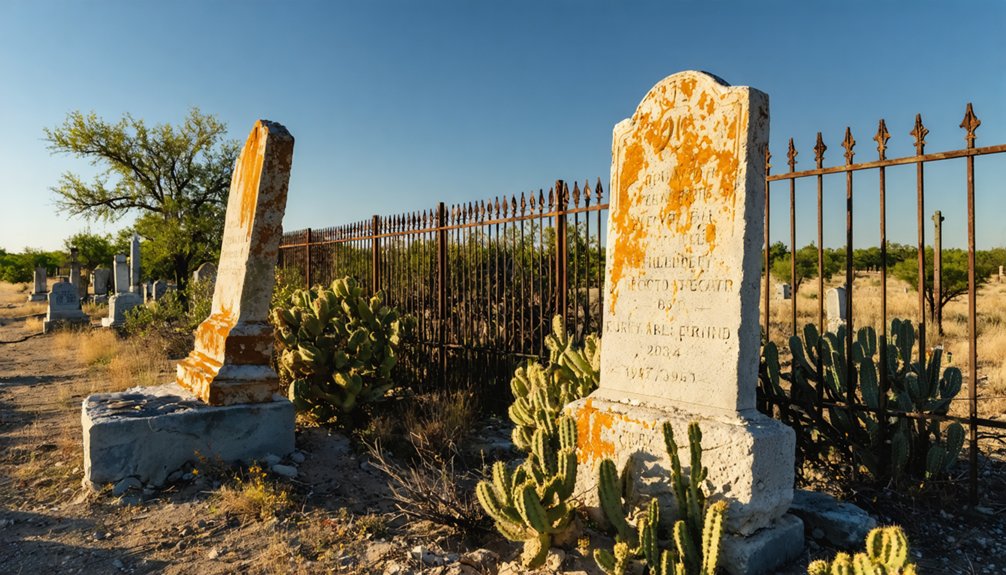
Beyond the weathered doors of Trinity Lutheran Church, Clara Cemetery Road winds south toward what remains of this vanished German settlement’s heart. You’ll discover graves dating from 1854 to the present, their brass markers meticulously maintained despite the town’s 1920s collapse. Iris flowers surge around headstones, creating purple waves each spring—a living manifestation to cultural preservation by descendants who refuse to let Clara fade completely.
The historical significance reveals itself in German inscriptions and sheep-carved child markers from the 1880s. Infant graves cluster from 1907-1911, silent testimonies to harsh frontier life. Two-sided stones tell stories in both English and German, while the 1978 historical marker chronicles Specht’s failed utopia. You’re walking through freedom-seeking immigrants’ dreams, permanently etched in limestone and memory.
Nearby Attractions in Wichita County
After absorbing Clara’s haunting history, you’ll find Wichita Falls just twenty miles northwest offers a striking contrast—a vibrant city where German settlers’ dreams evolved into modern Texas culture.
Wichita Falls transforms German pioneer aspirations into thriving Texas heritage, blending historic roots with contemporary city life just miles away.
Lucy Park sprawls along the Wichita River with 3,000 rose bushes, playgrounds, and the rebuilt man-made waterfall rising from 1886 flood ruins.
River Bend Nature Center provides 20 acres of nature trails where you’ll observe wildlife and connect with conservation efforts through live exhibits.
Kemp Center for the Arts showcases rotating exhibits in its art galleries within the 1911 historic building’s downtown complex.
World’s Littlest Skyscraper stands as downtown’s iconic architectural oddity, ranking fourth among Tripadvisor attractions.
Castaway Cove Waterpark delivers aquatic thrills perfect for Texas summer heat.
You’re free to explore history, nature, culture, or pure entertainment—no prescribed itinerary required.
Frequently Asked Questions
Are There Any Entrance Fees to Visit the Clara Ghost Town Site?
There aren’t any entrance fees to explore Clara’s abandoned structures—you’ll find free public access during standard visitor hours. You’re welcome to roam the crumbling remains at your own pace, embracing the untamed spirit of Texas’s forgotten frontier without restrictions.
Can I Bring My Dog to the Cemetery and Ruins Area?
Ironically, ghosts roam free while your living companion can’t—most ghost town ruins lack official dog-friendly policies. You’ll need checking local leash requirements beforehand. However, outdoor Texas sites typically welcome leashed dogs, letting you both explore abandoned history together freely.
Is Camping Allowed Near the Clara Historic Site Overnight?
Camping isn’t available directly at Clara Historic Site, but you’ll find designated sites at nearby Big Bend Ranch State Park. Check in at Fort Leaton for accommodation options, where you can access facilities and explore freely within regulations.
Are There Restroom Facilities Available at or Near the Location?
No restroom facilities exist at Clara’s ghost town site—96% of Texas ghost towns lack modern amenities. You’ll need to plan ahead, visiting Jefferson or New Berlin beforehand. Public restrooms there offer accessibility for visitors with disabilities.
Do I Need Permission From Landowners to Explore the Area?
You’ll need to respect private property concerns when exploring beyond the church and cemetery. The historical marker site’s classified as non-private, but surrounding areas require landowner permission. Always follow historical preservation guidelines to protect this vanishing Texas heritage.