You’ll find Harlan at the crossroads of Cleon Township in northeast Manistee County, where a solitary weathered church stands as the last sentinel of a once-thriving railroad town. Pack detailed maps marking the former village sites along County Line Road near Copemish, and you’ll discover sparse homes dotting the roadside where 75 residents once bustled around general stores and sawmills. The foundations whisper stories of four competing railroads that transformed isolated homesteads into commerce hubs, and there’s plenty more to uncover about this vanished frontier community.
Key Takeaways
- Cleon Township is located in northeast Manistee County with Township Hall at 16505 Imhoff Dr in Copemish.
- Visit Harlan’s weathered church, the only original public structure remaining from the 1889-1912 lumber boom era.
- Explore Harlan southeast of Copemish where sparse homes mark the former village that once had 75 residents.
- Pack detailed maps marking former village sites and photograph remnant log piles and historic railroad infrastructure.
- Consider visiting Fayette Historic Townsite’s museum to enhance understanding of Michigan’s ghost town history.
Getting to Cleon Township and Nearby Harlan
Tucked into the northeast corner of Manistee County, Cleon Township sits at a quiet crossroads where four counties meet—a geographical quirk that makes finding it feel like discovering a hidden corner of Michigan’s rural heartland. You’ll reach Township Hall at 16505 Imhoff Dr in Copemish, where Pioneer Road and Thompsonville Highway guide you through zoning preservation areas protecting forests and wetlands.
County line accessibility becomes your advantage here—Manistee County Line Road and Karlin Road connect directly to neighboring Wexford County, where Harlan awaits just across the border. An interactive ZIP Code map from zipdatamaps.com displays the township’s precise boundaries and surrounding postal code areas, with clickable features that reveal detailed information about each zone. MapQuest offers directions with traffic estimates, though you’ll find these rural routes blissfully uncongested. The township operates on Eastern Daylight Time, running 5 hours behind Coordinated Universal Time (UTC), which matters when coordinating visits to local businesses or township offices. The township’s 1,063 residents (as of 2020) have plenty of elbow room, and you’ll appreciate that same breathing space as you navigate these back roads.
The Early Settlement Days of 1857-1866
You’ll find Cleon’s settlement story begins in late 1865, when pioneers like Kaleb Ream and S.M. Grennell staked their homestead claims in the township’s virgin timber.
Envision this: by August 1866, four families pooled their resources to construct a single 18×26-foot log cabin positioned precisely at the corner where their four properties met—each family occupying one corner to satisfy government homestead requirements. That communal cabin, born from necessity and pioneer ingenuity, stood for years until highway construction claimed it, leaving settlers mourning the loss of their shared symbol of survival.
S.M. Grennell would officially settle on his homestead on May 1, 1866, marking the beginning of permanent occupation in the area.
The fledgling community’s growth continued steadily, and within just ten years, over 200 people had made Cleon Township their home.
First Oxen Team Arrival
Long before lumber barons and railroad surveyors ever dreamed of Wexford County’s timber wealth, a solitary pioneer guided his oxen team into what would become Harlan in 1857. He’d traveled from Benton Harbor, his oxen’s steady hooves marking the initial pioneer entry through unmapped wilderness. You’ll find it remarkable that this journey predated formal township organization by nearly a decade—true frontier independence at its finest.
This arrival established settlement patterns that’d define the region. No roads existed, no neighbors for miles, just virgin timber and possibility. His oxen team wasn’t luxury—it was survival technology, capable of hauling supplies through terrain that’d stop wagons cold. The settlement actually lies in Cleon Township in Manistee County, positioned a few miles southeast of Copemish where original railroad tracks would later be rerouted. Within a decade, John Wheeler’s sawmill would transform the county’s economy in 1867, marking the shift from subsistence pioneering to industrial lumbering. Today, as you explore Harlan’s ghost town site southeast of Copemish, you’re walking where genuine pioneer grit carved civilization from nothing.
When four homesteading families arrived in 1866, they engineered an ingenious solution to federal residency requirements—a single 18-by-26-foot log cabin built precisely where their property corners intersected. Kaleb Ream, George Estabrook, Micajah Amos, and Oliver Gernell constructed this shared dwelling in August, with each family occupying one corner on their own land.
This combined log cabin construction satisfied Uncle Sam’s mandate while conserving precious resources during that brutal first winter.
The divided property ownership arrangement proved brilliant—four families, four corners, zero bureaucratic hassles. Each homesteader technically lived on their claim while sharing walls, warmth, and workload. These settlers joined a wave of emigration from western New York and New England states that had been reshaping Michigan’s landscape since the Erie Canal opened pathways west in 1825.
You’ll find nothing left of this cleverness today; highway construction obliterated the site. The township itself was erected in October 1868 by the board of supervisors, formalizing what these pioneering families had begun two years earlier. But imagine the conversations around that shared hearth, where independence met cooperation out of necessity, not government decree.
How the Railroad Changed Everything in 1889
When the Toledo, Ann Arbor & Northern Railroad decided to bypass those brutal uphill climbs through original Cleon in 1889, it didn’t just redraw a map—it pulled the commercial heart of the township three miles southeast to a brand-new settlement called Harlan.
You’ll find it remarkable how quickly entrepreneurs followed those fresh-laid tracks: within two years, Harlan boasted two general stores, a hotel, a pickle factory, and a depot humming with activity.
Meanwhile, nearby Copemish exploded from a lumber camp to an incorporated village of 300 residents in just eight years, proving that railroad junctions were the ultimate economic catalyst in Michigan’s north woods. The Arcadia & Betsey River Railway extended its line to reach Copemish in 1896, connecting this growing community to the broader rail network. The depot there even featured a lunch room to feed passengers traveling through this bustling junction point.
Rerouting From Cleon Town
The Bear Lake and Eastern Rail Road’s narrow 3-foot gauge tracks first wound through Cleon Township on January 20, 1882, snaking through dense hardwood forests where maintenance crews constantly battled the terrain. You’ll understand why railroad engineers abandoned this route when you consider the uphill climbs and sharp curves that plagued operations.
Harlan’s Rapid Business Growth
As soon as Toledo, Ann Arbor & Northern Railroad steel touched Harlan’s soil in September 1889, hammers started pounding and businesses sprang up like wildflowers after rain. You’d have witnessed diverse entrepreneurial ventures transforming empty prairie into a bustling railroad hub within months.
The thriving agricultural industry sparked practical infrastructure:
- Pickle factory and potato warehouse – Processing local harvests for distant markets
- Two sawmills – Converting Michigan timber into construction lumber
- Two general stores, hotel, and blacksmith shop – Serving railroad workers and settlers
Multiple Villages Emerge Quickly
Four competing railroads carved through Cleon Township’s farmland in 1889, and within months, you’d have watched entire villages materialize where cattle once grazed. The Manistee & Northeastern, Frankfort & Southeastern, Chicago & West Michigan, and Toledo Ann Arbor & Northern transformed isolated homesteads into bustling commerce hubs.
Harlan sprouted blacksmith shops, two general stores, and a pickle factory—rural industry innovations that would’ve seemed impossible just years earlier. Down the tracks, Copemish exploded at the railroad junction, earning its reputation as the line’s liveliest town by 1890. Pomona claimed its 20-acre plot between sections, while agricultural commerce expansion turned potato warehouses and sawmills into money-makers.
You’ll find it hard imagining this happened in mere months, but when freedom-seeking settlers met steel rails, nothing stopped their momentum.
Boom Times and the Peak Years Through 1912
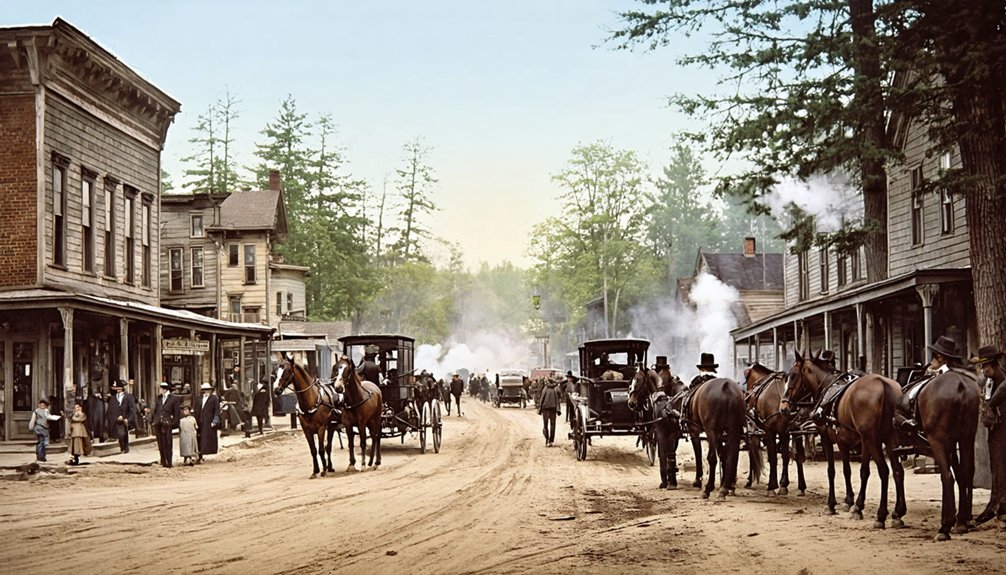
When the Toledo, Ann Arbor & Northern Railroad rolled through Harlan in 1889, it sparked a transformation that turned this quiet settlement into a bustling hub almost overnight. You’d have witnessed railroad operations breathing life into this frontier community, creating economic diversity that few could’ve imagined when that first settler arrived with his oxen team in 1857.
The railroad didn’t just connect Harlan to distant markets—it unleashed economic possibilities that transformed isolation into opportunity.
By 1912, Harlan peaked at 75 residents who enjoyed:
- Commercial conveniences: Two general stores, a hotel, and a blacksmith
- Industrial opportunities: Two sawmills, a pickle factory, and potato storage
- Community essentials: A church, schoolhouse, depot, post office, and telephone operator
This wasn’t just growth—it was freedom materialized. Every service you’d need existed within walking distance, creating self-sufficient living before the inevitable decline began.
What Remains Standing Today
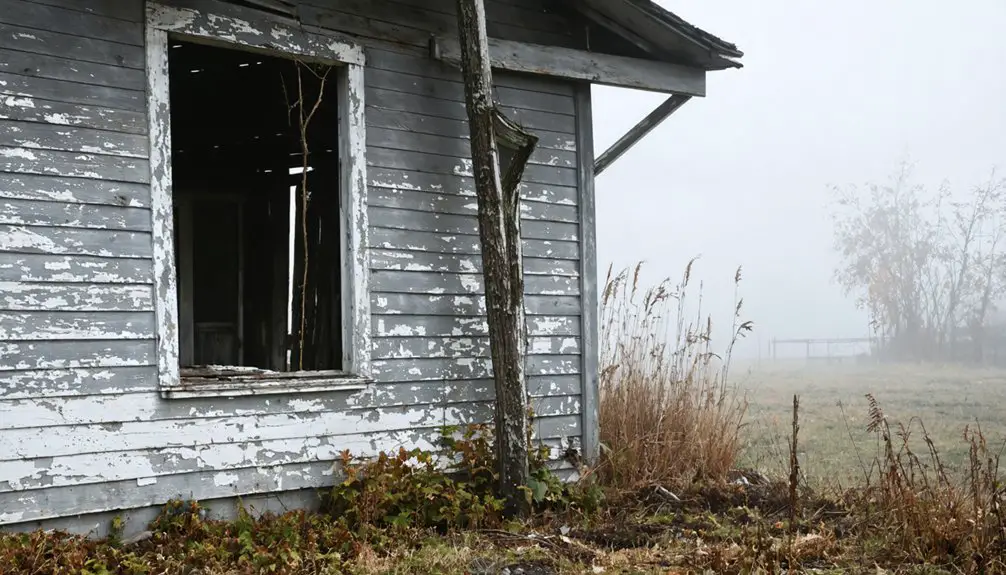
The weathered Harlan Church stands sentinel along the highway—a solitary guardian of memories from the lumber boom that once defined this crossroads. You’ll find it’s the only original public structure still standing in Cleon Township, making it essential for capturing that perfect ghost town photograph.
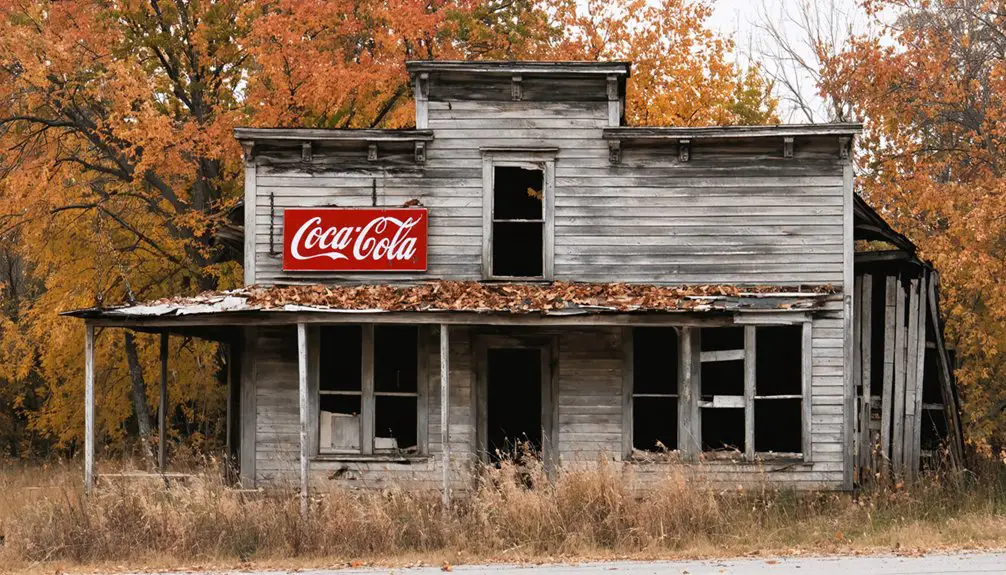
The original commercial structures—those two general stores, the blacksmith shop, and sawmills—have vanished entirely. What you’ll discover instead are sparse homes dotting the roadside southeast of Copemish, where a handful of villagers maintain their independence in this semi-abandoned settlement.
Don’t expect seasonal tourist attractions or guided tours here. The schoolhouse closed in the 1950s, leaving only potential foundations. This isn’t a preserved destination—it’s an authentic glimpse into Michigan’s forgotten lumber legacy.
Making the Most of Your Ghost Town Visit
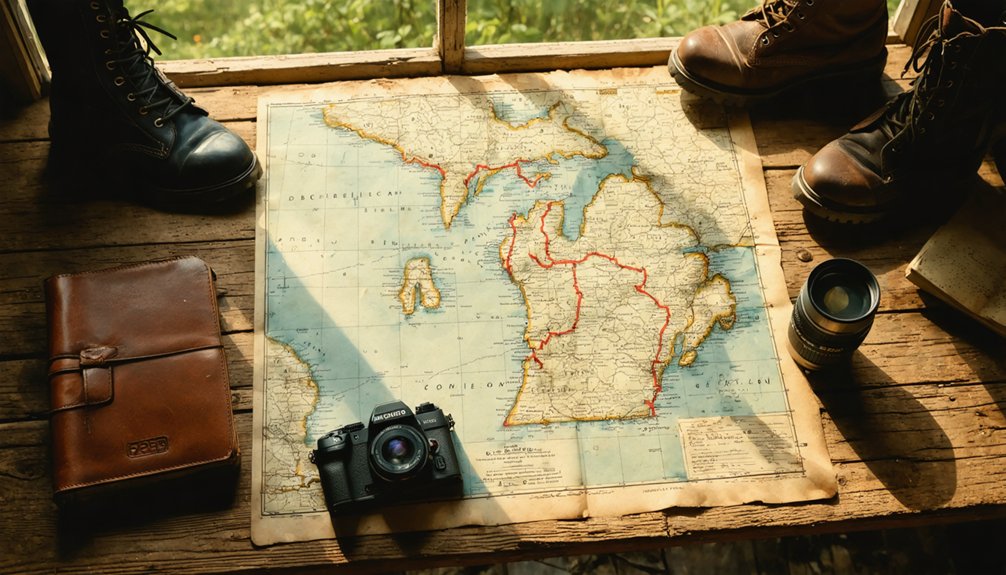
Before you set out for Cleon, arm yourself with knowledge about the township’s layered history—understanding that what appears as empty roadside today once bustled with competing railroad lines and multiple sawmill villages. Create your own self guided historical tours by mapping surviving structures like Harlan’s old church and the deteriorating boathouse near Indian Hill Road Bridge.
Maximize your ghost town exploration:
- Pack detailed maps marking former village sites of Harlan, Pomona, and surrounding settlements
- Visit nearby Fayette Historic Townsite’s interactive museum exhibits showcasing authentic 1867-1891 buildings for context
- Photograph remnant log piles and railroad infrastructure before they vanish completely
You’ll discover freedom in wandering unmarked crossroads where sawmills once roared, piecing together stories that no tourist trap could manufacture.
Frequently Asked Questions
Are There Any Restaurants or Gas Stations Near Cleon and Harlan?
You won’t find amenities availability in ghost town Cleon or Harlan. Head to nearby Clio for restaurants like Lucky’s Steak House and fuel stations. These local attractions disappeared long ago, so fuel up before exploring these abandoned freedom roads.
Is It Safe to Explore the Old Church and Remaining Structures?
View from the road only—most ghost towns see 70% of structures privately owned. Potential hazards include unstable floors and liability concerns if you’re trespassing. You’ll capture great photos safely from public highways without risking injury or legal trouble.
What’s the Best Time of Year to Visit These Ghost Towns?
Visit during shoulder season—late spring or early fall—when you’ll dodge crowds and enjoy ideal weather conditions. Pack layers for Michigan’s unpredictable shifts, and you’ll experience vibrant foliage or wildflowers while exploring freely without summer’s tourist crush.
Can You Camp Overnight in the Cleon Township Area?
You won’t find camping facilities directly in Cleon Township, but you’ve got excellent nearby alternatives. Tippy Dam Recreation Area sits closest on the Manistee River, offering rustic sites year-round. Monument Campground and Camp Deer Trails provide more amenities within easy driving distance.
How Long Should I Plan to Spend Exploring Harlan and Copemish?
You’ll want about 45 minutes in Harlan for the old church’s historical significance, then another hour in nearby Copemish. The scenic views along the route between them make this freedom-filled backroad adventure absolutely worth your time.
References
- https://99wfmk.com/harlanmi/
- https://lostinmichigan.net/a-michigan-ghost-town-church/
- https://www.cleontownship.com/history
- https://kids.kiddle.co/List_of_ghost_towns_in_Michigan
- https://rivergrandrapids.com/copemish-michigan-2018/
- https://en.wikipedia.org/wiki/Cleon_Township
- https://en.wikipedia.org/wiki/List_of_ghost_towns_in_Michigan
- https://www.zipdatamaps.com/en/us/zip-maps/mi/township/borders/cleon-township-zip-code-map
- https://www.mapquest.com/us/michigan/cleon-mi-364492904
- https://www.mapquest.com/us/michigan/cleon-township-hall-350731520