Coles Settlement — now called Independence — sits quietly along F.M. 50, waiting for curious travelers willing to leave the main roads behind. You’ll find Sam Houston’s baptism site, the original Baylor University ruins, and seventy-seven preserved nineteenth-century homes packed into a town of just 140 people. It’s a ghost town that never fully disappeared. Stick around, and you’ll discover why this tiny Texas crossroads carries an outsized piece of the state’s most defining history.
Key Takeaways
- Coles Settlement, now called Independence, was founded in 1824 by John P. Coles and renamed in 1836 to commemorate Texas’s Declaration of Independence.
- Take F.M. 50 from Brenham to Independence, then follow F.M. 390 west to explore the town’s historical landmarks and Old Baylor ruins.
- Visit mid-April for peak bluebonnet blooms along the scenic F.M. 390 drive past Old Baylor’s preserved ruins.
- The Historical Center and museum are open Wednesday through Saturday, 10 a.m. to 4 p.m., offering access to old records and family histories.
- Independence retains seventy-seven nineteenth-century homes and key attractions, including the Antiquity Rose Emporium and Independence Baptist Church, Sam Houston’s conversion site.
What Was Coles Settlement and Who Founded It?
Coles Settlement got its start in 1824 when John P. Coles, a North Carolina native born in 1793, staked his claim in what’s now northern Washington County, Texas. He was one of Stephen F. Austin‘s legendary Old Three Hundred, the pioneering colonists who helped shape early Texas.
Coles established a mill operation and built a community around it, giving the settlement its original name: Coles Settlement. You can trace the Coles Settlement origins directly to this frontier energy — French families, Austin recruits, and determined homesteaders all carved out lives here along a tributary of Yegua Creek.
Then came 1836. When Texas declared its independence, locals renamed the town Independence to honor that defining moment.
The name changed, but the pioneering spirit of John P. Coles never faded.
How Independence, Texas Got Its Name in 1836
When you trace the town’s name back to its roots, you’ll find a deliberate act of patriotism at work.
In 1836, residents renamed Coles Settlement “Independence” to commemorate the signing of the Texas Declaration of Independence, forever linking the town to a pivotal moment in Lone Star history.
It’s a bold naming choice that gives your road trip an extra layer of meaning before you’ve even arrived.
Coles Settlement Becomes Independence
Settled in 1824 by John P. Coles, one of Stephen F. Austin’s original Old Three Hundred colonists, this northern Washington County community first carried the name Coles Settlement.
Coles established a mill operation along Yegua Creek, drawing early settlers — including French families and Austin recruits — who built an agricultural foundation that defined the frontier economy.
Then came 1836. When Texas declared its independence, residents renamed the settlement Independence to commemorate that transformative moment.
The name change wasn’t merely symbolic — it reflected the cultural heritage and fierce freedom these colonists embodied.
That historical significance still resonates today.
You’ll find the town square once planned for a Washington County courthouse, reminding you that Independence nearly became something far larger than the quiet rural community you’ll explore on your road trip.
Commemorating Texas Declaration Signing
The year 1836 changed everything for this small Texas settlement. When Texans signed the Declaration of Independence, the community seized the moment, renaming itself Independence to honor that bold act of freedom.
It’s a powerful historical significance you can still feel walking through town today.
This town transformation wasn’t just symbolic — it reflected the fierce independent spirit driving settlers like John P. Coles, who’d carved this community from frontier wilderness.
They wanted their home’s name to echo that defining moment in Texas history.
As you plan your road trip, consider what it means to stand where that patriotic pride took root.
The name Independence wasn’t chosen casually; it was a declaration in itself, permanently connecting this community to Texas’s fight for freedom.
Sam Houston’s Surprising Chapter in Coles Settlement
When you visit Coles Settlement, you’ll discover that Sam Houston himself once called this small community home, living here from 1853 to 1858.
During those years, Houston experienced a profound personal transformation, converting to Christianity at Independence Baptist Church in 1854.
You can still visit the very church where Dr. R. C. Burleson baptized the legendary Texas statesman, making this stop one of the road trip’s most unexpectedly powerful moments.
Houston’s Years In Independence
Few visitors expect to discover that one of Texas’s most legendary figures once called this quiet settlement home, but Sam Houston lived in Independence from 1853 to 1858—a surprisingly intimate chapter in the life of a man better known for commanding armies and governing republics.
During these years, Houston’s influence extended beyond politics into personal transformation. In 1854, he converted at Independence Baptist Church and was baptized by Dr. R. C. Burleson—a moment of profound historical significance that still resonates at the site today.
Standing where Houston once walked, you’ll feel the weight of that legacy differently than any textbook delivers it. The church, organized in 1839 as Texas’s third oldest Baptist congregation, remains active, connecting you directly to this remarkable intersection of faith and frontier history.
Faith And Baptism Here
Redemption came quietly to Sam Houston in 1854, right here in Independence Baptist Church—a moment that surprises most visitors who know him only as the general who won Texas its independence or the governor who refused to support the Confederacy.
Dr. R. C. Burleson performed the baptism, adding Houston’s name permanently to this congregation’s baptism history. The church itself, organized in 1839, carries deep faith traditions as Texas’s third oldest Baptist church.
When you visit, consider what this place represented:
- A frontier community where spiritual conviction shaped public leaders
- A congregation that welcomed one of history’s most complicated figures
- A living institution still active today, not merely a historical footnote
You’re standing where personal transformation intersected with Texas history.
The Baylor University Connection Most Visitors Miss
Tucked into the rolling hills of Washington County, Independence holds a secret that most Texas history buffs overlook entirely: it’s the birthplace of Baylor University.
The university launched its first year of operation here in 1846, with upper-level studies following in 1847. You can still walk the original campus grounds, now preserved as Old Baylor ruins, where the Baylor Legacy began before economic decline forced relocation.
Baylor University launched here in 1846, its legacy born on grounds you can still walk today.
Drive half a mile west on F.M. 390 to reach the site. Historical Preservation efforts have kept the ruins accessible, with exhibits greeting you at the campus entrance.
The museum, open Wednesday through Saturday from 10 a.m. to 4 a.m., contains old records and family histories. Most visitors drive right past it—don’t make that mistake.
Why Independence Never Recovered From the Railroad
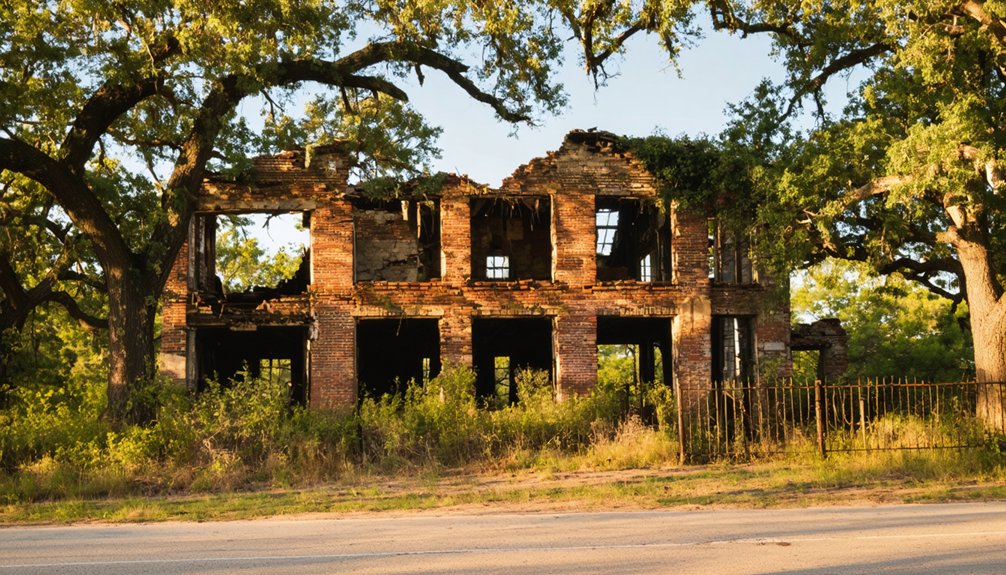
Walking away from Old Baylor’s ruins, you start to wonder why a town with this much history never grew into something bigger. The answer comes down to railroad impact and pure bad luck.
When railroad lines expanded across Texas, every route bypassed Independence completely, and that economic decline hit fast and hard. Other towns along those tracks absorbed the commerce, the settlers, and the future that Independence never got.
- Brenham beat Independence by just two votes for the Washington County courthouse
- Railroad tracks stretched in every direction but never reached the town
- Younger residents left for opportunity elsewhere, shrinking the population to roughly 140 today
You’re fundamentally standing in a town that history sidestepped, which makes exploring it feel even more rewarding.
What Remains: Ruins, Roses, and Graves Worth the Drive
Despite being bypassed by history’s biggest opportunities, Independence rewards curious visitors with an unexpected richness of surviving landmarks. You’ll discover seventy-seven nineteenth-century homes standing as evidence to historic architecture and preservation efforts that refused to let this place disappear quietly.
Walk the Old Baylor ruins, where cultural heritage and historical significance intersect at the university’s original campus. The scenic views along F.M. 390 make the drive itself worthwhile, especially during bluebonnet season.
You’ll find local legends alive at Independence Baptist Church, where Sam Houston converted in 1854. The cemetery holds stories carved in stone, connecting you directly to agricultural roots that built this region.
Stop at the Antiquity Rose Emporium, where older rose varieties bloom alongside native plants, honoring the community’s botanical heritage with living beauty.
When to Visit Independence for Bluebonnets Near Old Baylor
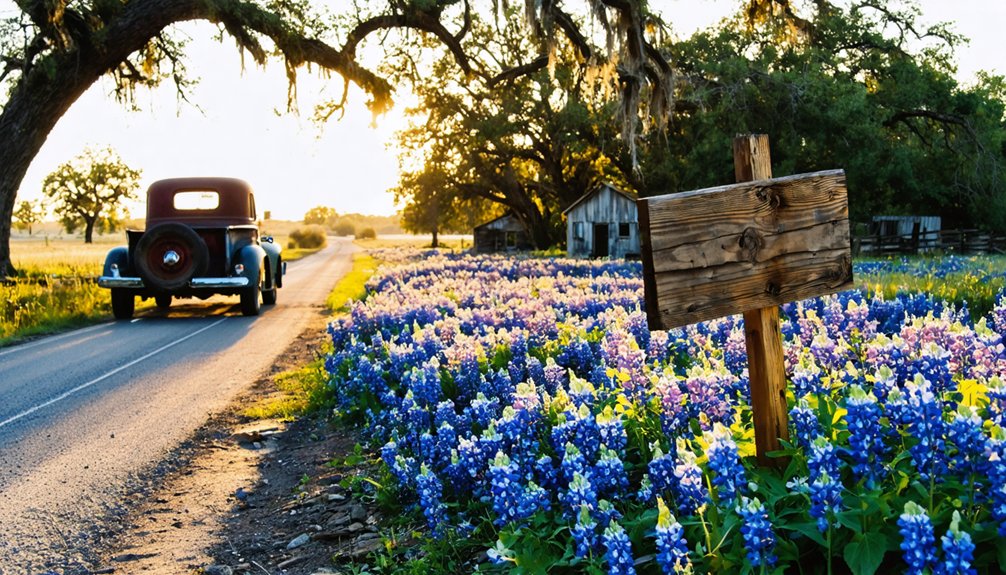
Timing your visit around mid-April puts you at Independence when bluebonnets peak along F.M. 390, transforming the route past Old Baylor’s ruins into one of Texas’s more quietly spectacular drives.
Mid-April transforms F.M. 390 into something rare — bluebonnets framing Texas history at its quietest and most spectacular.
You’ll want to arrive on a weekday to explore the historic trails without crowds, giving you space to absorb both the scenery and the history simultaneously.
- Museum access: Wednesday through Saturday, 10 a.m. to 4 p.m., pairs perfectly with morning bluebonnet blooms along the eastern stretch of F.M. 390
- Nursery visit: Antiquity Rose Emporium opens Tuesday through Saturday, 9 a.m. to 6 p.m., offering native plants alongside your wildflower experience
- Church grounds: Independence Baptist Church remains active, so respect services while walking the surrounding landscape
Spring gives you everything here at once.
How to Get to Independence, Texas on F.M. 50
Few roads in Central Texas deliver a ghost town experience as efficiently as F.M. 50, which carries you directly into Independence from Brenham just a few miles to the south.
This is one of those Historic Routes that rewards every mile with rolling terrain, open pastures, and glimpses of a vanished era.
Once you reach the F.M. 390 intersection, you’re at the heart of what remains.
Head west on F.M. 390 to reach the Old Baylor ruins, where Scenic Views stretch in both directions along the roadway.
The museum sits right at the junction, making it your natural starting point.
No complicated navigation required — just point north on F.M. 50 out of Brenham, and Independence finds you.
What to Expect When You Visit Independence Today
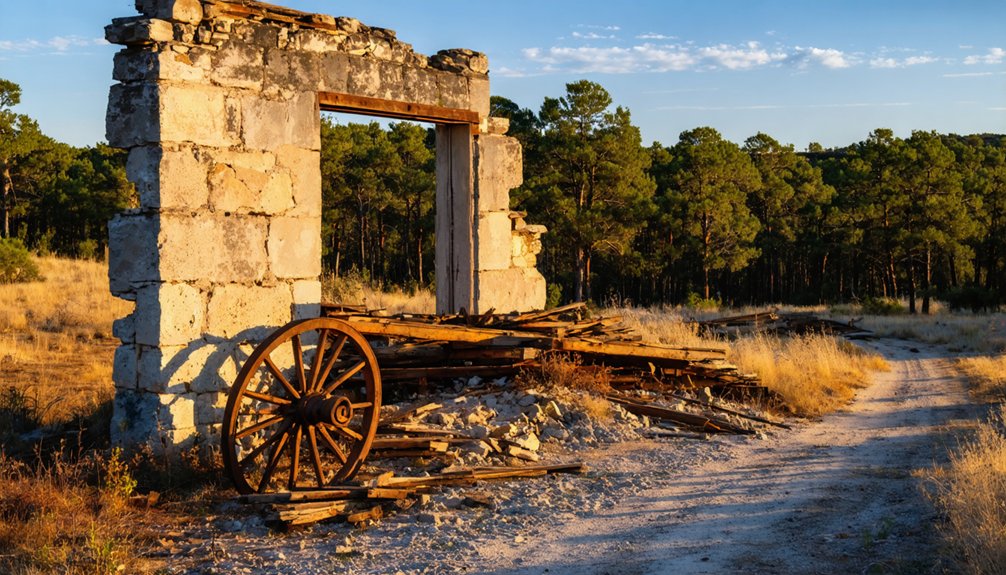
Stepping into Independence feels like arriving somewhere time forgot but never quite abandoned.
Stepping into Independence feels like arriving somewhere time forgot but never quite abandoned — a town that remembers everything.
You’ll find 77 historic nineteenth-century homes still standing, ruins of Old Baylor University, and an active Baptist church where Sam Houston converted in 1854. These historical landmarks tell stories no museum can fully capture.
Explore local heritage through these key stops:
- Historical Center – Old records, family histories, and exhibits open Wednesday through Saturday, 10 a.m. to 4 p.m.
- Old Baylor Ruins – Half a mile west on F.M. 390, offering scenic views and restored structures
- Antiquity Rose Emporium – Native plants and heritage roses Tuesday through Sunday near F.M. 50
You’re not visiting a frozen exhibit.
You’re walking through a living, breathing fragment of Texas history.
Frequently Asked Questions
Are There Any Restaurants or Dining Options Available in Independence?
You won’t find formal dining experiences in Independence, as it’s a rural community with minimal commercial development. Pack your own local cuisine and enjoy the modern picnic facilities available at the historic site!
Is There an Admission Fee to Visit the Old Baylor Ruins?
You won’t believe it — exploring the ghost town history and Baylor significance at Old Baylor ruins won’t cost you a thing! You can freely roam this enchanting historic site without paying any admission fee.
Can Visitors Stay Overnight Near Independence, Texas?
You’ll find camping options and local accommodations near Independence, Texas! Brenham sits just a few miles south, offering hotels and cozy bed-and-breakfasts. Lake Somerville’s nearby parks also provide fantastic camping options for freedom-seeking adventurers like you!
Are the Historic Homes in Independence Open for Interior Tours?
You’ll find Independence’s 77 historic homes showcase stunning historic architecture from the outside, but interior tours aren’t confirmed. You can still explore local legends by wandering freely past these enchanting nineteenth-century treasures lining the quiet streets.
Is Independence, Texas Accessible for Visitors With Mobility Limitations?
The knowledge doesn’t detail mobility accessibility specifics, but you’ll find visitor resources like the museum, gardens, and historic sites spread across manageable outdoor spaces, making Independence explorable if you’re comfortable traversing rural terrain and uneven ground.
References
- https://www.texasescapes.com/TOWNS/Independence/IndependenceTexas.htm
- https://www.ghosttowns.com/states/tx/independence.html
- https://en.wikipedia.org/wiki/List_of_ghost_towns_in_Texas
- https://www.co.washington.tx.us/page/washington.independence
- https://www.ghosttowns.com/states/tx/tx.html
- https://texashistory.unt.edu/ark:/67531/metapth61101/m1/171/
- https://texashistory.unt.edu/ark:/67531/metapth61101/m1/167/
- https://texashistory.unt.edu/ark:/67531/metapth61101/m1/170/
- https://www.texasescapes.com/Texas-Ghost-Towns-A-to-Z.htm
- https://www.tshaonline.org/handbook/entries/coles-john-p