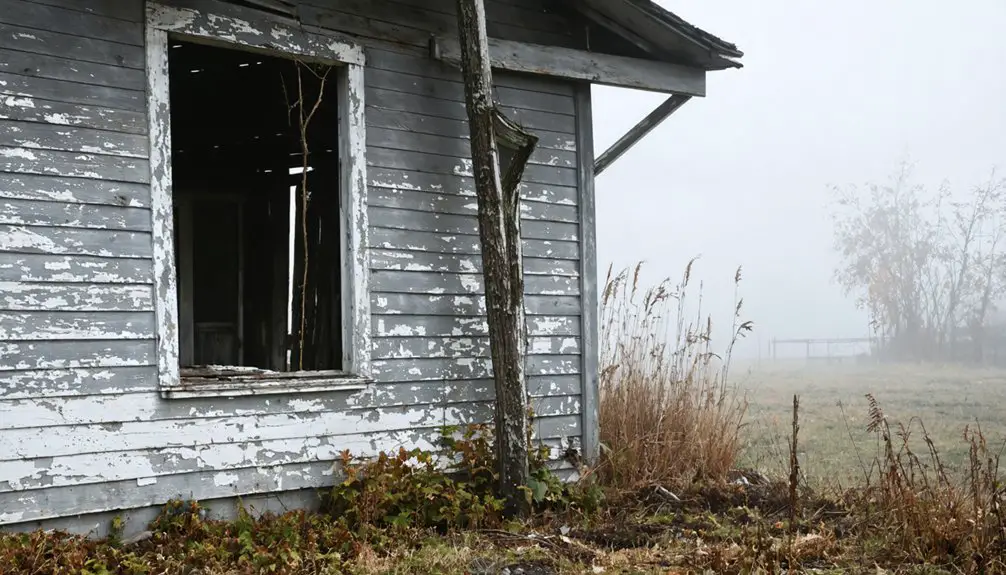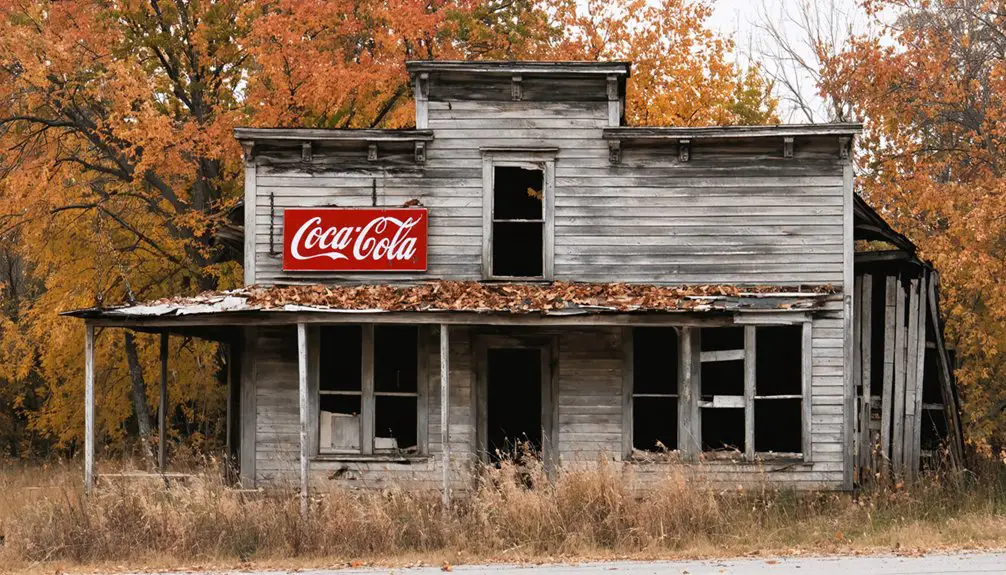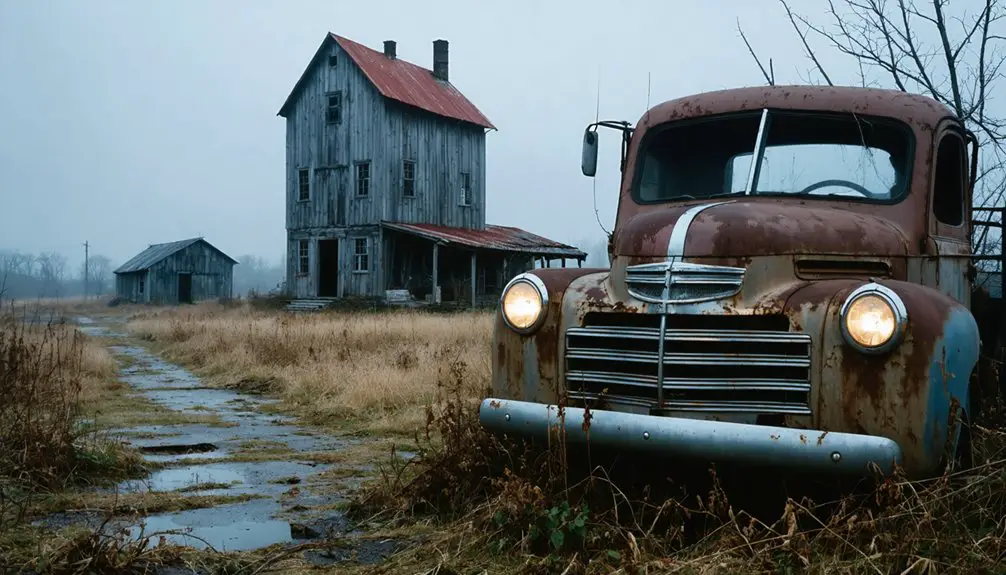
Dighton, Michigan sits about 12 miles south of Cadillac in Osceola County, and it’s one of the state’s most overlooked ghost towns. At its peak, it supported nearly 1,000 residents, three lumber mills, and a railroad station before timber depletion gutted the economy. Today, you’ll find crumbling storefronts, an 1887 general store, and a forgotten original town site a mile northeast. There’s far more to this place than most ghost town guides ever reveal.
Key Takeaways
- Dighton is located in Osceola County, Michigan, approximately 12 miles south of Cadillac, at the intersection of 130th Avenue and 19 Mile Road.
- Notable landmarks include the Victor Rolfe General Store from 1887, the Dighton General Store, and remnants of a one-room schoolhouse.
- Approach from the north via 20 Mile Road, avoiding the eastbound stretch of 19 Mile Road due to washboard dirt conditions.
- Pack essential gear including sturdy closed-toe shoes, insect repellent, water, a first aid kit, and a camera for exploration.
- Bring a physical map or offline GPS, as cell coverage is unreliable throughout the Dighton area.
Where Dighton, Michigan Actually Is
Tucked into Sherman Township in Osceola County, Dighton sits roughly 12 miles south of Cadillac — close enough to civilization but just far enough to feel forgotten.
Its geographical significance becomes clear when you realize this quiet crossroads once hummed with life, lumber, and local legends dark enough to make your skin crawl.
You’ll find the old downtown at the intersection of 130th Avenue and 19 Mile Road.
Pull up Google Maps and search Dighton General Store, because the town itself has vanished from some maps entirely — fitting for a place that’s half ghost already.
The original townsite sits one mile northeast on 20 Mile Road, marked only by an old foundation.
That’s your first clue you’re chasing something real, raw, and worth the drive.
How Dighton Went From 1,000 Residents to Almost Nobody
When you look at Dighton’s history, you can see how a logging boom once pushed its population to around 1,000 residents, supporting three lumber mills, a railroad station, churches, and even a telephone company.
But like so many Michigan ghost towns, Dighton’s fate was tied directly to its timber, and once the surrounding forests were stripped bare, the economic engine stalled fast.
You’re fundamentally walking through the aftermath of that collapse today, where abandoned storefronts and a handful of structures are all that remain of a once-thriving settlement.
Logging Boom Fuels Growth
Before the railroad arrived and reshuffled everything, Dighton thrived as a legitimate boomtown, pulling nearly 1,000 residents into its orbit during the late 1880s.
Three lumber mills ran hard, shaping the town’s logging history and cementing its lumber legacy deep into Osceola County’s identity. You’d have found a railroad station, telephone company, stagecoach stop, churches, and a one-room schoolhouse all packed into this small northern Michigan settlement.
The Victor Rolfe General Store went up as a false-front building, and the David Family Store opened in 1887. Dighton wasn’t surviving — it was genuinely alive.
Timber drove every nail, funded every business, and kept every family fed. Once the trees disappeared, though, so did the reason to stay.
Resource Exhaustion Triggers Decline
Once the timber ran out, Dighton didn’t slowly fade — it collapsed. The three lumber mills that powered the local economy had no resource management strategy keeping them sustainable. They cut, they profited, and they left.
Without economic sustainability, the businesses that depended on those mills had nothing to anchor them. The railroad station went quiet. The telephone company disappeared. The dance halls, schools, and churches — once signs of a thriving community — emptied out fast.
You’re now driving through what remains of a town that peaked at 1,000 residents and burned through its future without a second thought.
Dighton didn’t die from neglect. It died from success that nobody planned beyond the last tree.
The Murders and Mayhem Nobody Writes About
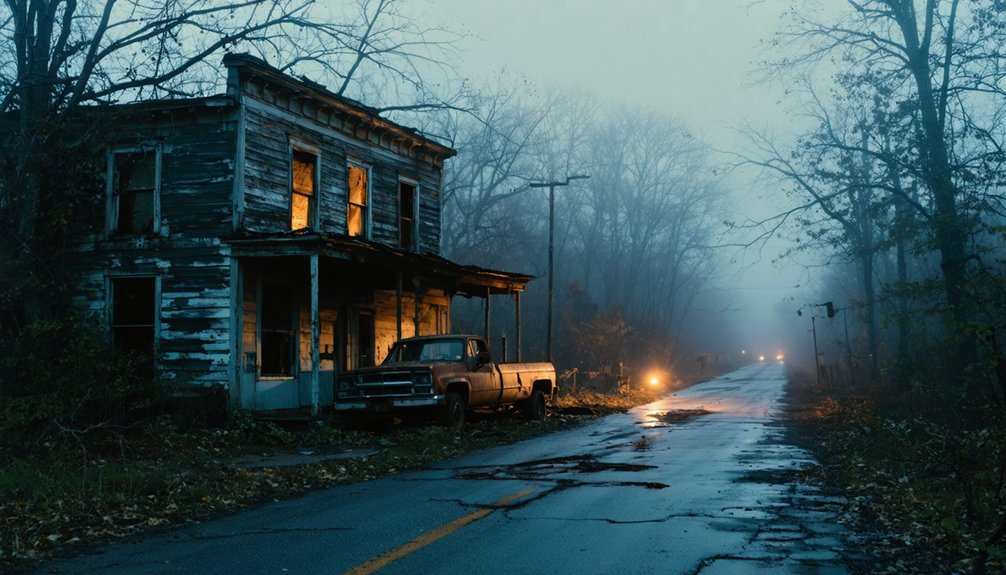
Dighton’s past carries a darkness that most ghost town guides skip right over, but you’ll feel it when you walk those quiet streets.
In 1868, Daniel White was murdered here because of his skin color, a brutal act that haunts the town’s early history.
The violence didn’t stop there—a dance hall once stood in Dighton until a night of chaos ended with a man thrown from a second-story window and the whole building burning to the ground.
Daniel White’s Tragic Murder
Though Dighton’s wild past included a dance hall burning down after someone threw a man from a second-story window, perhaps the darkest chapter in the town’s history is one that rarely gets told.
In 1868, someone murdered Daniel White because of his skin color. This act of racial violence carries deep historical significance, reminding you that Dighton’s story isn’t just about lumber and railroads.
When you visit, consider what this town witnessed:
- A community named after Dighton Marvin, built on both ambition and brutality
- A murder rooted in racial hatred during Reconstruction-era Michigan
- A history largely omitted from mainstream ghost town narratives
You deserve the full truth of a place, not just its romanticized ruins.
The Burning Dance Hall
The dance hall didn’t just burn — it earned its fate. Before Dighton faded into ghost stories and overgrown foundations, it ran wild. The kind of wild that ends with someone getting thrown from a second-story window of a dance hall. Whatever happened next, fire settled the score.
You won’t find this story on a historical marker. Nobody’s preserving it in a pamphlet. But when you stand at that quiet intersection of 130th Avenue and 19 Mile Road, you’re standing where people once lived hard and died harder.
The dance hall is long gone, reduced to ash and memory. That’s what makes Dighton worth the drive. The ghost stories here aren’t invented — they’re built from real violence, real flames, and real consequences.
Violence Shapes Dighton’s Past
The Murders and Mayhem Nobody Writes About
Before the railroad arrived and gave Dighton its second life, violence had already carved its name into the town’s foundation.
You’re walking ground soaked in raw, unfiltered history — the kind that speaks to both darkness and community resilience.
Three incidents define Dighton’s violent historical significance:
- Daniel White was murdered in 1868 solely because of his skin color.
- A man got thrown from a second-story dance hall window.
- That same dance hall later burned to the ground.
These weren’t isolated footnotes — they shaped the town’s character.
When you stand at that old intersection today, you’re not just sightseeing.
You’re acknowledging the real human cost behind every ghost town’s story.
Why Dighton Qualifies as One of Michigan’s True Ghost Towns

Once a bustling lumber town of 1,000 residents, Dighton has earned its ghost town status through a familiar Michigan story: the timber ran out, and the people followed.
Three lumber mills fell silent, the railroad lost its purpose, and buildings like Gibson’s drugstore simply disappeared.
When the last mill went quiet, the railroad followed — and Gibson’s drugstore vanished like it never existed.
What remains tells you everything about Dighton’s legacy — the abandoned Victor Rolfe General Store still stands with its false front intact, and the Dighton General Store anchors a crossroads that once hummed with stagecoaches and telephone lines.
Wikipedia and kids’ encyclopedias alike list it among Michigan’s true ghost towns.
You’re not visiting a theme park version of the past here.
These forgotten stories live in crumbling foundations and empty storefronts, waiting for curious travelers willing to seek them out.
What’s Left Standing in Dighton Today
When you pull up to the old downtown intersection of 130th Avenue and 19 Mile Road, two historic storefronts immediately catch your eye.
You’ll spot the Victor Rolfe General Store, a weathered false-front building from 1887 that still stands despite decades of abandonment, alongside the Dighton General Store, originally built by the David family that same year and still operating today.
If you look carefully, you’ll also find remnants of the one-room schoolhouse that once served Dighton’s thriving population of 1,000 residents.
Historic Stores Still Standing
Despite decades of decline, two historic stores still stand in Dighton, offering a tangible glimpse into the town’s bustling past.
These structures represent remarkable historic preservation in an otherwise forgotten landscape.
Here’s what you’ll find:
- Victor Rolfe General Store – Built in the late 1880s, this abandoned false-front building still stands, quietly holding local legends within its weathered walls.
- Dighton General Store – Originally the David Family Store, constructed in 1887, it’s actually listed on Google Maps, making navigation straightforward.
- Old Foundation – Located one mile northeast on 20 Mile Road, this original town site marks where Dighton first took root.
Walk these grounds and you’ll feel history pressing against the present, raw and unfiltered.
Abandoned Schoolhouse Remnants
Scattered across Dighton’s overgrown landscape, the remnants of a one-room schoolhouse stand as a quiet memorial to the town’s educational roots. You’ll find these abandoned structures tucked among the vegetation, whispering stories of children who once filled their walls.
During Dighton’s peak, over 1,000 residents supported a thriving community that valued education enough to build and maintain dedicated learning spaces. Ghost town preservation efforts keep these remnants accessible, though nature steadily reclaims them.
A three-story school reportedly exists somewhere nearby, though visitors have missed it entirely on previous trips. Walk carefully through the area, and you’ll piece together fragments of daily life that logging-era families once considered ordinary.
These crumbling educational relics remind you exactly what prosperity looks like when the industry sustaining it disappears.
The Victor Rolfe Store and What Else Still Survives
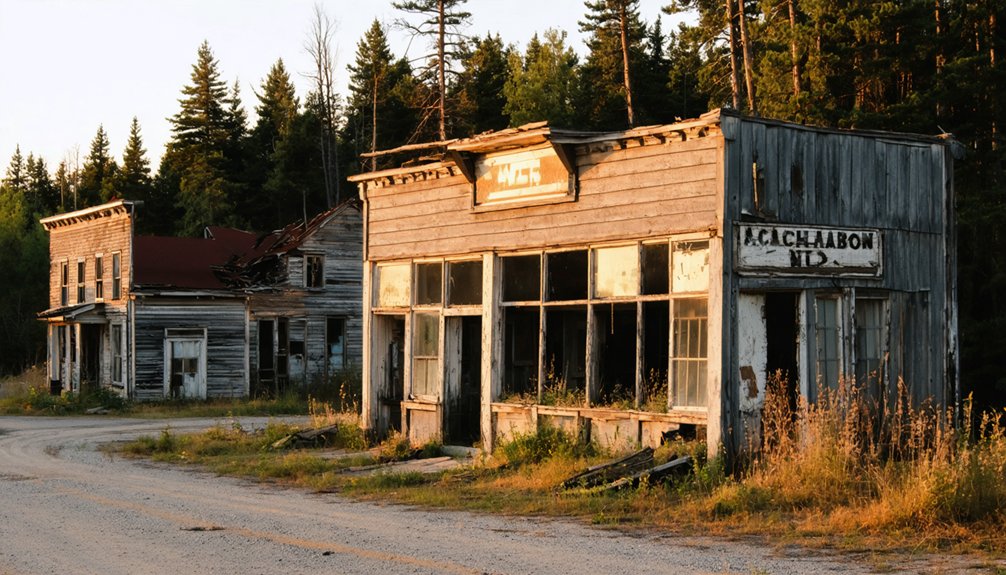
One of Dighton’s most striking survivors is the Victor Rolfe General Store, a false-front building that’s been standing since 1887 and still holds its ground today despite decades of abandonment.
It’s a rare, tangible link to Dighton’s lumber boom era.
Beyond Victor Rolfe, you’ll find other surviving structures worth your attention:
- The Dighton General Store, originally the David Family Store, built in 1887 and still operating today.
- The old foundation northeast of town on 20 Mile Road, marking where Dighton first stood.
- The one-room schoolhouse remnants, quietly decaying near the old downtown corridor.
Each stop rewards the curious traveler willing to wander off the beaten path and piece together what this once-thriving town of 1,000 residents looked like at its peak.
The Original Town Site Is Still Out There If You Know Where to Look
Before Dighton relocated in 1901 to meet the Manistee & Grand Rapids Railroad, it stood a full mile to the northeast on 20 Mile Road — and if you make the drive out there, you’ll still find the old foundation waiting in the grass.
It’s a quiet, easy-to-miss piece of hidden history, but that’s exactly what makes it worth seeking out. Most ghost town visitors stick to the current downtown intersection and never venture up to the original site.
Don’t make that mistake. Pull off, walk the ground, and let the silence do the talking. That crumbling foundation is all that’s left of where Dighton truly began — a tangible reminder that even ghost towns have their own buried past.
How to Reach Dighton Without Destroying Your Shocks
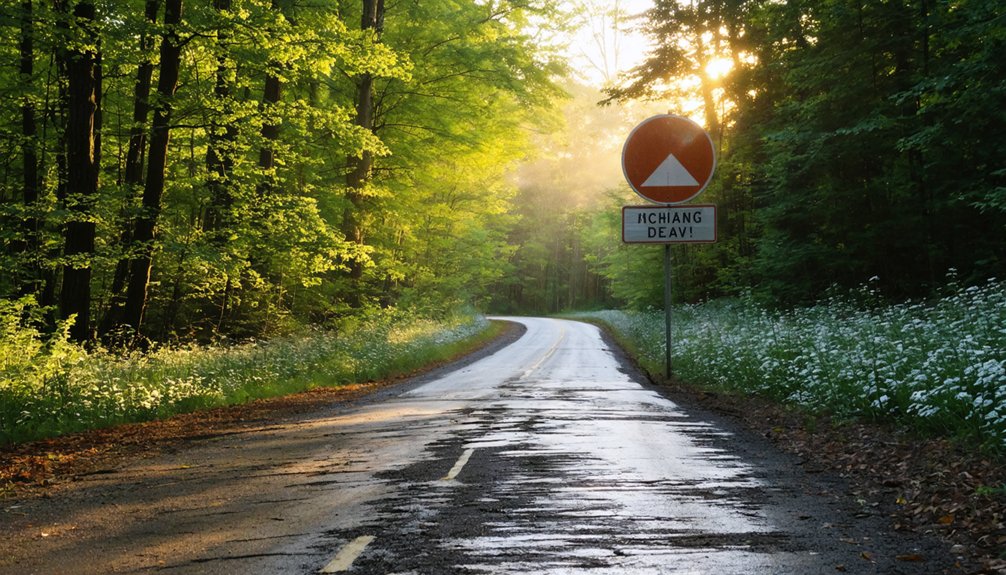
Getting to Dighton requires a bit of strategic thinking, because not every road leading there’s created equal. That eastbound stretch of 19 Mile Road is notorious washboard dirt, and it’ll punish your shocks without mercy.
Smart road condition tips can save your vehicle maintenance budget considerably.
Follow this route instead:
- Take 20 Mile Road to approach Dighton from the north.
- Head south through town, exploring at your own pace.
- Turn around and exit the same way you entered.
Avoiding 19 Mile Road eastbound keeps your suspension intact and your adventure enjoyable.
You’re out here chasing freedom and history, not repair bills. Navigate smart, protect your vehicle, and you’ll arrive ready to explore everything this forgotten Michigan town still holds.
What to Pack for Dighton’s Rough Roads and Overgrown Sites
Packing smart makes the difference between a miserable slog and a genuinely rewarding ghost town experience. Dighton’s rough terrain demands preparation, so load your vehicle with the right essential gear before heading out.
Bring sturdy, closed-toe shoes for traversing overgrown lots and uneven ground around abandoned structures like the Victor Rolfe General Store. Pack a first aid kit, insect repellent, and plenty of water since services are virtually nonexistent here.
A camera captures the haunting beauty of false-front buildings and forgotten foundations. Toss in a physical map or downloaded offline GPS since cell coverage can be unreliable in rural Osceola County.
Dress in layers, wear long pants to push through brush, and carry a flashlight if you’re exploring later in the day. Freedom favors the prepared traveler.
When Dighton’s Dirt Roads and Foundations Are Most Accessible
Timing your visit to Dighton can mean the difference between an accessible adventure and a frustrating washout. Dirt road accessibility peaks during specific windows, so plan accordingly:
- Late summer (August–September): Dry conditions firm up the washboard dirt on 19 Mile Road, making foundation exploration easier on your vehicle.
- Late spring (May–June): Vegetation hasn’t fully overtaken old structures, giving you clearer sightlines to the Victor Rolfe Store and original foundations.
- Avoid early spring: Snowmelt turns dirt roads into muddy traps, cutting off the northeast foundation site entirely.
You’ll want to approach from 20 Mile Road regardless of season, skipping the punishing eastbound stretch of 19 Mile.
Check recent weather before heading out—Dighton rewards the prepared explorer.
Frequently Asked Questions
Can You Camp Near Dighton’s Ghost Town Sites Overnight?
Imagine pitching your tent under Michigan stars! You’ll need to check camping regulations for nearby state forests. Explore Dighton’s nearby attractions by day, then find your perfect legal campsite to rest your adventurous spirit overnight.
Are There Guided Tours Available for Dighton’s Historic Locations?
You won’t find formal guided tours in Dighton, but you’re free to explore its historic significance independently. Wander the abandoned storefronts, uncover local legends, and let Dighton’s raw, untamed history speak directly to your adventurous spirit.
Is the Dighton General Store Still Selling Products Today?
You’ll find the Dighton General Store still operating today! It’s a living piece of Dighton history, where you can browse store inventory while soaking up the authentic, rustic charm of this fascinating Michigan ghost town.
Are There Any Annual Events or Festivals Held in Dighton?
The knowledge doesn’t confirm any annual events or festivals in Dighton, but you’ll find its haunted history and local legends intriguing enough to explore year-round, making every visit feel like your own personal discovery adventure.
What Other Ghost Towns Are Located Near Dighton, Michigan?
Michigan’s got over 100 ghost towns! Near Dighton, you’ll find several abandoned structures steeped in local legends. Explore nearby Tustin, Falmouth, and Luther — each former logging boomtown offering you the freedom to uncover forgotten history throughout Osceola County.
References
- https://99wfmk.com/dighton-michigan/
- https://www.nailhed.com/2016/09/dawn-patrol.html
- https://kids.kiddle.co/List_of_ghost_towns_in_Michigan
- https://en.wikipedia.org/wiki/List_of_ghost_towns_in_Michigan
- https://privatelandswildlife.com/ghost-towns-michigan/