Starting in Deadwood, you’re just 10 miles from one of the Black Hills’ most unconventional ghost towns. Trojan, South Dakota doesn’t offer wooden storefronts or saloon facades — an open-pit mine swallowed the entire townsite by the 1980s. You’ll navigate US-85 south toward Lead, park along forest service roads, and hike through pine-covered terrain to scattered concrete foundations. It’s a raw, rewarding experience unlike any traditional ghost town, and there’s far more to this story than meets the eye.
Key Takeaways
- Trojan is located 10 miles from Deadwood; navigate US-85 south toward Lead, following local signage around the Wharf Mine to reach the area.
- The Wharf Mine’s expansion erased Trojan’s townsite, leaving only scattered concrete and stone foundations in surrounding pine-covered woods to explore.
- Research current Wharf Mine boundary maps before visiting, as active mining operations restrict access to certain areas for safety and legal reasons.
- Wear sturdy boots and bring walking sticks, as short hikes through uneven terrain lead to the scattered foundational remnants throughout the woods.
- Enhance your trip by visiting nearby ghost towns like Rochford and Mystic, offering a richer Black Hills mining history experience overall.
What Made Trojan, South Dakota a Ghost Town?
When gold fever swept through the Black Hills in 1877, prospectors flooded Bald Mountain and Green Mountain, transforming a rugged stretch of Lawrence County into a thriving mining community.
The Trojan Mining Company consolidated claims by 1900, and Bald Mountain Mining Company took over in 1928, keeping operations alive for decades.
By 1900, the Trojan Mining Company had consolidated its claims — Bald Mountain Mining Company carrying the torch nearly three decades later.
But mining decline hit hard, and by 1959, everything shut down. Rails were pulled up in 1960, homes emptied, and Trojan’s ghost town origins became official — though one resident, Alvin Carlson, still lived there when promoters already labeled it abandoned.
The 1983 Wharf Mine expansion erased what little remained, swallowing the entire townsite into an open pit.
You’re chasing a community the earth literally reclaimed.
What’s Actually Left to See at the Trojan Townsite?
Honestly, there’s not much left to see — and that’s the brutal truth about Trojan. The Wharf Mine swallowed the entire townsite in 1983, leaving nothing but a massive open pit where homes and mills once stood. Even the Bald Mountain Mill disappeared completely.
What you *can* find are foundational remnants scattered through the surrounding woods — concrete and stone outlines quietly reclaiming their place under pine needles and brush. These fragments carry real historical significance, connecting you directly to the miners and artists who once called this mountain community home.
Approach carefully, respecting active mine boundaries. Bring the “Vanished South Dakota” documentary as your visual guide before visiting.
Sometimes knowing what *was* there makes the empty landscape speak louder than standing structures ever could.
The 1970s Artist Community That Briefly Revived Trojan

Before the Wharf Mine swallowed Trojan whole, a surprising cast of hippies and free-thinkers breathed new life into the abandoned mountaintop town during the 1970s, drawn by dirt-cheap housing and the romance of high-altitude isolation.
You can imagine them snapping up weathered homes for as little as $7,000, then discovering old telegraphs and letters tucked in attics like hidden dispatches from Trojan’s gold-rush past.
Local newspapers even celebrated their presence, calling it a “Small City of Talented Citizens,” a creative community of poets, painters, singers, and woodcarvers who carved out a quirky legacy in a town the world had already written off.
Bohemian Settlers Discover Trojan
After the mines fell silent and the last rails were pulled up in 1960, Trojan didn’t simply fade into obscurity — it attracted an unlikely second act.
By the 1970s, hippies and free-thinkers had discovered what the mining corporations left behind: dirt-cheap housing perched high in the Black Hills. Properties sold for as little as $7,000, making Trojan irresistible to anyone craving a bohemian lifestyle far from mainstream constraints.
These settlers transformed the abandoned mountaintop into a genuine hub of artistic expression. Poets, singers, woodcarvers, and painters carved out a creative community locals nicknamed “the hole in the sky.”
They even unearthed old telegraphs and letters from the early 1900s tucked inside attics — ghost town artifacts hiding in plain sight, waiting for the right people to find them.
Creative Community Leaves Legacy
Their presence didn’t go unnoticed. A 1970s newspaper celebrated Trojan’s unexpected renaissance, running the headline “Small City of Trojan Has Talented Group of Citizens.” That headline captured something real — this forgotten mining town had quietly become an artistic legacy worth remembering.
These creative settlers left behind more than memories. They documented stories, preserved artifacts, and breathed human warmth into abandoned structures before the Wharf Mine erased everything.
Their cultural impact echoes through “Vanished South Dakota: Towns of Yesterday,” where former residents share firsthand accounts of mountaintop living.
When you research Trojan today, you’re fundamentally chasing their stories. The foundations scattered in nearby woods aren’t just mining relics — they’re also remnants of a thriving bohemian experiment that briefly made a ghost town feel gloriously alive again.
How to Reach Trojan Without Crossing Wharf Mine
Starting your journey in Deadwood, head south on US-85 toward Lead.
Then watch for local signage directing you around the active Wharf Mine‘s restricted boundaries, which cut off direct access to the original Trojan townsite.
You’ll need to navigate carefully along the mine’s perimeter roads, respecting all posted boundary markers since trespassing on active mining land carries serious legal consequences.
Once you’ve identified a safe pull-off near the surrounding woods, you can park and walk toward the scattered foundations that remain as the ghost town‘s only visible evidence.
Starting Point From Deadwood
Deadwood sits just 10 miles from the ghost town of Trojan, making it the ideal launching point for your Black Hills exploration.
Deadwood history runs deep with gold mining roots that mirror Trojan’s own story, giving you rich context before you even hit the road.
Head south on US-85, then cut west through the Black Hills terrain toward Lawrence County. You’ll navigate around the active Wharf Mine boundaries, so stay alert to posted signage marking restricted zones.
The drive takes roughly 20 minutes, winding through pine-covered ridgelines with Terry Peak visible on your horizon.
Pack your map, because GPS signals can drop in these hills.
Starting from Deadwood grounds your journey in the same restless frontier spirit that once built Trojan from nothing.
Because the Wharf Mine swallowed the original Trojan townsite whole, you can’t simply drive to where the buildings once stood. Safe navigation here means respecting active mining boundaries while still exploring what remains.
Follow these steps for responsible access:
- Research current Wharf Mine boundary maps before departing Deadwood, as operational zones shift regularly.
- Stay on Lawrence County public roads running along Bald Mountain’s perimeter, where scattered foundations appear in the surrounding woods.
- Watch for posted mining signs marking restricted zones — crossing them isn’t just illegal, it’s dangerous.
You’re fundamentally circling a massive hole in the ground where history once breathed.
The real discoveries happen at the woodland edges, where foundations peek through decades of pine needles and forgotten stories still wait.
Safe Parking Near Foundations
Once you’ve mapped the Wharf Mine’s outer boundaries, finding a safe place to park becomes your next puzzle. Your parking options are limited but workable — pull off along forest service roads near Terry Peak, where shoulder space accommodates vehicles without blocking traffic.
From there, you’ll hike short distances through pine-covered terrain toward scattered foundation remains.
Foundation safety demands your full attention once you’re on foot. These stone remnants sit unevenly in the earth, often hidden beneath decades of undergrowth and loose soil.
Step carefully around edges, never inside sunken areas where ground stability is uncertain. Bring sturdy boots and a walking stick for uneven terrain.
You’re fundamentally a detective here, piecing together Trojan’s story from what little the Wharf Mine left behind — broken stone, quiet woods, and imagination.
Other Black Hills Ghost Towns Worth Adding to Your Route
While Trojan makes for a fascinating destination, the Black Hills region hides several other ghost towns that’ll reward curious travelers willing to explore beyond the well-worn Deadwood tourist trail.
The area’s rich mining heritage runs deep, and ghost town legends echo through every canyon.
Add these stops to your route:
- Deadwood – Though touristy, its preserved Wild West core anchors your understanding of Black Hills boom-era history.
- Rochford – A quieter settlement with surviving structures and authentic atmosphere minus the crowds.
- Mystic – Tucked into a narrow valley, this former logging and mining community offers foundations and genuine solitude.
Each destination layers another dimension onto your Black Hills experience, transforming a single-stop trip into a genuinely immersive journey through South Dakota’s independent, untamed past.
What to Know Before You Drive Out to Trojan
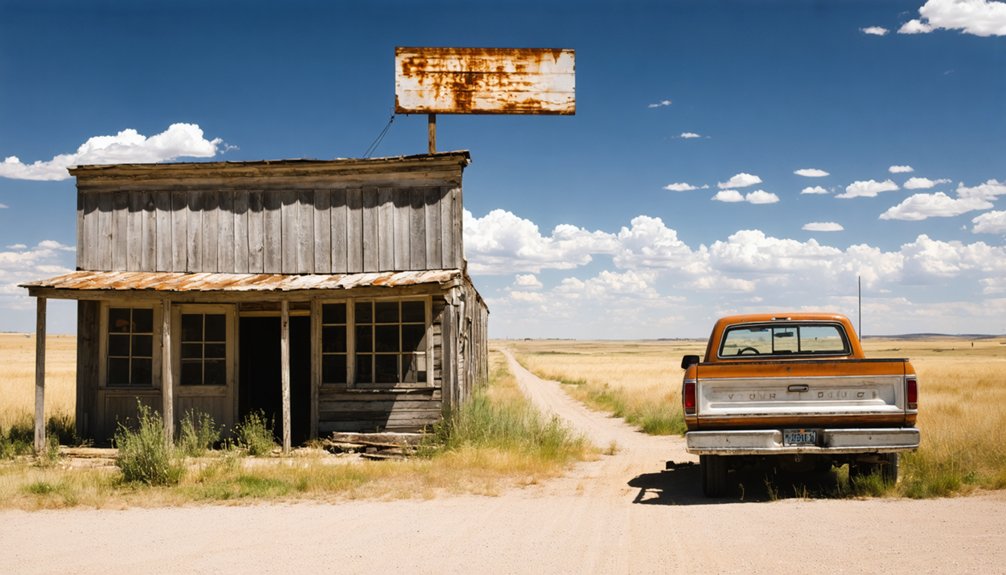
Before you load up the car and head toward Lawrence County, there’s some hard truth worth knowing: Trojan doesn’t exist in any conventional ghost town sense anymore.
Before you load up the car and head to Trojan, accept this hard truth: there’s nothing left to find.
The open-pit Wharf Mine, established in 1983, swallowed the entire townsite using aggressive excavation mining techniques that left nothing standing. No buildings, no mill, no streets — just a working industrial hole.
Understanding Trojan history means accepting that your experience happens at the edges: scattered foundations hidden in surrounding woods, viewpoints near Terry Peak, and the stories carried by former residents documented in *Vanished South Dakota*.
Active mine boundaries restrict direct access, so research current Wharf Mine perimeter limits before arriving.
Come prepared with curiosity rather than cameras expecting photogenic ruins, and you’ll still find something genuinely worth the drive.
Frequently Asked Questions
What Year Did the Trojan Mining Company Originally Establish the Town?
Trojan’s town history traces back to 1911, when the Trojan Mining Company claimed its mighty mining legacy! You’ll discover this daring, deep-rooted chapter shaped the Black Hills’ bold, beautiful, and breathtaking history forever.
Who Bought the Trojan Mining Company in 1928?
You’ll find that the Bald Mountain Mining Company bought the Trojan Mining Company in 1928, marking a pivotal shift in Trojan history and shaping the town’s enduring mining legacy for decades to come.
Is Trojan, South Dakota Also Known by Another Name?
Like a traveler with two passports, Trojan’s got another name — Portland! You’ll uncover this ghost town history and mining legacy when you explore Lawrence County’s fascinating, freedom-calling Black Hills region.
What Documentary Features Former Trojan Residents and Visual Remnants?
You’ll uncover rich ghost town history by watching “Vanished South Dakota: Towns of Yesterday,” which offers mesmerizing documentary insights featuring former Trojan residents sharing memories and showcasing visual remnants of this fascinating, freedom-inspiring community swallowed by time and mining.
What Were the Approximate Property Prices During the 1970S Artist Settlement?
Like Thoreau seeking simplicity, you’d have found property value trends remarkably low — houses sold for around $7,000. Historical land ownership shifted as free-thinkers claimed Trojan’s cheap mountaintop homes, embracing that liberating “hole in the sky” community spirit.
References
- https://en.wikipedia.org/wiki/Trojan
- https://bhcleanwateralliance.org/2018/02/05/trojan-sd/
- https://www.southdakotamagazine.com/one-man-towns
- https://www.youtube.com/watch?v=6rmb8_ZzOw0