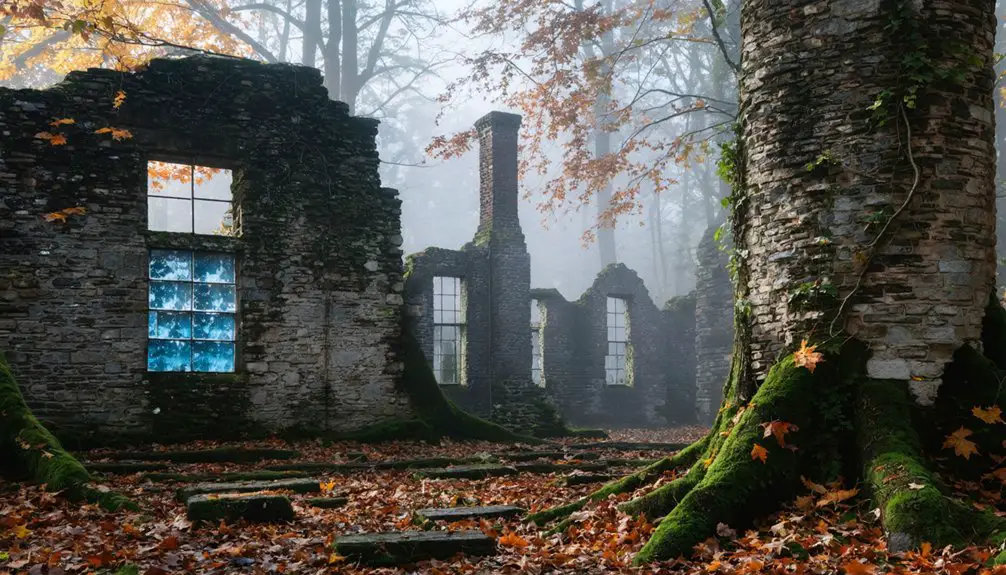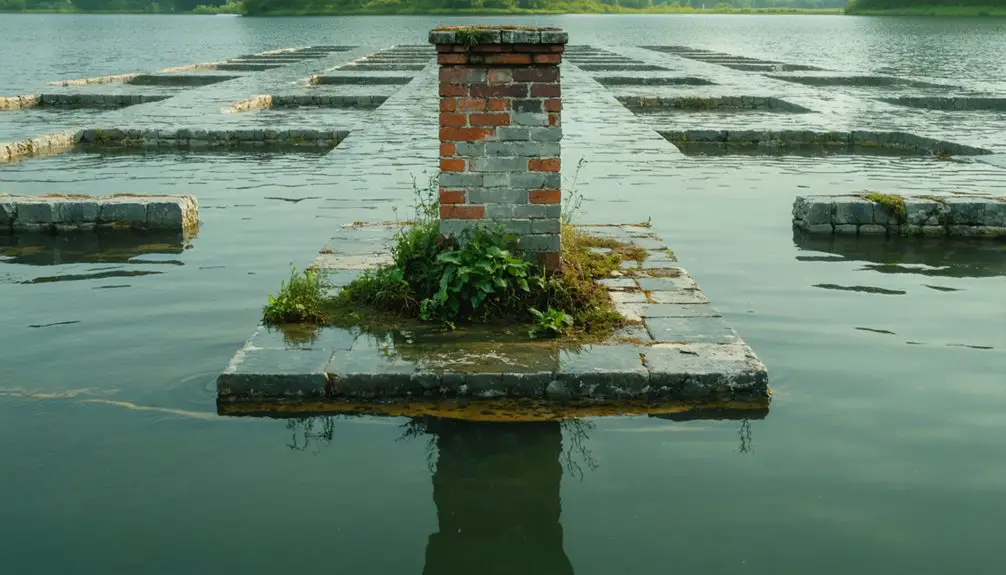
You’ll find Enfield’s submerged remains 150 feet beneath Quabbin Reservoir‘s surface, where eminent domain displaced 2,000 residents in 1927. Start at the Enfield Lookout for panoramic views, then explore accessible stone walls and cellar foundations via designated trails from the John Bottume House visitor center. Visit during late summer’s reservoir drawdown to observe the most archaeological features. Dana Common’s above-water cellar holes and Prescott Peninsula’s structural remnants offer additional sites for documenting these displaced Swift River Valley communities through careful conservation-minded exploration.
Key Takeaways
- Enfield was submerged in 1938 beneath Quabbin Reservoir; access the site via Quabbin Hill Road and designated hiking trails.
- Visit late summer when reservoir drawdown exposes cellar foundations and stone walls most completely.
- Start at John Bottume House visitor center for trail maps before exploring remnants along accessible pedestrian paths.
- Enfield Lookout provides panoramic views over the former village site now covered by 412 billion gallons of water.
- Extend your trip to nearby Dana Common, Prescott, and Greenwich for additional above-water cellar holes and structural remains.
The Story Behind Enfield’s Disappearance

European settlers established Enfield in 1787 as one of four Swift River Valley communities, part of a colonization wave that swept through the region between 1737 and 1822. Your ancestors built a thriving manufacturing center producing wool, cotton, and leather goods, reaching 1,200 residents by the 1850s.
However, Boston’s explosive growth—from 40,000 to 560,000 between 1820 and 1900—demanded water infrastructure expansion. The 1927 Legislature seized the valley through eminent domain, forcing over 2,000 residents from their homeland. You’ll find documentation of resident grief over displacement throughout archival records, with landowners receiving roughly $108 per acre.
Loss of generational ties to land sparked lasting bitterness. All four towns disincorporated April 27, 1938, before systematic demolition cleared the valley for flooding in August 1939.
What You Can Still See Today
After the demolition crews finished their systematic clearance in 1939, Quabbin Reservoir submerged nearly all traces of Enfield beneath 412 billion gallons of water. You’ll find the Enfield Lookout offers panoramic views across the reservoir where the village once thrived.
From the Enfield Lookout, you’ll gaze across 412 billion gallons concealing an entire village demolished in 1939.
No standing buildings survived the forced evacuation. You can access remnant preservation efforts at the John Bottume House visitor center, which displays trail maps and oral histories from former residents.
Old Route 21 lies beneath the waterline, though you’ll locate accessible stone walls and cellar foundations through designated hiking trails. The Massachusetts Division of Conservation and Recreation maintains interpretive signage featuring archival photographs.
You’re free to explore former town boundaries on foot, discovering granite steps and stone fenceposts that mark property lines from Enfield’s disappeared landscape.
Getting There and Trail Access
To reach the submerged town site, you’ll navigate to coordinates 42.4667°N, 72.3°W in what’s now the Quabbin Reservation, where former Enfield boundaries were partitioned among Belchertown, New Salem, Pelham, and Ware following the 1938-1939 demolition.
Quabbin Hill Road provides vehicular access to overlooks, while Old Dana Road remains closed to cars but open for pedestrian exploration. Trail maps are available at the visitor center in John Bottume House.
The Quabbin Reservation trail network traverses hardwood forests, wetlands, and a 17-acre wildflower meadow, granting access to foundation remnants and stone walls. Public transportation options don’t serve this remote location, requiring personal vehicles.
Accessibility for disabled visitors varies greatly—paved overlooks accommodate wheelchairs, but backcountry trails to historical sites present challenging terrain unsuitable for mobility devices.
Best Times to Visit the Ruins
You’ll find ideal viewing conditions during late summer months when reservoir drawdown exposes the most archaeological features, including cellar holes at Dana Common and stone foundations throughout the disincorporated towns.
Early morning visits between June and September minimize encounter with other explorers while maximizing structural visibility before afternoon heat affects hiking comfort.
Northeast seasonal patterns make these months preferable to winter’s ice hazards or autumn’s peak visitation during regional heritage events.
Seasonal Weather Considerations
When planning your visit to Enfield’s submerged ruins, seasonal water levels dictate ruin accessibility more than any other factor. Summer’s drought conditions expose cellar holes and Dana Common foundations most completely, while fall’s increased precipitation partially submerges these remnants.
Spring presents mixed precipitation risks and unstable reservoir access as snowmelt raises water tables. Winter conditions render sites inaccessible through ice formation and trail closures.
Your clothing recommendations should account for temperature swings—layered systems for spring’s 40-47°F nights, lightweight gear for summer’s 70-81°F days. Photography conditions peak during summer’s 11-12 hour daylight windows with minimal precipitation interference.
Fall foliage provides dramatic backdrops mid-September, though strengthening winds (15-25 mph gusts) challenge tripod stability. Monitor local forecasts for ideal 50-70°F days with sub-40% precipitation probability.
Avoiding Crowd Peak Times
Strategic timing separates solitary exploration from crowded group encounters at Enfield’s ruins. You’ll guarantee congestion through off peak tour booking on weekdays rather than October weekends when the scheduled 2025 guided walks attract maximum participation. Early morning access provides unrestricted trail navigation before interpretive programs commence at 11 a.m. The October 12 event caps at 25 participants, creating bottlenecks at foundation sites and stone wall remnants.
Effective crowd minimization strategies involve visiting during non-anniversary periods—historical dates like April 28, 1938 disincorporation or August 14, 1939 reservoir filling generate negligible modern traffic. Self-guided exploration using trail maps from the visitor center grants autonomous route selection without group constraints. Mid-week scheduling assures unobstructed documentation of cellar holes and infrastructure remnants along Greenwich Dana Road corridors.
Other Lost Towns to Explore Nearby

While Enfield lies completely submerged beneath the reservoir, you can explore physical remnants of the other three disincorporated towns that shared its fate on April 28, 1938.
Dana Common, managed by the Massachusetts Division of Conservation and Recreation, remains slightly above the water line with accessible cellar holes, granite steps, and stone fenceposts marking former settlement sites.
Prescott and Greenwich also left behind structural evidence including stone basements and deteriorating paved roads where you’ll find nature gradually reclaiming the landscape.
Dana Common and Trails
Dana Common serves as the primary destination for exploring the lost Quabbin towns, accessible via DCR Gate 40 on Route 32A in Petersham for a 4-mile roundtrip hike. You’ll traverse a paved trail restricted to foot traffic, reaching the triangular common in 1.5 miles. Remnant foundations, granite steps, and curbstone fragments mark where buildings stood from 1840-1855. Stone walls and fence posts preserve the former town layout across this 68-acre National Register site.
Unlike the other flooded settlements, Dana’s land remained above water after disincorporation in 1938. Laminated signage with historical photographs identifies each structure’s location. The 1996 memorial stone honors displaced residents. Massachusetts Water Resources Authority permits spring maple tapping here, maintaining this ghost town’s connection to traditional land use while protecting Quabbin Reservoir’s watershed.
Prescott and Greenwich Remnants
Beyond the accessible paths of Dana Common, Prescott Peninsula extends into Quabbin Reservoir’s western waters, preserving above-water remnants from two additional lost towns. You’ll find evidence of Prescott and Greenwich through cellar holes and former tavern foundations marking their 1938 disincorporation. Church structure relocations saved some architecture—Prescott’s moved to Orange until 1949, while Greenwich buildings reached Dorset, Vermont.
Key remnants you can explore:
- Daniel Shays’ homestead site remains above water but inaccessible to visitors
- Conkey Tavern foundations lie submerged where Shays’ Rebellion was planned
- Five College Radio Astronomy Observatory occupied former Prescott Center (1969-2011)
- Greenwich golf course clubhouse survives on an island, though difficult to reach
Access via Gate 39 permits biking and hiking through these displaced communities’ archaeological footprints.
Haunted Tales and Local Legends
The systematic displacement of over 2,500 residents and the destruction of their communities created lasting psychological scars that manifest in persistent spectral folklore surrounding the Quabbin Reservoir.
You’ll encounter reports of unexplained phenomena throughout the former town sites, with visitors documenting what paranormal researchers term residual hauntings—energetic imprints from the traumatic displacement events of the 1930s.
While debunked myths persist about submerged church steeples visible to fishermen, legitimate mysteries remain regarding the cemetery relocations of approximately 7,500 graves. Pre-flood documentation noted rectangles where headstones were removed but no evidence of exhumed remains, fueling decades of speculation.
The bitterness from forced evictions under eminent domain combined with undisturbed Native American burial grounds beneath the reservoir’s waters contributes to ongoing reports of visual echoes and supernatural encounters along accessible trail systems.
Frequently Asked Questions
Were Residents of Enfield Fairly Compensated for Their Lost Properties?
Records don’t confirm residents received fair property values or adequate relocation assistance. You’ll find displaced families remained bitter for decades, suggesting compensation fell short of what they’d lost through eminent domain seizures for the reservoir project.
Can You Swim or Boat in Quabbin Reservoir Today?
The reservoir’s waters remain forbidden territory—you can’t swim due to public access restrictions protecting water quality testing standards. You may boat exclusively for fishing after inspection, but recreational boating stays prohibited to safeguard 412 billion gallons.
Are There Any Original Photographs of Enfield Before It Was Flooded?
Yes, you’ll find over 2,900 historical photographs documenting pre-flood Enfield from circa 1916-1938. Massachusetts Archives holds original glass plate negatives, while preserved memorabilia includes real-photo postcards showing the town’s buildings, businesses, and community life before inundation.
What Happened to the Cemetery Remains From the Displaced Towns?
Over 7,600 graves required relocation from 34 cemeteries across the doomed towns. You’ll find the reinterment of remains occurred at Quabbin Park Cemetery in Ware, though cemetery relocation logistics faced scrutiny when original headstones remained at flooded sites.
Is Overnight Camping Allowed Near the Enfield Ruins?
No overnight camping’s permitted directly at Enfield ruins. You’ll find no dispersed camping options near the Quabbin Reservoir area. For quiet solitude, you must reserve designated campsites at nearby Tolland State Forest, following Massachusetts state park regulations.