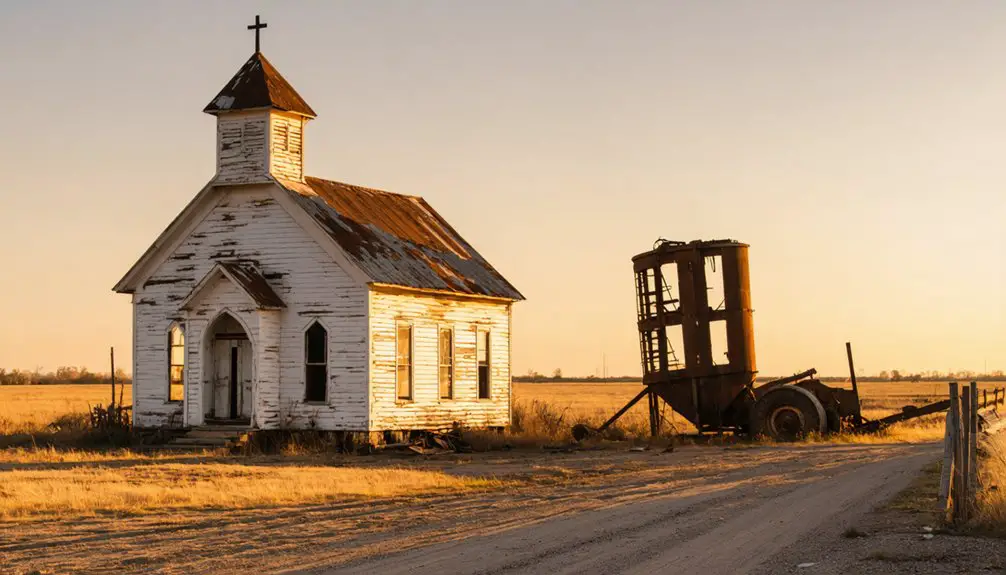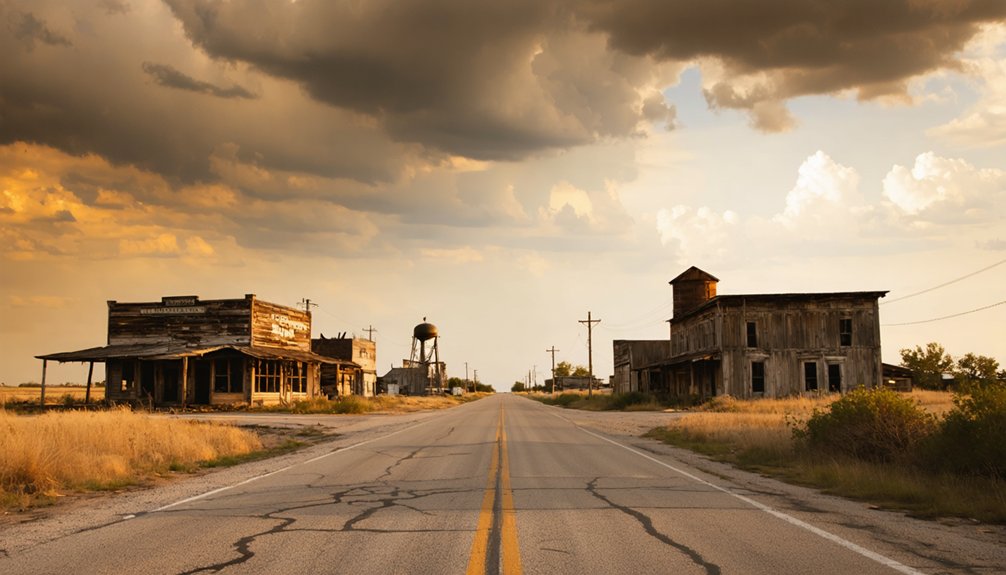
Planning a ghost town road trip to Fleetwood, Oklahoma means chasing a ferry town that nature’s nearly swallowed whole. Founded in 1885 and abandoned in 1961, this Jefferson County community left behind weathered frames, crumbling foundations, and rusted equipment scattered across quiet farmland. You’ll want offline maps, sturdy boots, and a reliable vehicle before venturing down rural roads south of Waurika. Knowing what to look for before you arrive makes all the difference.
Key Takeaways
- Fleetwood, Oklahoma, is located in Jefferson County, accessible via rural roads south of Waurika, with spotty cell service requiring offline maps.
- Pack water, sturdy boots, a first aid kit, printed maps, and a portable charger for this remote destination.
- The site features weathered wooden frames, crumbling foundations, and rusted farm equipment reclaimed by surrounding farmland.
- Nearby ghost towns like Faxon, Fay, Atwood, and Alluwe offer additional stops along your road trip route.
- Respect remaining structures by avoiding disturbance or damage, supporting preservation of this historically significant 1885 community.
How Fleetwood, Oklahoma Went From Ferry Town to Ghost Town
Tucked along the banks of the Red River, Fleetwood, Oklahoma once thrived as a small but essential community built around the ferry operations of H.H. Fleetwood, its namesake. Founded in 1885, the town’s historical significance stemmed directly from that ferry operation, connecting travelers and commerce across the river when few other crossings existed.
Fleetwood, Oklahoma was born from necessity — a ferry crossing that linked people, goods, and ambition across the Red River.
For decades, Fleetwood sustained itself as an unincorporated Jefferson County community, free from formal government constraints yet bound together by shared purpose. But that independence couldn’t shield it from decline.
By 1961, residents evacuated, effectively ending civic life in the town.
Today, you’ll find farms and abandoned structures where neighbors once gathered. The river still flows, indifferent to what’s been lost, but Fleetwood’s story reminds you how quickly a thriving place can fade into memory.
What’s Left of Fleetwood, Oklahoma Today
When you visit what remains of Fleetwood today, you’ll find the land has largely swallowed its own history. Farms now stretch across ground where neighbors once gathered, and abandoned structures stand as quiet punctuation marks in an otherwise open landscape.
Don’t expect museums or marked trails — historical artifacts are scarce, and physical evidence of the original community is minimal at best.
What you’ll find is atmosphere. The Red River still moves nearby, indifferent to the town it once sustained through ferry crossings.
Local legends linger among those who know the region well, passed down rather than preserved in bronze or stone.
Fleetwood rewards curious travelers willing to read absence as evidence — to see farmland and recognize the ghost of something that once genuinely mattered.
How to Get to Fleetwood, Oklahoma
Fleetwood sits in Jefferson County in southern Oklahoma, and getting there means committing to rural roads that thin out the closer you get to the Red River. You’ll want a reliable vehicle and a downloaded map since cell service gets spotty fast.
Waurika is your best launching point, sitting roughly 20 miles north and offering the last real fuel stop before you head south. From there, you’re threading through open farmland where local legends say ferry crossings once connected whole communities.
No historic landmarks mark the entrance — Fleetwood doesn’t announce itself. You’ll recognize the site by what’s missing: the silence, the empty fields, the occasional weathered structure standing alone.
That absence is the destination. Embrace it and drive toward it with intention.
What You’ll Actually Find When You Reach the Site
When you arrive at the former site of Fleetwood, you’ll find a landscape that’s more farmland than ghost town, with agricultural fields stretching across land where homes and businesses once stood.
A few abandoned structures still break the horizon, offering tangible proof that a community once thrived here from 1885 until its evacuation in 1961.
You’ll need to look carefully, though, because the physical evidence of Fleetwood’s past is minimal and the land has largely reclaimed its rural character.
Abandoned Structures Still Standing
Though time has claimed most of Fleetwood’s original structures, a few abandoned remnants still dot the landscape, standing as quiet affirmations to the community that once thrived here.
You’ll find pieces of historic architecture that whisper local legends if you listen closely enough.
As you walk the site, expect to encounter:
- Weathered wooden frames leaning against the Oklahoma sky, stripped bare by decades of wind
- Crumbling foundations half-swallowed by native grasses and wildflowers
- Rusted farm equipment left behind when families evacuated in 1961
- Forgotten fence lines marking boundaries of homesteads that once buzzed with daily life
These remnants aren’t dramatic ruins — they’re honest fragments.
They remind you that freedom sometimes means leaving everything behind and never returning.
Agricultural Land Surrounds Site
Arriving at the former townsite of Fleetwood, you’ll find that agriculture has largely reclaimed what civic life once built. Fields stretch across land where businesses and homes once stood, offering little visual drama but quiet historical significance. The agricultural landscape speaks honestly about how completely a community can dissolve into the earth.
You won’t discover dramatic ruins or foundation outlines here. Instead, working farms occupy the ground, their crops indifferent to the human stories buried beneath. This absence itself tells a story — one about impermanence, resilience, and the relentless patience of the land.
Come prepared to use your imagination. Bring the history in your head, because the soil won’t hand it to you. Fleetwood rewards visitors who appreciate subtlety over spectacle, freedom over guided narrative.
Which Ghost Towns Near Fleetwood Are Worth the Detour?

Oklahoma’s ghost town landscape stretches far beyond Fleetwood, and if you’re already making the drive through Jefferson County, a few detours are well worth your time. Each nearby site carries its own historical preservation story and cultural significance that rewards curious travelers.
Consider adding these stops to your route:
- Faxon (Comanche County) — Abandoned structures stand quietly, echoing a community that thrived from 1902 to 1995.
- Fay (Dewey County) — A small remnant community survives, offering rare human connection to a fading past.
- Atwood (Hughes County) — Weathered buildings mark where families once built entire lives.
- Alluwe (Nowata County) — Now submerged beneath Oologah Lake, its haunting disappearance reminds you how completely a town can vanish.
You’re free to explore on your own terms — these towns reward the unscripted road trip.
What to Bring for a Day Trip to Fleetwood and Nearby Sites
Before you head out to Fleetwood and its neighboring ghost towns, pack water, snacks, sturdy boots, and a first aid kit, since these remote agricultural sites offer no modern amenities.
You’ll also want a downloaded offline map and a fully charged phone, as cell service near the Red River corridor can be unreliable.
A portable charger, a paper backup map, and a whistle round out the safety essentials that’ll keep your road trip on track.
Essential Gear and Supplies
Exploring a ghost town like Fleetwood means venturing into a remote, rural stretch of Jefferson County where modern conveniences are scarce, so packing smart will make or break your day trip. You’ll want reliable photography equipment to capture the haunting beauty of abandoned structures before the land swallows them completely.
If you’re extending into overnight exploration, lightweight camping gear keeps you self-sufficient under wide Oklahoma skies.
Pack these essentials before you leave:
- Water and snacks — no stores exist nearby
- Navigation tools — cell service is unreliable here
- Photography equipment — document what time is erasing
- Camping gear — stay longer, explore deeper, roam freer
Freedom belongs to those who prepare. Pack deliberately, and Fleetwood will reward you.
Traveling to Fleetwood demands more than a quick glance at your phone’s map app — cell service drops unpredictably across rural Jefferson County. A dead signal on an unmarked dirt road isn’t the adventure you’re after. Download offline maps before you leave, and carry a printed backup showing county roads near the Red River corridor.
Pack a compass, a fully charged power bank, and a first aid kit. The terrain around former agricultural sites hides hazards — uneven ground, rusted remnants, and unstable structures carry real risk. Respect the historical significance of what remains; preservation efforts depend on visitors who leave sites undisturbed.
Share your itinerary with someone before heading out. Freedom on the open road tastes better when someone knows where you’re roaming.
Frequently Asked Questions
Is There an Entrance Fee to Visit the Fleetwood Ghost Town Site?
You’ll find no entrance fee to explore Fleetwood’s ghost town site. It’s open, free land where historic preservation meets visitor safety awareness — you’re free to roam abandoned structures and farms at your own adventurous discretion.
Are There Any Guided Tours Available for the Fleetwood Area?
You won’t find formal guided tours here, but you’re free to explore Fleetwood’s historical significance independently. Seek local historians who champion preservation efforts — they’ll paint vivid pictures of this hauntingly quiet, abandoned Oklahoma community.
Is It Legal to Remove Artifacts or Souvenirs From the Site?
You shouldn’t remove artifacts or engage in souvenir collection at Fleetwood — it’s illegal on protected lands. Respect the site’s haunting remnants, leave history untouched, and you’ll preserve the freedom for future explorers to experience its quiet, abandoned beauty.
What Is the Best Time of Year to Visit Fleetwood?
Fall’s finest weather frames Fleetwood’s forgotten fields beautifully. You’ll capture stunning photography tips in action at historic landmarks when visiting between September and November — mild temperatures, golden light, and minimal rainfall make exploring this ghost town’s agricultural remnants truly unforgettable.
Are There Any Nearby Accommodations for Overnight Stays?
You won’t find hotels nearby, but you’ll love the freedom of camping options under Oklahoma’s vast, starlit skies. Explore local eateries in surrounding Jefferson County towns to fuel your adventurous ghost town journey through Fleetwood’s hauntingly beautiful, abandoned landscape.
References
- https://en.wikipedia.org/wiki/List_of_ghost_towns_in_Oklahoma
- https://www.travelok.com/articles/oklahomaghosttowns
- https://www.okhistory.org/publications/enc/entry?entry=GH002
- https://www.youtube.com/watch?v=OF-bpvVR6-I