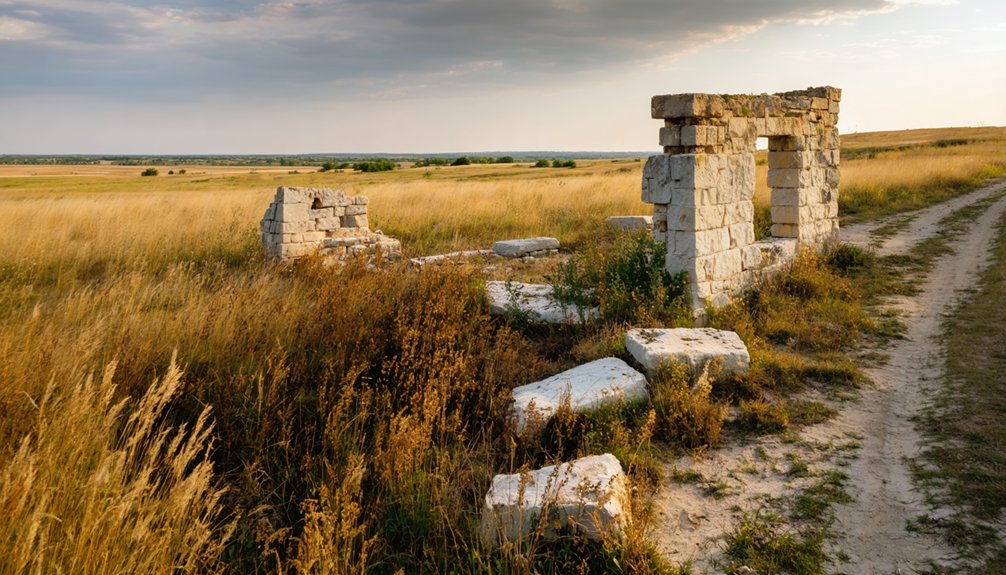
Your road trip to Fort de Cavagnial traces Kansas’s oldest European roots to a quiet stretch of Missouri River bluffs where French traders once bartered with Native tribes in 1744. You won’t find crumbling walls or dramatic ruins here — just a commemorative plaque marking where history quietly faded. Spring and fall offer the best conditions for exploring this archaeological mystery. Stick around to uncover the full story behind what’s left, where to find it, and what’s nearby.
Key Takeaways
- Fort Cavagnial, established in 1744, was Kansas’s first permanent European settlement and now exists only as a commemorative plaque.
- From Kansas City, drive northwest on I-29 approximately 30 miles, then navigate local roads toward Kickapoo Community Cemetery.
- Visit in spring or fall for mild temperatures; summer heat and winter mud make rural road navigation difficult.
- No facilities exist on-site, so bring water, a printed map, and prepare for unreliable cell service near the cemetery.
- Combine your trip with nearby sites like Fort Leavenworth Historical District and Missouri River Overlooks for a fuller historical experience.
What Was Fort De Cavagnial, Kansas?
Fort de Cavagnial was the first permanent European settlement within present-day Kansas, established on August 8, 1744, by French merchant Joseph Deruisseau. Named in honor of Pierre de Rigaud, Marquis de Vaudreuil-Cavagnal, Governor of Louisiana, it sat on the bluffs above the confluence of the Missouri and Kansas Rivers.
This strategic outpost drove French trading between European merchants and Native American tribes, particularly the Kansa and Osage. Traders exchanged firearms, axes, knives, beads, and cloth for valuable furs, shaping Native relations across the region.
At its peak, over 50 marines and civilians called the fort home.
When Lewis and Clark passed through in 1804, they documented only chimneys and structural outlines — the French era had ended, and Fort de Cavagnial never reopened.
Where Is Fort Cavagnial Actually Located?
Pinpointing Fort de Cavagnial‘s exact location is one of Kansas’s most enduring archaeological mysteries. Most historical accounts place it roughly three miles northwest of Fort Leavenworth, near Weston, Missouri.
A 2012 discovery on a farm near the Kickapoo Community Cemetery added new layers to the ongoing debate about its precise coordinates.
When you visit, you’ll find a commemorative plaque marking the most likely site. Despite its historical significance, no substantial physical remains survive above ground.
Archaeological findings have yet to definitively confirm the fort’s footprint, leaving historians and explorers alike searching for answers.
You can reach the area easily from Kansas City, making it a natural stop along the Lewis and Clark Trail. The mystery itself becomes part of the journey.
How to Get to Fort Cavagnial From Kansas City

From Kansas City, you’ll head northwest on I-29 toward Fort Leavenworth, covering roughly 30 miles before exiting near Leavenworth, Kansas.
Once off the highway, you’ll navigate local roads toward the Kickapoo Community Cemetery, which sits close to the farm where researchers believe Fort de Cavagnial once stood.
Keep an eye out for Fort Leavenworth itself as a landmark anchor, since the original French post sat approximately three miles northwest of that still-active military installation.
Driving Route From Kansas City
Whether you’re chasing history or just curious about Kansas’s oldest European settlement, the drive from Kansas City to Fort Cavagnial is straightforward.
Head north on I-29, then take US-73 toward Leavenworth. From there, continue northwest approximately three miles past Fort Leavenworth toward the bluffs above the Missouri River.
The journey takes roughly 45 minutes, but it carries real historical significance. You’re retracing corridors once traveled by French traders whose trade relations with the Kansa and Osage tribes shaped the early frontier economy.
Lewis and Clark passed through this same stretch in 1804, documenting the fort’s ruins along their westward push. A commemorative plaque near the Kickapoo Community Cemetery marks the site, giving you a tangible connection to Kansas’s forgotten French past.
Landmarks Near Fort Cavagnial
Once you’re past Fort Leavenworth’s main gate, the surrounding landscape itself becomes your guide. Head northwest, and you’ll notice the bluffs rising sharply above the Missouri River—the same terrain French traders navigated in 1744.
The Kickapoo Community Cemetery sits nearby, marking the farm where researchers identified the fort’s likely footprint in 2012.
Local folklore threads through every mile here. Residents still debate the exact site, keeping the historical significance of Fort de Cavagnial alive through generations of storytelling.
Watch for the commemorative plaque near Weston—it’s your clearest landmark. The Lewis and Clark Trail signs along the route also connect you directly to 1804 expedition accounts, when explorers documented the fort’s visible chimneys before wilderness eventually swallowed the site entirely.
What’s Actually Left at the Fort Cavagnial Site Today
When you arrive at the Fort Cavagnial site, don’t expect to find crumbling walls or weathered timbers — there’s nothing left of the original structure.
A commemorative plaque marks the likely location, giving you a tangible, if modest, connection to this 1744 French trading post.
Archaeologists still haven’t pinpointed the fort’s exact footprint, making your visit part history lesson, part unsolved mystery.
Commemorative Plaque Marks Site
If you make the trek out to the likely site of Fort de Cavagnial today, you won’t find crumbling walls or weathered timbers—just a commemorative plaque marking the grounds of what’s believed to be Kansas’s first permanent European settlement.
Yet that plaque significance runs deep, grounding you in remarkable historical context. Standing there, you’re connecting with 1744 French frontier ambition on the Missouri bluffs.
The plaque reminds visitors of three defining realities:
- French traders once exchanged goods with Kansa and Osage tribes yards from where you’re standing.
- Lewis and Clark documented visible chimneys here in 1804.
- This ground represents the westernmost edge of French colonial reach in the region.
It’s a small marker carrying enormous historical weight.
No Physical Ruins Remain
Three centuries of Kansas weather, farming, and frontier development have erased nearly every trace of Fort de Cavagnial from the earth. When you visit this ghost town, you won’t find crumbling walls, buried foundations, or weathered timbers. The stockade, commandant’s house, and powder magazine have completely vanished beneath cultivated fields and Missouri River bluffs.
What remains is invisible to the naked eye — buried history waiting for archaeologists to uncover it. The site’s historical significance survives not in physical ruins but in documented records, Lewis and Clark journals, and French colonial archives.
You’re fundamentally standing on sacred frontier ground where fur traders and Kansa warriors once negotiated deals that shaped early American expansion. The absence of ruins makes this destination uniquely powerful for those who value authentic, unpolished history.
Archaeological Mystery Continues
Despite decades of curiosity and historical documentation, archaeologists haven’t definitively pinpointed Fort de Cavagnial‘s exact footprint. The archaeological significance of this site keeps researchers returning to the bluffs near Fort Leavenworth, searching for answers buried beneath Kansas soil.
Three key facts define the ongoing mystery:
- A 2012 discovery near the Kickapoo Community Cemetery revealed promising evidence of the fort’s location.
- Lewis and Clark documented visible chimneys and structural outlines in 1804, confirming the site existed.
- Most historical reports place the fort roughly three miles northwest of Fort Leavenworth.
The historical implications stretch far beyond Kansas borders.
You’re fundamentally standing at the edge of French colonial ambition in North America — a frontier trading empire that shaped entire generations of Native and European interaction.
When Should You Visit Fort Cavagnial?
When you visit Fort Cavagnial matters more than you might expect. The best seasons are spring and fall, when mild temperatures make exploring the bluffs above the Missouri River genuinely comfortable.
Summer heat along the Kansas-Missouri border can be punishing, and winter turns the rural roads near Fort Leavenworth unpredictably muddy.
Plan your trip for April through June or September through October. You’ll move freely across the open landscape without battling extreme weather. Arrive early in the day before afternoon winds pick up along the river bluffs.
A few visitor tips worth knowing: there are no facilities on-site, so bring water and a printed map. Cell service is spotty near the Kickapoo Community Cemetery area.
Come prepared, stay curious, and you’ll leave with a genuine sense of frontier history.
Nearby Lewis and Clark Trail Stops Near Fort Cavagnial
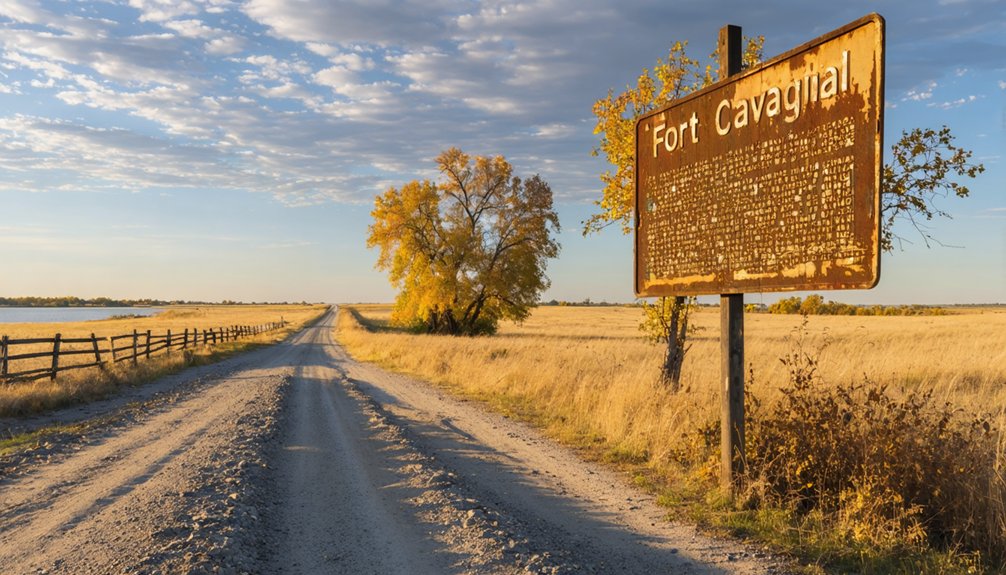
Fort Cavagnial doesn’t stand alone on the historical landscape — it sits within striking distance of several Lewis and Clark Trail stops that’ll deepen your understanding of the 1804 expedition.
The Corps of Discovery passed directly through this region, leaving behind documented trail history you can still trace today.
The Corps of Discovery passed through this region, leaving documented trail history you can still trace today.
Explore these nearby Lewis Clark landmarks:
- Kanza Village Site – Lewis and Clark visited this nearby settlement on July 2, 1804, observing the same tribe that traded at Fort Cavagnial.
- Fort Leavenworth Historical District – Just three miles southeast, it anchors the region’s military and exploration heritage.
- Missouri River Overlooks – The confluence bluffs offer the same vantage point explorers documented in their journals.
Each stop connects you directly to America’s westward story.
Frequently Asked Questions
What Items Did French Traders Exchange With Native Americans at the Fort?
At Fort Cavagnial, you’d find French traders exchanging firearms, axes, knives, beads, and cloth for furs. These trade goods fueled a remarkable cultural exchange, connecting freedom-seeking Europeans with Native American communities across the regional frontier.
How Many People Lived at Fort De Cavagnial During Its Peak Years?
During Fort de Cavagnial’s peak era, you’d have rubbed shoulders with over 50 souls — marine troopers and civilians alike — shaping the fort’s population dynamics in this bold, freedom-seeking French frontier settlement.
Who Originally Founded Fort De Cavagnial and What Was Their Occupation?
You’ll find that French merchant Joseph Deruisseau originally founded Fort de Cavagnial on August 8, 1744. His bold French Exploration venture carries immense Historical Significance, shaping regional trade and freedom across what’s now Kansas’s earliest European settlement.
What Building Materials Were Used to Construct Fort De Cavagnial’s Structures?
Ever wonder how frontier builders worked with what they had? You’ll find Fort de Cavagnial’s historical significance lies in its architectural styles — they constructed the log buildings with mud coverings for insulation, reflecting resourceful regional craftsmanship.
Was Fort De Cavagnial Ever Reoccupied After the French Abandoned It?
No, fort reoccupation never happened after the French abandoned it. You’ll find its historical significance lies in its untouched legacy — a silent, western frontier outpost that’s never seen another settler claim its rugged Kansas bluffs.
References
- https://www.nps.gov/places/fort-de-cavagnial.htm
- https://vi.wikipedia.org/wiki/Danh_sách_phố_ma_tại_Kansas
- https://www.legendsofamerica.com/fort-cavagnial/
- https://www.legendsofamerica.com/ks-forts/
- https://www.travelks.com/listing/fort-de-cavagnial/66074/
- https://aroundus.com/p/9796375-fort-de-cavagnal
- https://www.ghosttowns.com/states/ks/ks.html
- https://en.wikipedia.org/wiki/List_of_ghost_towns_in_Kansas
- https://www.lewisandclark.travel/listing/fort-de-cavagnial/
- https://lostkansas.ccrsdigitalprojects.com/sites/lostkansas/files/private_static/2022-12/LT_LV_Kickapoo_Baker.pdf