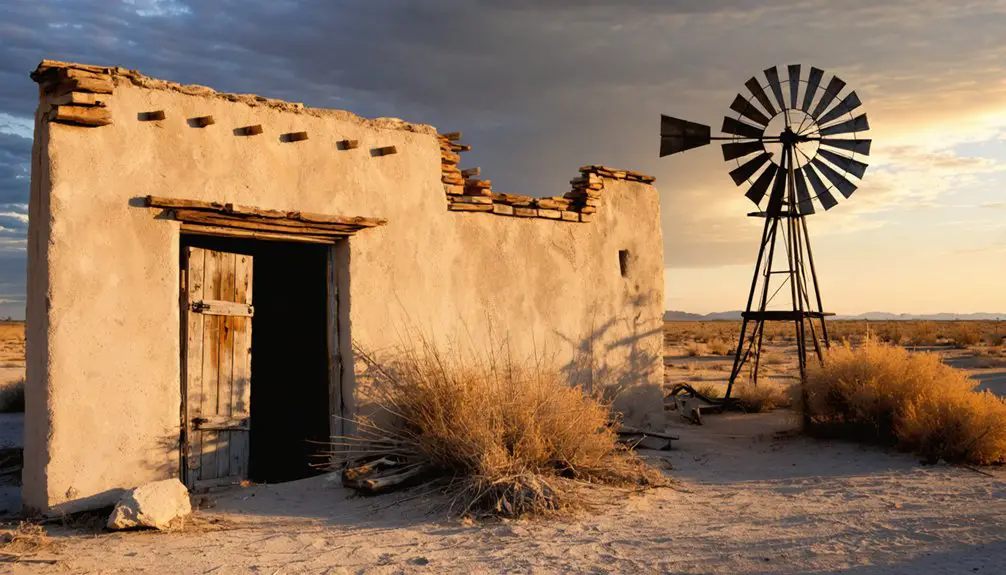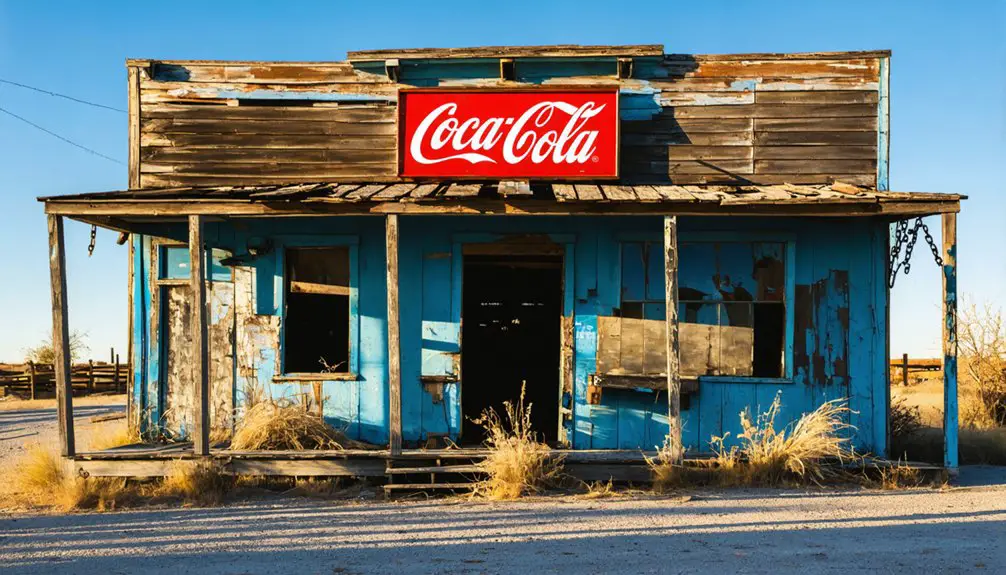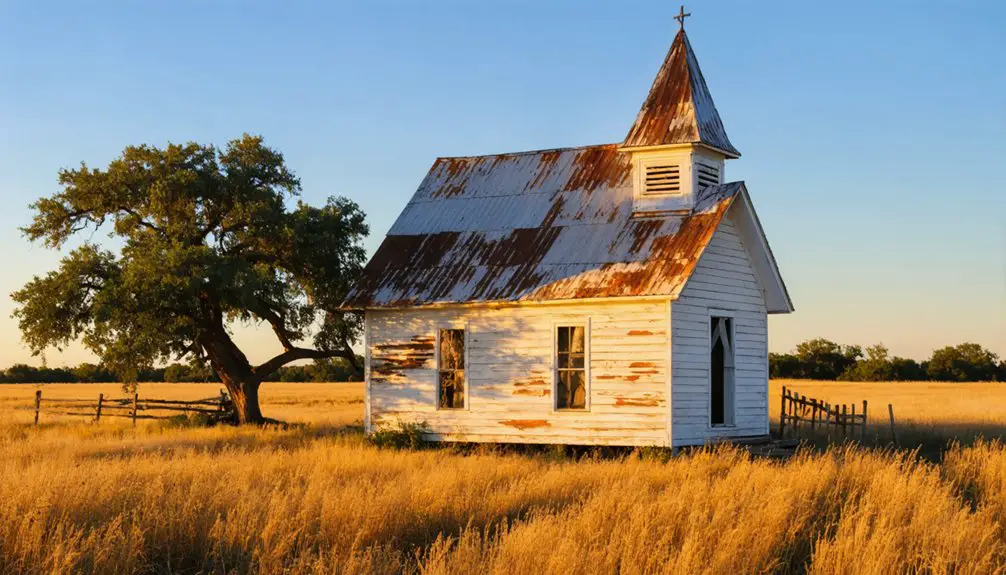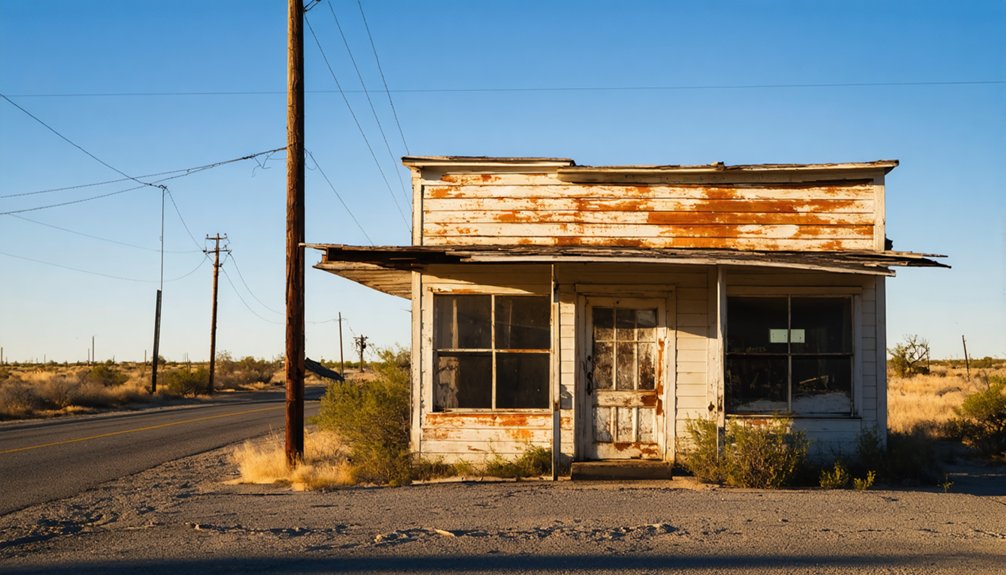
Trickham, Texas sits quietly along Farm to Market Road 1176 in southeastern Coleman County, roughly 12 miles southeast of Santa Anna. You’ll find a weathered church, a historic schoolhouse, and a cemetery recognized as a Historic Texas Cemetery since 2004. There are no services, so fuel up before heading out. Spring and fall offer the most comfortable temperatures for exploring. Stick around, and you’ll uncover everything you need to plan an unforgettable Coleman County ghost town adventure.
Key Takeaways
- Trickham is located in Coleman County, Texas, about 12 miles southeast of Santa Anna along Farm to Market Road 1176.
- Visible remnants include a weathered church, historic schoolhouse, four houses, and a cemetery designated as Historic Texas Cemetery in 2004.
- No services exist in Trickham; fuel up beforehand, visit during daylight, and obtain permission before accessing private property.
- Coleman and Santa Anna offer nearby dining, budget-friendly lodging, and grocery stores for road trip provisions.
- Spring and fall provide the most comfortable temperatures for exploring Trickham’s open, serene landscape.
What Is Trickham, Texas?
Tucked away in the southeastern corner of Coleman County, Texas, Trickham is a semi-abandoned unincorporated community that sits along Farm to Market Road 1176, hugging the banks of Mukewater Creek at roughly 1,350 feet above sea level.
You’ll find it about 12 miles southeast of Santa Anna and 20 miles southeast of Coleman.
Trickham history stretches back to 1855, when cattle barons like John Chisum used it as a trading post along busy cattle trails. Cowboys rode through freely, trading stories, goods, and plenty of tricks at the local store.
That mischievous spirit even shaped the town’s name.
Today, only about 12 residents remain. A handful of structures still stand, reminding you that this quiet crossroads once buzzed with the untamed energy of the open frontier.
How Trickham Went From Cattle Town to Ghost Town
Between 1860 and 1890, Trickham thrived as a bustling crossroads for cowboys driving cattle along the trails that cut through Coleman County.
The town’s saloon, trading post, and lively atmosphere made it a natural stopping point for drovers, giving it an energy that few small Texas settlements could match.
But once the cattle drives faded and the trails went quiet in the early 1900s, Trickham’s pulse slowed with them, and the community never recovered.
Trickham’s Cattle Trail Roots
Before it faded into near-obscurity, Trickham thrived as a rowdy cattle trail hub where cowboys drove herds through Coleman County between 1860 and 1890. Founded around 1855 as a trading post for cattle baron John Chisum, the community quickly became a crucial stop for cattle trading along active trail routes.
Cowboy culture shaped everything about early Trickham. Trail hands stopped at the local saloon, swapped stories, and spent their wages before pushing herds further down the trail.
The town’s original name, Muke Water, came from nearby Mukewater Creek, but notorious pranks pulled at the local store eventually earned it the name Trick’em.
If you’re chasing authentic Texas history, Trickham represents a raw, unpolished snapshot of what frontier cattle country actually looked like during its peak years.
Trickham’s Gradual Decline
Once the cattle trails dried up, Trickham had no fallback plan. The booming crossroads that once buzzed with cowboys, saloons, and trading activity simply faded.
By the early 1900s, the town’s purpose had evaporated alongside the cattle drives that sustained it.
You can still feel that community resilience in what remains — a weathered church, a historic schoolhouse, and four standing houses that refused to fully surrender.
The cemetery, marked officially in 2004, preserves the town’s historical significance for anyone willing to make the drive.
What’s Left to See in Trickham Today?
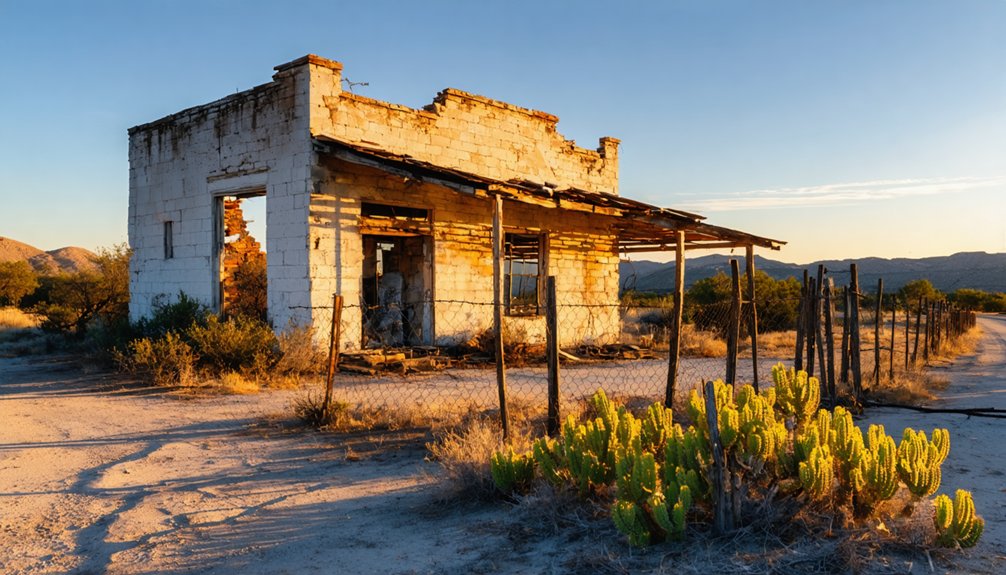
What’s left of Trickham won’t take long to find, but it’ll leave a lasting impression. As you roll down Farm to Market Road 1176, you’ll spot four standing houses, an old church, and a historic schoolhouse — quiet witnesses to a rowdy past.
Ghost town exploration here feels intimate rather than overwhelming.
The town’s cemetery earned a Historic Texas Cemetery marker in 2004, giving you a tangible connection to Trickham history. Nearby, the remnants of Camp Colorado once sheltered soldiers guarding the edge of Comanche territory, and some ruins remained visible into the late 1970s.
You won’t find crowds or gift shops here — just open sky, Mukewater Creek, and the honest silence of a place that outlived its purpose but never lost its story.
What to Know Before Driving to Trickham, Texas
Planning your drive out to Trickham takes a little prep work, and that effort pays off once you’re standing in the middle of nowhere with exactly what you came for.
Pack your road trip essentials and brush up on the community history before you go.
- Navigate carefully — Trickham sits on Farm to Market Road 1176, roughly 12 miles southeast of Santa Anna.
- Fuel up beforehand — No services exist here.
- Respect the land — Four houses still stand, and people may live nearby.
- Visit the cemetery — It earned a Historic Texas Cemetery marker in 2004 and anchors the site’s story.
Cell service is unreliable, so download offline maps and arrive with a full tank and a flexible schedule.
The Best Time to Visit Trickham, Texas
Timing your visit to Trickham makes a real difference in what you experience. Spring and fall are the best seasons to explore this semi-abandoned community, offering mild temperatures that make wandering the open landscape genuinely comfortable.
Summer heat in Coleman County can be brutal, pushing well above 100°F, so you’ll want to avoid mid-July if possible. Winter visits are quieter and cooler, but the sparse vegetation actually reveals the historic structures more clearly.
Since Trickham has no local events calendar of its own, check what’s happening in nearby Coleman or Santa Anna before heading out. Local events in those towns can add dimension to your road trip without pulling focus from Trickham’s raw, unhurried atmosphere.
Plan for daylight hours only, as there’s no commercial lighting anywhere near the community.
Who Actually Enjoys Visiting Trickham, Texas?
Few places filter their visitors as naturally as Trickham does. If you’re drawn here, you likely fit one of these profiles:
- History seekers who crave raw, unpolished Texas history beyond museum walls
- Photographers hunting weathered structures, open skies, and forgotten stories
- Road trippers who’d rather discover something real than something staged
- Solitude lovers who find freedom in wide-open, crowd-free spaces
Trickham visitors aren’t casual tourists — they’re curious, self-directed, and comfortable with silence.
You won’t find gift shops or guided tours here. What you’ll find is a crumbling church, a marked cemetery, and the quiet weight of a cattle trail past.
If that excites rather than disappoints you, Trickham’s already yours.
Camp Colorado and What Remains of It Today
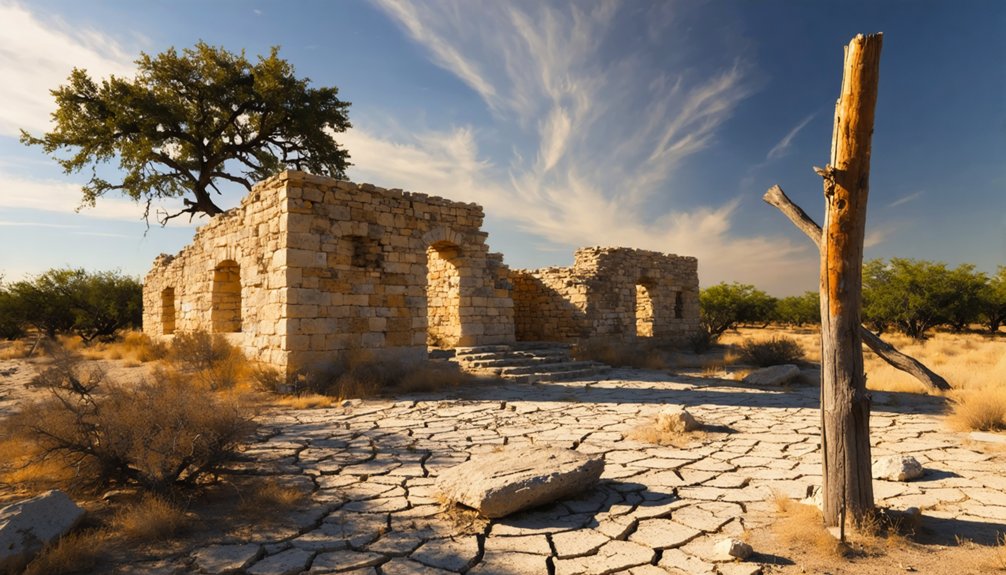
Just a short drive from Trickham, you’ll find the site of Camp Colorado, a mid-1800s military installation that once guarded Anglo settlements along the edge of Comanche territory.
The camp played an essential role in protecting early settlers as they pushed into what was then Brown County, now Coleman County.
If you’d visited as recently as the late 1970s, you could’ve spotted the ruins of the original camp on nearby hunting ranches, though little remains visible today.
Camp Colorado’s Military History
While Trickham’s rowdy cowboy culture was taking shape, a quieter but equally significant chapter was unfolding nearby. Camp Colorado carried real military significance as a frontier defense post protecting Anglo settlements from Comanche territory encroachments.
Here’s what defined Camp Colorado’s role:
- Established in the mid-1800s along the military road running through what’s now Coleman County.
- Positioned strategically between Trickham and the Colorado River to intercept territorial threats.
- Protected expanding settlements pushing against the edge of Comanche-controlled lands.
- Operated as a small but active installation during Texas’s most volatile frontier period.
You’re standing near ground where soldiers once held the line between civilization and open wilderness. That tension shaped everything Trickham eventually became.
Visible Ruins Today
Time has done its quiet work on Camp Colorado, and what remains today is fragmentary at best. By the late 1970s, ruins were still visible on private hunting ranches between Trickham and the Colorado River, but don’t expect dramatic stone walls or preserved barracks.
What you’ll find rewards patient ruins exploration rather than casual glancing — subtle earthworks, scattered foundations, and terrain shaped by mid-1800s military life.
Historic preservation efforts haven’t heavily touched this site, which means it retains a raw, undisturbed quality that history enthusiasts genuinely appreciate.
Since the land sits on private property, always secure permission before venturing out. Come prepared with good maps and realistic expectations.
The reward isn’t spectacle — it’s the rare, quiet experience of standing where frontier soldiers once held the edge of Comanche territory.
Other Ghost Towns Worth Pairing With Trickham
Trickham pairs well with several other ghost towns scattered across central Texas, making it easy to plan a full day of exploration. The region rewards rural exploration with raw, unfiltered history at every turn.
Consider adding these ghost town attractions to your route:
- Santa Anna – Just 12 miles northwest, offering historical markers and frontier-era character.
- Coleman – 20 miles northwest, with preserved 19th-century architecture worth photographing.
- Burkett – A quiet, faded community sitting along forgotten Coleman County roads.
- Valera – Another semi-abandoned stop where crumbling structures tell their own silent stories.
Each location adds depth to your journey without requiring major detours.
Every stop enriches your route, layering history and discovery into the drive without pulling you far off course.
Cluster these stops strategically, and you’ll experience central Texas’s layered frontier past in a single, unforgettable drive.
Where to Eat and Sleep Near Trickham, Texas
Since Trickham itself offers no restaurants or hotels, you’ll need to plan your meals and overnight stay in one of the nearby towns, with Coleman and Santa Anna being your closest and most practical options.
Coleman, just 20 miles northwest, provides a handful of local diners, convenience stores, and modest lodging choices that’ll cover your basic needs.
Santa Anna, sitting 12 miles to the northwest, offers a smaller but workable selection of spots where you can fuel up before or after exploring the ghost town.
Nearby Dining Options
Because Trickham is fundamentally a ghost town with no commercial infrastructure, you’ll need to drive to nearby Santa Anna or Coleman for food and lodging.
Both towns offer authentic local eateries that deliver honest Texas dining experiences worth the detour. Here’s what you can expect:
- Coleman features classic Texas diners serving hearty breakfast and lunch plates.
- Santa Anna offers small-town local eateries with homestyle cooking.
- Coleman’s main strip includes casual spots perfect for a post-exploration meal.
- Grocery stores in Coleman let you pack your own provisions for a roadside picnic near Mukewater Creek.
Embrace the freedom of the open road by planning your meals ahead, ensuring Trickham’s remote landscape remains the centerpiece of your adventure.
Local Lodging Choices
As a ghost town with zero commercial infrastructure, Trickham won’t offer you a single bed or meal, so you’ll need to base yourself in Coleman or Santa Anna for the night.
Coleman, just 20 miles northwest, gives you the most lodging variety, with several budget-friendly motels lining its main corridor.
Santa Anna, roughly 12 miles away, offers a quieter overnight option closer to your destination.
Both towns put you within easy striking distance of local attractions beyond Trickham itself, including Camp Colorado’s historic ruins and the surrounding ranch country.
A few practical travel tips worth remembering: book ahead on weekends, pack your own snacks for the drive out, and fill your gas tank before heading down Farm to Market Road 1176.
What Makes Coleman County Worth a Longer Trip?
Coleman County doesn’t just offer a quick peek at Trickham and send you on your way — it’s a region packed with layered history that rewards the curious traveler.
The scenic landscapes stretch wide across rolling Texas terrain, giving you room to breathe and explore freely.
Here’s why you should stay longer:
- Historical significance — Camp Colorado’s military ruins connect you directly to frontier-era Texas.
- Scenic landscapes — Open ranchland and creek valleys offer stunning, unfiltered views.
- Local wildlife — Deer, wild turkey, and native birds thrive across Coleman County’s hunting ranches.
- Small-town authenticity — Nearby Santa Anna and Coleman offer genuine Texas culture without tourist crowds.
This county moves at its own pace, and that’s exactly what makes it worth your time.
Frequently Asked Questions
Is There Cell Phone Service Available While Driving Through Trickham?
You’ll likely struggle with cell coverage in Trickham’s remote, semi-abandoned landscape. Signal strength drops markedly in this rural Coleman County area, so download your maps beforehand and embrace the freedom of disconnecting from the digital world!
Are There Any Guided Tours Specifically Focused on Trickham’s History?
You won’t find guided tours specifically for Trickham, but you’re free to explore its historical significance independently. Wander the remnants, uncover local legends, and let the ghost town’s mysterious past speak directly to your adventurous spirit.
Is It Legal to Explore the Remaining Structures in Trickham?
You’ll want to respect historical preservation laws before urban exploration in Trickham. Don’t trespass on private property — always seek permission first. Publicly accessible areas let you freely discover the remaining structures without legal trouble.
Has Trickham Ever Appeared in Any Films or Television Shows?
No records confirm Trickham’s appeared in film or TV, but with only 12 residents recorded in 2000, you’ll find its real draw lies in Trickham legends and ghost sightings that captivate freedom-seeking explorers like you.
Are Pets Allowed When Visiting Trickham’s Historic Cemetery?
No official pet friendly policies exist for Trickham’s historic cemetery, but if you bring your furry companion, you’ll want to practice proper cemetery etiquette—keep pets leashed and respect this hallowed, timeworn ground.
References
- https://www.ghosttowns.com/states/tx/trickham.html
- https://www.brownwoodnews.com/2022/10/13/diane-adams-the-ghosts-of-trickham-texas/
- https://www.allacrosstexas.com/texas-ghost-town.php?city=Trickham
- https://www.texasescapes.com/TOWNS/Trickham/Trickham_Texas.htm
- https://www.burningcompass.com/countries/united-states/states/texas/texas-ghost-towns-map.html
- https://www.texasescapes.com/Texas-Ghost-Towns-A-to-Z.htm
- https://www.wikiwand.com/en/articles/List_of_ghost_towns_in_Texas
- https://www.ghosttowns.com/states/tx/tx.html
- https://www.texasescapes.com/TOWNS/Texas-Ghost-Towns-5-Texas-Panhandle.htm
- https://en.wikipedia.org/wiki/Trickham