From Minot, you’ll drive two hours northwest through wind-swept prairie on US-52 and ND-5, following county roads to Hartland’s haunting remains. This settlement peaked at 150 residents in 1920 before collapsing to fewer than 10 by 2000, leaving deteriorating structures behind no-trespassing signs. You’ll need permission to explore, sturdy boots for rattlesnake country, and downloaded maps since cell service vanishes. Nearby ghost towns like Omemee and Temple extend your journey through North Dakota’s forgotten agricultural past, where crumbling foundations reveal stories waiting to be discovered.
Key Takeaways
- From Minot, drive north on US-52, then west on ND-5 toward Mohall before taking county roads for a two-hour journey.
- Download offline maps before departure, as cellular signals disappear beyond civilization and winter blizzards can arise without warning.
- Respect no-trespassing signs and seek explicit permission before entering sites to avoid liability and legal issues.
- Wear sturdy boots and sun protection, watch for prairie rattlesnakes in grass, and bring recovery gear for emergencies.
- Extend your trip to nearby ghost towns like Sherbrooke, Omemee, Temple, Arena, and Charbonneau for additional exploration.
The Rise and Fall of Hartland’s Community
Springing up from the North Dakota prairie in 1907, Hartland emerged as Martin D. Johnson’s vision, named after an Iowa township. You’ll discover historical development patterns that transformed raw grassland into a thriving hub by 1912, boasting a machinery shop, general store, bank, and Zion Lutheran Church. The town peaked at 150 residents in 1920, offering everything settlers needed—from hotel rooms to blacksmith services.
But demographic shifts over time tell a starker story. You’ll find the population plummeted below 100 by 1940, then collapsed to fewer than 10 by 2000. The post office shuttered in 1966, church services ended in 1969, and buildings scattered across North Dakota. Today, you’re visiting what Ward County officially recognizes as a ghost town.
What Remains Standing Today
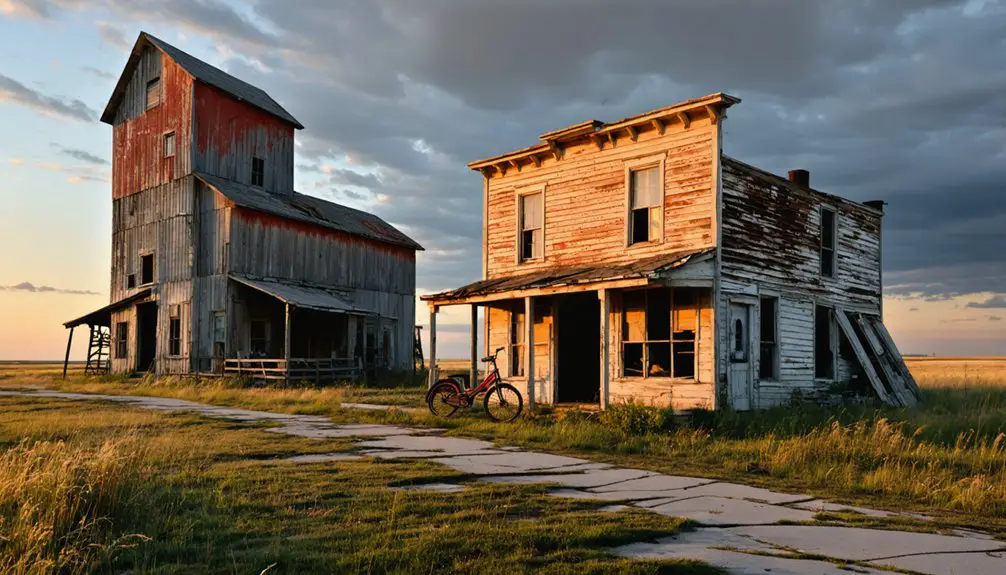
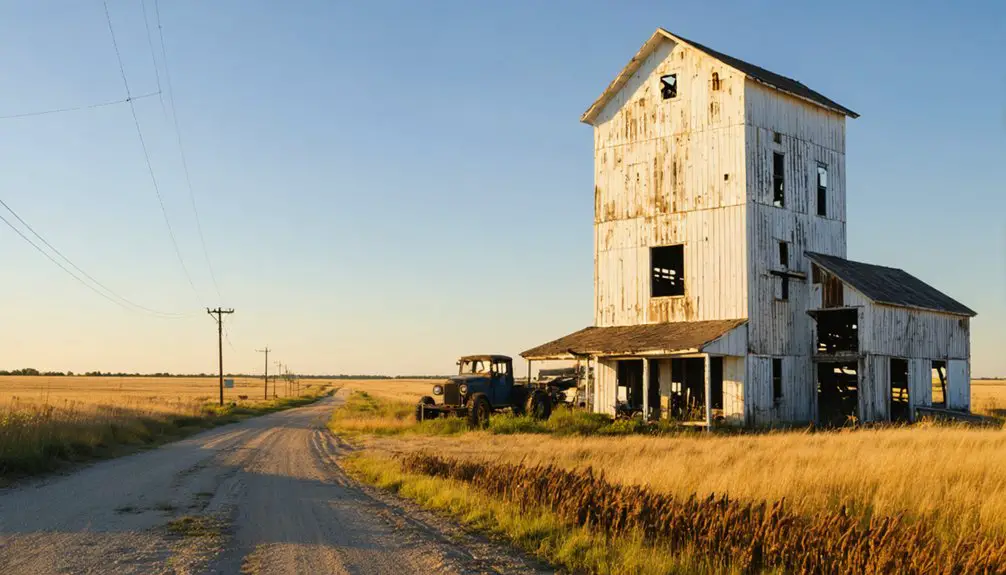
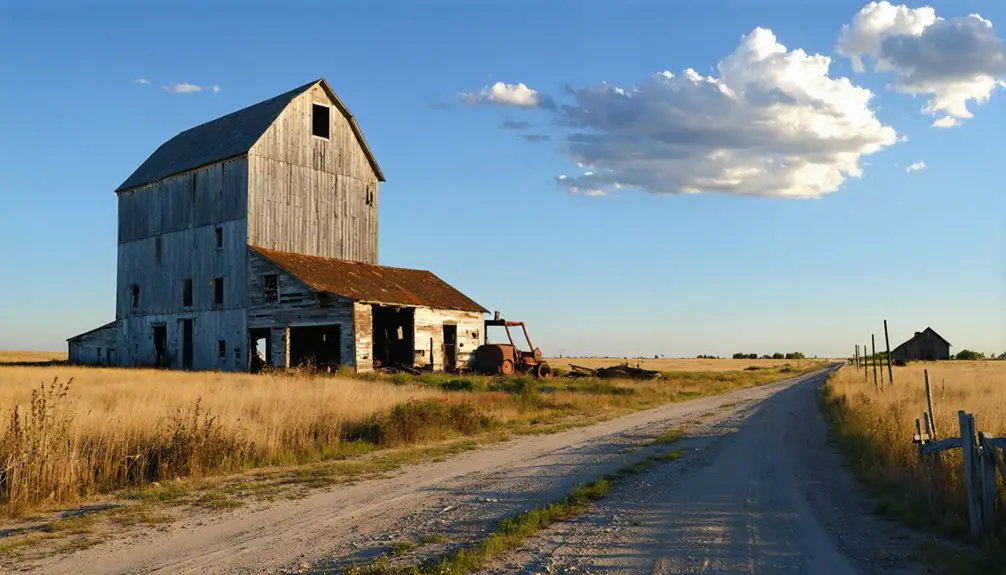
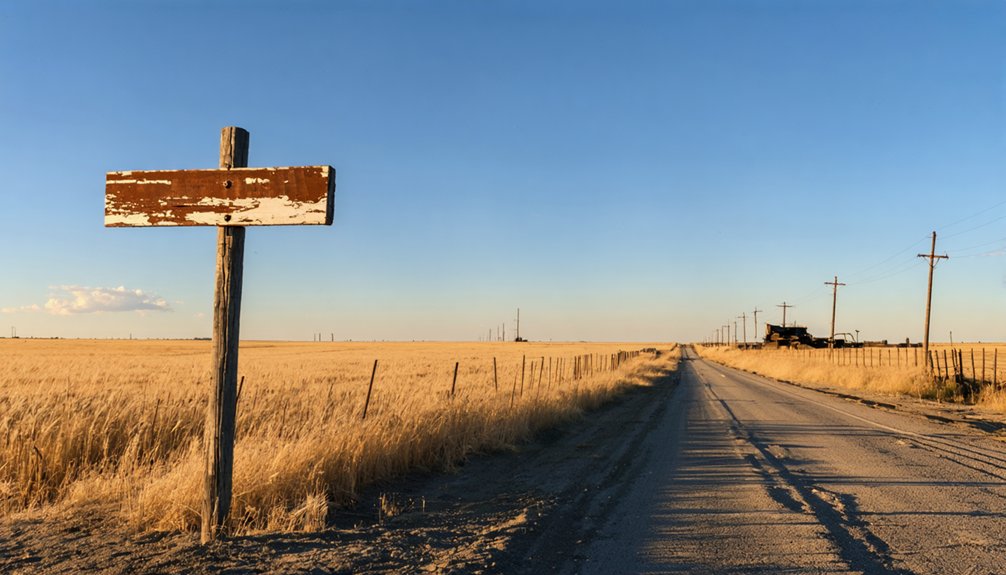
When you arrive at Hartland’s coordinates today, you’ll find a haunting landscape of decay behind stark no-trespassing signs. The current condition of remnant structures reveals advanced deterioration—rotting homes and businesses barely clinging to existence where 150 souls once thrived. Fencing blocks your access to what little remains from the original 1907 layout.
Most landmarks have vanished entirely. The blacksmith shop, bank, and pool hall exist only in memory. The 1910 Zion Church, which held its last service in 1969, found new life through preservation efforts underway at Kenmare Pioneer Park in 1972. Even the grocery store escaped—first relocated from Foxholm, then converted to a residence before moving to Berthold. You’re left standing outside barriers, glimpsing fragments of a ghost town that won’t let you wander freely through its past.
Getting to Hartland From Minot
Your journey to Hartland begins at Minot, approximately 75 miles to the southeast, requiring a two-hour drive through the wind-swept prairie of northwest North Dakota. Head north on US-52, then veer west onto ND-5 toward Mohall before traversing county roads into Burke County’s vanishing landscape.
Road conditions in winter demand respect—blizzards materialize without warning across these open plains. Download MapQuest or Waze before departing, as cellular signals fade beyond civilization’s edge. Local radio stations to monitor include Minot’s KCJB and KMOT for weather alerts that could trap unwary travelers.
Pack emergency supplies: blankets, water, snacks. This isn’t a casual Sunday drive—it’s a pilgrimage to North Dakota’s forgotten corners where asphalt surrenders to gravel and ghost towns guard their solitude jealously.
Exploring Nearby Abandoned Settlements
Radiating outward from Hartland, a constellation of abandoned settlements dots Burke County and beyond, each one surrendering to the relentless prairie winds at its own pace.
You’ll find Sherbrooke in Steele County, stripped to just two homes and a cemetery. Omemee‘s 650 residents have vanished, leaving scattered structures crumbling into memory.
Temple’s church still stands while its schoolhouse collapses nearby, swallowed by oil patch expansion. Arena preserves St. John’s Lutheran Church and a relocated schoolhouse among working farms.
Charbonneau’s grain elevators rise like monuments where rails once connected forgotten commercial buildings to distant markets. These abandoned homesteads tell stories of communities that couldn’t outlast economic shifts. Each site rewards your curiosity with tangible evidence of North Dakota’s boom-and-bust cycles.
Essential Tips for Visiting Safely
The thrill of discovery shouldn’t come at the cost of your safety or legal standing. Abide local property laws by seeking explicit permission before entering any sites—trespassing creates liability you can’t afford when unstable structures collapse beneath you.
Emphasize personal responsibility through proper preparation: sturdy boots, sun protection, and recovery gear transform potential disasters into manageable challenges. Watch for prairie rattlesnakes in tall grass and shaded areas; walk heavy-footed to announce your presence. Never use deteriorating buildings as winch anchors—you’ll damage protected structures and risk catastrophic failure.
Travel with companions when possible, as remote locations offer limited rescue options. Research current conditions beforehand, understanding that seasonal washouts render historical routes impassable. Your freedom to explore depends entirely on respecting boundaries and preparing intelligently.
Frequently Asked Questions
Is Camping Allowed Near Hartland Ghost Town Overnight?
Overnight camping isn’t specifically documented at Hartland itself, but you’ll find permitted campgrounds nearby in state forests and parks. Designated primitive campsites offer free backcountry options, letting you explore North Dakota’s wild spaces on your own terms.
What Is the Best Season to Photograph Hartland’s Remaining Structures?
Late summer through fall offers you the best photography conditions. Golden hour’s warm light and ideal weather conditions enhance deteriorating structures, while thinning vegetation reveals hidden details. You’ll capture dramatic textures without harsh shadows or overgrowth obscuring your shots.
Are There Any Documented Paranormal Activities Reported in Hartland?
Like an empty stage awaiting its ghost story, Hartland has no haunting sightings reported or eerie occurrences documented. You’ll find historical abandonment here, but paranormal activity remains unrecorded—leaving you free to explore without supernatural expectations.
Can I Remove Artifacts or Souvenirs From the Abandoned Buildings?
No, you can’t legally remove artifacts. Despite Hartland’s abandoned appearance, ownership claims persist, and you’ll face serious legal consequences including hefty fines and potential felony charges. Respect the site’s integrity—explore freely, but leave everything untouched.
Is Cell Phone Reception Available in the Hartland Area?
You’ll ironically find modern connectivity in this ghost town—cell phone coverage’s excellent through AT&T, Verizon, and T-Mobile. While availability of public utilities vanished decades ago, robust signals guarantee you’re never truly disconnected from civilization here.