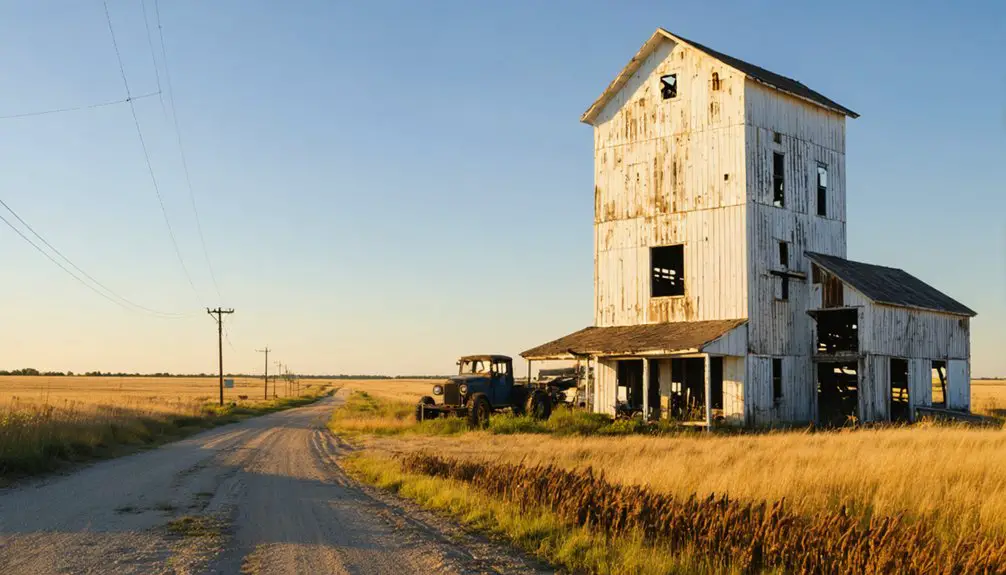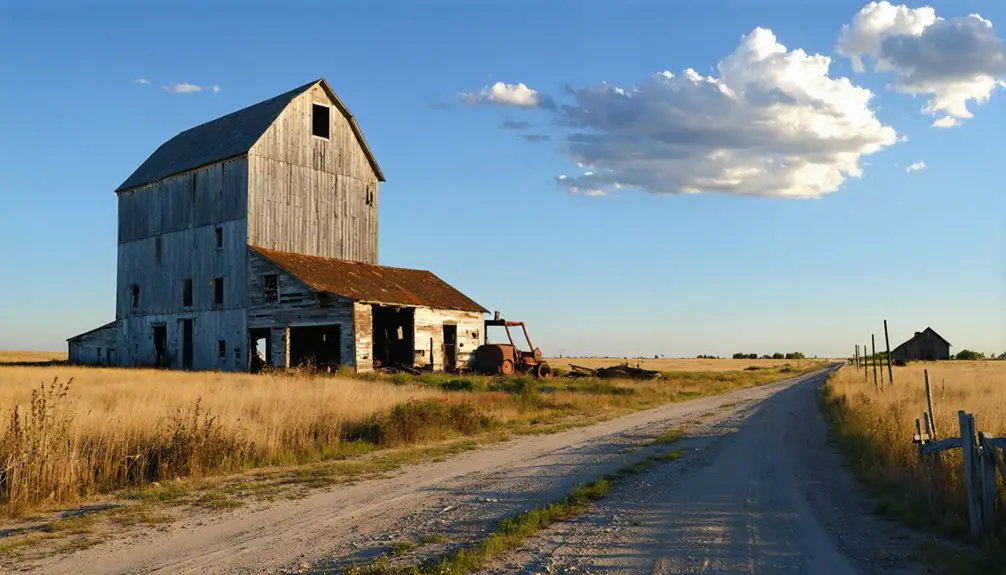
You’ll find Heaton 20 miles west of Carrington at coordinates 47.47833°N, -99.54778°W, where grain elevators stand sentinel over scattered foundations and one lone occupied dwelling. Download offline maps before cellular service fades into static, and plan for summer or early fall when gravel roads stay passable. This semi-ghost town won’t fill your day, so plot a strategic loop hitting Sykeston, Fessenden, or Pillsbury—ghost towns cluster thick along these dead railroad lines, and the full story of what happened here in 1910 reveals why survivors abandoned their prairie dreams.
Key Takeaways
- Start from Carrington and travel 20 miles west; download offline maps beforehand as cellular service becomes unreliable.
- Visit during summer or early fall when seasonal conditions offer the best accessibility for rural exploration.
- Expect scattered remnants including grain elevators and mostly vacant structures; demolitions claimed most buildings between 2004-2012.
- Combine Heaton with nearby ghost towns along dead railroad lines using routes like Fessenden Loop or Sykeston Circuit.
- Pack water and supplies as services disappear between destinations; Heaton alone won’t fill an entire day.
Getting to Heaton: Directions and Route Planning
The windswept plains of central North Dakota stretch endlessly as you navigate toward Heaton, a ghost town that exists more as coordinates on a map than an actual destination you’ll spot from the highway. You’ll want to punch 47.47833°N, -99.54778°W into your GPS—there aren’t any road signs pointing the way.
Start from Carrington and head west for twenty miles through Wells County’s rural network. Navigation considerations become critical here; cellular service gets spotty, so download offline maps beforehand.
Seasonal road conditions dramatically affect accessibility—spring thaw transforms dirt roads into muddy traps, while winter blizzards can erase routes entirely. Summer and early fall offer your best window. This isn’t a Sunday drive; it’s an expedition into North Dakota’s forgotten corners where independence meets isolation.
What Remains at the Ghost Town Site Today
When you arrive at Heaton’s coordinates, don’t expect the dramatic skeleton of a once-thriving prairie town—what greets you is something more unsettling in its ambiguity. Current site conditions reveal a semi-ghost town: scattered remnants, a handful of grain elevators standing sentinel without rail service, and maybe one occupied dwelling among the vacant structures.
Between 2004 and 2012, demolitions claimed most buildings after lots reverted to the county for unpaid taxes. Visitor experiences from those years documented this progressive erasure through photographs—one traveler heard kids playing nearby in 2004, capturing the strange liminality of life persisting amid decay.
Historical Background: From Railroad Boom to Abandonment
Understanding Heaton’s gradual disappearance requires stepping back to 1864, when Congress chartered the Northern Pacific Railroad and handed it the largest land grant in American history. Railroad financing challenges plagued this ambitious vision from the start—Jay Cooke’s 1873 bankruptcy halted construction at the Missouri River, forcing desperate searches for German investors.
Yet by the 1880s, the Great Dakota Boom exploded as wheat profits lured competing lines westward.
Early settler experiences reflected this volatile landscape:
- James J. Hill’s Manitoba line netted $1 million profit in 1879 alone
- Construction peaked by 1890 with frenzied track-laying across southeastern Dakota
- 8,000 workers wintered in Minot during the 1886 expansion push
- Heaton emerged in 1899 as railroads finally penetrated deeper inland
- The boom collapsed by 1885, exposing speculative overbuilding
You’ll find Heaton’s fate mirrors countless railroad towns built on optimism rather than sustainability.
The 1910 Tornado and Common Misconceptions
On August 29, 1910, violent winds tore through Heaton’s modest streets, ripping a house from its foundation and flinging it 300 feet through the air like a child’s toy. The F2 twister killed two residents and injured four others, pulverizing the grain elevator and leaving homes scattered like matchsticks. United Press reported from Jamestown the next day, spreading word of the disaster.
The 1910 tornado aftermath marked Heaton’s death sentence. Survivors packed their belongings and left for towns with better prospects. The tornado’s economic impact proved catastrophic—without capital to rebuild, the village withered. You’ll find some accounts mistakenly claim a 1907 tornado, but records confirm 1910. Don’t confuse Heaton with other photographed North Dakota tornadoes from that era, either.
Combining Heaton With Other North Dakota Ghost Towns
Heaton’s crumbling foundations won’t fill an entire day, so smart visitors bundle multiple ghost towns into one sweeping route across Wells County’s windswept prairie. Starting from Carrington’s active hub, you’ll trace forgotten railroad corridors where communities once thrived on Northern Pacific’s promise.
Ghost towns cluster thick along dead railroad lines—plan your route to catch three or four in a single prairie sweep.
Strategic Multi-Town Routes:
- Fessenden Loop (25 miles north): Minimal remains, but combines easily with Heaton for morning exploration
- Sykeston Circuit (30 miles southwest): Scattered structures offer photography opportunities without trespassing concerns
- Pillsbury Extension (35 miles northwest): Railroad-era buildings showcase ghost town preservation efforts better than demolished sites
- Arena Challenge (50 miles south): Full-day commitment, though vandalism limits tourism opportunities for ghost towns
- Pettibone Addition (40 miles southwest): Post-railroad decay parallels Heaton’s trajectory through population collapse
Pack water—services disappear between dots on your map.
Frequently Asked Questions
Is It Legal to Visit and Explore the Heaton Ghost Town Site?
You can legally explore Heaton’s public areas, but respect private property access boundaries. The active meat processing business remains off-limits. While historical preservation concerns are minimal here, tread carefully—what’s left tells stories worth honoring through responsible exploration.
Are There Any Nearby Facilities for Food, Gas, or Restrooms?
Like desert oases for wanderers, you’ll find public amenities availability in surrounding towns—Fessenden offers gas, food, and restrooms fifteen miles south. Nearby accommodation options exist in larger communities, though Heaton itself remains beautifully untouched and facility-free.
What Is the Best Time of Year to Visit Heaton?
Visit Heaton during late spring through early fall for ideal weather conditions. You’ll dodge the tourist peak season crowds while enjoying mild temperatures perfect for exploring abandoned buildings. May and September offer optimal freedom without summer’s bustle.
Can I Camp Overnight Near the Heaton Ghost Town Location?
You can’t camp directly at Heaton’s ghost town site, but nearby options abound. Legion Campground’s 24-hour camping policies and local regulations allow flexible stays under $50 nightly, perfect for adventurers seeking unrestricted exploration freedom.
Are There Any Safety Concerns or Hazards at the Site?
Yes, you’ll face serious hazards—Heaton’s 1907 tornado destroyed 75% of structures, leaving fragile structures with collapsed roofs and unstable floors. You’re also trespassing on county land, risking contamination from nearby oil fields and disrupting wildlife habitats.