To plan your ghost town road trip to Kennicott, Alaska, you’ll need to brace for a rugged 60-mile gravel drive along McCarthy Road before arriving at one of America’s most dramatic preserved industrial sites. This former copper empire produced over 1.3 billion pounds of copper before shutting down in 1938, leaving behind a stunning frozen-in-time landscape framed by glaciers and towering peaks. Book accommodations early, check seasonal road conditions, and keep your camera ready—there’s far more to uncover ahead.
Key Takeaways
- Kennicott, Alaska, is a preserved copper mining ghost town surrounded by glaciers and Wrangell Mountains, producing over 1.3 billion pounds of copper before 1938.
- Access requires navigating a rugged 60-mile gravel McCarthy Road, which closes in winter, so confirm conditions before traveling.
- Book accommodations in McCarthy early, as options are limited, ranging from rustic lodges to campsites.
- Wildlife sightings of moose, bears, and eagles are common along the route; keep your camera accessible for opportunities.
- The site features preserved historical buildings maintained by the National Park Service, offering deep insight into industrial Alaskan history.
What Makes Kennicott Alaska Worth a Road Trip?
Because few ghost towns combine industrial history and raw Alaskan wilderness the way Kennicott does, it’s worth every mile of the drive. You’re not visiting a reconstructed tourist attraction — you’re stepping into a preserved industrial landscape that once produced over 1.3 billion pounds of copper before the last train rolled out in 1938.
The setting pulls you in from every direction. Kennicott Glacier frames the rusting mill buildings, local legends trace back to the 1900 ore discovery that launched one of history’s richest copper operations. Wildlife encounters along the route remind you that this land belongs to something much larger than any ghost town.
If you crave history without guardrails and scenery without crowds, Kennicott delivers exactly that kind of unfiltered freedom.
How to Get to Kennicott Alaska
Getting to Kennicott means committing to the journey before you ever arrive. You can fly into the area or drive the rugged McCarthy Road, a roughly 60-mile gravel route that demands patience and a spare tire.
The road follows an old railroad bed, so expect rough conditions and slow speeds. Weather considerations matter here — rain softens the road, and winter closes it entirely, so timing your trip is essential.
If you drive, you’ll leave your vehicle at a parking area and walk or take a short shuttle across the footbridge into McCarthy, then continue to Kennicott.
Watch for local wildlife along the way; moose and bears frequent the corridor.
However you arrive, the remoteness is part of the reward.
The Rise and Fall of the Kennicott Copper Mine
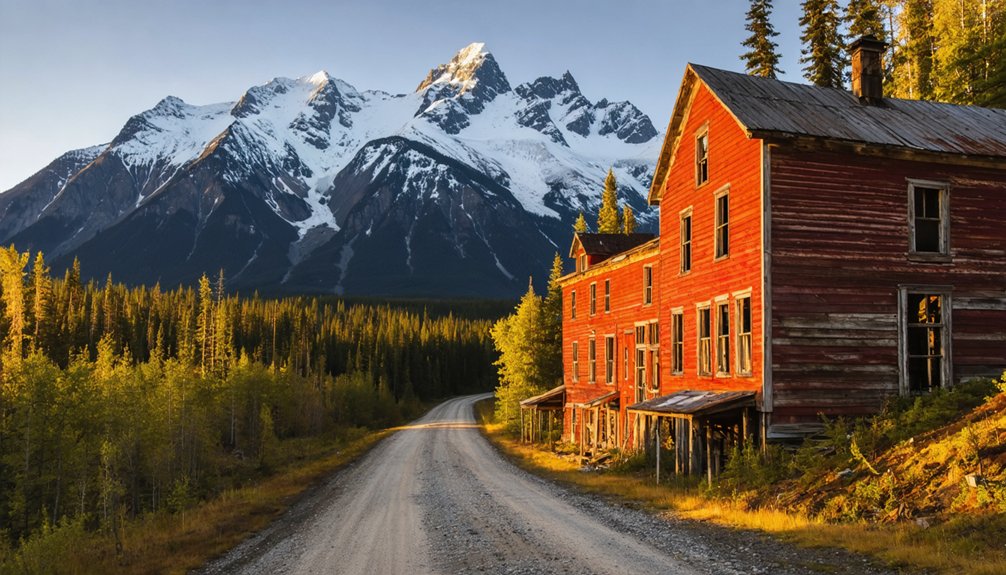
Once you cross that footbridge and catch your first glimpse of the towering red mill buildings rising against the Wrangell Mountains, you’ll want to know the story behind them.
In 1900, prospectors Clarence Warner and Jack Smith discovered impossibly rich ore here — local legends say some samples reached 77.9% pure copper. That discovery launched one of history’s greatest mining operations, demanding revolutionary mining technology: 77 miles of underground tunnels, 6 miles of aerial tramways, and a 196-mile railroad costing $25 million.
At peak production in 1925, 500 to 600 men worked three shifts around the clock. But falling copper prices during the Great Depression eventually sealed Kennicott’s fate. The last train rolled out in November 1938, leaving this industrial giant frozen in time for you to explore today.
How Big Was the Kennicott Mining Operation?
When you stand among Kennicott’s ruins, it’s hard to picture the sheer scale of what once operated here.
At its peak, the mine employed 500 to 600 men working three 8-hour shifts around the clock to keep production moving.
Peak Workforce And Shifts
At its peak, Kennicott wasn’t just a remote outpost — it was a full-scale industrial machine humming around the clock. The operation ran three 8-hour shifts, keeping the mills grinding day and night through Alaska’s brutal seasons.
Between 500 and 600 men powered this mining technology marvel at maximum output, while local legends still echo through the bunkhouses and tunnels they left behind.
You’d have found roughly 300 workers running the mill town itself, with another 200 to 300 pushing deeper into the mountains through 77 miles of underground tunnels.
Picture that scale — hundreds of men working in rotating shifts inside a glacier-carved wilderness. When you walk these grounds today, you’re stepping into the footprint of one of North America’s most ambitious industrial operations.
Copper And Silver Output
Those hundreds of workers grinding through round-the-clock shifts produced something truly staggering — numbers that still stop historians cold. By the time the last train rolled out in 1938, Kennicott had yielded over 591,535 short tons of copper from roughly 4.5 million tons of ore. That translates to more than 1.3 billion pounds of copper and 280 tons of silver pulled from deep Alaskan rock.
Advanced mining technology — including 77 miles of underground tunnels and 6 miles of aerial tramways — made that scale possible. The richest ore reportedly hit 77.9% copper, an almost unbelievable concentration.
Today, historic preservation efforts protect what remains, letting you walk through a site that genuinely shaped American industrial history. These numbers give those crumbling buildings real weight.
What’s Left to See at Kennicott’s Ghost Town Today?
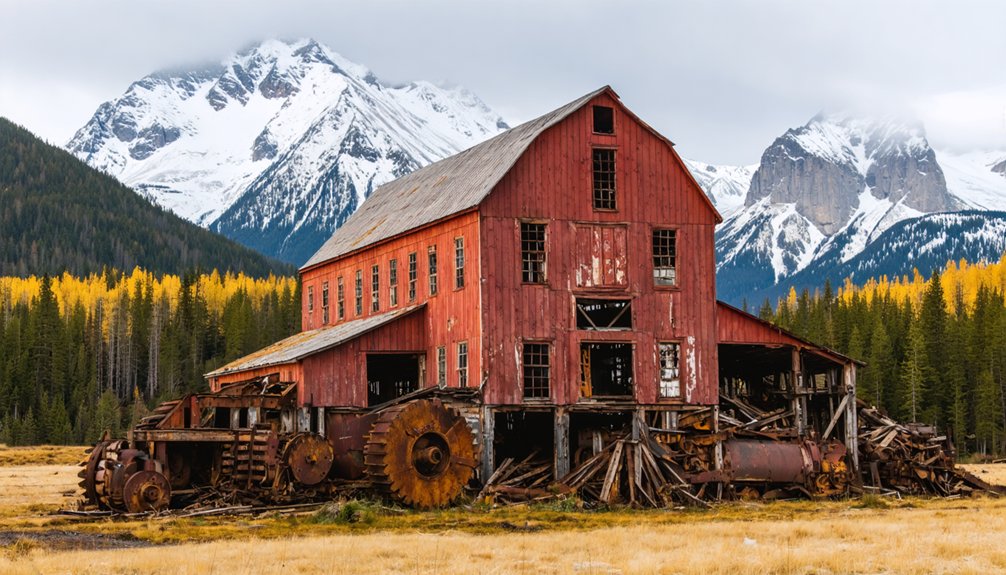
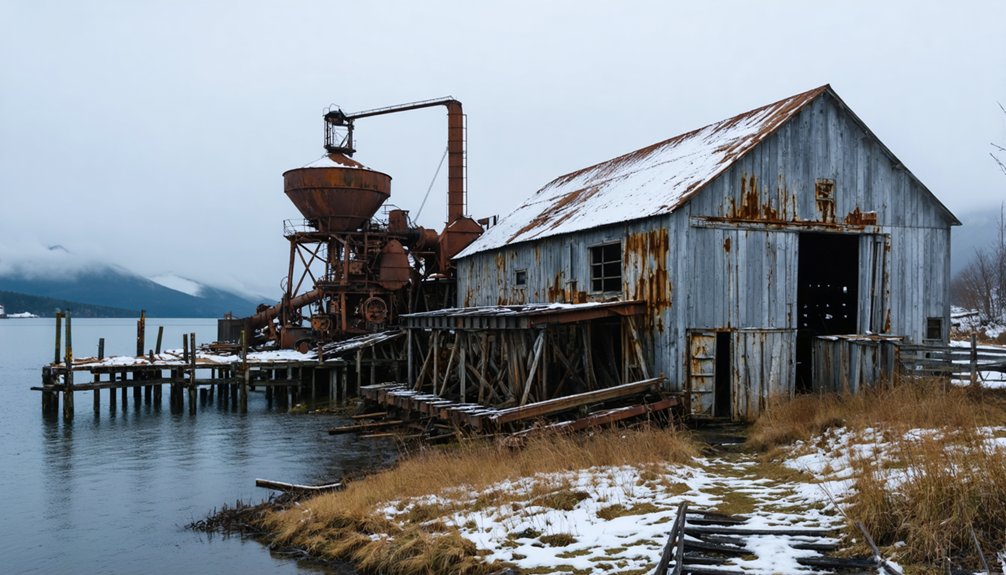
Stepping into Kennicott feels less like visiting a museum and more like walking onto a frozen-in-time industrial set. You’ll find mining relics scattered across the landscape — massive mill buildings, rusting machinery, and original company-town structures still standing after decades of abandonment.
Kennicott isn’t a museum — it’s a frozen-in-time industrial set, rusting machinery and all.
The National Park Service preserved key buildings, including a hospital, general store, school, and recreation hall, giving you a rare, unfiltered look at early 20th-century industrial life.
Glacier views add a dramatic backdrop, with Kennicott Glacier framing the ruins against raw Alaskan wilderness. You’re not getting a polished theme park here — you’re getting the real thing.
Plan time for walking tours rather than a quick drive-through. This place rewards the curious traveler who slows down and actually explores.
Where to Stay Near Kennicott and McCarthy, Alaska
Because Kennicott sits deep inside Wrangell-St. Elias National Park, local accommodations are limited, so book early. McCarthy, just a short walk across a footbridge, serves as your base camp with small lodges, guesthouses, and cabin rentals that put you close to the action without sacrificing comfort.
Some properties offer stunning scenic viewpoints overlooking the glacier and surrounding peaks, turning your mornings into something worth waking up for. You’ll find options ranging from rustic to surprisingly cozy, matching the independent spirit the region rewards.
Camping is another solid choice if you prefer sleeping under Alaska’s big sky. Whatever you choose, remember that services here run lean — confirm reservations, stock up on supplies before arriving, and embrace the self-reliant mindset this remote corner of Alaska demands.
What to Do On-Site: Tours, Trails, and How Long to Spend
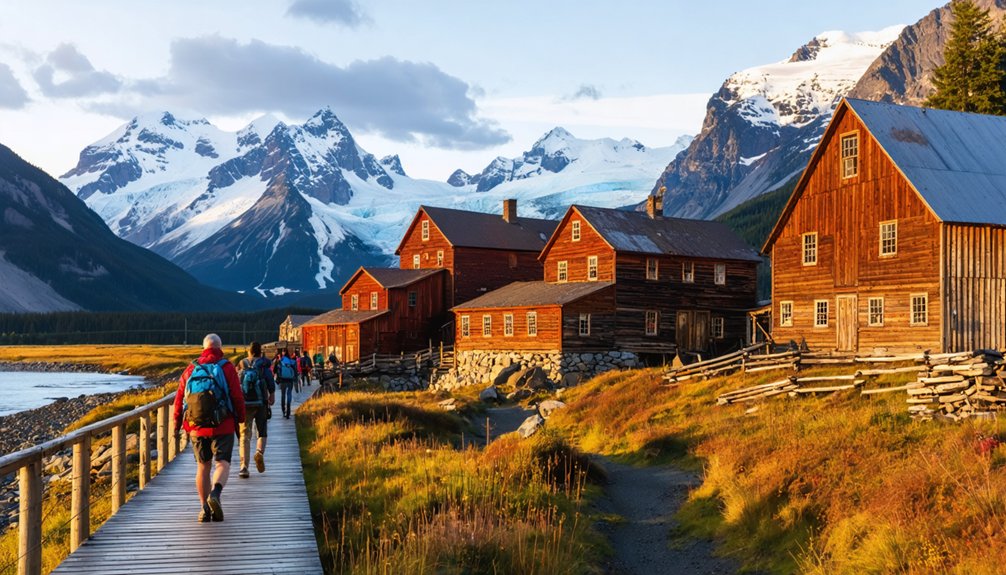
Once you’ve settled into your lodgings and mapped out your base, Kennicott itself will demand at least a full day — ideally two — to do it justice.
Kennicott demands at least a full day — ideally two — before you can truly say you’ve done it justice.
Walking tours put you face-to-face with remarkable historical preservation, where original mill buildings, a hospital, and company-town structures still stand largely intact. You’ll trace 77 miles of underground tunnels and six miles of aerial tramways through interpretive signage that explains the mining technology that made this one of history’s richest copper operations.
Trails extend toward Kennicott Glacier, rewarding hikers with raw mountain scenery beyond the industrial ruins.
Ranger-led programs add context that self-guided walks can miss. Don’t rush this site — it rewards curiosity, and the remote setting means you’ve already committed to being here fully.
Road Conditions, Fuel, and Seasonal Access to Kennicott
Getting to Kennicott is half the adventure, but the road will humble you if you’re not prepared. The McCarthy Road stretches roughly 60 miles of unpaved, tire-punishing gravel, so bring two spare tires and drive slowly.
Fuel up in Chitina — there’s nothing reliable beyond that point. The road typically opens in late spring and closes seasonally, so confirm conditions before you commit.
Wildlife encounters are common along this corridor. Moose, bears, and eagles appear without warning, rewarding patient drivers who scan the treeline.
Keep your camera accessible for photography tips worth remembering: golden-hour light hits the Wrangell peaks beautifully from pullouts along the route.
You’re not just driving to a destination here — you’re moving through genuine Alaskan wilderness on your own terms.
Frequently Asked Questions
Are Pets Allowed Inside Wrangell-St. Elias National Park and Preserve?
You can bring pets into Wrangell-St. Elias National Park and Preserve, but you’ll want to review pet policies and visitor regulations carefully, as restrictions apply to trails, buildings, and wildlife-sensitive areas.
Is There Cell Phone Service or Wi-Fi Available Near Kennicott?
Don’t count on staying connected—cell service and wifi availability are extremely limited near Kennicott. The remote wilderness location means you’ll embrace true digital freedom, exploring Alaska’s stunning ghost town completely unplugged and fully present in the adventure.
What Is the Elevation of the Kennicott Ghost Town Site?
The knowledge base doesn’t include Kennicott’s exact elevation, but you’ll feel it! You’re exploring a high-altitude marvel of mining history and historical preservation, surrounded by glaciers and rugged peaks that’ll take your breath away.
Can Visitors Purchase Souvenirs or Gifts Near the Kennicott Site?
You’ll find local artisan shops in nearby McCarthy, where you can snag unique memorabilia that captures Kennicott’s rugged spirit. It’s your chance to take home a piece of Alaska’s wild, storied mining history!
Is the Kennicott Site Accessible for Visitors With Mobility Limitations?
Mobility accessibility at Kennicott’s rugged, remote terrain can challenge wheelchair-friendly travel, but you’ll still explore parts of this legendary ghost town. The National Park Service actively helps visitors with limitations experience this breathtaking, history-rich Alaskan adventure on your own terms.
References
- https://westernmininghistory.com/towns/alaska/kennecott/
- https://www.nps.gov/places/kennecott-mines.htm
- https://dggs.alaska.gov/webpubs/dggs/mp/text/mp021.pdf
- https://www.alaska.org/detail/kennicott-mine-ghost-town-walking-tour
- https://www.travelalaska.com/destinations/cities-towns/kennicott-mccarthy
- https://home.nps.gov/wrst/learn/historyculture/kennecott-mines-national-historic-landmark.htm
- https://www.nps.gov/wrst/learn/historyculture/upload/Kennecott-CLR-Part-One.pdf
- https://en.wikipedia.org/wiki/Kennecott
- http://www.17silkstockingrow.com/history-kennicott/
- https://www.alaska.org/blog/history-of-the-kennecott-mine