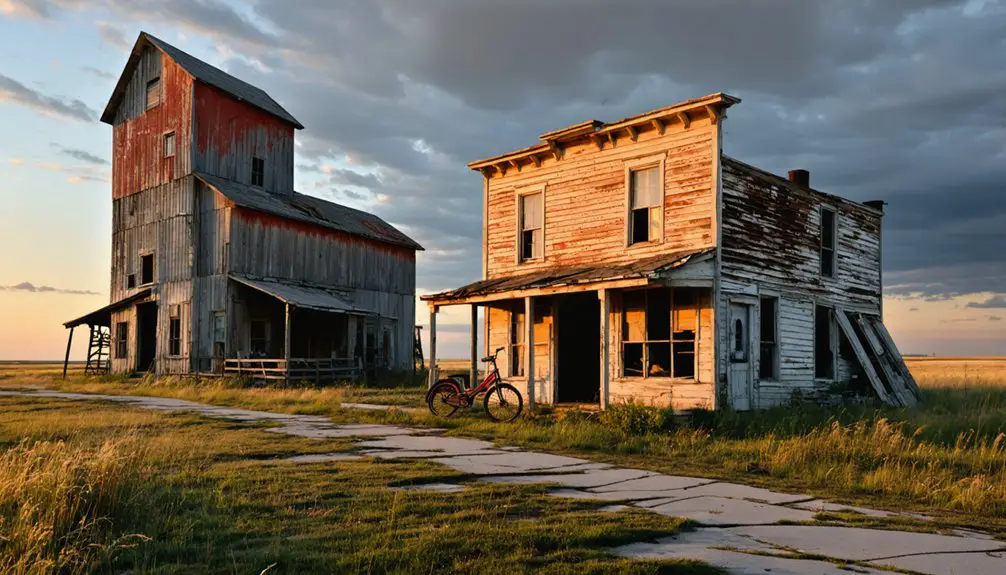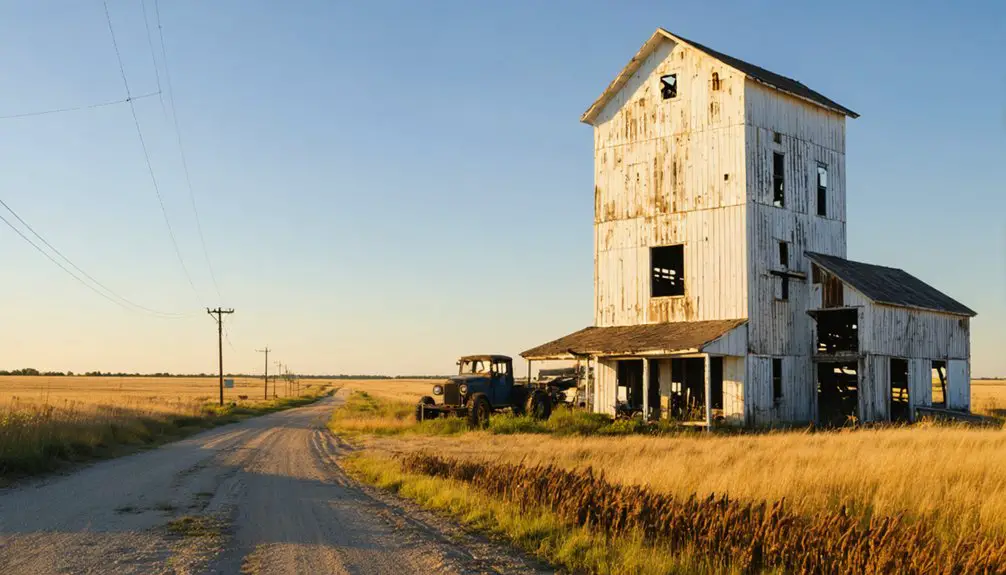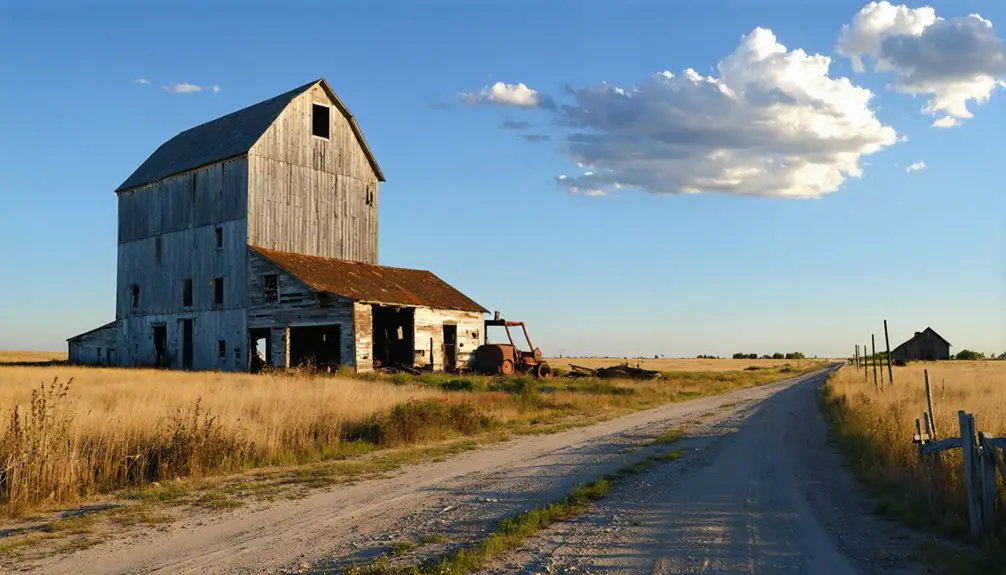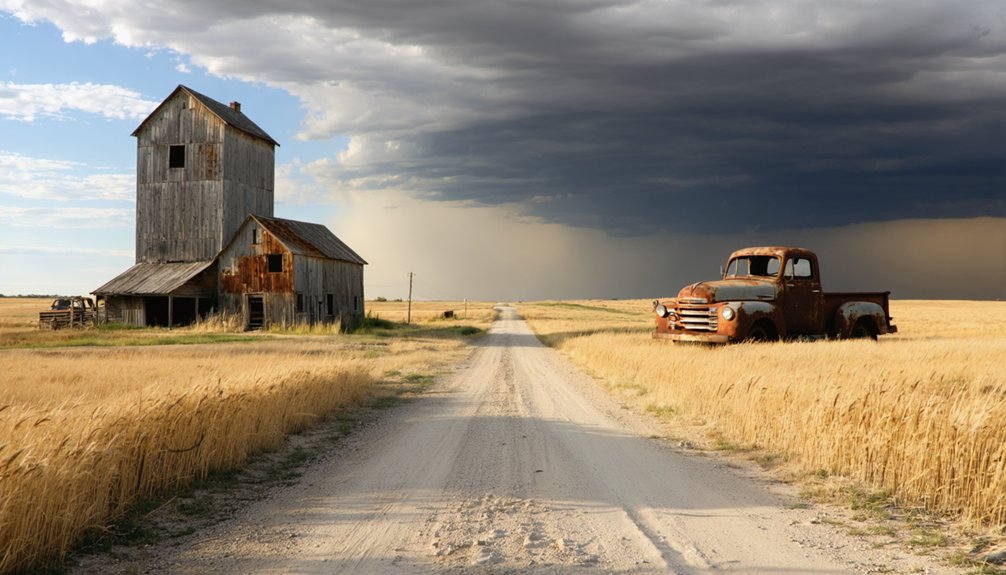
You’ll find Krem eight miles north-northeast of Hazen on accessible 2WD roads, where prairie grass now conceals the foundations of a town that thrived from 1888 until the Northern Pacific Railroad bypassed it in 1913. The haunting stone wall of the old flour mill still stands as Krem’s most prominent remnant, while Saint James Lutheran and St. John’s cemeteries mark where German-Russian settlers once built their dreams. Explore this ghost town’s compelling story of ambition, rivalry, and abandonment that shaped North Dakota’s prairie landscape.
Key Takeaways
- Krem is located 8 miles north-northeast of Hazen, North Dakota, and is accessible via 2WD roads.
- Visit two historic cemeteries: Saint James Lutheran Krem Cemetery and St. John’s Cemetery, marking the German-Russian settler community.
- The most prominent remnant is a standing wall from the old flour mill that burned in 1906.
- Partial basements and foundations emerge from the grass where buildings once stood throughout the ghost town site.
- Combine your visit with trips to nearby Mercer County ghost towns Mannhaven and Expansion for a complete road trip.
The Rise and Fall of Krem: A Brief History
In 1888, Carl Semmler carved out a new settlement on his farm north of Hazen, planting the seeds for what he hoped would become the heart of the region’s German-Russian immigrant community. He named it Krem—short for Crimea—honoring the settlers’ ancestral homeland.
The town flourished when a flour mill rose in 1899, processing local wheat and driving economic prosperity. The four-story roller mill could grind 50 bushels per day, powered by steam from local lignite coal. Martin Netzer opened the first general store in 1902, followed by William Richter’s competing establishment the next year, transforming Krem into a central trade hub. By 1906, Krem stood as Mercer County’s most progressive town. But fortune turned when fire destroyed the mill that same year, then struck the final blow in 1913—the railroad chose Hazen instead.
Shifting population trends followed as residents hauled entire buildings south to the new rail hub. By 1940, Krem surrendered to the prairie, leaving only cemetery stones and crumbling walls.
The County Seat Battle That Almost Changed Everything
You’d understand Krem’s confidence. Martin Netzer’s general store and William Richter’s competing business had transformed the settlement into Mercer County’s trading hotspot. Victory seemed inevitable.
The 1906 vote delivered 236 favorable ballots against 136 opposed—a commanding 100-vote lead. Krem’s newspaper prematurely declared triumph. They even shipped vaults for future county offices.
Then reality struck. Auditor Henry Sagehorn’s calculation revealed the brutal truth: 236 votes fell short of the required two-thirds majority.
Stanton retained the seat. Krem’s momentum died overnight, beginning its slow transformation into the ghost town you’ll explore today. Mercer County had been created in 1874-75 and organized on August 4, 1884, giving Stanton’s establishment as county seat deep historical roots. The Northern Pacific Railroad dealt the final blow in 1913 when tracks laid eight miles south sparked Hazen’s creation, pulling away Krem’s remaining residents and buildings.
What Made Krem the Trading Hub of Mercer County
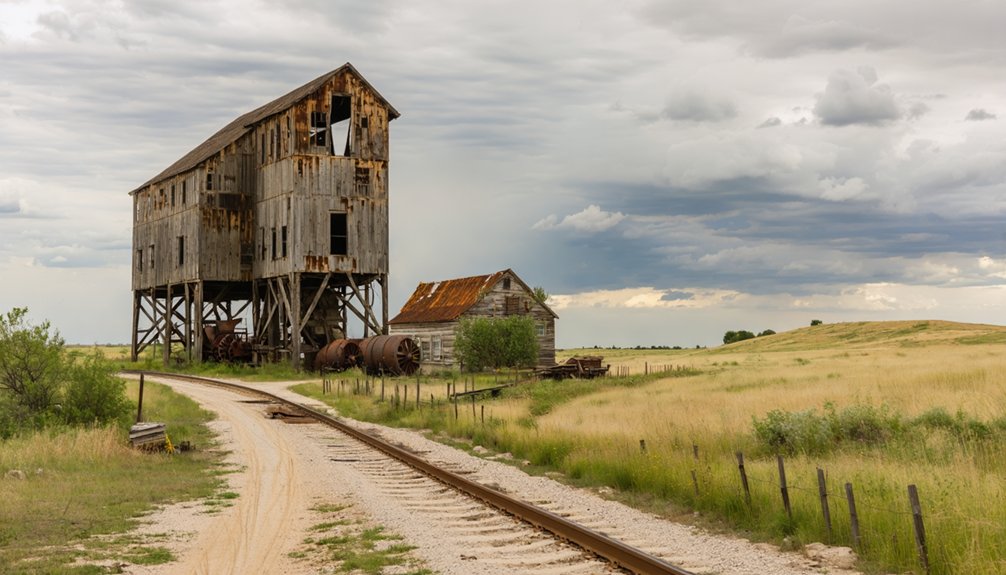
Everything changed when Martin Netzer opened his general store in 1902. William Richter followed with a competing store in 1903, igniting a commercial rivalry that transformed this German-Russian settlement into Mercer County’s premier trading center.
You’d have witnessed two merchants slashing prices and expanding inventory to outmaneuver each other—a cutthroat competition that paradoxically benefited everyone.
The population influx of homesteaders needed supplies, and Krem’s central location made it accessible from all directions. These stores weren’t just selling goods; they were fueling ambitions. Like the earlier North West Company and XY Company posts that competed for control of trade with Indians, Krem’s rival merchants understood that competition drove business and settlement. The Northern Pacific Railroad had already reached the region decades earlier, making transportation of goods more feasible for remote settlements. Farmers, settlers, and entrepreneurs converged here, drawn by competitive prices and abundant inventory.
Why the Railroad Sealed Krem’s Fate
When the Northern Pacific Railroad chose a route 8 miles south of Krem in 1913, the bustling trading hub faced its death sentence. Residents watched the lifeblood of commerce drain away as businesses, homes, and entire buildings were physically hauled to the new railroad town of Hazen.
Dr. L.G. Eastman and countless German-Russian settlers abandoned their established community for the promise of rail access, leaving Krem to wither into the prairie landscape. The railroad tied communities to grain markets in Minneapolis and St. Paul, making proximity to the tracks essential for survival. Krem joined fellow casualties Mannhaven and Expansion as ghost towns of Mercer County, their foundations now barely visible beneath the North Dakota soil.
The history of Krem, North Dakota, serves as a poignant reminder of the challenges faced by small communities in the wake of modernization. Once bustling with life, the town now stands as a testament to the unpredictability of settlement patterns and economic shifts. As time passed, the memories of the German-Russian settlers faded, leaving behind only the whispers of their aspirations amid the vast, unyielding plains.
Hazen Gets the Tracks
The Northern Pacific Railroad’s surveyors made their choice in 1912, and it wasn’t Krem. They’d staked out ground eight miles south—flatter terrain, easier grades, cheaper construction. The Northern Pacific’s rationale was purely practical: engineering economics trumped community hopes.
By December, they’d purchased the Hazen townsite, and local reactions to bypass ranged from disbelief to resignation in Krem.
The tracks reached Hazen in 1913, and everything changed. A boxcar depot appeared first, then permanent buildings sprouted along fresh-cut streets. The platted townsite, filed that November, transformed empty prairie into opportunity. The railroad spur line brought banks, cafes, stores, and even an opera house to the new town.
You’ll find Krem’s residents didn’t waste time mourning—they loaded wagons and followed commerce south. By 1914, Hazen’s trustees held their first meeting while Krem’s businesses stood empty, already becoming the ghost town you’d explore today.
Mass Migration to Railroad
Railroad economics didn’t care about sentiment or community roots. When the Mandan-Killdeer Branch bypassed Krem by eight miles in 1914, residents faced a stark choice: adapt or fade into obscurity. Most chose survival over stubbornness.
The exodus transformed both communities:
- Dr. L.G. Eastman relocated his entire practice to Hazen
- Abandoned buildings were physically hauled to the new railroad town
- German-Russian immigrants who’d named Krem after Crimea packed up stakes
- General stores that’d thrived since 1902 followed the tracks
You’re witnessing transportation infrastructure’s raw power over human settlement. Without rail access, Krem couldn’t compete for grain shipments or trade. The town that nearly won the county seat in 1906 became a ghost by the 1920s—proof that freedom sometimes means knowing when to move on. Each railroad depot station became the lifeblood of frontier towns, determining which settlements would prosper and which would vanish into prairie dust.
What You Can Still See at Krem Today
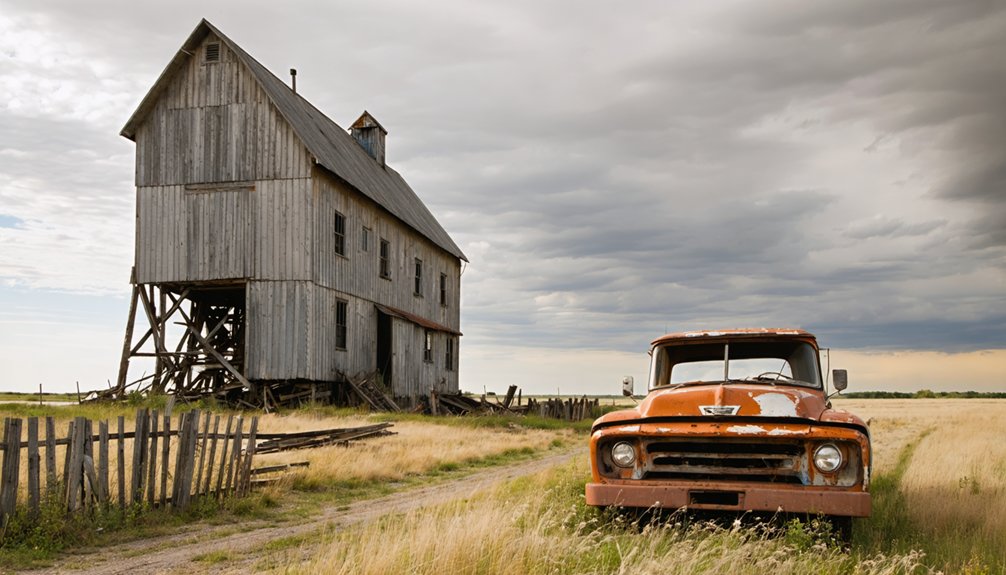
Today, Krem exists as scattered traces across the North Dakota prairie, visible from eight miles north-northeast of Hazen along accessible 2WD roads. The most prominent remnant is the old flour mill’s standing wall—once part of a four-story structure that dominated the early 1900s main street.
Beyond this sentinel of stone, you’ll discover two historic cemeteries marking the German-Russian settlers’ community and partial basements emerging from the grass where buildings once anchored this failed county seat contender.
Two Historic Cemetery Sites
Among the windswept prairie grasses where Krem once thrived, two historic cemeteries stand as silent sentinels to a vanished German-Russian community. Saint James Lutheran Krem Cemetery and St. John’s Cemetery preserve the resting places of settlers who arrived from Crimea beginning in 1902, their cultural heritage markers etched with names like Adam Baisch and Heinrich Baisch.
The cemetery preservation status remains remarkably accessible:
- 29 documented memorial records spanning multiple decades of settlement history
- Maintained grounds that you can explore freely via standard 2WD vehicle roads
- Genealogical treasures providing essential records from an era before mandatory documentation
- Tangible connections to Krem’s brief glory as a regional trade center
These burial grounds offer you an unfiltered glimpse into the lives of pioneers who dared to build communities on North Dakota’s unforgiving frontier.
Flour Mill Ruins
The weathered bones of Krem’s 1899 flour mill lie scattered at the bottom of a gentle hill, just past the bridge crossing—a four-story giant reduced to rubble and memory. You’ll find a surprisingly intact concrete foundation rising from the debris field, alongside limestone abutments that once channeled water through the mill’s grinding wheels.
Historic milling equipment fragments peek through burnt lumber—remnants of the fire that likely consumed the structure in the late 1990s. One partial wall still stands defiant against the prairie winds, marking where farmers once hauled their wheat to avoid the grueling journey to Missouri River mills.
This water-powered workhorse processed grain throughout the gold rush era, anchoring Krem’s economy until the railroad bypassed it in 1913.
Scattered Foundation Remnants
Driving eight miles north-northeast from Hazen along gravel roads brings you to what little remains of Krem—primarily two windswept cemeteries that mark the settlement’s German-Russian heritage. Beyond these stone markers, you’ll need to explore on foot to discover scattered foundation remnants across the abandoned townsite.
What You’ll Find While Exploring:
- Partial basement depths from relocated buildings, revealing underground structural layout
- General store foundation traces from Martin Netzer’s 1902 and William Richter’s 1903 competing establishments
- County seat era remnants where 236 voters once championed Krem’s ambitions
- Carl Semmler’s farmstead location where the 1888 post office anchored early settlement
These fragments tell stories of ambition meeting abandonment—accessible without specialized equipment, requiring only curiosity and sturdy boots.
How to Get to Krem From Hazen
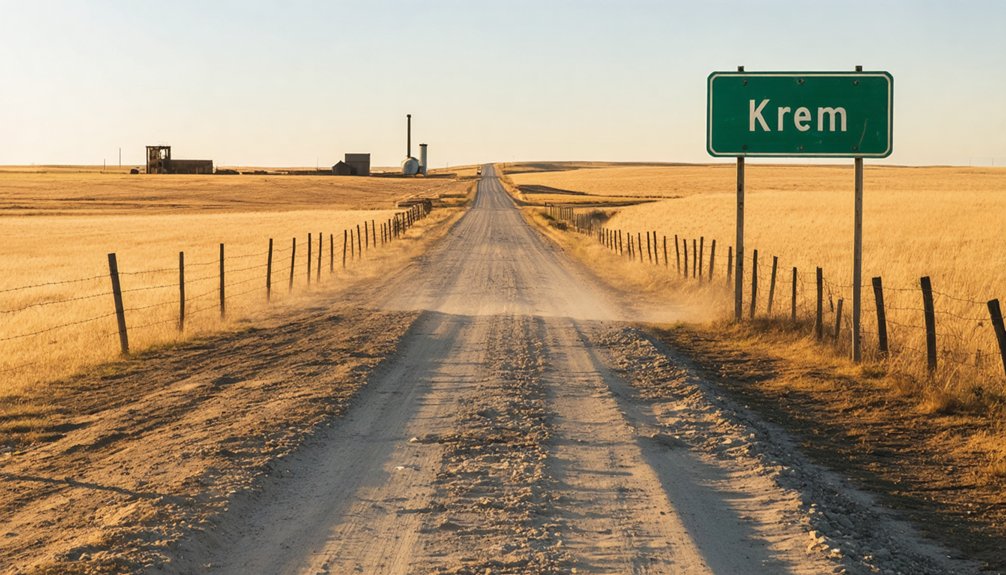
From Hazen, you’ll head north-northeast across eight miles of open prairie to reach what remains of Krem. The local grid system access makes navigation uncomplicated—straightforward driving directions available in town will guide you along 2WD roads suitable year-round. You won’t need special equipment or permits; just point your vehicle northeast and follow the grid.
The fifteen-minute journey traces the path those German-Russian settlers once traveled, though they moved in the opposite direction when the Northern Pacific Railroad arrived in 1913. Today’s empty landscape reveals why they abandoned Krem for Hazen’s rail connection. No gates block your way, no residents remain to ask permission from. The prairie opens freely before you, offering direct passage to two cemeteries and scattered ruins.
Best Time to Visit This Prairie Ghost Town
Timing your visit to Krem requires balancing North Dakota’s dramatic seasonal swings against your tolerance for isolation and weather extremes. Weather considerations dictate distinct windows for comfortable exploration of these abandoned homesteads.
The ideal ghost town exploration season breaks down into four distinct periods:
- Late Spring (May-Early June): Manageable crowds, accessible roads, and comfortable temperatures create perfect conditions for wandering through ruins without fighting summer heat or winter ice.
- Early Summer (June-July): Extended daylight maximizes your exploration time, though you’ll share the prairie with peak-season visitors.
- Early Fall (September): Moderate temperatures and reduced crowds offer solitude among the crumbling foundations.
- Avoid Winter (December-February): Brutal cold and heavy snow make accessing these remote sites treacherous, restricting your freedom to roam.
Exploring the Cemeteries and Mill Ruins
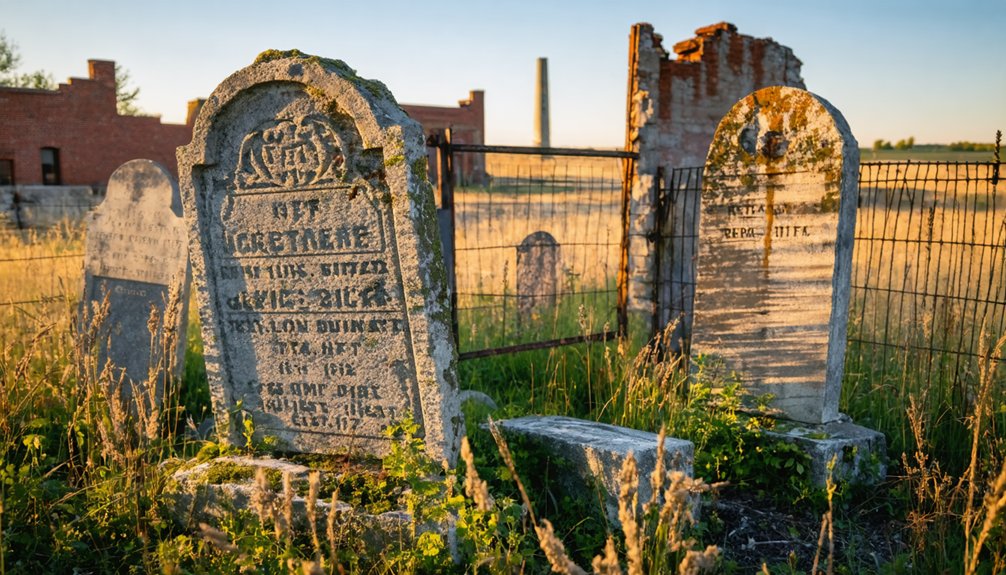
Standing among the windswept graves of Krem’s two cemeteries, you’ll find weathered markers that tell the story of German-Russian immigrants who journeyed from Crimea to stake their claim on this unforgiving prairie in 1888. These pioneer gravestones significance extends beyond names and dates—they’re evidence, proof, or record to families who built everything from nothing, only to watch it crumble after the 1913 railroad bypass.
Walk northeast to the mill ruins, where a four-story corner wall still defies gravity. Built in 1899, this was Mercer County’s largest wheat processor until fire ravaged it in 1906. Though milling machinery artifacts have long vanished, the remaining basements reveal the foundation’s sprawling footprint. You’ll discover freedom in wandering these silent remnants, where prairie grass reclaims what ambition once built.
Other Nearby Ghost Towns Worth Visiting
Within a 90-mile radius of Krem, five forsaken settlements beckon explorers to piece together North Dakota’s boom-and-bust frontier narrative.
These abandoned prairie outposts stand as weathered monuments to railroad dreams, homestead ambitions, and the unforgiving realities of frontier economics.
Notable Ghost Towns Near Krem:
- Sims – Featured in regional history documentation, this town maintains historic preservation efforts through its active Scandinavian Lutheran Church, where local folklore preservation includes tales of the “Gray Lady Ghost” haunting the organ.
- Blue Grass – Reaching only 20 residents at its peak, this railroad-bypassed settlement showcases early architecture patterns 35 miles northwest of Mandan.
- Griffin – Once housing southwest North Dakota’s largest stockyards along the Yellowstone Trail, marked by distinctive yellow-painted stone monuments.
- Arena – Founded in 1906, St. John’s Lutheran Church anchors this agricultural community with remaining homesteads and schoolhouse offering authentic frontier perspectives.
Each site rewards independent exploration with unfiltered glimpses into territorial perseverance.
Frequently Asked Questions
Is Camping Allowed Near the Krem Ghost Town Site?
I can’t confirm camping availability near Krem’s ghost town site. You’ll need to research current land ownership and regulations beforehand. Always avoid trespassing and respect private property—these abandoned places often sit on restricted land requiring permission.
Are the Cemetery Grounds Maintained or Accessible Year-Round?
Time has largely forgotten Krem’s silent resting places. You’ll find minimal cemetery upkeep at these abandoned grounds, though year-round visitation remains technically possible when weather permits—rural roads and harsh North Dakota winters become your primary obstacles.
The best season for North Dakota ghost towns is undoubtedly late spring when the snow has melted and the roads are more navigable. Visitors can explore the eerie beauty of these desolate sites, accompanied by a backdrop of blooming wildflowers. However, once summer yields to autumn, the once vibrant landscapes of these ghost towns take on a haunting yet captivating atmosphere.
Among the notable remnants of the state is the history of churchs ferry ghost town, a once-thriving community that tells a story of resilience and abandonment. As you wander through its ruins, the tales of its former residents echo in the wind, offering a glimpse into the past. Adventurous souls are often drawn to the ghost town, searching for signs of its eerie past amidst the quiet landscape that surrounds it.
Do I Need Permission to Explore the Mill Ruins?
You’ll likely need private property access permission since Krem sits on farmland, though no gates currently block entry. Respect historical preservation concerns—the unstable mill wall’s fragile, and securing landowner consent protects both you and these vanishing ruins.
What Safety Precautions Should I Take When Visiting Krem?
Bring proper navigation equipment and wear sturdy hiking boots for rough terrain. Share your route with someone trusted, pack winter survival gear, and stay with your vehicle if stranded. Always check road conditions before departing into remote North Dakota backcountry.
Are There Any Guided Tours Available for Krem?
You’ll chart your own course through Krem’s abandoned landscape—no tour schedules or guided exploration options exist for this isolated ghost town. Freedom awaits in self-guided discovery, where you’re the explorer traversing forgotten streets independently.
References
- https://news.prairiepublic.org/main-street/2019-11-07/krem-a-ghost-county-seat
- https://news.prairiepublic.org/show/dakota-datebook-archive/2022-05-29/flour-mill-fire
- https://visithazennd.com/about-hazen/history/
- https://www.youtube.com/watch?v=hRFfy3HQaus
- https://ghostsofnorthdakota892857007.wordpress.com/2015/10/30/true-ghost-towns-population-zero/
- https://www.ghosttowns.com/states/nd/krem.html
- https://www.atlasobscura.com/lists/americas-best-preserved-ghost-towns
- https://ghostsofnorthdakota892857007.wordpress.com/2013/11/02/ten-lost-north-dakota-places/
- https://www.history.nd.gov/publications/ndh_45_98.PDF
- https://www.ndaco.org/about-counties/county-histories/