Your ghost town road trip to Manda begins roughly 20 miles northeast of Austin along FM 1100, where Swedish settlers built their dreams in 1885. You’ll find the weathered schoolhouse standing sentinel over scattered foundation stones hidden in the grassland, with the cemetery holding generations of pioneers who once ran the cotton gin and general store. Plan your visit between October and April when temperatures cooperate, and bring sturdy boots for exploring the overgrown remnants. The route naturally connects with New Sweden Church‘s stunning copper steeple and other rural ghost towns, creating a full day of discovering what railroad bypasses left behind.
Key Takeaways
- Manda is located in northeastern Travis County off FM 1100, approximately 18-20 miles from Austin via US Highway 290.
- Visit the 1885 schoolhouse, cemetery with original settlers’ graves, and foundation stones scattered across the grassland.
- Plan your trip between October and April for optimal weather conditions and comfortable exploration of the ruins.
- Bring navigation tools, sturdy boots, water, sunscreen, and camera gear for wide-angle shots of historic structures.
- Stop at nearby J. Lorraine Ghost Town and New Sweden Church with its iconic 104-foot copper steeple.
Where to Find Manda in Travis County
Finding Manda requires traversing the rolling terrain of northeastern Travis County, where the ghost town sits quietly along Manda Carlson Road, just off FM 1100. You’ll drive four miles north from Highway 290, then turn east onto Manda Carlson Road—about two miles from the FM 1100 junction. The thirty-minute journey from South Austin rewards you with solitude and historical significance most travelers never discover.
Watch for the New Sweden Evangelical Lutheran Church as your landmark; you’re close when you spot it. This former community importance fades into grassland now, with barely a trace beyond the old schoolhouse. The isolation speaks volumes—Manda isn’t packaged for tourists. You’ll need decent directions and determination, but that’s exactly what makes ghost town hunting worthwhile.
The Story Behind This 1885 Settlement
You’ll discover Manda’s roots stretch back to 1885, when Swedish immigrants carved out a new life on this Texas prairie, led by enterprising settlers like J. Victor Morell who brought modern industry with his steam cotton gin.
The community thrived through the early 1900s, complete with churches, farms, and all the trappings of frontier prosperity. By the 1960s, though, Manda had faded into silence—leaving behind only a cemetery and memories etched in historical markers along Wells School Road.
Early Pioneer Settlement Days
- J.V. Morell claimed his stake in 1885, becoming the first permanent settler
- Otto Bengston and fellow pioneers John Sanders and Aaron Johnson followed within three years
- A cotton gin processed their harvests while the blacksmith shop kept their tools sharp
- The general store became the trading hub where neighbors exchanged goods and news
- Swedish Methodist and Lutheran congregations organized spiritual life by the 1890s
J. Victor Morell’s Impact
In 1885, J. Victor Morell transformed raw Texas prairie into a thriving settlement through sheer determination. You’ll find his fingerprints everywhere—from the 640-acre tract he secured to the general store that served 200 residents within a year. His community leadership extended beyond land deals; he donated property for the church, funded the schoolhouse for 50 students, and served as Manda’s first postmaster.
Morell’s cotton operations yielded 1,200 bales at peak production, proving this frontier gamble could sustain families. Until 1902, he mentored three generations of pioneers who followed his path. That 1976 historical marker you’ll spot isn’t just ceremony—it’s legacy preservation for a man who turned wilderness into home for homesteaders seeking their own slice of independence.
Decline to Ghost Town
While Morell’s cotton empire churned out profits through the 1890s, the distant thunder of railroad construction spelled Manda’s eventual fate. You’ll find that economic shifts in Texas agriculture hit hardest where rail lines never reached. Manda watched neighboring settlements boom while trains passed them by.
The community’s slow fade reveals a pattern you’ll recognize across rural Texas:
- Railroad abandonments steered commerce toward better-connected towns
- Families packed wagons and followed opportunity to Austin’s expanding edges
- The cotton gin fell silent as farmers sought markets elsewhere
- School doors closed when too few children remained
- Only headstones and one weathered schoolhouse defied the exodus
What Remains at the Manda Ghost Town Site
Though time has erased most traces of Manda’s bustling past, the weathered schoolhouse stands as the town’s most commanding remnant. You’ll find this 1885 structure undergoing preservation efforts, its bones still defying the Texas wind.
Nearby, the cemetery holds stories in stone—graves of settlers who carved life from this unforgiving land.
Beyond these landmarks, you’ll discover Manda through absence. Original street patterns ghost across the prairie if you look carefully. Foundation stones peek through wild grass where homes once stood. The historical documentation tells of a thriving community, but nature’s reclaimed most of it.
You’re free to wander this quiet ground, tracing roads that once connected neighbors, reading names on weathered markers, imagining voices that filled that one-room schoolhouse.
Driving Directions From Austin via US 290
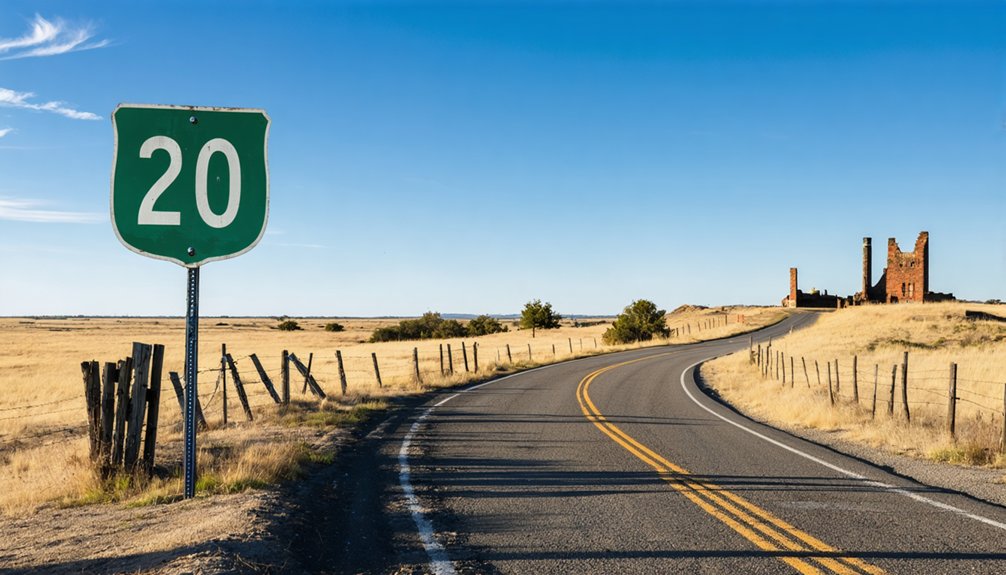
Your journey to Manda begins where Austin’s sprawl surrenders to the Hill Country, following US-290 East as it unspools toward forgotten corners of Texas. I’ve made this drive half a dozen times, watching the highway markers count down while the landscape shifts from strip malls to cattle ranches, each mile carrying you deeper into territory where ghost towns outnumber gas stations.
You’ll cover roughly 60 miles before veering onto farm roads that lead to Manda’s abandoned homesteads, so fill your tank and download your maps—cell service grows patchy once you leave the main corridor.
Route Overview and Mileage
Since Manda lies in the rural heart of Texas, your journey from Austin begins where the city’s sprawl gives way to rolling ranch land along US Highway 290.
You’ll cover approximately 189 miles of open highway, and road planning requirements are straightforward—just follow US-290 east through authentic Texas countryside.
Route segment details break down as follows:
- Austin to Bastrop: 30-35 miles through initial rural movement
- Bastrop to Giddings: Additional 40 miles of pure ranch country
- Giddings to Columbus: Another 50 miles deeper into forgotten territory
- Final approach: 60-70 miles through back roads near Seguin
- Total drive time: 2.5-3 hours under normal conditions
Use Waze for real-time traffic updates, especially traversing Austin’s outskirts on E Highway 290, where congestion occasionally slows your escape.
Key Landmarks En Route
The highway stretches before you like a ribbon through time, and about 15 miles east of Austin, Manor appears as your first waypoint—a small community that’s become home to one of Texas’s most peculiar roadside attractions.
US 290 serves as one of the region’s primary regional transportation routes, carrying you through developing suburbs that gradually dissolve into authentic countryside. You won’t find dramatic scenic overlooks here—central Texas keeps things modest with flat terrain and wide horizons—but there’s beauty in the simplicity.
Watch for J. Lorraine Ghost Town’s spur road just off the highway, where George Lorraine’s Disney-inspired creation waits with its maze and western facades. Beyond Manor, the landscape grows quieter as you continue toward Manda, where a different kind of ghost town—one genuinely abandoned—marks your final destination.
Final Approach to Manda
From Austin’s central districts, traverse to West Highway 290 and head east, merging onto the main artery that’ll carry you past the MOPAC interchange and into genuinely rural Texas. You’ll leave suburban sprawl behind as pavement narrows and fencelines stretch toward distant horizons.
Essential navigation notes:
- Check Waze for realtime updates on US 290 segments before departure
- Rural road conditions deteriorate past major intersections—slow down accordingly
- Watch for unmarked farm-to-market turnoffs as highway signage thins
- Traversing construction zones near Springdale requires patience and alternate routes
- Download offline maps since cell service drops considerably
The final miles demand attention. Crumbling asphalt and sudden cattle crossings replace predictable city traffic patterns. When modern infrastructure fades completely, you’re close—Manda exists where Texas forgot to pave.
New Sweden Church and Cemetery Stop
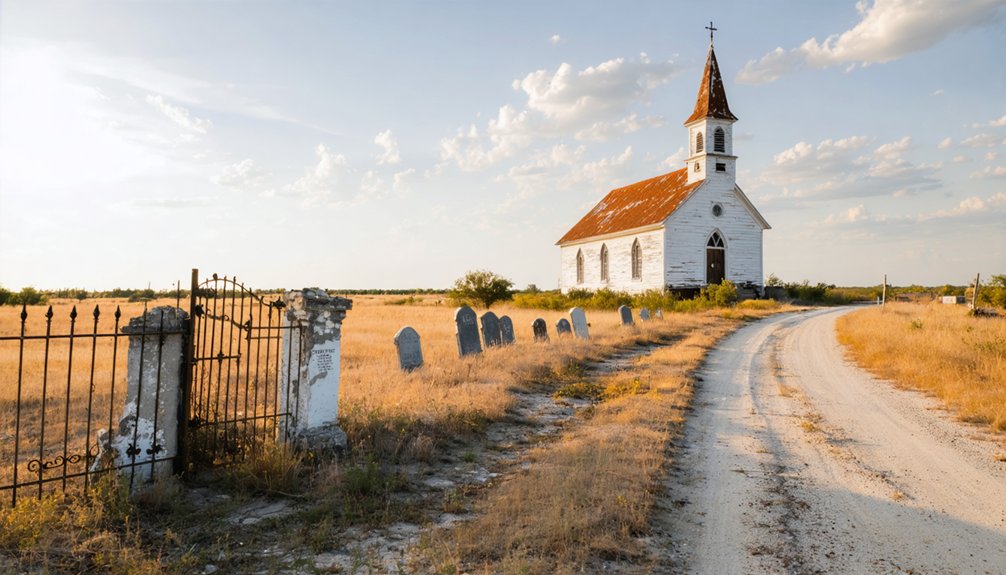
Standing tall against the Texas sky, New Sweden Church‘s 104-foot copper steeple beckons travelers from miles away—a gleaming monument to Swedish pioneers who carved their community from Travis County wilderness in 1873. You’ll find this photographer’s dream at 12809 New Sweden Church Road, where the 1923 sanctuary showcases church architecture that’s reportedly Texas’s most photographed.
Pull over at the adjacent cemetery corner—its cast iron archway guards stories from 1876. The old section spreads left, while numbered concrete-walled plots mark newer graves. Here lies the cemetery historical significance: 43 charter members and generations who followed, transcribed by volunteers who preserved their legacy.
Rev. J.O. Cavallin organized this congregation when these immigrants worshipped in homes and schoolhouses. Their exquisite sanctuary still stands, defying ghost town oblivion.
J. Lorraine Ghost Town Add-On in Manor
Just a mile off US 290 near Manor, George T. Richards transformed his 15-acre property into an authentic Old West experience. This Navy veteran’s personal backstory includes serving on the USS Independence and witnessing Apollo launches before earning his degree and working as a systems analyst.
From Navy deck to Old West town builder—George T. Richards traded aircraft carriers and Apollo launches for saloon doors and dancing halls.
Inspired by Walt Disney’s philosophy of creating fun spaces, Richards discovered original planks from the 1900s-era town and initiated a modern redevelopment that’d make any freedom-seeker smile.
You’ll find:
- Multiple saloons, dance halls, and a fort for overnight camping
- Dozens of walkable buildings with creaking floorboards and authentic details
- Free admission for leisurely exploration of this hidden gem
- Kid-friendly activities like mazes, human foosball, and washer toss
- Burgers and beer in genuinely atmospheric surroundings
Reports of ghostly voices and pipe smoke add mysterious authenticity.
Best Times to Visit Rural Ghost Town Sites
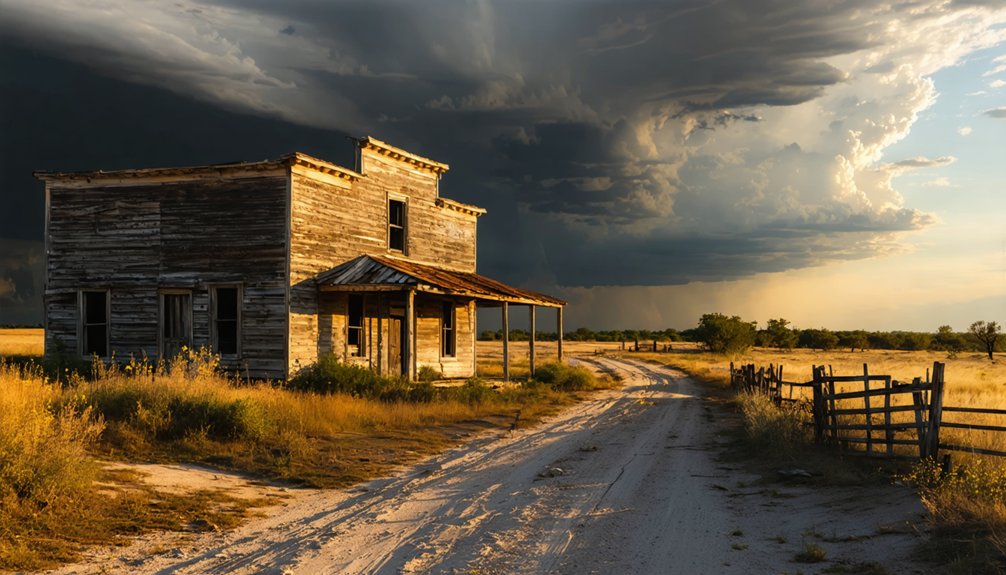
You’ll want to time your Manda ghost town adventure between October and April, when Texas transforms into an explorer’s paradise rather than an open-air furnace. I learned this the hard way after attempting a July visit to Terlingua—by noon, the steering wheel was too hot to touch and the crumbling adobe offered zero shade.
The history of Fort Griffin, Texas, is rich with tales of frontier life and dramatic change. Once a bustling outpost, it now serves as a reminder of the resilience and hardships faced by those who ventured into the Wild West. Exploring its remnants can give you a unique perspective on the challenges settlers endured amidst the vast landscapes of Texas.
The history of Coles Settlement, Texas, offers a fascinating glimpse into the lives of early pioneers who sought fortune and stability in a harsh environment. As you wander through the remnants of this once-thriving settlement, you can almost hear the echoes of daily life and the dreams that drove its inhabitants. Each stone and structure tells a story of determination amidst adversity, making it a worthwhile stop on your journey through Texas’s rich past.
Plan for full daylight hours in spring or fall, giving you comfortable temperatures for hiking through overgrown foundations while still catching that golden-hour light that makes abandoned structures look absolutely haunting.
Seasonal Weather Considerations
When planning your ghost town road trip to Manda, Texas, timing can make the difference between a memorable adventure and a sweltering ordeal. Weather forecasting accuracy matters here—spring brings frequent thunderstorms with potential storm disruptions that’ll turn dirt roads into muddy traps.
Consider these seasonal realities:
- Spring (80-87°F): Expect 20-50% thunderstorm chances and up to 1 inch of rainfall washing out backroads
- Summer (80-88°F): Brutal heat index under relentless sun, but only 0-16% rain risk for reliable access
- Fall (60-82°F): Sweet spot with 74-81°F days and minimal precipitation after early-season storms
- Winter (60-65°F): Cool exploration temps under cloudy skies, though drizzle occasionally dampens morning ventures
Fall’s pleasant highs and minimal rain give you maximum freedom to roam without weather constraints.
Daylight Hours Matter
Since Manda’s remote location lacks streetlights and nearby towns fade into darkness miles before you arrive, daylight becomes your most valuable resource. You’ll want to time your exploration for mid-morning through late afternoon, maximizing visibility for photography and safe navigation of crumbling structures.
Summer offers extended daylight—up to fourteen hours—giving you freedom to explore at your own pace without watching the clock. Winter shortens your window to roughly ten hours, demanding earlier starts and tighter schedules.
Seasonal lighting conditions dramatically affect your experience. Golden hour transforms weathered wood and rusted metal into stunning compositions, while harsh midday sun reveals details you’d otherwise miss. The best times of day bracket noon: arrive early to scout locations, then capture that magical late-afternoon glow before retreating to civilization.
Avoiding Extreme Heat
Texas heat doesn’t just make you uncomfortable—it can turn your ghost town adventure into a dangerous ordeal. June through September brings relentless temperatures exceeding 95°F, with midday conditions climbing past 100°F in exposed rural areas. Finding shade structures becomes nearly impossible in abandoned settlements, amplifying your risk.
Critical heat avoidance strategies:
- Visit December-February when highs stay comfortably between 60-80°F
- Escape before June when summer’s brutal assault begins
- Plan October-November trips with pleasant 70-80°F averages
- Avoid overnight lows above 70°F that prevent body cooling
- Watch for spring thunderstorms adding dangerous humidity
Avoiding summer heat means exploring when temperatures won’t exceed your body’s limits. Winter’s sunny mid-70s days offer perfect conditions for photographing crumbling buildings without heat exhaustion threatening your freedom to roam.
Photography Opportunities at Abandoned Structures
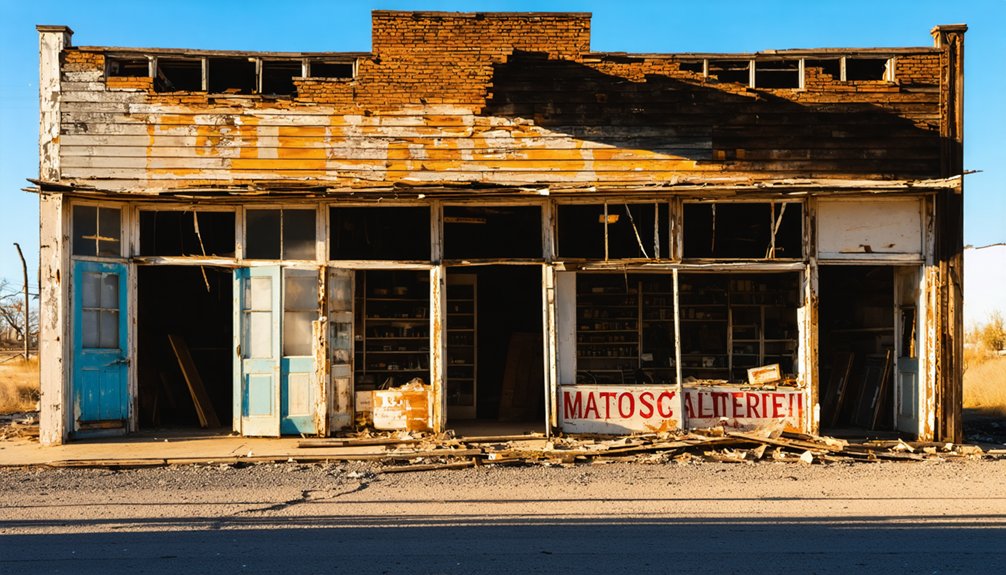
As you frame your shot through the viewfinder, these abandoned Texas structures reveal themselves as perfect subjects for dramatic photography. Terlingua’s crumbling mining buildings catch golden hour light against Chisos Mountains, while Lobo’s stark cotton farm ruins offer expansive scenes of minimalist decay. You’ll find coastal atmospherics at Indianola’s hurricane-battered port remnants, where tidal effects create moody bayfront compositions.
Medicine Mound’s general store stands defiant beneath sacred healing hills, and Catarina’s vibrantly painted hotel shell bursts with faded color against arid scrubland. Pack your wide-angle lens for capturing Big Bend backdrops and high-contrast filters for desert textures. These weathered facades tell stories of freedom-seekers who once called these desolate places home—now yours to document without crowds or restrictions.
Combining Multiple Ghost Towns in One Day
Your camera’s memory card might overflow with architectural drama, but there’s strategic planning required if you want to bag multiple ghost towns before sunset. When budgeting day trips from Austin, Manda pairs perfectly with New Sweden—both sit along Highway 290 for seamless exploration. Planning multi site itinerary becomes an art of geographic clustering rather than wishful thinking.
Travis County Ghost Town Combinations:
- Start with New Sweden’s weathered church, then cruise to Manda’s schoolhouse renovation
- Multiple Travis County sites cluster within two-hour driving radius
- Old D’Hanis works as logical extension for ambitious explorers
- Skip distant outliers like Lobo (El Paso), Indianola (coastal), or Medicine Mound (Panhandle)
- Eight-hour window accommodates three sites with photography breaks
You’ll maximize freedom by choosing proximity over ambition—quality documentation beats frantic windshield time.
Essential Supplies for Your Ghost Town Adventure
While romanticizing abandoned buildings comes naturally, actually exploring them demands unglamorous preparation that separates documented adventures from cautionary tales. Pack water—more than you think—because Manda’s open terrain offers zero shade. Your phone won’t cut it; bring proper navigation tools since cell service disappears beyond Austin’s sprawl.
That 1885 schoolhouse won’t photograph itself, so protect your camera gear from dust that’ll infiltrate everything. Sturdy boots matter when you’re stepping through century-old debris. Sunscreen, first-aid supplies, and a charged backup battery become lifelines, not luxuries. Texas heat doesn’t negotiate with romantics who showed up unprepared.
You’re chasing freedom, not recklessness—there’s a difference worth respecting when you’re miles from help.
Frequently Asked Questions
Are There Any Guided Tours Available for Manda Ghost Town?
No organized group tours operate in Manda—you’ll explore independently. Self-guided tours available through your own research let you wander freely among weathered ruins. Nearby San Antonio and Austin offer professional ghost tours if you’re craving structured experiences with spine-tingling storytelling.
Is It Legal to Enter the Old Schoolhouse Under Renovation?
Better safe than sorry—you’ll need permission before entering. Historic building regulations and site accessibility considerations mean the renovating schoolhouse is likely private property. Check with Travis County or the owner first to avoid trespassing charges.
What Cell Phone Reception Can I Expect in the Area?
You’ll encounter limited coverage in Manda’s remote landscape. While major carriers show signals, expect spotty connectivity once you’re exploring the ghost town. Download maps beforehand—you’ll want independence from unreliable service during your adventure.
Are There Restrooms or Facilities Near the Manda Site?
You’ll find nothing but tumbleweeds at Manda—no restrooms exist onsite. Plan ahead using Austin facilities before departing. Parking availability’s informal along roadsides, and local amenities nearby require driving back toward Highway 290’s civilization.
Can I Camp Overnight Near Manda or New Sweden?
Camping availability near Manda is extremely limited—you won’t find dedicated sites nearby. For off-grid accommodation options, you’ll need to explore private land boondocking or head to Terlingua’s ghost town campgrounds, over 500 miles west.