Mill Fork, Utah sits along U.S. Route 6 in Spanish Fork Canyon, and it’s a ghost town that’ll stop you cold. Once home to nearly 250 residents, this canyon settlement thrived on sawmills and charcoal production before vanishing almost entirely by 1900. Today, you’ll find only a well-maintained cemetery with an arched entrance visible from the highway. It takes about 20 minutes to explore, but the history behind this forgotten community runs much deeper than what the graves alone can tell you.
Key Takeaways
- Mill Fork, Utah, is located along U.S. Route 6 east of Spanish Fork, approximately 12 miles past Thistle.
- The site features a well-maintained cemetery with an arched entrance visible from the highway, but no standing buildings remain.
- Plan for a 20-minute visit covering parking, exploring grave markers, photographing the entrance, and reflecting on the landscape.
- Mill Fork peaked at 250 residents before charcoal production collapsed around 1890 and the railroad station closed in 1947.
- Nearby ghost towns including Thistle, Soldier Summit, Helper, and Spring Canyon can easily be added to your road trip itinerary.
What Was Mill Fork, Utah?
Once a bustling canyon settlement of nearly 250 people, Mill Fork, Utah, sprang to life in the late 1870s when railroad crews pushed the Utah and Pleasant Valley Railroad through Spanish Fork Canyon, building three sawmills to cut the timber they needed for railroad ties.
Charcoal production soon followed, drawing workers deeper into the canyon’s timber resources.
By 1900, most residents had vanished, and the town’s railroad station finally closed in 1947.
Today, you won’t find standing buildings or historical artifacts lining the streets.
What you’ll find instead is a small, well-tended cemetery with an arched entrance visible from U.S. Route 6, a quiet tribute to preservation efforts that keep this forgotten community’s memory alive.
Mill Fork rewards the curious traveler willing to read between the landscape’s lines.
How to Get to Mill Fork on U.S. Route 6
Reaching Mill Fork takes you along the same corridor that railroad crews carved through Spanish Fork Canyon in the 1870s. U.S. Route 6 puts you directly on that historic path, connecting local legends and historical artifacts scattered across the canyon landscape.
Every mile east on U.S. Route 6 traces the same canyon path railroad crews cut in the 1870s.
Follow these four steps to reach Mill Fork:
- Start in Spanish Fork and head east on U.S. Route 6.
- Pass through Thistle, roughly 12 miles before your destination.
- Watch for the arched cemetery entrance visible from the highway on your right.
- Pull over safely and explore the well-tended grounds at coordinates 39.9639°N, 111.3081°W.
The drive itself tells the story. You’re tracing a route built for timber, railroad ties, and survival — raw freedom carved into canyon rock.
What You’ll Actually See at Mill Fork Today
Although the canyon once hummed with sawmills and charcoal kilns, you’ll find Mill Fork stripped down to a single, quiet landmark: a small, well-tended cemetery marked by an arched entrance that catches your eye from the highway. Pull over on U.S. Route 6 and step inside.
The cemetery holds at least 16 known burials, each stone a historical artifact connecting you to the railroad workers, woodcutters, and families who built something here and then vanished.
Local legends suggest the settlement once supported 250 souls before charcoal profits collapsed and the railroad moved on.
No buildings stand. No platforms remain. Just graves, wind, and canyon walls.
For travelers chasing genuine history rather than reconstructed facades, that stark honesty makes Mill Fork worth every minute you give it.
How Long Mill Fork Actually Takes to Visit
Mill Fork won’t demand much of your day, and that’s part of its appeal. Pull off U.S. Route 6, and you’re looking at a focused, purposeful stop built around genuine history.
Mill Fork won’t consume your day — just your curiosity. A focused stop built around genuine history.
Here’s how your time breaks down:
- Arrive and park — 2 minutes along the highway shoulder
- Walk the cemetery — 10 minutes reading markers, absorbing local legends tied to railroad workers and charcoal laborers
- Photograph the arched entrance — 5 minutes capturing the site’s most striking historical artifact
- Reflect on the canyon setting — 5 minutes connecting the timber, rails, and vanished lives to the landscape around you
Total: roughly 20 minutes. Mill Fork rewards curiosity without consuming your schedule, leaving you free to push onward toward Price or backtrack through Spanish Fork Canyon.
How Mill Fork Went From Boomtown to Ghost Town
Few settlements burned brighter or faded faster than Mill Fork. In the late 1870s, railroad construction pulled workers, sawmills, and ambition into Spanish Fork Canyon simultaneously. At its peak, roughly 250 people called this canyon community home.
Then the dominoes fell. Charcoal production collapsed around 1890, the general store shuttered shortly after, and most residents had packed out by 1900. A handful of stubborn homesteaders hung on until the 1930s, and the railroad station didn’t officially close until 1947, when diesel locomotives made the water stop irrelevant.
The historical significance of Mill Fork lies in how completely one industry’s collapse erased an entire community. Today, preservation efforts center on the small, well-tended cemetery — the last honest evidence that people once built real lives here.
Other Ghost Towns Worth Stopping at Nearby
Spanish Fork Canyon doesn’t hoard its history at a single stop — if you’re already on U.S. Route 6, you’re within striking distance of several forgotten settlements worth exploring. Local legends and abandoned structures pepper this corridor, rewarding curious travelers who push a little further.
- Thistle – A flooded ghost town with haunting, submerged foundations visible during dry years.
- Soldier Summit – A railroad town that once serviced mountain crossings, now eerily quiet.
- Helper – A working-class railroad hub preserving genuine mining-era character.
- Spring Canyon – A coal camp community with crumbling abandoned structures scattered across the hillsides.
Each stop deepens the same story Mill Fork started: boom, utility, silence. String them together and you’ve got a full day of unfiltered canyon history.
What to Know Before Driving Spanish Fork Canyon
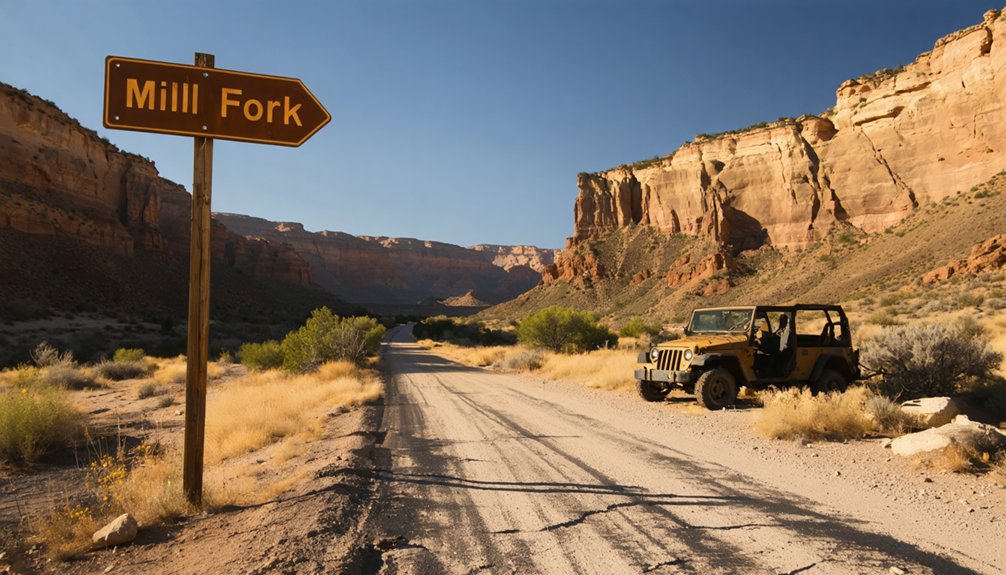
Before you string those stops together and head out, knowing the road itself saves you from a few canyon surprises. U.S. Route 6 through Spanish Fork Canyon moves fast, with trucks, tight curves, and weather shifts that catch unprepared travelers off guard. Pull over safely before exploring any roadside stop.
The canyon carries more than asphalt — it holds local legends tied to railroad camps, timber crews, and lives cut short. Some travelers swap haunted stories about the canyon’s isolated stretches after dark, and honestly, the atmosphere earns those tales.
Winter conditions can close or complicate sections without much warning.
Travel with a full tank, a paper backup map, and flexible timing. The canyon rewards curiosity, but it respects preparation first.
Before You Go: Safety at Abandoned Sites
Ghost town structures have stood without maintenance for decades. Floors, stairs and roof timbers fail without warning, and a building that looks solid from outside may not hold your weight. Stay out of standing structures unless the site is actively maintained and open to visitors.
Mine workings are the more serious hazard. Vertical shafts can be hundreds of feet deep, are often unfenced, and may be hidden by brush or capped with rotted boards. Never enter an adit, tunnel or shaft: abandoned workings can hold oxygen-poor or toxic air that gives no warning before you lose consciousness.
Enclosed spaces with rodent droppings carry a risk of hantavirus, which is contracted by breathing contaminated dust. Do not sweep or stir up dust inside old cabins and outbuildings.
Cell coverage at these sites is usually poor or absent. Tell someone your route and expected return time, and carry more water than you think you need.
Frequently Asked Questions
Are There Restrooms or Parking Areas Available at the Mill Fork Cemetery?
Don’t expect luxury amenities—you’ll find zero restrooms or formal parking! This historically preserved roadside cemetery follows minimal cemetery regulations, so you’ll pull off U.S. Route 6, step out freely, and explore this hauntingly beautiful ghost town on your own terms.
Is the Mill Fork Cemetery Open to Visitors Year-Round?
You can visit Mill Fork Cemetery year-round, as it’s roadside along U.S. Route 6. Its historical significance endures through ongoing preservation efforts, so you’re free to explore this quietly powerful ghost town remnant whenever adventure calls.
Can Visitors Leave Flowers or Tributes at the Mill Fork Graves?
Like a traveler honoring ancient waypoints, you can leave flowers at Mill Fork’s graves. Respect burial site etiquette and the cemetery’s historical significance — let your tribute speak quietly for those who carved life from this canyon’s rugged wilderness.
Are Pets Allowed When Visiting the Mill Fork Cemetery Site?
No official pet rules are posted, but you’ll want to prioritize pet safety and honor the grounds by following general leash policies—keep your companion close as you explore this quietly haunting, historically rich canyon cemetery.
Is There Cell Phone Reception Along U.S. Route 6 Near Mill Fork?
Cell service along U.S. Route 6 near Mill Fork is a ghost itself — it vanishes. Signal strength drops in the canyon’s depths, so you’ll want to download your maps before you chase this forgotten railroad town’s spirit.
References
- https://en.wikipedia.org/wiki/Mill_Fork
- https://www.facebook.com/groups/864060180303556/posts/6859303990779115/
- https://thefrugaltrekker.wordpress.com/2014/10/13/mill-fork-cemetery/
- https://kids.kiddle.co/Mill_Fork
- https://www.utahvalley.com/plan/day-trips-itineraries/history-buff/ghost-towns-and-haunted-places/
- https://www.youtube.com/watch?v=gMPuZ2P-08M
- https://roamze.com/ghost-towns/mill-fork-ghost-town-ut
- https://kasbyrealestate.com/2022/11/22/7-utah-county-ghost-towns-and-the-fascinating-stories-behind-them/
- https://en.wikipedia.org/wiki/List_of_ghost_towns_in_Utah
- https://www.instagram.com/reel/DBSEmv6ybgV/