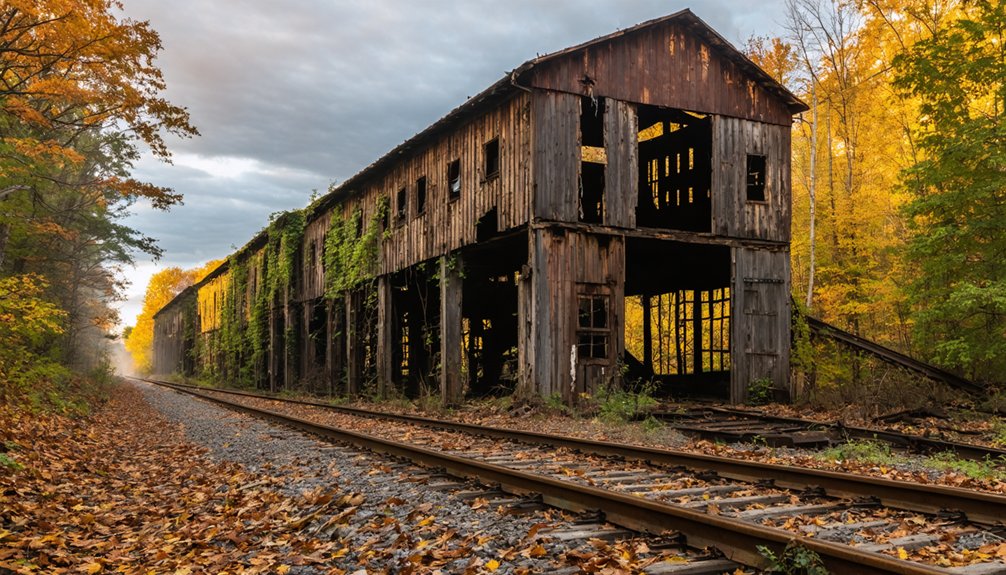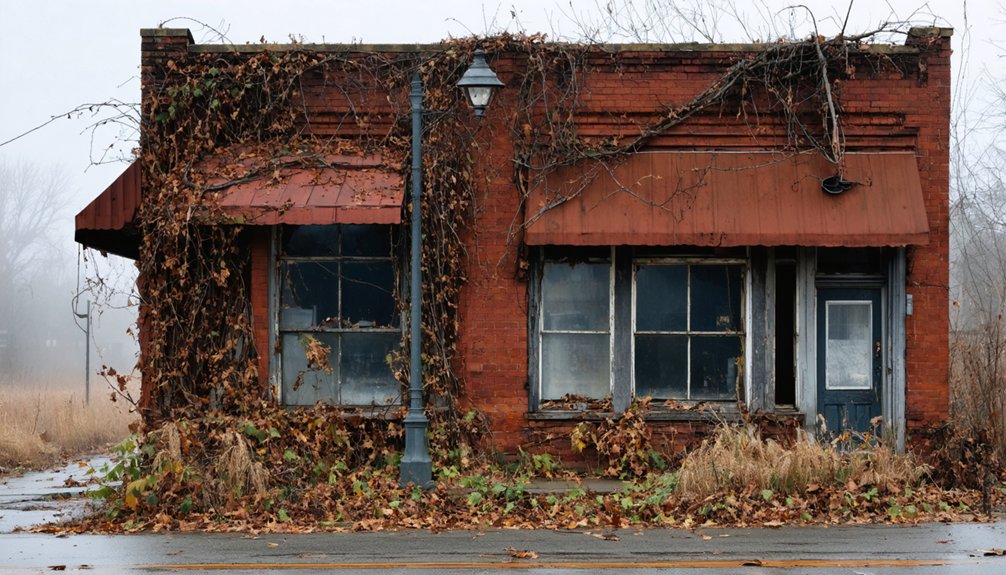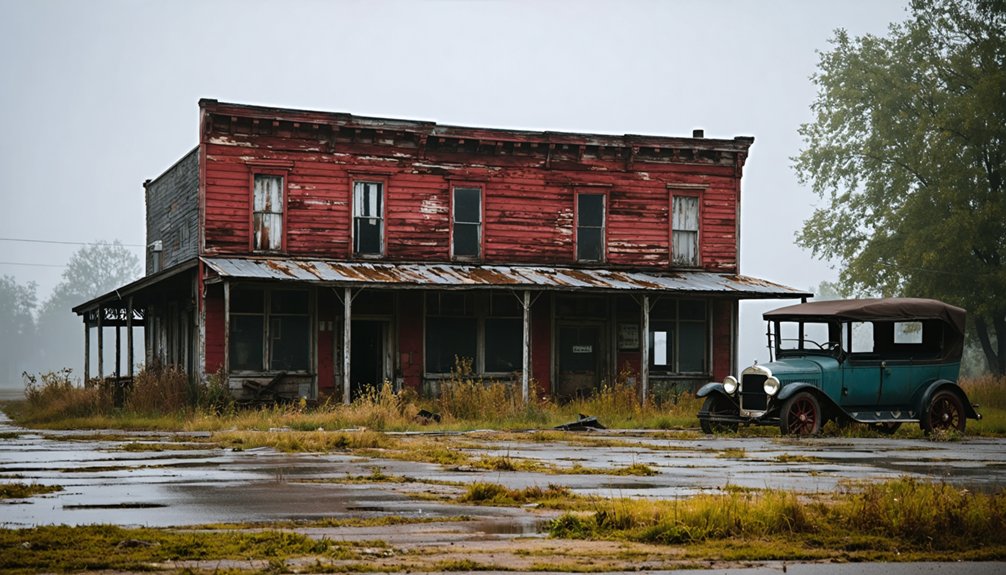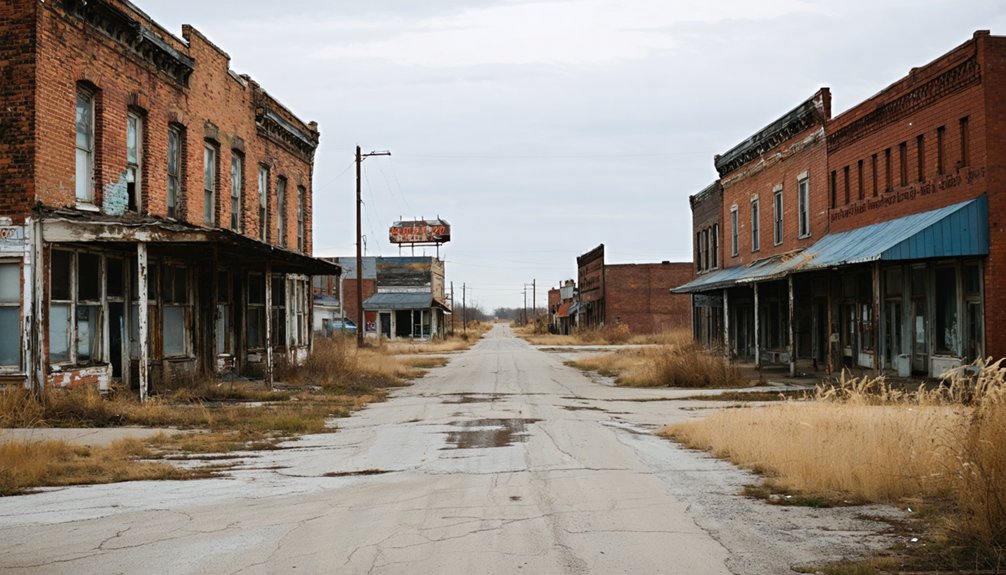
Planning a ghost town road trip to Mollie, Indiana means heading to Blackford County’s Harrison Township, where Indiana’s natural gas and oil boom once turned a quiet crossroads into a buzzing railroad community. Today, you’ll find the intersection of county roads 400 North and 300 East, two remaining houses, and open land where buildings once stood. Grab a county map before you go, because there aren’t any signs guiding you in — and there’s much more to this forgotten town’s story worth uncovering.
Key Takeaways
- Mollie, Indiana is located in Blackford County’s Harrison Township, at the intersection of county roads 400 North and 300 East.
- Grab a county map before visiting, marking the crossroads to navigate the rural area and locate the ghost town easily.
- Only two remaining houses mark the former community, with commercial buildings and railroad infrastructure having completely vanished over time.
- No signs or guided tours exist, making exploration a personal, immersive experience requiring self-guided interpretation of Mollie’s history.
- Mollie offers history enthusiasts a raw glimpse into Indiana’s oil and gas boom era, reflecting a once-thriving railroad community.
What Is Mollie, Indiana’s Forgotten Ghost Town?
Once a thriving hub during Indiana’s natural gas and oil boom, Mollie is a ghost town tucked away in Harrison Township, Blackford County, sitting roughly halfway between Hartford City and Montpelier.
Mollie’s history stretches from the 1880s through the 1920s, when it bustled with industry, railroad access, and oil workers enthusiastic to tap into the region’s rich reserves.
From the 1880s through the 1920s, Mollie roared with industry, railroads, and oil workers chasing the region’s rich reserves.
Named after an early resident whose last name history has forgotten, Mollie grew organically around its train station rather than following any planned layout.
Ghost town significance runs deep here — Mollie represents one of over 60 Indiana communities that rose and fell alongside America’s resource-dependent economy.
If you’re chasing authentic American history off the beaten path, Mollie delivers a raw, unfiltered glimpse into a vanished world.
Why Mollie Boomed During the Indiana Gas Rush
Mollie didn’t just happen by accident — its rise was fueled by one of the most electrifying economic explosions in American history. The Indiana Gas Boom transformed the region into a powerhouse of economic growth, and Mollie sat right in the middle of the action.
By the mid-1890s, roughly two-thirds of Harrison Township was actively producing oil, making the surrounding landscape a goldmine for workers and investors alike. Nearby Montpelier was dubbed “the very heart of the greatest natural gas and oil field in the world.”
Mollie’s position along the Fort Wayne, Cincinnati, and Louisville Railroad made it the perfect base for gas industry workers needing quick access to the oil fields. You could feel the opportunity in the air.
What Killed Mollie’s Economy for Good?
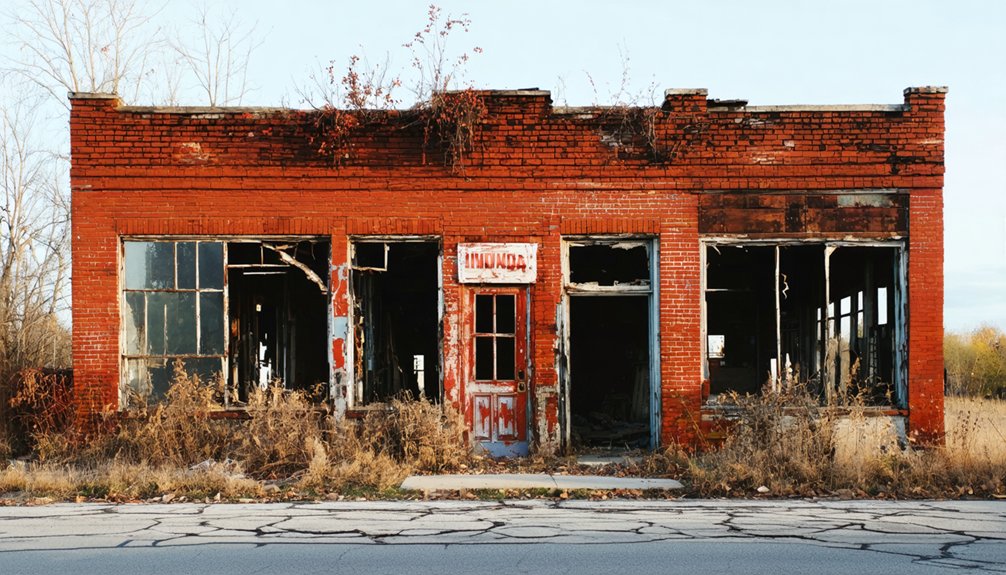
Every boom has a bust, and Mollie’s came hard and fast. Several forces hit simultaneously, triggering a swift economic collapse that the town simply couldn’t survive.
The natural gas and oil reserves depleted, stripping away the industry that built Mollie from the ground up. The clay supply for the local factory ran dry, accelerating industrial decline even further.
When the natural gas, oil, and clay ran out, Mollie’s industrial foundation didn’t just crack — it crumbled entirely.
Then came the automobile. As car culture took hold, demand for train travel collapsed, making Mollie’s railroad stop irrelevant.
Eventually, workers dismantled the tracks entirely, erasing the town’s single greatest infrastructure advantage.
Without energy, without industry, and without the railroad, there was nothing left to keep people there. Residents packed up and moved on, leaving Mollie to fade quietly into the Indiana countryside.
What Can You Actually See at Mollie Today?
When you pull up to the ghost town site of Mollie today, you’ll find only two houses standing near where a once-bustling community thrived.
The commercial buildings are completely gone, the railroad infrastructure has been stripped away, and no old businesses remain to hint at the town’s prosperous past.
What surrounds you now is a quiet rural landscape at the intersection of county roads 400 North and 300 East, where the silence itself tells the story of a boom town that time left behind.
Remaining Structures Still Standing
Visiting Mollie today means accepting that almost nothing remains of the once-bustling boom town. The remaining structures consist of just two houses near the ghost town site — that’s it.
Every commercial building has been dismantled, and the railroad infrastructure that once defined the community has completely disappeared from the landscape.
Despite the sparse scene, the historical significance of this location runs deep. You’re standing where two-thirds of Harrison Township once pumped oil, where workers stepped off trains bound for the fields, and where an entire community built its livelihood around resources that eventually ran dry.
The open landscape actually tells the story powerfully — nature has quietly reclaimed what industry abandoned. Bring your curiosity, because your imagination will do most of the heavy lifting here.
The Surrounding Landscape Today
Beyond those two remaining houses, the surrounding landscape opens up into a quiet stretch of rural Indiana that looks deceptively ordinary — flat farmland, gravel roads, and wide sky.
But look closer, and you’ll notice the subtle landscape changes that hint at what once stood here. Where railroad tracks once cut through, you’ll find only earth reclaimed by grass and time.
The natural features of Harrison Township — its fertile soil, open fields, and gentle terrain — remain largely unchanged, yet they now swallow the memory of an entire community.
You won’t find sidewalks, foundations, or signage marking what was. What you’ll find is space, silence, and the rare freedom of standing somewhere history quietly erased itself, leaving only land behind.
Can You Still Access the Mollie Ghost Town Site?
How do you find a town that’s practically vanished from the map? Mollie’s ghost town exploration requires minimal equipment but maximum curiosity.
Head to Blackford County, making your way to where county roads 400 North and 300 East intersect.
Navigate to Blackford County and follow the roads until county roads 400 North and 300 East intersect.
Here’s what you’ll encounter during your visit:
- Two remaining houses mark the boundaries of what was once a thriving railroad community.
- Open landscape where commercial buildings and railroad infrastructure once dominated daily life.
- Historical significance embedded in the terrain itself, connecting you to Indiana’s oil and gas boom era.
You won’t find signage or guided tours. Instead, you’ll experience raw, unfiltered American history — a reminder that resource-dependent communities rise and fall on nature’s terms.
Where Is Mollie Located in Blackford County?
Tucked between Hartford City and Montpelier in Blackford County, Indiana, Mollie sits at the intersection of county roads 400 North and 300 East — roughly 4.5 miles from Hartford City and 3.6 miles from Montpelier.
This strategic placement made Mollie history: workers flooded the area during the 1890s oil boom, when nearly two-thirds of Harrison Township produced oil. The now-vanished railroad line once ran directly through town, connecting laborers to the surrounding fields.
If you’re planning ghost town adventures through Indiana, you’ll find Mollie in Harrison Township, easily reachable by following those county roads into the quiet countryside.
The landscape looks nothing like its booming past, but standing at that intersection, you can feel the weight of what once thrived there.
Why Mollie Still Belongs on Your Indiana Road Trip
Even though almost nothing remains of Mollie’s bustling past, that’s exactly what makes it worth the detour.
Mollie’s legacy isn’t preserved in buildings — it lives in the landscape itself and what it teaches you.
Mollie’s story isn’t written in walls or windows — it’s written in the land that outlasted everything.
Here’s why you should add it to your route:
- Economic lessons in real time — You’ll witness firsthand what happens when a town relies entirely on one resource.
- True off-the-beaten-path freedom — No crowds, no admission fees, just open Indiana countryside and raw history.
- Perspective on American resilience — Boom towns rose fast and fell hard, and standing where Mollie once thrived makes that tangible.
You don’t need grand ruins to feel history.
Sometimes two quiet houses and an empty crossroads say everything.
How Mollie Compares to Other Blackford County Ghost Towns
Mollie isn’t the only ghost town haunting Blackford County’s history. Indiana counts over 60 ghost towns statewide, and Blackford County holds its share.
What makes Mollie comparisons interesting is how distinctly its story reflects the gas boom era. Many Blackford ghost towns faded for similar reasons — depleted resources, abandoned railroads, and industries that simply vanished.
But Mollie’s organic development around a single train station gives it a rawer, more spontaneous character than towns built on formal grids. When you explore these Blackford ghost towns side by side, Mollie stands out as a place shaped entirely by economic urgency rather than civic planning.
That unplanned nature makes wandering its remaining landscape feel genuinely different — less like visiting history and more like stumbling upon it.
How to Reach Mollie From Hartford City or Montpelier
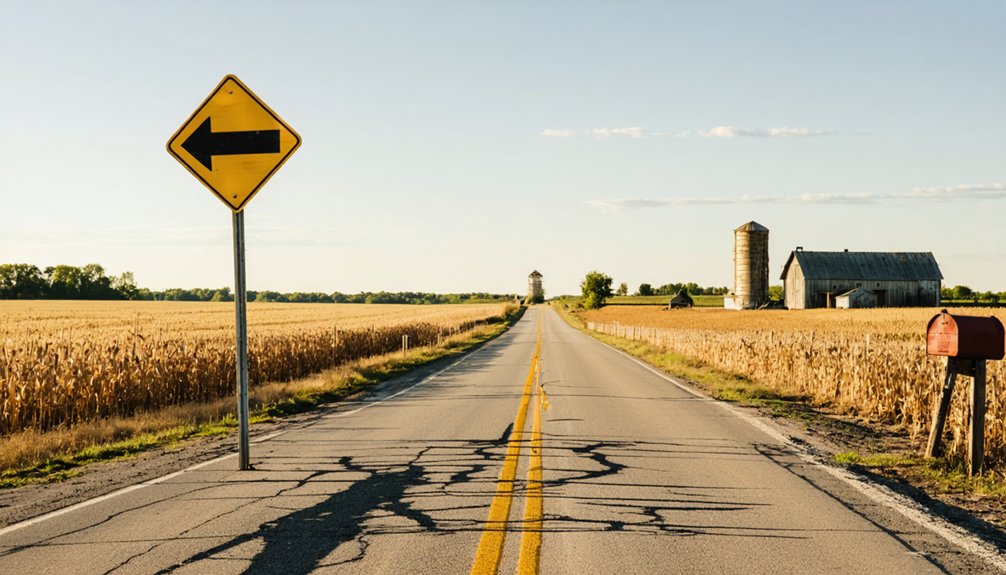
Reaching Mollie is straightforward whether you’re coming from Hartford City or Montpelier, since the ghost town sits almost perfectly between them along Blackford County’s rural roads.
From either direction, you’ll find Mollie at the intersection of County Roads 400 North and 300 East.
Here’s how to plan your ghost town exploration:
grab a county map, mark the crossroads, and let Mollie reveal itself.
- From Hartford City: Head northwest approximately 4.5 miles along rural county roads toward the 400 North and 300 East intersection.
- From Montpelier: Travel southeast roughly 3.6 miles until you reach the same crossroads.
- On-site: Look for the two remaining houses marking the area where Mollie history unfolded during Indiana’s gas boom.
The open landscape lets you move freely, piecing together the story of a once-thriving railroad community on your own terms.
Frequently Asked Questions
Who Was the Original Mollie That the Town Was Named After?
You’ll find that Mollie history leaves you with more questions than answers — local legends confirm the town’s named after an early resident named Mollie, but her last name has sadly been forgotten over time.
How Many Ghost Towns Are Officially Recognized Across Indiana Today?
Scroll through Indiana folklore, and you’ll discover over 60 officially recognized ghost towns! Each site’s ghost town history tells a unique story of boom-and-bust eras, giving you the freedom to explore Indiana’s fascinating, forgotten past.
What Railroad Company Operated the Train Line Through Mollie?
You’ll find that the Fort Wayne, Cincinnati, and Louisville Railroad once ran through Mollie, connecting its railroad history to local legends of a booming era where you could ride straight into Indiana’s oil and gas heartland.
What Percentage of Harrison Township Produced Oil During the 1890S?
During the 1890s, you’ll discover that approximately two-thirds of Harrison Township actively drove oil production, highlighting the area’s remarkable historical significance as a thriving resource-rich region that fueled Mollie’s explosive growth and economic prosperity.
Did Mollie Ever Have an Officially Planned Town Layout or Design?
With over 60 Indiana ghost towns existing, Mollie never had an official town layout—it organically developed around its train station. You’ll appreciate its raw, unplanned historical significance, embodying true freedom as you explore this naturally evolved community.
References
- https://kids.kiddle.co/Mollie
- https://103gbfrocks.com/where-nobody-lives-ghost-towns-in-indiana/
- https://www.onlyinyourstate.com/experiences/indiana/ghost-towns-in
- https://www.youtube.com/watch?v=GQuQJldC2fY
- https://www.ezhomesearch.com/blog/ghost-towns-in-indiana/
- https://commons.wikimedia.org/wiki/Category:Ghost_towns_in_Indiana
- https://en.wikipedia.org/wiki/Category:Ghost_towns_in_Indiana