You’ll find Owenville’s ghost town at GPS coordinates 31.073, -96.519, five miles northwest of Franklin along Farm Road 46 in Robertson County. Founded in 1854, this former county seat died when railroads bypassed it in 1868, forcing officials to relocate everything to Calvert by 1870. Today, you can explore the historic Owensville Cemetery, Texas’s oldest burial ground dating to 1846, where weathered headstones tell stories of settlers, formerly enslaved individuals, and the community that refused erasure despite their town’s abandonment. Understanding what drove families from these dusty streets reveals much about Texas’s frontier evolution.
Key Takeaways
- Owenville is located at GPS coordinates 31.073, -96.519, five miles northwest of Franklin along Farm Road 46 in Robertson County.
- Franklin provides the nearest services including gas, food, and lodging before heading into the remote ghost town area.
- Visit Owensville Cemetery, the county’s oldest burial site from 1846, featuring historical graves of enslaved individuals and descendants.
- Explore nearby ghost towns like Port Sullivan and Tenoxtitlan to maximize your Robertson County historical road trip experience.
- The town declined after railroads bypassed it in 1868, with the county seat moving to Calvert by 1870.
The History Behind Owenville’s Rise and Fall
In 1854, when Harrison Owen staked his claim along Walnut Creek’s wooded banks, he couldn’t have imagined his namesake town would vanish within a generation. The rise of the town came swiftly after becoming Robertson County’s seat in 1855. Churches sprouted, shops thrived, and Owen’s boarding house welcomed travelers seeking frontier opportunity. You’d have found bustling streets where county business drew settlers from miles around, even through Civil War hardships when Sheriff Clay managed prisoners without a proper jail.
But freedom-seekers soon discovered Owensville’s fatal flaw. The causes of decline struck hard when railroads chose different routes, strangling commerce. By 1870, County Judge Ellison moved government operations to railroad-connected Calvert. Merchants dismantled their buildings and followed. Within two years, only wind wandered these abandoned streets.
Getting to the Ghost Town: Directions and Coordinates
When you’re ready to trace Owensville’s faded footsteps, you’ll find the ghost town resting at coordinates 31.073, -96.519 in Robertson County’s heart, five miles northwest of Franklin along Farm Road 46. Your GPS will guide you there, though the historical significance of location tells a different story—this settlement once thrived at a crossroads where travelers naturally converged.
The impact of transportation changes sealed Owensville’s fate when railways bypassed its dusty streets, leaving only scattered remnants along this quiet farm road.
Punch those coordinates into any mapping app, or reference Find a Grave’s database for cemetery-specific navigation. Franklin offers your nearest services before venturing into this ghost town’s solitary landscape. You’ll drive through central Texas terrain that’s witnessed generations rise and vanish, each bend bringing you closer to Owensville’s silent testimony.
Along the way, keep an eye out for other ghost towns to explore in Texas, each with its own unique story etched into the landscape. As you traverse these forgotten places, you’ll discover relics of the past and the echoes of lives once lived, inviting you to imagine their histories. Make sure to take your time—each deserted street is a canvas painted with the remnants of a vibrant community that once thrived.
What Remains: Exploring Owensville Cemetery
As you step onto Owensville Cemetery‘s hallowed ground, you’re entering Robertson County’s oldest burial site—a nearly 200-year-old sanctuary where headstones lean like weathered sentinels over graves dating back to 1846. You’ll walk where a fence once divided white and African-American sections, that barrier finally removed in 2024 after standing for generations as a symbol of segregation.
This Historic Texas Cemetery shelters formerly enslaved individuals beside their descendants—veterans, trailblazers, and community elders who defied discrimination’s weight.
The Owensville Cemetery Association tackles ongoing restoration challenges through regular clean-ups and community advocacy efforts, fighting neglect with determination. You’ll witness resilience carved in stone, a chronicle to those who refused erasure. Their legacies demand remembrance, and this ground delivers that freedom through preservation.
The Railroad That Sealed Owenville’s Fate
The Houston & Texas Central Railway’s decision to bypass Owensville in 1868 delivered the death blow to this once-promising county seat. Within two years, you’d have watched wagons hauling Robertson County’s records down the road to the new railroad town of Calvert, where merchants had already abandoned Owensville’s empty storefronts for better prospects.
Railway Bypasses Town 1868
The bypass triggered immediate consequences:
- County records relocated to rail-connected Calvert within months
- Public officials and professionals abandoned Owenville for accessible opportunities
- Businesses shuttered as commerce shifted to the railway hub
- County seat status officially transferred to Calvert in 1869
- Economic isolation effects accelerated the town’s death spiral
No station. No tracks. No future. The railway’s route sealed Owenville’s fate, transforming a thriving administrative center into the ghost town you’ll explore today.
Records Moved to Calvert
Within months of the railway’s arrival, Calvert’s ascent gutted Owenville’s administrative heart.
You’ll discover that courthouse relocation happened swiftly—county records packed up and hauled to the new railroad town after 1868. The courthouse and jail that stood as Owenville’s symbols of authority were dismantled, their purpose transferred to Calvert’s bustling streets.
Post Office Closes Forever
After county records departed, Owenville’s lifeline held on for just two more years. You’ll find that the post office closed permanently in 1872, severing the town’s final federal connection. The railroad’s 1868 arrival in nearby Calvert had already drained away merchants, lawyers, and families seeking prosperity along the iron rails.
Signs of Owenville’s Final Collapse:
- Lawyers abandoned their practices for Calvert’s opportunities
- Stores physically relocated buildings to rail-accessible sites
- Houston wagon routes became obsolete overnight
- Population scattered within months of courthouse closure
- Cemetery became sole remaining landmark
The post office reopened briefly from 1895 to 1897, sparked by community efforts to revive town functions. But freedom-seekers had already chosen rails over isolation. By the late 1890s, Owenville existed only in memory and headstones.
Robertson County’s Other Forgotten Towns Worth Visiting
Your ghost town journey needn’t end with Owensville—Robertson County harbors several vanished settlements that reward the determined explorer. Head north to discover Tenoxtitlan’s remarkable history as a Mexican military outpost that birthed five signers of the Texas Declaration of Independence, or seek out Port Sullivan’s remains 1.3 miles down County Road 259, where fire consumed an entire town in 1878.
Before Owensville claimed the county seat in 1856, Wheelock held that distinction, making it an essential stop for understanding the power struggles that shaped this region’s forgotten communities.
Tenoxtitlan and Port Sullivan
Though Mexico established Tenoxtitlan in 1830 as a military bulwark against American expansion, the fort on the Brazos River’s west bank became an ironic monument to failed policy. Named after the Aztec capital, this garrison under Lieutenant Colonel José Francisco Ruiz couldn’t stem the tide of Anglo settlers who befriended Mexican soldiers and secured settlement exemptions.
Mexico’s colonization efforts collapsed when General Manuel de Mier y Terán’s despair ended in suicide.
You’ll find historical markers where this strategic outpost once stood:
- Five signers of the Texas Declaration of Independence called Tenoxtitlan home
- One resident died defending the Alamo
- Seven soldiers fought at San Jacinto
- Francis Smith’s trading post served Native Americans
- The post abandonment trade continued until 1860
The settlement vanished, leaving only frontier ghosts along these forgotten riverbanks.
Wheelock’s County Seat History
When Eleazer Louis Ripley Wheelock first glimpsed this stretch of Texas prairie during an 1823 business trip to Mexico, he couldn’t have imagined his name would mark one of Robertson County’s most significant settlements. After meeting Sterling C. Robertson in 1826, he brought his family from Illinois in 1833, establishing what became a thriving transportation hub by 1845.
The Wheelock family legacy reached its zenith when the town claimed the county seat in 1850, drawing Sam Houston himself during campaign stops. But political turmoil in the county seat sparked its downfall—Owensville seized the designation in 1856, triggering an exodus. When George Ripley Wheelock died in 1889, the dream had faded. Today, you’ll find scattered remnants where twenty businesses once flourished.
Best Time to Visit and What to Bring
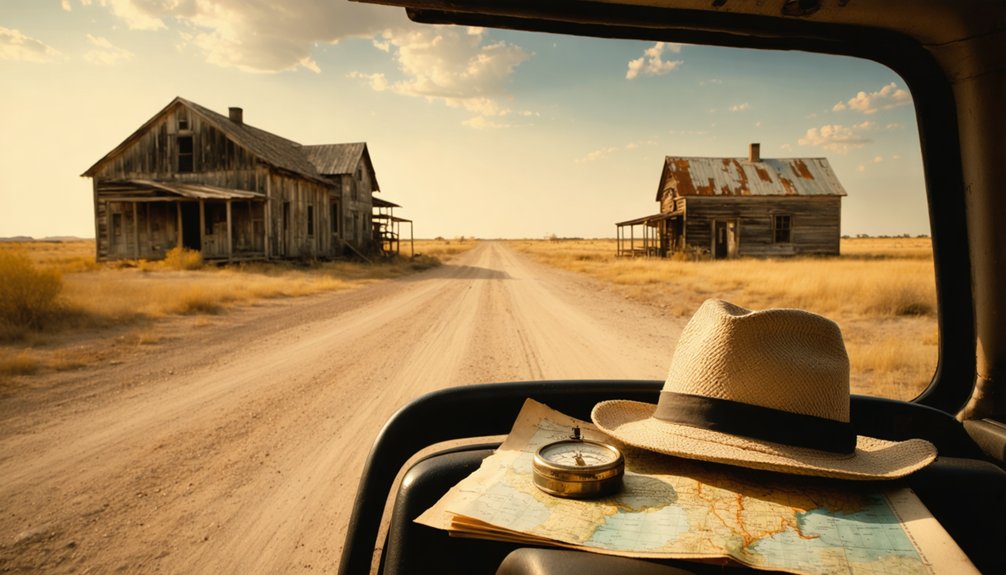
Timing your visit to Owenville’s weathered remains means embracing the ghost town under Robertson County’s moody subtropical skies. The ideal tourist season stretches mid-spring through early fall when 265 frost-free days let you roam freely without winter’s bite.
Owenville’s 265 frost-free days invite mid-spring through early fall exploration beneath Robertson County’s unpredictable subtropical heavens.
Summer brings sweltering 95°F heat and muggy air, while winter offers milder exploration at 38°F to 59°F.
Your packing essentials should include:
- Lightweight, breathable layers for temperature swings between 27°F and 94°F
- Waterproof jacket and sturdy boots to handle 38 inches of annual rainfall
- Wide-brimmed hat and high-SPF sunscreen for relentless Texas sun
- Insect repellent against subtropical bugs thriving in 83% humidity
- Emergency supplies considering tornado risks and remote location isolation
Pack smart—this abandoned landscape won’t accommodate forgotten necessities.
Nearby Attractions in Franklin and Calvert
After wandering Owenville’s desolate ruins, you’ll find Franklin and Calvert brimming with tangible history just minutes away. Franklin Cemetery’s white marble obelisk stands sentinel over Texas music legends like Ruby Owens Fox and “Cattle Call” composer Doie “Tex” Owens, alongside Civil War veterans beneath striking Woodmen of the World markers.
You’ll trace centuries of exploration along El Camino Real de los Tejas, where historic sites dot the landscape with stories of settlement and struggle. Franklin Ranch’s 84 acres welcome you with nine miles of trails, fishing lakes, and splash pads for spontaneous adventures. Drive through the safari for untamed encounters, tee off at Oak Grove’s nine-hole course, or catch community events at Franklin Lions Stadium. These aren’t curated tourist traps—they’re living remnants of Texas freedom.
Frequently Asked Questions
Are There Any Public Restrooms or Facilities Available at the Owensville Site?
No facilities await you—ghosts don’t need restrooms, after all. You’ll face limited water access and potential wildlife concerns in this abandoned pasture. Pack supplies, embrace self-reliance, and handle nature’s call behind history’s crumbling walls like true pioneers.
Is the Cemetery Accessible for Visitors With Mobility Challenges or Wheelchairs?
Accessibility for the disabled isn’t documented at this remote cemetery. You’ll find no maintained paths through the overgrown grounds, where uneven terrain and rural isolation challenge wheelchair navigation. The wild, untamed landscape demands physical mobility for exploration.
Can Visitors Take Photographs or Conduct Genealogical Research at the Cemetery?
You’re welcome to photograph freely and pursue genealogical research at Owensville Cemetery. Document preservation efforts continue through online transcriptions, while genealogical records availability expands via TXGenWeb and Find a Grave, letting you explore ancestral connections without restriction.
Are There Any Entrance Fees or Visiting Hour Restrictions for the Site?
You’ll find no entrance fees or visiting restrictions at this abandoned site. You’re free to explore anytime, though parking availability remains limited and nearby amenities are nonexistent—bring supplies for your self-reliant adventure into Texas’s forgotten past.
Is It Safe to Visit Alone or Should Visitors Go in Groups?
You’ll find greater personal safety visiting with companions due to remote location challenges and limited emergency services. Group size considerations matter here—traveling with at least one other person guarantees/provides/secures assistance if you encounter vehicle trouble or navigation issues.