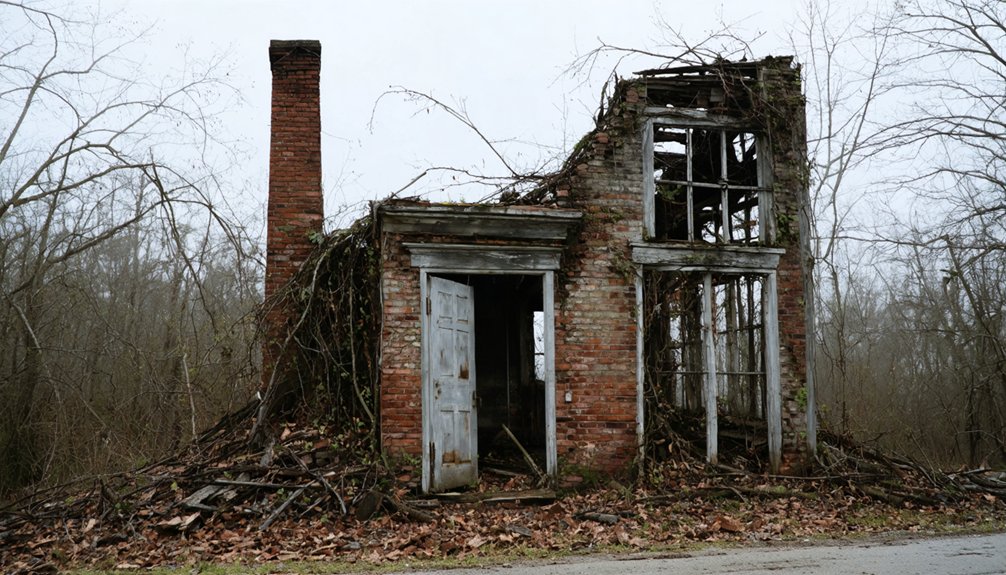
Planning a ghost town road trip to Pikeville, Alabama starts with a drive along U.S. Highway 43, between Hamilton and Guin in Marion County. You won’t find tourist signs or guided tours here — just an old courthouse with original benches, frontier cemeteries, and traces of Andrew Jackson’s Military Road. Established in 1820 as Marion County’s first county seat, Pikeville faded after 1882 when Hamilton took over. Stick around, and there’s much more to uncover about this forgotten Alabama landmark.
Key Takeaways
- Pikeville sits along U.S. Highway 43 between Hamilton and Guin, making it easy to access by car with no special equipment needed.
- Key landmarks include the standing old courthouse, city cemetery, Civil War cemetery, and visible traces of Andrew Jackson’s Military Road.
- No modern signage or guided tours exist, so drive slowly and stay observant to discover historical sites along the route.
- Bring water and comfortable shoes, as the rural site lacks amenities but rewards visitors with authentic, unfiltered frontier history.
- Combining Pikeville with nearby Hamilton creates a satisfying regional loop connecting Alabama’s early governance and frontier military history.
What Was Pikeville, Alabama?
Tucked along U.S. Highway 43 between Hamilton and Guin, Pikeville once stood as Marion County’s first permanent county seat. Established in 1820, the town saw rapid development — surveyors mapped it in 1821, a courthouse rose in 1822, and a post office opened by 1824.
Town development pushed forward steadily, and by 1860, Pikeville supported roughly 15 businesses and 20 to 30 homes, including tanneries, hotels, and saloons.
The town also carried deep military history. Andrew Jackson’s army bivouacked here during the War of 1812, and Union forces later used it as a headquarters during the Civil War.
When the county seat moved to Hamilton in 1882, Pikeville faded. Today, historical preservation efforts keep its story alive through surviving structures and cemeteries still visible on the site.
Why Pikeville Is Worth the Drive for Ghost Town Hunters
You won’t find a gift shop or a guided tour waiting for you in Pikeville, but you’ll find something rarer — a ghost town with genuine historical weight.
The old courthouse still stands, the cemeteries remain, and the traces of Andrew Jackson’s Military Road run right through the site, connecting you to frontier-era Alabama in a way few places can.
If you’re hunting for ghost towns with real stories behind them, Pikeville delivers on every count.
A Rare Historical Find
Few ghost towns in Alabama can claim the layered history that Pikeville carries. You’re not just walking through a forgotten town — you’re stepping into a place where Andrew Jackson’s army once camped, Union soldiers once headquartered, and frontier justice once shaped an entire county.
The historical architecture still standing here, particularly the old courthouse, gives you a direct, tangible connection to the 1800s that most ghost towns simply can’t offer.
Local legends tied to War of 1812 graves and Civil War occupations add a deeper dimension to every step you take on this ground.
Pikeville rewards curious travelers who want more than scenery — you’ll find a rare convergence of military history, frontier settlement, and Alabama’s early county-seat legacy packed into one overlooked roadside stop.
Jackson’s Military Road Legacy
What makes Pikeville genuinely worth the detour isn’t just its ghost-town status — it’s that you’re driving along the same corridor Andrew Jackson’s army marched through during the War of 1812. That history isn’t abstract here. Jackson’s troops actually bivouacked in Pikeville, and a grave of an unknown War of 1812 soldier still marks the ground you’re walking on.
The military road shaped this town’s entire identity, drawing settlers, commerce, and eventually a courthouse that still stands as a testimony to the area’s historical architecture. You’re not just passing through — you’re reading layers of cultural heritage carved into Alabama’s frontier past.
Follow U.S. Highway 43 between Hamilton and Guin, and you’ll find Court House Square sitting quietly beside traces of that original military corridor.
Surviving Landmarks Still Stand
Unlike most ghost towns that leave you squinting at a historical marker and wondering what once stood there, Pikeville still has bones. The two-story courthouse stands as a symbol of historical architecture that survived fire, war, and abandonment. You’ll find original benches preserved inside, a detail that connects you directly to frontier-era justice.
The city cemetery and a separate Civil War cemetery anchor the landscape with quiet weight. Local legends surround the grave of an unknown War of 1812 soldier still resting somewhere on the site.
Court House Square remains identifiable along the old highway corridor, giving you something real to walk and photograph. For ghost town hunters who want tangible remnants rather than imagination alone, Pikeville delivers exactly that kind of unfiltered historical access.
How to Get to Pikeville, Alabama
You’ll find Pikeville tucked along U.S. Highway 43 in Marion County, sitting between the towns of Hamilton and Guin. Use Hamilton to the north or Guin to the south as your anchor points when plotting your route, since Pikeville itself won’t appear on most modern maps.
As you drive the corridor, watch for the old courthouse area and the traces of Jackson’s Military Road, which mark the heart of what’s left of this former county seat.
Pikeville’s Highway 43 Location
Tucked along U.S. Highway 43 between Hamilton and Guin, Pikeville sits in a stretch of Marion County that rewards curious travelers willing to slow down. You’ll find the site without much fanfare — no billboard, no welcome center — just open road and history pressing through the tree line.
The historical architecture here speaks quietly but clearly, from the old courthouse structure to the remnants of Court House Square. Local legends tie this corridor to Andrew Jackson’s Military Road, where his army once camped during the War of 1812.
If you’re driving Highway 43, keep your eyes open. The landmarks concentrate near the highway corridor, making a quick pull-off entirely worth your time. Freedom-seekers who crave unfiltered history will find Pikeville doesn’t disappoint.
Nearby Towns For Reference
Getting to Pikeville means orienting yourself around a handful of nearby towns that anchor the route. Hamilton sits to the north and serves as Marion County‘s current seat, making it your most practical launching point.
Guin anchors the south end of the same corridor. Pikeville falls directly between them along U.S. Highway 43, so you won’t need complicated navigation to find it.
These towns aren’t just logistical markers — they’re part of the same regional story. Hamilton replaced Pikeville as the county seat, and that political shift is what turned a once-thriving village into a ghost town worth chasing.
Local legends about frontier justice, Civil War activity, and historical preservation efforts all trace back through this same stretch of Marion County highway. Use these towns as your compass.
Landmarks Along The Route
Once you’re heading south from Hamilton on U.S. Highway 43 toward Guin, Pikeville’s ghost town remnants appear along the corridor before you expect them. Keep your eyes open for the old courthouse area, which anchors the site’s historic preservation efforts and still stands as a tangible connection to Marion County’s earliest days.
The city cemetery and a Civil War cemetery sit nearby, quietly marking generations of settlers and soldiers. Traces of Andrew Jackson’s Military Road once crossed this same ground, giving the route a layered historical weight that rewards curious travelers.
You won’t find roadside signs pulling you in, so slow down, pay attention, and let the landscape tell its story. The landmarks here are subtle but genuinely worth the stop.
Pikeville’s Civil War and Military Road History
Pikeville’s history runs deeper than its ghost-town status suggests, stretching back to the War of 1812 when Andrew Jackson’s army bivouacked here along his famous Military Road. You can still trace remnants of that corridor today, connecting you directly to one of Alabama’s most significant frontier routes.
A grave of an unknown War of 1812 soldier remains on-site, making it one of the more sobering historical artifacts you’ll encounter on this road trip. Decades later, Union forces briefly used Pikeville as a headquarters, and Civil War relics are tied to the cemetery grounds still visible today.
Fire destroyed the original courthouse in 1866, but it was rebuilt. Walking this land means stepping through layers of American conflict few tourists ever find.
What You Can Still See at the Pikeville Site Today

Although the town itself faded long ago, enough survives at the Pikeville site to make the stop genuinely worthwhile. Local legends surrounding Jackson’s Military Road add atmosphere you won’t find in a museum, and archaeological excavations have hinted at deeper stories beneath the surface. Here’s what you can explore:
- The courthouse – Still standing, it once housed original benches and later became Probate Judge John Dabney Terrell’s residence.
- City cemetery – A quiet, preserved space reflecting Pikeville’s frontier community.
- Civil War cemetery – A sobering reminder of the conflict that touched this ground.
- Military Road traces – Walk sections of the route Jackson’s army once traveled.
You’re not visiting a polished attraction — you’re reading history directly off the land.
Other Marion County History Stops Worth Adding to the Loop
Making Pikeville your anchor point pays off even more when you build a broader Marion County loop around it. Hamilton, the town that replaced Pikeville as county seat in the early 1880s, offers a natural contrast — you’ll see exactly what a county seat looks like when it survives and grows.
Pikeville anchors the story. Hamilton shows where it leads — a county seat that survived, grew, and left a record.
Historical preservation efforts there give you context Pikeville can’t provide on its own.
Dig into local legends while you’re moving through the county, and you’ll find stories tied to frontier justice, Civil War skirmishes, and Jackson’s Military Road that stretch well beyond any single site.
Marion County rewards curious travelers who push past the obvious stops and follow the old roads connecting communities that shaped Alabama’s earliest inland settlements.
Road Conditions, Access, and What to Expect on Site

Getting to Pikeville is straightforward — the site sits along U.S. Highway 43 between Hamilton and Guin, making it easy to reach by car. Don’t expect urban development, modern amenities, or signage guiding your every step. This is raw, unfiltered history.
Here’s what to expect on site:
- Paved highway access — U.S. 43 runs directly past the key landmarks.
- The old courthouse — still standing and worth a close look.
- Two cemeteries — the city cemetery and a Civil War cemetery sit nearby.
- Jackson’s Military Road traces — visible remnants along the corridor reward observant visitors.
Wear comfortable shoes, bring water, and embrace the quiet. Pikeville rewards curiosity, not convenience.
Frequently Asked Questions
Was Pikeville Ever Known by a Different Name Historically?
The knowledge doesn’t confirm you’ll find historical name changes for Pikeville. It’s held that name through its early settlement history, serving Marion County since 1820 — a freedom-seeker’s untouched, original ghost town worth exploring.
Is There an Admission Fee to Visit the Pikeville Site?
Like an open road stretching to the horizon, Pikeville’s history is free. You’ll find no admission fee here — historical preservation doesn’t restrict your access, and visitor amenities remain minimal, letting you explore this ghost town’s haunting remnants unrestricted.
Are Guided Tours Available at the Pikeville Ghost Town Site?
No guided tours are available, so you’ll explore freely on your own terms. Chase haunted legends through the old courthouse grounds, and use natural light for stunning photography tips while wandering this hauntingly beautiful, forgotten Alabama landmark.
What Is the Best Time of Year to Visit Pikeville?
Spring and fall are your sweet spots—when nature’s paintbrush softens the landscape, you’ll explore Pikeville’s historical landmarks and soak in local legends without summer’s brutal heat making every step a struggle.
Can Visitors Legally Access the Pikeville Courthouse and Cemetery Grounds?
You’ll want to verify access with local Marion County authorities before exploring. Historic preservation efforts protect the courthouse and cemetery grounds, and you might uncover local legends while respectfully discovering Alabama’s frontier past firsthand.
References
- https://algenweb.org/marion/pikevilleghost.htm
- https://en.wikipedia.org/wiki/Pikeville
- https://www.marioncountyal.org/Default.asp?ID=428&pg=County+History
- https://digitalalabama.com/alabama-ghost-towns/
- https://www.algenweb.org/marion/marionotes.htm
- https://www.youtube.com/watch?v=vdwMgelc4SA
- https://en.wikipedia.org/wiki/List_of_ghost_towns_in_Alabama
- https://archive.org/stream/pikecounty18221902robe/pikecounty18221902robe_djvu.txt
- https://en.wiktionary.org/wiki/Pikeville
- https://www.youtube.com/watch?v=39_FgCCjoTQ