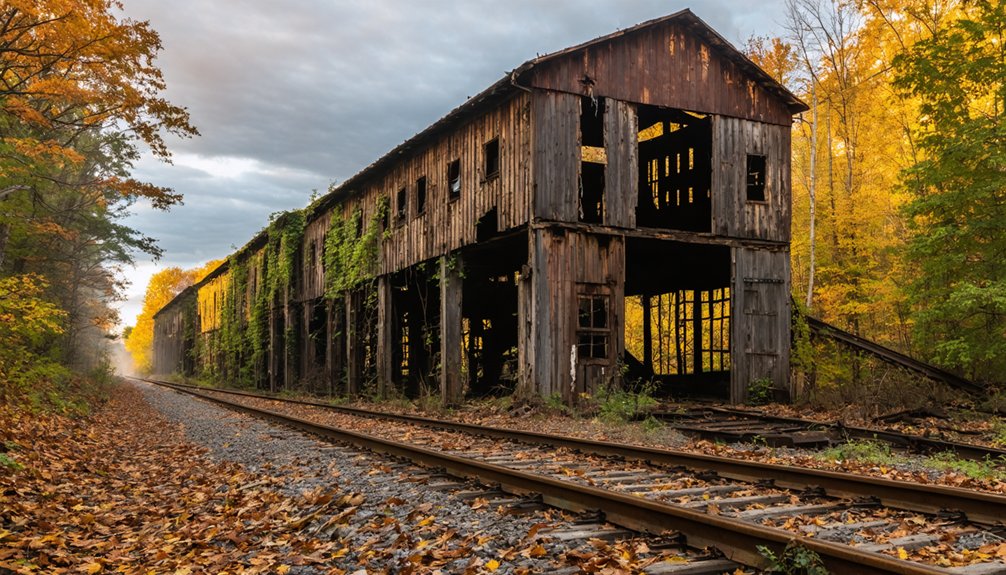
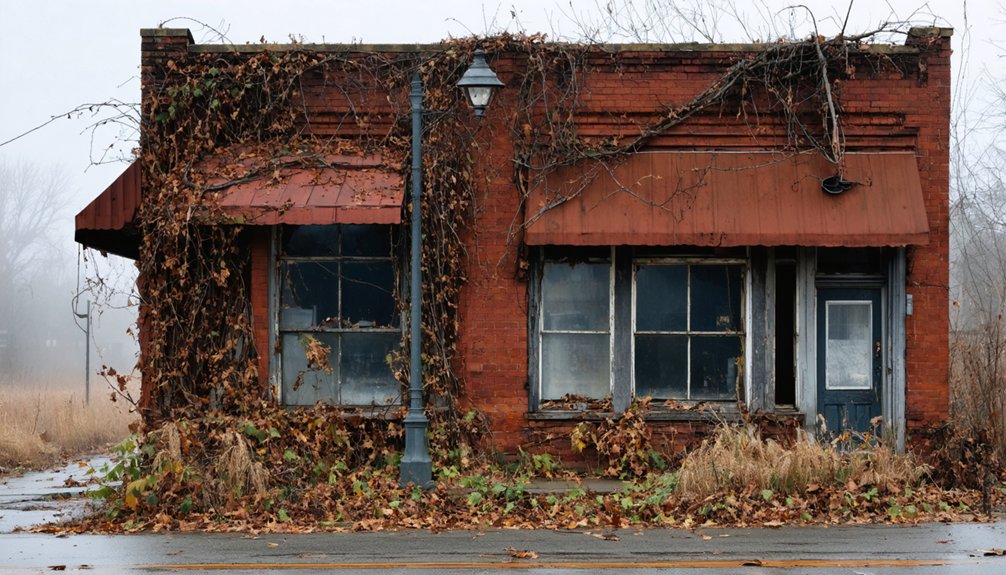
Point Pleasant in Warren County exists only in 1830 plat records—John H. Bartlett’s settlement near Big Pine Creek left virtually no physical trace after it failed to develop. You’ll find open farmland where streets were platted in section 33’s northeast quarter of Pine Township. Don’t confuse this with Jefferson Township’s Pleasant Plain (Pike County), which thrived during the oil boom before its 1928 de-platting. The archaeological footprint has vanished entirely, but historical survey maps and county records reveal what once stood on these consolidated farming parcels.
Key Takeaways
- Point Pleasant in Jefferson Township, Pike County is accessible via IN-62, IN-256, and US-421, with Troy Road as a historic reference route.
- The former village site, established as “Nixville” in 1875 and de-platted in 1928, now contains only agricultural fields with no remaining structures.
- Use Willis Cemetery coordinates (38.4775° N, 87.1406° W) as a landmark for navigating the rural road network near the townsite.
- Combine your visit with nearby ghost towns including Hindostan Falls, Aberdeen, and Pleasant Plain in Warren County for a comprehensive trip.
- No archaeological traces or original buildings survive; only historical records document the community that once occupied this farming land.
The Rise and Fall of Pleasant Plain: From Oil Boom to Farmland
On July 14, 1830, John H. Bartlett platted Point Pleasant in Pine Township, Warren County, strategically positioning it near Big Pine Creek and Mud Pine Creek‘s confluence. You’ll find this settlement’s history lacks the oil claims history that defined other Indiana towns—no petroleum boom ever transformed this location.
Early resident profiles remain sparse: Bartlett himself operated the settlement’s liquor store and possibly a saw mill from his residence. The plat occupied the northwest half of section 33’s northeast quarter, but development stalled immediately.
To reach Jefferson Township in Pike County, you’ll navigate a network of county roads that have evolved from historical routes like the Troy Road, which once connected the Ohio River to Vincennes.
Your nearest reference points include the town of Otwell within the township and the hamlet of Algiers, both accessible via Pike County’s rural road system.
Key landmarks for orientation include McClure Cemetery and Willis Cemetery, which appear on maps at coordinates approximately 38.4775° N, 87.1406° W, at an elevation of 509 feet.
Traversing Jefferson County‘s rural road network to reach Jefferson Township requires careful preparation, as the area relies entirely on state highways and county roads rather than interstate access. You’ll traverse winding county roads using IN-62 and IN-256 as your primary routes, with US-421 providing north-south connectivity through nearby towns.
Negotiating historical details from the 1936 survey maps reveals critical information about road widths and bridge conditions that remain relevant today.
Essential Navigation Resources:
- Jefferson County GIS interactive map – Click features to reveal real-time road conditions, parcel boundaries, and waterway locations across the 362-square-mile territory
- 2011 township boundaries PDF – Confirms Jefferson Township’s position relative to Madison, Hanover, Milton, and Saluda townships for accurate route planning
- 1949 general highway map – Provides polyconic projection scale understanding at 1:130,000 for distance estimation
Nearest Towns and Landmarks
While modern GPS systems won’t recognize Point Pleasant by name, you’ll find the former settlement’s location approximately 1.5 miles southwest of Rainsville in Pine Township, Warren County—not to be confused with the Jefferson County routes discussed in previous navigation sections. The site now exists as Rocky Ford, marking where Big Pine Creek meets Mud Pine Creek.
For driving directions from major cities, travelers from Indianapolis should navigate northwest through west-central Indiana’s county road network. Regional tourism highlights near your route include Turkey Run State Park‘s rugged trails and Putnam County‘s nine covered bridges, particularly the photogenic Dunbar Covered Bridge.
Crown Point’s historic courthouse and the Ernie Pyle World War Two Museum in Dana offer worthwhile detours. These landmarks provide contextual stops while pursuing Indiana’s vanished settlements.
What Remains: Exploring the Former Village Site
You’ll find only a small cluster of farms marking Point Pleasant’s former townsite, with open agricultural fields replacing the streets, alleys, and lots that were vacated in 1928. No original structures from the oil boom era remain standing, as the entire plat was absorbed into the Beedy family’s farmland for more efficient cultivation.
Close examination of the landscape may reveal subtle archaeological traces—slight depressions, vegetation patterns, or soil discolorations—hinting at where blacksmith shops, general stores, and the two-story brick schoolhouse once anchored this Jefferson Township community.
Farm Cluster Layout Today
Standing at the heart of Perry Farm Park, the Durham-Perry Farmstead preserves five core structures from its 1840s origins. You’ll find the I-shaped farmhouse, Three-Bay English Barn with its distinctive Shutter quilt block, Horse Barn recognized as a state and federal landmark, plus the red wood-framed garage from 1922. The preserved farmstead layout clusters these buildings centrally, following the original arrangement documented in 1974’s Historic American Building Survey.
Key structures to explore:
- Three-story brick farmhouse – Central hub of the 1840s homestead
- Horse Barn – Features quilt block designation on south side
- English Barn – Original 1840 three-bay timber construction
Historical property boundaries extend from the farmstead westward through hardwood forest to Indian Caves, where Bourbonnais Creek meets the Kankakee River. The 1983 restoration maintained authentic spacing between buildings you can walk today.
Oil Boom Archaeological Traces
The Pleasant Plain village site reveals almost nothing to modern visitors—just scattered farms where streets, businesses, and a two-story brick schoolhouse once stood. You’ll find no trace of the blacksmiths and ice cream shops that served the community during its peak. The land consolidation following the 1928 de-platting erased physical evidence of population and business growth that once defined this oil boom town.
Historical records from the 1909 *Warren Tribune* and 1926 *Huntington Herald* provide the only documentation of what existed here. You’re walking across single farming parcels that once encompassed an entire platted village with alleys, a post office, drugstore, and sawmill. The archaeological footprint has vanished, leaving nearby towns like Gas City and Marion as the sole industrial remnants of this era.
Nearby Ghost Towns Worth Adding to Your Route
While Point Pleasant anchors your journey through Indiana’s forgotten settlements, the surrounding region holds several compelling ghost towns that merit exploration. Each site offers distinct historical significance and varying degrees of architectural remnants.
Essential stops for your expanded route:
- Hindostan Falls (Martin County) – Founded in 1816, this once-thriving settlement at East Fork White River’s falls served as early Daviess County’s largest town. An 1820s epidemic devastated the population, leading to complete abandonment by 1853.
- Pleasant Plain (Jefferson Township) – Established in 1875 as “Nixville,” this community thrived until automobile transportation and oil well depletion forced its de-platting in 1928 for agricultural use.
- Aberdeen (Ohio County) – Dr. Robert Gesy’s 1819 Scottish settlement maintains scattered buildings and a population under 50, preserving its frontier-era layout.
Locust Grove Cemetery: Soldier Ghosts and Local Legends

Nestled in Henry County’s rural landscape, Locust Grove Cemetery—also known as Locust Grove German Baptist Cemetery—serves as both historical archive and paranormal hotspot for ghost town enthusiasts. You’ll discover notable burials including Reverend Samuel Bissell and Civil War veterans whose spirits allegedly wander the grounds during autumn nights. The site features a remarkable sandstone vault constructed from 138 tons of locally quarried stone, originally built for winter burials when frozen ground prevented digging.
The cemetery’s African American connections trace back to 1840, when burials began in Mr. Weir’s private yard. The Lewis family dominated the area’s Black population, owning a mill near Monmouth during the 1830s-1840s. Today, lantern-lit historical reenactments bring these figures back to life, though vandalism and weathering threaten this two-hundred-year-old burial ground’s preservation.
Monument City and Salamonie Lake: The Town That Disappeared Underwater
Before Salamonie Lake’s waters claimed it in 1967, Monument City thrived along the Salamonie River as a modest community that Jacob Leedy and John Pilcher laid out in spring 1874. The U.S. Army Corps of Engineers flooded the town for Wabash River flood control, displacing residents in 1964 and submerging roughly 20 homes under 30 feet of water.
You’ll find the town reappears during winter drawdowns and droughts:
- 2012 drought exposure revealed paved roads, foundations, and bulldozer tracks before DNR closed access for preservation efforts
- Cemetery relocations moved over 1,200 burials from Monument City alone, part of 7,000 graves displaced region-wide
- Local oral histories document the 1913 stone schoolhouse and horse-racing incidents involving students
The highest point became an island—all that remains above water of this vanished settlement.
Best Time to Visit and What to Bring

Since Point Pleasant sits within Indiana’s varied climate zone, your visit timing directly affects what you’ll experience at this ghost town site. Late September through mid-October delivers peak fall foliage across nearby Brown County’s scenic overlooks, with vibrant hillsides framing your exploration.
Arrive on weekday mornings to avoid crowds and catch mist rolling over valleys. Spring visits from mid-April forward reveal wildflower blooms along forgotten trails. Weather patterns favor comfortable temperatures in April and May, while late summer sidesteps tornado season.
Pack sturdy boots for traversing overgrown footpaths, layers for variable conditions, and camera gear for panoramic views. Book accommodations early during foliage season and check weekly color updates. Bring water, sunscreen, and picnic supplies—you’ll find seasonal facilities at trailheads for extended daylight exploration.
Diving Deeper: Historical Records and Research Resources
After you’ve planned your visit and packed your gear, understanding Point Pleasant’s documented past requires tapping into specific archival collections and local historical societies. Jefferson Township’s records hold the 1875 plat filing and the 1928 de-platting petition filed by the Beedy family. These primary sources reveal the village’s complete lifecycle from incorporation to dissolution.
Jefferson Township’s archives document Point Pleasant’s entire existence through the 1875 plat filing and 1928 de-platting petition.
Essential archival research methods include:
- Examining post office records spanning April 1875 to February 1905 for resident names and business operations
- Reviewing circuit court documents detailing the May 1928 de-platting proceedings and land repurposing
- Consulting school district archives documenting the 1894-1905 high school period
Historical society contacts in Warren County maintain photographs, maps, and oral histories. They’ll connect you with descendants who remember stories passed down about the oil boom era‘s blacksmiths, general stores, and community gatherings.
Frequently Asked Questions
Are There Any Guided Tours Available for Pleasant Plain and Nearby Ghost Towns?
While guided tours for ghost town enthusiasts aren’t specifically offered at Pleasant Plain, you’ll find private guided tours available through Chaos Haunted & Historical Tours in nearby Crown Point, covering northwest Indiana’s spiritually active locations and forgotten communities.
Can I Camp Overnight Near the Pleasant Plain Site or Jefferson Township?
You’ll find limited amenities availability directly at Pleasant Plain’s historic site. However, you can access primitive camping options at nearby Ouabache State Park and Manapogo RV Campground, both offering tent sites within reasonable driving distance for overnight stays.
Is Pleasant Plain Site on Private Property Requiring Permission to Visit?
Yes, you’ll need permission since the de-platted site became private farmland after 1928. Accessibility considerations depend entirely on current landowner’s policies. The Beedy family’s farming operation transformed public streets into restricted agricultural property requiring explicit consent.
What Other Ghost Towns Exist in Huntington County Beyond Those Mentioned?
Like scattered pages from history’s ledger, you’ll find additional abandoned settlements including Warren, Majenica, and Huntington’s original town site among Huntington County’s historical landmarks. Each location offers unique stories waiting for your independent exploration and discovery.
Are Any Artifacts From Pleasant Plain Displayed in Local Museums?
No documented artifacts from Pleasant Plain currently exist in local historical society exhibits. You’ll find Huntington County’s museums focus on other settlements, leaving this ghost town’s material history largely unpreserved in formal collections.