You’ll find Questing Reservation in New Marlborough, Massachusetts, where 438 acres preserve the haunting remains of an 18th-century colonial settlement on Leffingwell Hill. A 2.3-mile trail system leads you past stone-lined cellar holes, crumbling foundations, and stone walls marking vanished homesteads. The property’s highest elevation once held a log-and-stone fort—though its exact location remains unknown. The Trustees of Reservations maintain this landscape where hardwood forests have reclaimed what settlers abandoned centuries ago, and the complete story reveals even more intriguing historical layers.
Key Takeaways
- Questing Reservation is located in New Marlborough, Massachusetts, encompassing 438 acres with colonial-era ruins and stone walls.
- The 2.3-mile trail system begins with a steep 250-foot climb before reaching Leffingwell Hill’s overlook and historic farmstead remains.
- Explore 200-year-old cellar holes, crumbling foundations, and stone walls marking abandoned 18th-century homesteads throughout the forest.
- The property features diverse habitats including hardwood forests, wetlands, and upland meadows supporting various wildlife and bird species.
- The Trustees of Reservations manages the site and offers seasonal programming to enhance your ghost town exploration experience.
The Forgotten Settlement on Leffingwell Hill
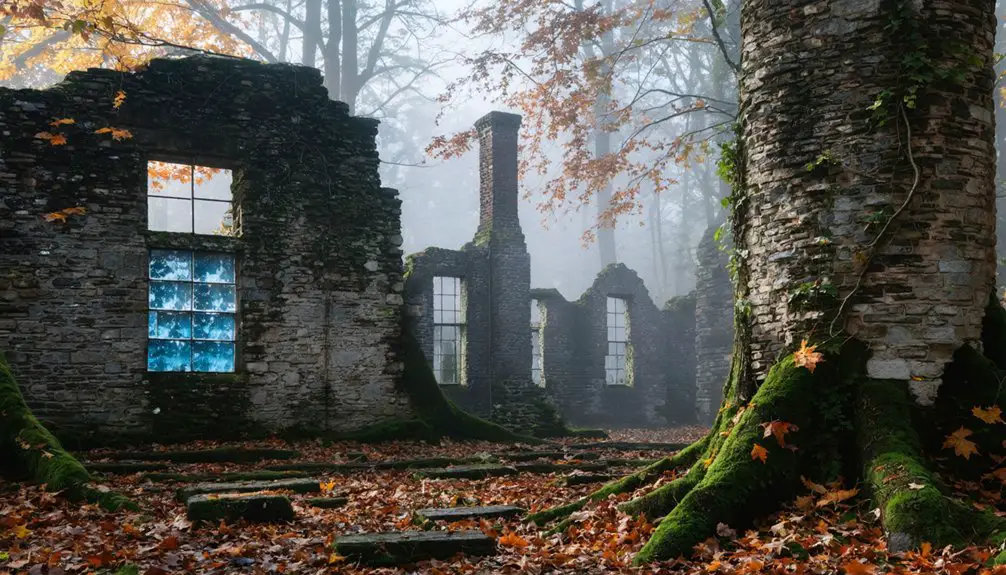
The 438-acre Questing Reservation in New Marlborough, Massachusetts preserves a landscape where an entire community once thrived and vanished. You’ll discover disappearing farmsteads throughout the property, marked by cellar holes and stone walls that once bounded pastures and roads.
The first settlers arrived in the early 18th century, building homes on feldstone foundations atop Leffingwell Hill. They constructed a log-and-stone fort for gunpowder storage and refuge during threats. This historic military fort was established in the early 18th century as protection for the settlement. According to verbal history, this fort was where the first non-Native American children were born in the Berkshires.
By mid-1800s, the Leffingwell brothers farmed this entirely cleared land until farming accidents claimed both their lives. Economic depression drove remaining families westward, transforming these lost family homesteads into forest.
Today’s half-mile trail and 1-mile Leffingwell Loop let you explore these remnants of colonial settlement frozen in time.
From Military Fort to Abandoned Village
Before settlers transformed Leffingwell Hill into farmland, they erected a log-and-stone fort at the reservation’s highest elevation during the early 18th century. This military installation stored gunpowder and witnessed the birth of the Brookins twins—the area’s first non-Native American children.
The military to civilian shift occurred as the fort’s strategic purpose diminished, allowing colonists to clear the surrounding trees and establish permanent homesteads. Similar to Fort Sewall’s 1644 construction, early colonists built protective fortifications on elevated terrain to defend their settlements from potential threats.
Dr. Robert Lehman and the Legend of the Questing Beast
Centuries after colonists abandoned their military outpost, a Philadelphia pharmacologist discovered the overgrown Leffingwell farmstead and recognized its potential for restoration. Dr. Robert Lehman, who’d developed treatments for heart failure and glaucoma, purchased the property in the 1970s through his wife Jane Fraser Lehman, a lifelong New Marlborough resident.
Together they transformed the tumbledown buildings into their summer retreat, naming it “Questing” after the donor’s passion for Arthurian legends—specifically the mythical Questing Beast that Jane favored from King Arthur tales. The Lehmans pursued their interests in science, botany, photography, music and literature at their restored farmhouse.
Lehman’s background as pharmacologist hadn’t dulled his appreciation for wild landscapes. He kept the surrounding 438 acres untouched, allowing evolving hardwood forests and wetlands to flourish. The property features remnant cellar holes and stone walls that mark where the 200-year-old settlement once stood. In 1996, he bequeathed the entire property to the Trustees of Reservations, ensuring you’d have permanent access to this historic site.
Exploring the 438-Acre Nature Reserve
Spanning 438 acres across New Marlborough’s rolling terrain, this Trustees of Reservations property offers a 2.3-mile trail system that winds through shifting hardwood forests, wetlands, and a 17-acre upland meadow. You’ll navigate an initial 250-foot climb at 12% grade before reaching Leffingwell Hill’s scenic overlook views.
This 438-acre sanctuary features 2.3 miles of trails ascending through hardwood forests and wetlands to Leffingwell Hill’s panoramic overlook.
The trail network connects a half-mile approach to the one-mile Leffingwell Loop, threading through diverse habitats supporting golden-crowned kinglets, warblers, and butterfly populations. Seasonal event programming enhances your experience throughout the year.
Access and Trail Features:
- Park at the hilly dirt lot on New Marlborough Hill Road (42°07′19″N 73°15′06″W)
- Enter through the narrow 2-foot opening beside the gate
- Follow mowed paths through wildflower meadows connecting to forest loops
- Download trail maps showing topographical details
The property lies within the Upper Housatonic Valley National Heritage Area, a federally designated landscape preserving the region’s natural and cultural history.
Walking Among 200-Year-Old Colonial Ruins
Scattered across the reservation’s 438 acres, stone-lined cellar holes and crumbling foundation walls mark where colonial families built their lives from the early 18th century through the mid-1800s. You’ll discover the Leffingwell farmstead ruins along hiking trails, including barn remnants from brothers William and Jerome’s agricultural operation that ended tragically in the early 1900s.
Stone walls reveal property boundaries and 18th century architectural features that demonstrate period construction methods. Look for plug and feather marks on large stones, a quarrying technique that indicates late 18th century construction. The fort’s exact location remains unknown, though records confirm it stood on Leffingwell Hill, storing gunpowder and sheltering the Brookins twins—New Marlborough’s first non-Native births.
Undocumented colonial inhabitants likely occupied additional structures whose foundations you’ll encounter throughout regenerated forests, evidence of settlement phases spanning 150 years before abandonment allowed nature’s return.
Trail Routes Through Questing’s Historic Landscape
Two distinct trail systems guide you through Questing Reservation’s archaeological landscape, each revealing different chapters of settlement history across the property’s 438 acres.
Your route options:
- Half-mile out-and-back trail – Connects trailhead to the main Leffingwell Loop, establishing access to the hilltop settlement site.
- Leffingwell Loop – Spans just over one mile around the hill’s perimeter, passing cellar holes, barn ruins, and carefully crafted stone walls from the mid-1800s farmstead.
- Mowed wildflower path – Traverses a 17-acre field before connecting to forest trails where colonial era footpaths once linked neighboring homesteads.
- Stone wall corridors – Follow boundaries that marked pasturage and roads, built atop feldstone foundations revealing geological features and early 18th-century settlement patterns.
These preserved routes let you navigate freely through two centuries of vanished Berkshire life. Like many abandoned settlements across the state, Questing’s population has decreased dramatically since its farming heyday, leaving only these stone remnants and pathways behind.
Wildflower Meadows and Wildlife Habitats
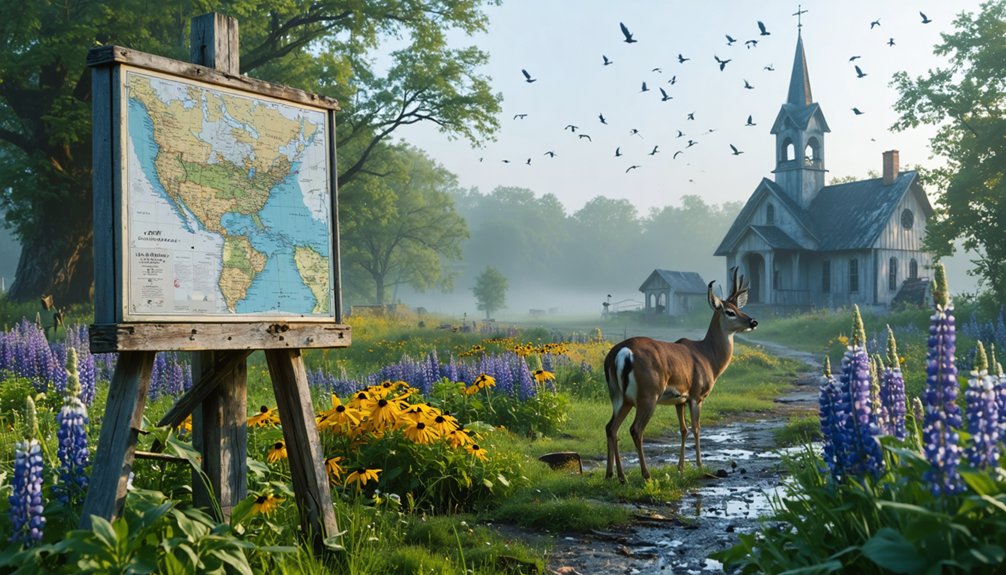
You’ll discover Leffingwell Hill Meadow’s 17-acre upland field supporting native wildflowers that serve as a critical habitat for regional pollinators. The open meadow attracts diverse dragonfly and butterfly species throughout summer months, with a mowed perimeter path providing access to observe these seasonal visitors.
This shifting habitat connects the grassland ecosystem to surrounding forest trails, creating essential corridors for wildlife movement across the 438-acre property. Similar restoration efforts across Massachusetts have shown that prescribed burning and mowing can maintain the open canopy conditions that support rare species and native plant communities. These protected habitats support wide-ranging species like black bear, moose, and bobcat that move freely through the Berkshire Wildlife Linkage connecting Vermont’s Green Mountains to New York’s Hudson Highlands.
Native Wildflower Field Features
Seventeen acres of native wildflowers blanket the upland field atop Leffingwell Hill, creating one of Massachusetts’s increasingly rare dry-soil meadow habitats. The nutrient-poor sandy soils support specialized wildflower species inventory including oxeye sunflower, lance-leaved coreopsis, wild bergamot, and the rare butterfly milkweed (Asclepias tuberosa).
You’ll discover rattlebox hosting ornate bella moth larvae—previously extirpated from the state.
Trail and Observation Features:
- Mowed path encircles the field edge, connecting to a 2/3-mile forest loop
- Open meadow at hilltop delivers panoramic views across neighboring hills
- Custom seeding with native grasses and wildflowers requires minimal maintenance
- Field attracts diverse dragonfly and butterfly populations throughout summer months
The shifting landscape from abandoned colonial settlement demonstrates ecological restoration’s capacity to sequester carbon and stem invasive species spread.
Seasonal Pollinators and Dragonflies
From spring’s first bloom through autumn’s final warm days, Leffingwell Hill’s seventeen-acre meadow hosts successive waves of pollinators drawn to its native wildflower matrix. You’ll observe seasonal butterfly dynamics peaking mid-summer when open meadows reach maximum floral diversity.
Dragonfly diversity concentrates along vernal pools and streams bordering the field, where adults patrol sunlit edges while nymphs develop in wetland pockets. The shifting hardwood forest creates protected corridors linking these habitats across the 438-acre preserve.
Bees, moths, and wasps supplement butterfly activity throughout warm months, with nocturnal pollinators working forest margins after dark. Stone walls and cellar holes provide microhabitats for ground-nesting species.
Winter dormancy suspends activity entirely, but the two-mile trail network remains accessible for off-season exploration of this documented pollinator ecosystem.
The Mystery of the Missing Fort Location
Local tradition places the fort at the field’s eastern edge, a few yards from the brook where the path first enters the clearing. You’ll find no markers or definitive archaeological evidence to confirm this location, though Proprietor’s records verify the structure once stored gunpowder at Leffingwell Hill’s highest point.
As you search the brook area today, only verbal history guides your quest—the precise coordinates of where the Brookins twins were born remain lost to time.
Verbal History and Tradition
According to New Marlborough Proprietor’s records, the log-and-stone fort stood at the highest point of the Leffingwell Hill reservation in the early 18th century, serving as both a gunpowder storage site and refuge for threatened settlers. Yet you’ll find no verifiable artifacts marking its exact location today.
Multiple sources preserve this settlement’s story through archival records and oral tradition:
- Proprietor’s Records document gunpowder storage at the reservation’s highest point
- Local Custom places the fort at field’s edge east of the brook where hiking paths enter
- Trustees Documentation confirms the Brookins twins’ birth inside the fort’s walls
- Hikers’ Accounts reference verbal histories passed through generations
The conflict between documented history and missing physical evidence creates an intriguing puzzle for those exploring these abandoned homesteads.
Searching the Brook Area
When you follow the hiking path eastward from the brook entrance, you’re retracing steps that colonial settlers took to reach their fortified refuge—yet the structure itself has vanished without leaving conclusive physical evidence. The brook exploration options remain limited despite this waterway’s documented importance to fort placement.
Dense forest regeneration across the 438-acre reservation obscures potential archaeological sites, while brook mapping challenges compound location verification efforts. Local tradition places the fort “a few yards east of brook” at field’s edge, but two centuries of landscape transformation erased definitive markers.
The Trustees of Reservations maintains trails throughout Leffingwell Hill’s suspected fort zone, yet cellar holes and stone walls—not fortification remnants—constitute the only tangible colonial evidence you’ll encounter during your search.
Nearby Ghost Towns and Berkshire Attractions
Several abandoned settlements dot the landscape within driving distance of Questing, forming a ghost town corridor across western Massachusetts. You’ll discover abandoned mining operations at Davis near Rowe, where 150 cellar holes mark the state’s largest iron pyrite venture that collapsed in 1911. Shifting hardwood forests now reclaim these settlements, offering unguided exploration:
- Catamount State Forest features mossy stone foundations and a schoolhouse monument from a community that faded by the early 1900s
- Dogtown in Essex County displays crumbling ruins and Depression-era boulders carved with words like “Courage”
- Quabbin Reservoir trails lead to foundations from submerged towns like Dana
- Hillsboro presents stone walls and factory foundations accessible through unmarked forest paths
You’ll find authentic remnants without commercialization or interpretation boards limiting your discovery.
Planning Your Visit to This Massachusetts Hidden Gem
Before arriving at Questing, you’ll want to verify current access conditions with The Trustees of Reservations, as trail maintenance and seasonal closures occasionally affect this 438-acre preserve. The organization occasionally hosts seasonal events and open house tours that provide guided exploration of the cellar holes and stone wall networks.
Bring a detailed trail map—the network of paths requires careful navigation to locate all historical remnants. The half-mile access trail connects to the mile-long Leffingwell Loop and two-thirds-mile forest circuit. Dogs are welcome, though you’ll encounter few other visitors in this low-traffic area. The 17-acre upland field serves as your navigational anchor if forest trails become confusing.
Pack water and wear sturdy footwear for uneven terrain around the farmstead ruins.
Frequently Asked Questions
What Are the Parking Fees and Hours for Questing Reservation?
You’ll find free parking and no permit details required at Questing Reservation’s eight-space lot. Parking availability operates year-round without gates or hours restrictions, though winter conditions mean no plowing. The Trustees welcomes unrestricted access for exploration.
Are Dogs Allowed on the Trails at Questing?
Yes, dogs are allowed on Questing’s trails, but you’ll need to follow their dog-friendly policies requiring leashes at all times. This guarantees trail accessibility while protecting the property’s historic settlement remains and sensitive wildlife habitats.
Is Camping Permitted at the Questing Reservation?
No camping’s permitted at Questing Reservation, as there’s no designated campsite availability or overnight accommodations. You’ll need to seek alternative locations with proper permits, as Massachusetts strictly restricts camping to authorized sites only.
What Facilities or Restrooms Are Available at the Trailhead?
No restrooms exist at the trailhead—you’ll need advance planning. Like early settlers who traversed these paths, you’ll find minimal infrastructure here. Wheelchair accessibility information and trail maintenance schedules aren’t documented, reflecting the reservation’s preserved, undeveloped character.
Can I Visit Questing During Winter or After Snowfall?
You can visit year-round with no seasonal trail closures. However, winter weather conditions mean the parking lot isn’t plowed after snowfall. You’ll need appropriate gear and suitable vehicles to access the trails safely during Berkshires winters.
References
- https://historyofmassachusetts.org/ghost-towns-massachusetts/
- https://berkshiresoutside.org/place/questing-reservation-new-marlborough-ma/
- https://en.wikipedia.org/wiki/List_of_ghost_towns_in_Massachusetts
- https://thetrustees.org/content/questing-history/
- https://thetrustees.org/place/questing/
- https://westernmasshilltownhikers.com/2024/03/04/questing-in-new-marlborough/
- https://lithub.com/5-great-literary-mysteries-set-in-coastal-massachusetts/
- https://en.wikipedia.org/wiki/Questing_(New_Marlborough
- https://coastalbyway.org/blog/famous-military-forts-sites-along-the-essex-coastal-scenic-byway/
- https://www.wonderfulmuseums.com/museum/fort-taber-fort-rodman-military-museum/