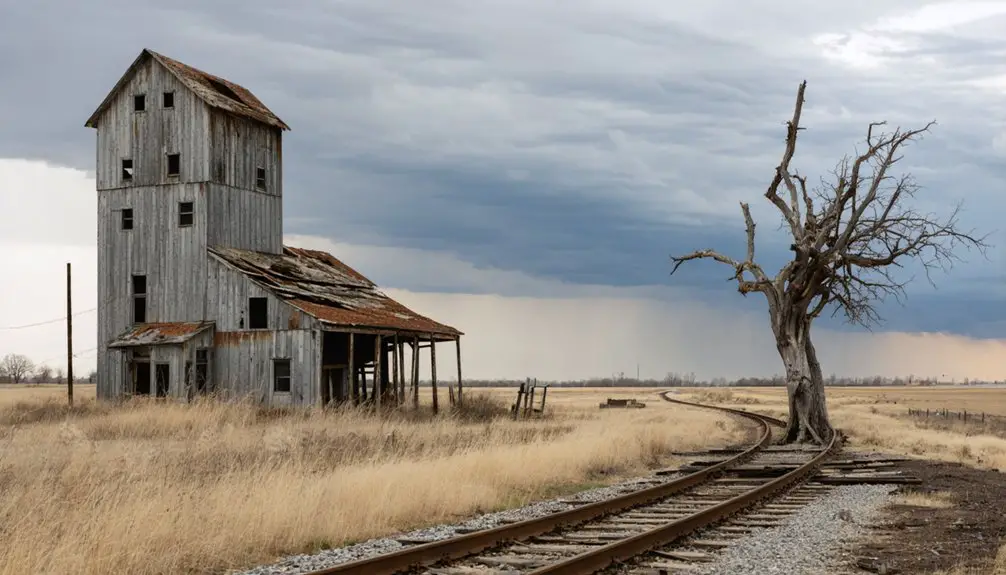
You’ll find Radium’s skeletal remains near Warren, Minnesota, where weathered structures still stand as monuments to wheat country’s golden age. Follow County Road markers south of Warren—the grain elevator serves as your landmark—then navigate gravel roads to the former Warren Sheaf building and Immanuel Lutheran Church at 48.22944°N, 96.61361°W. Before setting out, share your route with someone trusted and prepare for remote farmland conditions. The journey reveals how agricultural economics can transform thriving communities into prairie whispers, and there’s much more to discover about Minnesota’s vanished towns.
Key Takeaways
- Navigate using County Road markers toward Warren, with the grain elevator south of the original townsite serving as a key landmark.
- Visit the former Warren Sheaf Newspaper building, small church, and Immanuel Lutheran Church located 1.5 miles south at specified coordinates.
- Prepare for gravel roads and farmland terrain; share your route plans with someone before departing for safety.
- Respect the fragile structures by avoiding disturbances, packing out all belongings, and moving deliberately through ruins.
- Combine your visit with other Minnesota ghost towns like Forestville’s state historical site or Wasioja’s seminary ruins.
The Rise and Fall of Radium’s Agricultural Legacy
While Fort Snelling’s soldiers drilled on newly cleared grounds in 1819, Euro-American farmers were already turning over prairie soil with ox-drawn plows near the military outpost, planting the seeds of what would become Minnesota’s agricultural empire.
You’ll discover Radium emerged during wheat’s golden era when bonanza farms stretched across Red River Valley’s fertile plains. By the 1870s, southeastern counties exhausted their soil, pushing cultivation northwestward where technological advancements impacts transformed homesteading—steam tractors replaced oxen, mechanical binders supplanted hand-scythes.
When wheat prices collapsed in the 1920s depression, survivors embraced crop diversification strategies, introducing Holstein dairy herds and rotating fields. But Radium’s independent farmers couldn’t compete with corporate agriculture’s ruthless efficiency. Commercial operations devoured family homesteads, leaving only windswept foundations where self-reliant pioneers once thrived.
What Remains: Exploring the Abandoned Structures
The windswept foundations where self-reliant pioneers once thrived now stand as skeletal monuments to Radium’s vanished prosperity. You’ll discover the former Warren Sheaf Newspaper building still standing, alongside a small church that served as the community’s spiritual anchor.
The post office operated until 1984, marking nearly eight decades of stubborn resilience. As you explore these dilapidated structures, tread carefully—rotting floorboards and collapsing walls demand respect for both safety and material preservation.
The Soo Line Railroad corridor that once pumped life into this settlement now traces a ghost of commerce past. These remnants hold historical significance beyond their crumbling frames, offering tangible connections to Minnesota’s agricultural heritage and the optimistic era when radium symbolized boundless progress.
Getting There: Routes and Access Points
Finding community infrastructure remnants requires local knowledge:
- Follow County Road markers toward Warren, your postal hub reference point
- Watch for the grain elevator south of the original townsite—your landmark
- The railroad grade (now Northern Plains Railroad) parallels viable routes
- Immanuel Lutheran Church sits 1.5 miles south at coordinates 48.22944°N, 96.61361°W
Prepare for gravel roads and farmland reclaiming what pioneers once claimed.
Other Forgotten Minnesota Towns Worth Visiting
Beyond Radium’s windswept fields, Minnesota harbors dozens of ghost towns that tell similarly haunting stories of boom, bust, and erasure. You’ll find Elcor’s foundations buried beneath the Minorca mine—a complete town swallowed by industry’s relentless appetite.
Forestville offers something different: preserved buildings you can actually explore, maintained as a state historical site since the railroad bypassed it in 1868. The county infrastructure investments that saved some towns doomed others. Wasioja’s seminary ruins stand as Civil War memorials, while Vicksburg’s crumbling structures showcase regional economic impacts when railways chose different routes.
Up north, Taconite Harbor vanished almost overnight when LTV Steel pulled out, leaving haunting remnants along the shore. Each site reveals how quickly prosperity transforms into abandonment.
Respectful Exploration Guidelines for Ghost Town Visitors
When you step onto Radium’s abandoned grounds, you’re entering a preserved moment of Minnesota’s past—not a theme park. The ethics of documenting ghost town visits demands you engage thoughtfully with what remains. Preserving heritage site authenticity means resisting the urge to pocket square-headed nails or disturb weathered structures, regardless of how small the temptation.
Before exploring, share your route plan with someone trusted. Then focus on experiencing the place:
- Minimize phone distractions and excessive selfie-taking that centers you rather than the history
- Pack out everything you bring—leave no trace of your visit
- Lower your voice and move deliberately through the ruins
- Photograph structures and landscape, not just yourself
Trail cameras monitor these sites. Your caution guarantees future wanderers can discover Radium’s stories untouched.
Frequently Asked Questions
What Caused the Post Office to Close in 1984 Specifically?
The mill’s closure killed your post office dream—no increased mining activity meant declining population fled faster than radiation. Workers vanished, businesses died, and suddenly nobody needed stamps in a ghost town where prosperity glowed, then disappeared.
Are There Any Guided Tours Available for Radium’s Remaining Structures?
No guided tours of historic buildings exist for Radium—you’ll explore independently. The preservation of remaining structures relies on respectful visitors who tread carefully. You’re free to discover this forgotten place at your own pace, documenting its haunting beauty.
What Was the Peak Population of Radium During Its Thriving Years?
The peak population isn’t documented, but you’ll notice Radium wasn’t a mining operations town despite its name. The railroad’s decline triggered population decline from its early 1900s peak to today’s twenty residents seeking quiet independence.
Is Camping Allowed Near the Radium Ghost Town Site?
Freedom calls, but camping near Radium isn’t officially designated. You’ll find camping facilities nearby in surrounding state forests, where dispersed sites await beyond one-mile markers. Recreational activities available include exploring ruins and hiking untamed trails independently.
Are Any Original Residents or Descendants Still Living in the Area?
No original residents or descendants remain in Radium’s twenty-person population. You’ll find the area’s absorbed into Warren’s local community involvement now, though historical preservation efforts at nearby Immanuel Lutheran Church keep some pioneer stories alive.