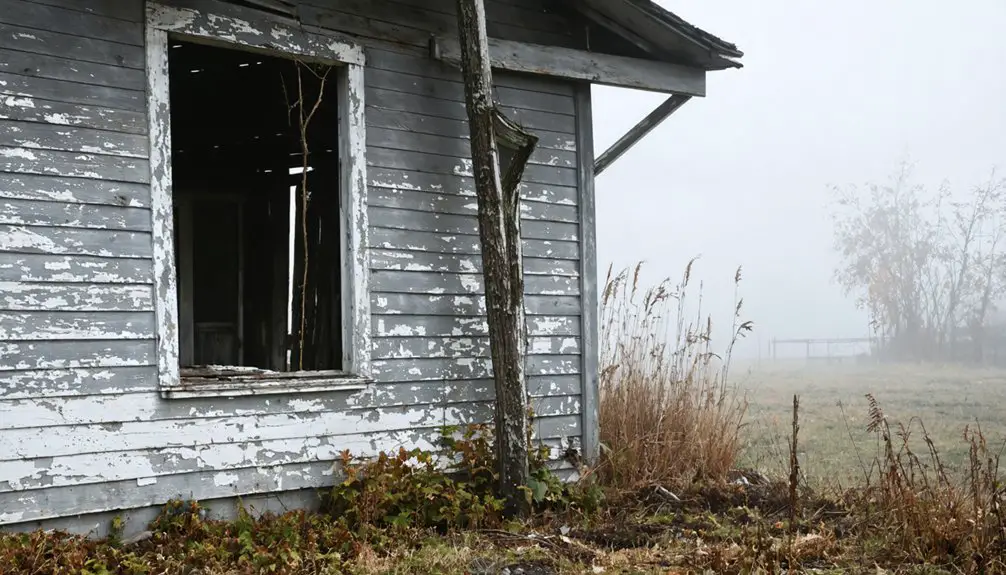
Your road trip to Singapore, Michigan takes you to one of the Great Lakes’ most fascinating ghost towns—an entire 23-building settlement swallowed by shifting sand dunes. Founded in 1836 to rival Chicago and Milwaukee, Singapore thrived until deforestation triggered a rapid natural burial that claimed mills, hotels, and stores within four years. You can explore its eerie legacy through boat cruises, dune rides, and local museums, and there’s far more to this buried town’s story than you’d expect.
Key Takeaways
- Singapore, Michigan, founded in 1836, lies buried beneath shifting sand dunes at the mouth of the Kalamazoo River in Allegan County.
- Deforestation following 1871 fires destabilized the dunes, burying all 23 buildings within four years through natural environmental reclamation.
- Visit the Saugatuck-Douglas History Museum to view artifacts, including original Singapore bank notes and historical photographs.
- Best views of the buried town are accessible from Mount Baldhead Park or narrated boat cruises aboard the Star of Saugatuck II.
- Saugatuck Dune Rides offer guided open-top truck tours, blending adventure with educational stories about Singapore’s environmental collapse.
What Is Singapore, Michigan’s Ghost Town?
Buried beneath the sand dunes of Lake Michigan lies Singapore, Michigan — a ghost town that once rivaled Chicago and Milwaukee as a major Great Lakes port.
Founded in 1836 by New York land speculator Oshea Wilder, Singapore stood at the mouth of the Kalamazoo River in Allegan County.
At its peak, the town boasted three mills, two hotels, several general stores, and Michigan’s very first schoolhouse — a remarkable example of early urban development on the frontier.
Why Singapore Was Built to Rival Chicago and Milwaukee
When Oshea Wilder founded Singapore in 1836, he wasn’t thinking small. This New York land speculator envisioned bold urban development that would transform Michigan’s Lake Michigan shoreline into a commercial powerhouse.
Singapore’s strategic position at the Kalamazoo River’s mouth made it ideal for competing directly with Chicago and Milwaukee. Wilder’s vision had serious economic impact potential, built on four key advantages:
- Direct Lake Michigan port access for major shipping routes
- Natural river connection enabling inland trade movement
- Prime location supporting sawmills and shipbuilding industries
- Infrastructure including three mills, two hotels, and general stores
You can appreciate how realistic this ambition actually was. Singapore wasn’t just a dream — it functioned as a legitimate commercial hub until deforestation ultimately sealed its dramatic, sand-buried fate.
How Deforestation Buried an Entire Town in Four Years
Once the surrounding forests were stripped bare to help rebuild Chicago and Holland after the fires of 1871, Singapore lost its only defense against Lake Michigan’s relentless dunes.
Without tree roots or dune grass to anchor the land, shifting sands swallowed the entire town within just four years. You’re looking at one of history’s starkest lessons in how quickly nature reclaims what humans leave unprotected.
Trees Gone, Town Vulnerable
The fires that ravaged Chicago and Holland in 1871 didn’t just destroy those cities — they sealed Singapore’s fate. Desperate for lumber to rebuild, workers stripped Singapore’s surrounding forests completely bare. Without tree roots anchoring the soil, Lake Michigan’s shifting sands faced zero resistance.
Here’s how urban decay claimed the town fast:
- Loggers cleared every tree surrounding Singapore
- Sand dunes lost their natural windbreaks overnight
- Drifting sands advanced unchecked toward the settlement
- All 23 buildings disappeared beneath dunes within four years
No replanted vegetation, no dune grass, nothing stopped the movement. Historical preservation efforts couldn’t save what nature had already reclaimed. You’re now looking at a town that didn’t burn or flood — it simply got swallowed whole by shifting sand.
Sand Swallows Singapore Fast
Stripped of every tree and stripped of every windbreak, Singapore didn’t stand a chance against Lake Michigan’s relentless dunes. Without vegetation anchoring the shoreline, sand moved fast and showed no mercy.
Within just four years, dunes consumed all 23 buildings, burying Michigan’s first schoolhouse, its sawmills, hotels, and general stores completely.
You’re looking at a cautionary tale about urban development gone wrong — a thriving port town erased because nobody replanted a single tree or strand of dune grass.
Historical preservation wasn’t a priority when timber profits ruled the day. Sand doesn’t negotiate. It simply advances.
Today, Singapore sits frozen beneath those dunes, invisible but intact. That buried silence is exactly what makes this ghost town road trip so hauntingly worth taking.
No Vegetation, No Protection
Deforestation didn’t just weaken Singapore — it sentenced the town to death. Once loggers stripped the surrounding woods to fuel urban development after Chicago’s and Holland’s 1871 fires, nothing remained to anchor the shoreline. Sand moved freely, swallowing everything within four years.
Here’s exactly how it unfolded:
- Loggers cleared all protective timber surrounding Singapore
- Lake Michigan winds accelerated without tree barriers blocking them
- Shifting dunes consumed all 23 buildings steadily
- No replanted vegetation or dune grass interrupted the burial process
Historical preservation efforts couldn’t reverse what deforestation set in motion. You’re looking at nature reclaiming land humanity abandoned carelessly. Today, those same dunes stand as both burial ground and monument — a stark reminder that stripping the land of its defenses carries permanent consequences.
What Did Singapore Look Like at Its Peak?

At its peak, Singapore wasn’t just a small lakeside settlement — it was a thriving, ambitious town built to compete with Chicago and Milwaukee. Picture a bustling port at the mouth of the Kalamazoo River, complete with three mills, two hotels, several general stores, and active shipbuilding operations.
Urban development here moved fast — 23 buildings rose from the ground as timber and trade fueled rapid growth. The town even housed Michigan’s very first schoolhouse, a remarkable milestone worth noting in any discussion of historical preservation.
Sawmills hummed constantly, ships loaded lumber bound for distant cities, and commerce flowed freely. For anyone who values independence and enterprise, Singapore represented exactly that — a bold community carving its own future on Lake Michigan’s shoreline.
What Survived: Singapore Artifacts and Buildings Still in Saugatuck
Though Singapore itself vanished beneath the dunes, pieces of it survived — and you can find them scattered across Saugatuck today.
Historical preservation efforts kept the town’s memory alive through artifacts, architecture, and local legends passed down through generations.
Here’s what you can explore:
- Saugatuck-Douglas History Museum – Houses Singapore bank notes, photographs, and recovered artifacts.
- Singapore Bank Building – Now a bookstore and art gallery, this structure directly connects you to the lost town’s commercial past.
- Historic Singapore Houses – Several original homes were relocated and still blend into Saugatuck’s neighborhoods.
- Local Legends – Residents and tour guides share firsthand stories that no museum display can fully capture.
Each surviving piece tells you something the sand tried to permanently erase.
Can You Actually Visit the Singapore Ghost Town Site?
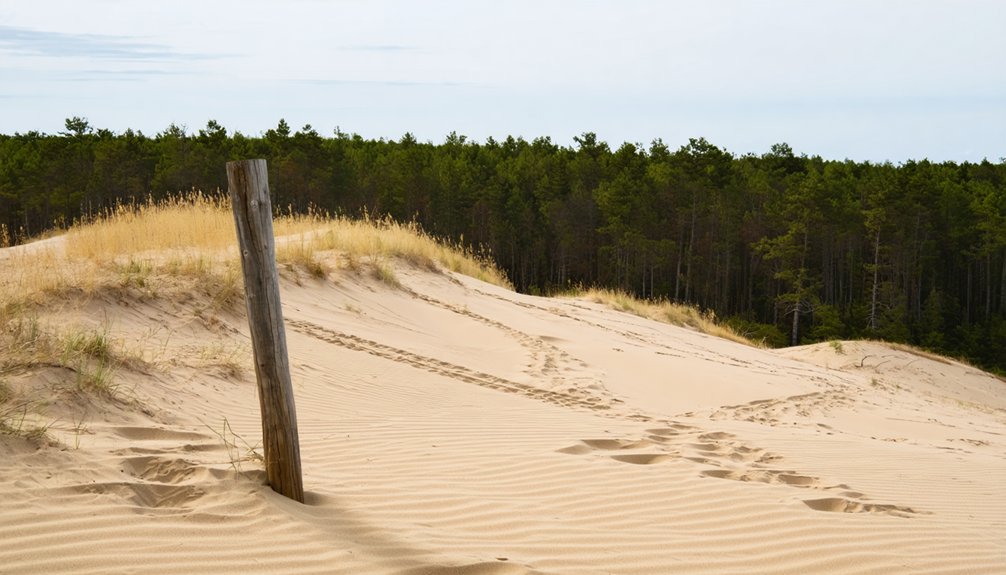
Visiting Singapore’s actual burial site is trickier than you’d expect — the land is privately owned, meaning you can’t just wander out to where the town rests beneath the dunes. Trespassing isn’t your ticket to uncovering its ghost stories or urban legends, so you’ll need to experience it from a respectful distance.
Your best views come from Mount Baldhead Park, where climbing 302 steps rewards you with a sweeping overlook of the sand-swallowed site. The Star of Saugatuck II paddlewheel boat also narrates Singapore’s story during a 90-minute cruise along the Kalamazoo River.
Saugatuck Dune Rides get you closest, rolling over the very dunes that erased the town. Each option delivers a vivid, legal glimpse into Michigan’s most dramatically buried settlement.
See Singapore From the Star of Saugatuck Boat
How does drifting along the Kalamazoo River while hearing the full story of a buried city sound? The Star of Saugatuck II paddlewheel boat makes it happen with 90-minute narrated cruises that reveal Singapore’s dramatic urban development and environmental impact firsthand.
You’ll gain perspective on how deforestation erased an entire settlement from existence. Here’s what the cruise delivers:
- Narrated history of Singapore’s founding, peak, and burial
- Views of the exact dunes covering the 23-building town
- Stories connecting Chicago’s 1871 fire to Singapore’s collapse
- A water-level perspective impossible to get on foot
You don’t need to own land or trespass to witness this ghost town. The river brings Singapore’s haunting legacy directly to you.
Which Dune Rides Give You the Best View of Singapore?

If you want to get up close to the dunes that swallowed Singapore, Saugatuck Dune Rides Tours load you onto open-top trucks and haul you across the shifting sands near the former town site.
You’ll get a ground-level perspective that no boat can match, feeling the scale of the dunes that buried 23 buildings whole.
Pair that with the Star of Saugatuck II’s narrated cruise, and you’ve seen Singapore from both the water and the dunes themselves.
Star Of Saugatuck Cruises
Since Singapore now lies buried beneath towering sand dunes, getting a good look at its resting place requires some creativity. The Star of Saugatuck II paddlewheel boat delivers exactly that freedom — a 90-minute narrated cruise pointing directly toward Singapore’s sunken remains.
Here’s what you’ll experience aboard:
- Guided narration sharing local legends about Singapore’s dramatic burial
- Scenic river views along the Kalamazoo River toward Lake Michigan
- Historical preservation stories explaining why deforestation doomed the settlement
- Direct sightlines to the exact dunes swallowing Singapore’s 23 buildings
You’re not just floating past pretty scenery — you’re witnessing an environmental cautionary tale from the water’s edge.
This cruise offers perspective that no land-based vantage point can fully replicate.
Saugatuck Dune Rides
While the Star of Saugatuck II puts Singapore’s burial site in view from the water, Saugatuck Dune Rides drops you directly onto the dunes that swallowed it. Open-top trucks carry you across rolling sand formations that buried 23 buildings beneath their weight, giving you an unfiltered, ground-level perspective that no boat cruise can match.
You’ll gain a real appreciation for dune ecology here — understanding how deforestation stripped Singapore’s natural defenses and let sand consume an entire town within four years. Guides weave historical preservation into every turn, connecting the landscape’s raw power to Singapore’s collapse.
If you crave an adventurous, hands-on encounter with Michigan’s most dramatic ghost town story, Saugatuck Dune Rides delivers the kind of freedom and immediacy that makes history genuinely unforgettable.
When to Visit Saugatuck to Explore Singapore’s Story
Summer is the best time to visit Saugatuck, when warm weather makes dune rides, boat cruises, and outdoor exploration fully accessible. You’ll hear local legends aboard the Star of Saugatuck II and witness preservation efforts firsthand at the history museum.
Each season, however, offers something distinct:
- Summer – Full access to dune rides, boat tours, and outdoor attractions
- Fall – Cooler temperatures reveal dramatic dune landscapes with fewer crowds
- Winter – The museum stays open, offering intimate artifact encounters
- Spring – Fresh light highlights the dunes beautifully for photographers
Whenever you visit, you’ll uncover a buried world that reminds you how quickly nature reclaims what humans abandon.
Singapore’s story never loses its power.
Frequently Asked Questions
Is Singapore, Michigan Related to the Country of Singapore?
They’re not linked! Singapore, Michigan’s historical origins trace back to 1836 New York land speculators, not Asian cultural influences. You’ll find its name simply echoes ambitions to build a mighty Lake Michigan port.
Were Any Bodies Ever Found Buried Beneath Singapore’s Sand Dunes?
The knowledge doesn’t confirm you’ll find any buried bodies beneath Singapore’s sand dunes. While burial mysteries and hidden graves spark curiosity, sand swallowed buildings, not people—you’re exploring an abandoned town, not a forgotten cemetery.
Did Singapore Ever Appear on Official Michigan State Maps?
Like Atlantis lost beneath the waves, Singapore’s maps tell a buried truth — the knowledge base doesn’t confirm its official state map appearances, but urban exploration and ghost town preservation efforts keep its remarkable, sand-swallowed legacy alive for you.
Are There Any Documentaries or Films Made About Singapore, Michigan?
No dedicated documentaries exist, but you’ll find Singapore, Michigan’s fascinating ghost town history woven into regional travel features and online explorations. These capture the abandoned structures now buried beneath Lake Michigan’s shifting dunes, igniting your adventurous spirit.
Has Anyone Ever Attempted to Excavate the Buried Buildings of Singapore?
Buried structures beckon boldly, yet you’ll find no confirmed excavation mysteries solved here. The privately owned site prevents public digging, leaving Singapore’s secrets sealed beneath shifting sands, sparking endless curiosity about what treasures time has hidden below.
References
- https://www.thepernateam.com/blog/singapore-michigan-the-ghost-town-buried-beneath-lake-michigans-sand/
- https://www.facebook.com/groups/michianahistory/posts/2937721929746458/
- https://mysdhistory.org/event/cruise-through-history-a-singapore-ghost-story/
- https://en.wikipedia.org/wiki/Singapore
- https://www.youtube.com/watch?v=50b7t8IBBQw
- https://michigan4you.com/michigan-road-trips-routes-and-pit-stops/
- https://www.reddit.com/r/Michigan/comments/1lmgyq/any_good_ghost_towns_in_michigan/
- https://www.audacy.com/wwjnewsradio/news/local/best-of-the-daily-j-the-story-of-singapore-michigans-buried-ghost-town