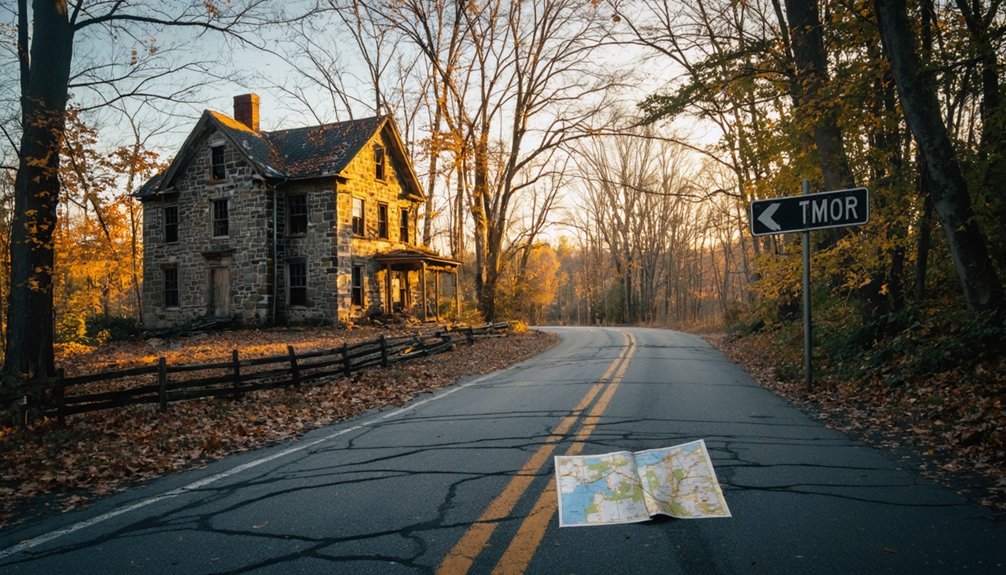
Your ghost town road trip to Smithfield, Rhode Island centers on Hanton City, an abandoned 18th-century settlement hidden deep in the forest. You’ll hike a 3.3-mile trail through dense vegetation to discover scattered stone foundations, the Alfred Smith Cemetery, and remnants of colonial life now reclaimed by nature. Plan your visit for October when fall foliage enhances the eerie atmosphere and temperatures hover around 60-70°F. Pack sturdy boots, layers, and a camera to capture the ruins. The area’s rich paranormal folklore and mysterious abandonment theories add intrigue to your exploration of this haunted village.
Key Takeaways
- Hanton City trail near Smithfield features stone foundations, cemeteries, and colonial ruins across a 3.3-mile moderate hike.
- Visit in October for 60-70°F weather, fall foliage, and ghost walks exploring the settlement’s paranormal folklore.
- Use GPS coordinates and detailed maps to locate the trailhead, as signage is limited and vehicle access is restricted.
- Pack hiking boots, layered clothing, flashlight, camera, and bug spray for navigating overgrown vegetation and ruins.
- Combine your trip with Smith-Appleby House Museum, Jaswell’s Farm, and Powder Mill Ledges Wildlife Refuge nearby.
The History of Hanton City: From Colonial Settlement to Abandonment
Nestled in the dense forests of Smithfield, Rhode Island, Hanton City emerged from the ashes of King Philip’s War when English colonial authorities granted land to three families around 1676. You’ll discover the Hantons, Paines, and Shippees carved out an isolated trading stop serving travelers between Providence and Woonsocket.
These poor tanners and bootmakers thrived in the 1730s, selling leather goods at Providence markets while farming their rugged land.
What Remains at the Lost Village Site Today
When you venture into the woods today, you’ll discover scattered stone foundations that mark where colonial families once built their homes and lives.
The Alfred Smith Cemetery stands as a solemn reminder of the community that thrived here, its weathered headstones nestled among the forest undergrowth. Beyond these dwelling sites, you can still trace the remnants of agricultural infrastructure—including a defunct dam and original well ruins—that sustained this 18th-century farming settlement.
Colonial Stone Foundations
As you navigate the second-growth forest, you’ll trace property boundaries through deteriorating fieldstone walls, some standing six feet high with flat capstones. Granite bedrock anchors these structures, while limestone remnants hint at grand chimneys.
Near Reaper’s Brook, mill foundations persist. Each year, forest growth claims more stonework, but these ruins stubbornly resist complete erasure—silent testimony to the settlement’s colonial-era builders.
Historic Burial Ground
Beyond the crumbling stone walls, scattered burial grounds tell fragmented stories of Hanton City’s forgotten residents. You’ll discover the Alfred Smith Cemetery, where three weathered headstones mark the graves of Alfred, Eliza, and Emor Smith—though vegetation now chokes the site.
More intriguing are the four graves in Smithfield Cemetery #513, identified as possible Indian burial practices from the area’s original inhabitants. These unmarked grave sites contrast sharply with colonial plots, lacking the wooden coffins and metal hardware typical of settler burials. The bones rest deliberately placed 3-4 feet underground, their brown coloration revealing centuries of silent waiting.
Since 2017, volunteers have been reclaiming over 60 abandoned cemeteries from nature’s grasp, resetting gravestones and clearing brush to preserve these final remnants of forgotten lives.
Agricultural Infrastructure Remnants
Scattered throughout Hanton City’s wooded expanse, crumbling agricultural remnants reveal the backbone of this 1700s farming settlement. You’ll discover stone walls snaking through thick forest, marking boundaries where colonists once tended their fields.
Remaining corn storage infrastructure sits near house foundations—raised stone supports where wooden cribs once dried harvests before rot claimed their frameworks. A massive threshing rock still occupies its original position, where farmers manually processed oats, barley, and rye.
Deep in the woods, you’ll find a nearly invisible dam that once supplied irrigation water. Though obsolete farm machinery has long vanished, these scattered ruins paint a vivid picture of self-sufficient frontier life. Navigate carefully through overgrown vegetation to locate cellar holes, foundation stones, and property markers from this abandoned community.
Getting to Hanton City: Directions and Trailhead Information
Finding your way to Hanton City requires traversing to Smithfield, Rhode Island, where the trailhead sits tucked away from major thoroughfare. You’ll discover the Hanton City Trail near this colonial ghost town—once called Lost City by locals who’ve explored its hidden clearings.
While traces of old asphalt pavement remain, vehicles can’t access the site anymore, ensuring its preservation through isolation. Once you’ve located public parking options in the vicinity, you’ll walk through an easily opened gate leading into the settlement’s main clearing.
Don’t expect obvious trailhead markers guiding your journey—this forgotten place rewards those willing to navigate by instinct and research. Bring GPS coordinates or detailed maps, as the extensive ruins scatter across a massive area, often disappearing beneath vegetation that reclaims civilization’s abandoned footprints.
Hiking the Hanton City Trail: What to Expect
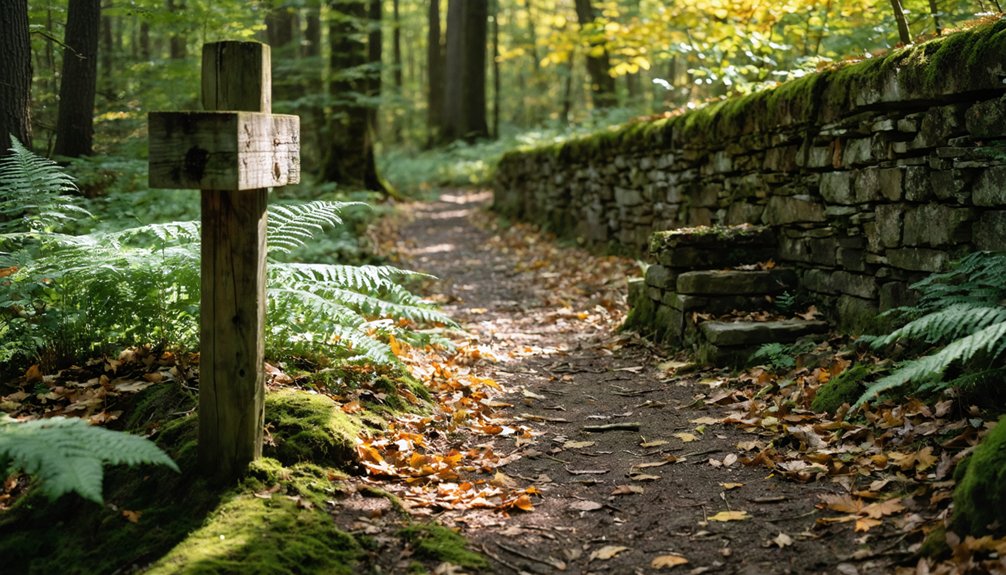
The Hanton City trail presents moderate difficulty as overgrowth blankets the entire site, forcing you to navigate through dense vegetation where traces of old asphalt pavement now lie completely inaccessible to vehicles. You’ll need to search carefully to spot the ruins—stone foundations, crumbling farm walls, and a defunct irrigation dam hide among the trees and require close inspection to identify.
What awaits your discovery includes remnants of roughly a dozen homesteads marked by foundation stones, scattered multicolored glass fragments, rusted metal artifacts, and the Alfred Smith Cemetery where early settlers rest beneath weathered headstones.
Trail Difficulty and Terrain
Covering roughly 3.3 miles round-trip, Hanton City Trail delivers an easy-to-moderate hike that’ll challenge your navigation skills more than your endurance. The hiking experience begins at 70 W. Reservoir Rd, where you’ll pass through an easily opened gate into complete wilderness.
Dense vegetation swallows stone foundations and crumbling walls, making ruins surprisingly hard to spot. You’ll encounter old asphalt pavement traces now reclaimed by nature, cut hillsides showing mini-landslides, and rusty metal remnants marking former homesteads. The trail challenges come from isolation and overgrowth rather than steep grades.
After walking three-quarters of a mile through thick woods, you’ll discover your first cellar ruin—a ghostly reminder of the 19th-century farming community abandoned before the Great Depression.
Locating the Ruins
Once you’ve traversed the overgrown trail, actually spotting Hanton City’s ruins becomes your next challenge. The settlement lives up to its “Lost City” nickname—stone foundations, crumbling walls, and a defunct irrigation dam hide beneath dense vegetation. You’ll need sharp eyes to distinguish colonial-era structures from natural rock formations.
Seasonal visibility changes dramatically impact your exploration. Winter and early spring offer the best window for identifying features, when bare branches reveal what summer’s canopy conceals. Negotiating the overgrowth during growing season makes the ruins nearly impossible to locate, even when you’re standing directly beside them.
Look for patterns: stone walls marking property boundaries, foundation corners creating rectangular shapes, and the Alfred Smith Cemetery as a reference point. These archaeological signatures persist beneath the forest’s reclamation.
What Remains to See
What actually awaits you along the 3.3-mile Hanton City trail? You’ll discover approximately a dozen stone foundations scattered through dense vegetation, their mysterious origins dating back to pre-Depression times. Traces of asphalt pavement guide your journey through what locals call the Lost City, though nature’s reclaimed most of the path.
Remnants of daily life appear everywhere—multicolored glass fragments, rusty metal artifacts, and weathered fence posts tell stories of families who once farmed here. You’ll pass the Alfred Smith Cemetery and a defunct irrigation dam. The east side reveals more glass debris, while west lots showcase additional homesteads.
Green wood fragments, possibly old shutters or shingles, peek through dilapidated stone walls that typify New England’s farming communities. The clearing’s gate opens easily for exploration.
Key Features to Discover Among the Ruins
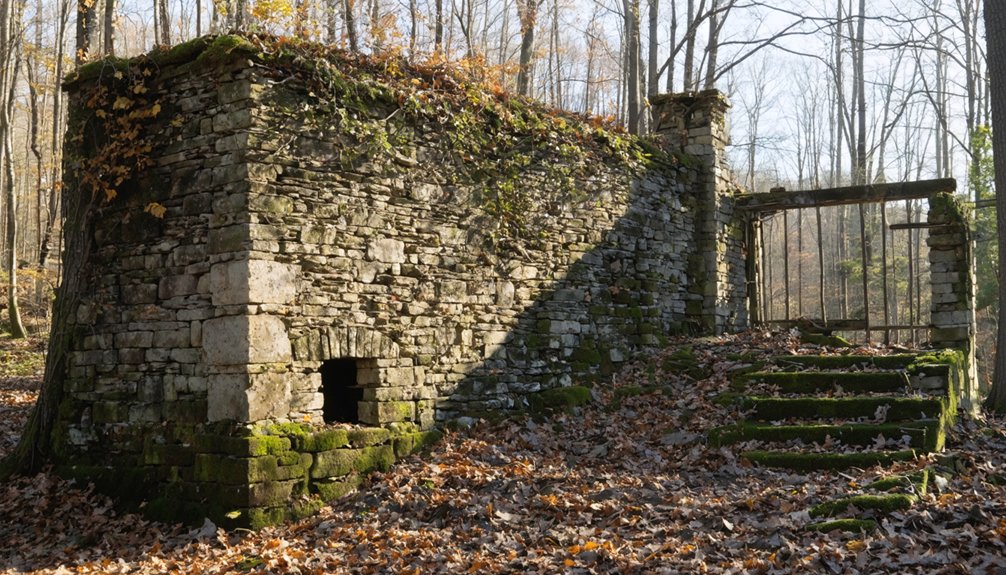
The forest floor of Smithfield reveals centuries-old stone foundations that emerge from thick vegetation like skeletal fingers reaching through time. You’ll discover intriguing archaeological finds scattered throughout: circular drill marks etched into rock surfaces, threshing stones that once processed colonial harvests, and chopped formations worn smooth by generations of footsteps. The skilled stone craftsmanship becomes evident as you trace crumbling cellar walls and examine the precise placement of quarried blocks in residential foundations.
Navigate overgrown streets that map the settlement’s original layout, leading you to a preserved well structure and remnants of stone bridges. Burial sites mark the presence of families who carved their existence from this wilderness. Each pathway and foundation tells stories of those who sought independence in Rhode Island’s untamed forests during the 1700s.
The Mysterious Theories Behind the Town’s Disappearance
Speculation swirls around why this once-thriving settlement faded into the forest, with theories ranging from political exile to calculated land grants. You’ll encounter unsolved mysteries at every crumbling foundation.
Local historian Jim Ignasher favors the most plausible explanation: three yeoman families—the Paines, Hantons, and Shippees—received these lands as payment for King Philip’s War service around 1676-1677. The colonial settlers’ origins, however, remain hotly debated.
Some historians suggest Loyalist exiles fled here during the Revolution, seeking refuge from Patriot persecution. Wild speculation in the 1930s spawned tales of runaway slaves and leper colonies, though research has debunked these claims.
The truth? The last Hanton descendant died around 1900, and nature simply reclaimed what remained—no dramatic catastrophe, just time’s relentless march forward.
Ghost Stories and Folklore Surrounding the Haunted City
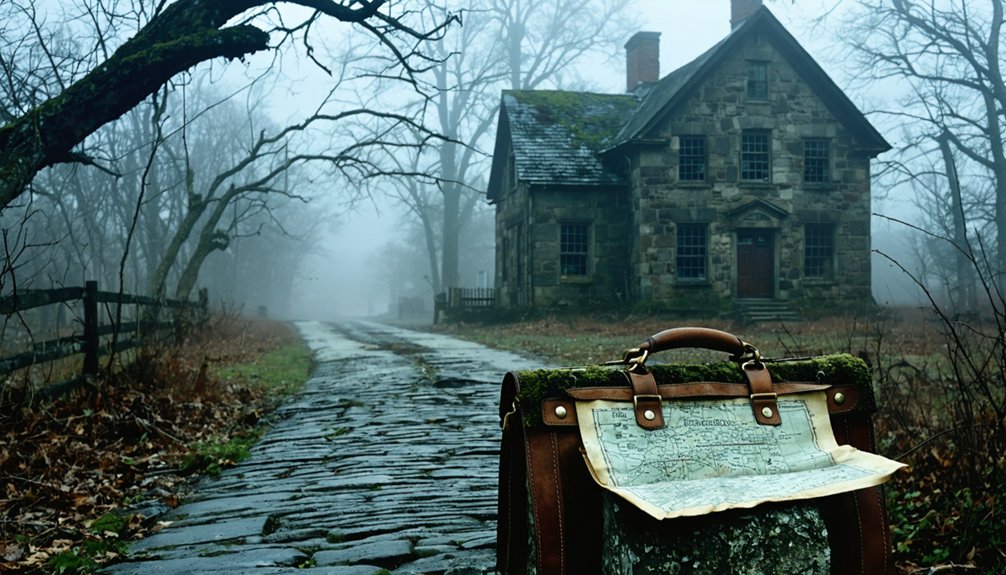
Long before Instagram ghost hunters and paranormal investigators descended upon these woods, a Providence Journal reporter stumbled upon the abandoned settlement in the 1880s and coined the term “Haunted City”—an ironic label for what was never more than a modest farm settlement.
Today, decaying cellar holes inspire constant speculation about occult rituals and supernatural encounters reported both day and night. The Pawtucket Paranormal Society‘s August 2007 investigation documented cold spots and captured orb photographs they interpreted as spirit manifestations.
Meanwhile, the legendary Witch Tree at Mann School and Colwell Roads allegedly marks where a witch was nailed into the ground—a 19th-century folk tradition to prevent the undead from rising. Local paranormal investigations continue attracting freedom-seekers enthusiastic to explore Smithfield’s shadowy folklore beyond conventional explanations.
Best Times to Visit and What to Bring
When should you venture into Smithfield’s haunted woods for the best experience? October’s your prime window, with Hanton City ghost walks scheduled throughout the month (13th, 20th, 15th, and 29th). The seasonal weather hovers around 60-70°F—perfect for exploring without summer’s oppressive humidity or winter’s brutal snow. Fall foliage transforms the abandoned village into an atmospheric backdrop for spooky paranormal sightings, while dying vegetation reveals ruins that summer’s overgrowth conceals.
Pack strategically: sturdy hiking boots navigate uneven woodland terrain, layered clothing handles temperature drops, and waterproof jackets combat Rhode Island’s unpredictable showers. Don’t forget your flashlight for investigating darkened homesites, camera for capturing unexplained phenomena, and bug spray if you’re visiting during warmer months.
Spring offers alternative tours (April 5-7, 23), but October’s supernatural energy remains unmatched.
Nearby Attractions and Where to Stay in Smithfield

Beyond Hanton City’s ghostly ruins, Smithfield delivers a surprisingly rich roster of attractions that’ll transform your paranormal pilgrimage into a full-fledged New England adventure.
Explore the 1702 Smith-Appleby House Museum for authentic colonial history, then wander Powder Mill Ledges Wildlife Refuge‘s untamed trails. The Crossings at Smithfield offers retail therapy at Target and Barnes & Noble, while Jaswell’s Farm tempts with fresh-baked donuts and apple picking. Adventure-seekers can browse LEGO treasures at Providence Brick Exchange or hunt vintage finds at Antiques Alley.
Accommodation options cluster around major attractions, with Tripadvisor listings near conservation areas and historic sites. Book December through February for rock-bottom rates—peak season runs June through August. Nearby dining choices include farm-fresh fare at local orchards and restaurants surrounding shopping centers, ensuring you’re fueled for ghost-hunting expeditions.
Frequently Asked Questions
Is It Legal to Visit Hanton City Ruins?
Yes, you’re free to explore! No signs bar entry to these woods where preservation efforts for Hanton City maintain trails. You’ll discover the historical significance of Hanton City through accessible stone foundations and that tiny, haunting cemetery awaiting adventurers.
Are the Hanton City Trails Suitable for Children?
The trails offer interesting historical significance and scenic natural surroundings, but they’re challenging for children. You’ll encounter overgrown vegetation, muddy conditions, scattered glass shards, rusty metal debris, and hidden wells—making supervision essential for young explorers’ safety.
Can You Camp Overnight Near the Hanton City Site?
You can’t camp overnight at Hanton City itself due to its historical significance and cultural preservation needs, but you’ll find several nearby campgrounds within minutes, including George Washington State Campground in neighboring Chepachet offering tent and RV sites.
Are There Guided Tours Available for Hanton City?
No guided tours exist for Hanton City—you’ll explore its haunted history and abandoned architecture independently via the self-guided hiking trail. This freedom lets you discover overgrown cellar holes, stone foundations, and gravestones at your own pace.
Is Cell Phone Service Available on the Hanton City Trails?
Cell signal reliability varies dramatically against the wild, untouched landscape. You’ll find spotty coverage throughout trail accessibility points, so download maps beforehand. Embrace the disconnection—it’s part of your adventure into Hanton City’s forgotten freedom, where nature reclaims civilization.