Planning a ghost town road trip to Spenazuma, Arizona means chasing one of the Southwest’s strangest stories. This tiny Graham County settlement exploded onto the map in 1898 and collapsed just a year later — not from failed mining, but from deliberate fraud. Con artist Richard C. Flower pocketed over $3 million before investigators exposed the scheme. Today, you’ll find barren ranch land near Safford where a fake boomtown once fooled thousands. Stick around — there’s much more to uncover.
Key Takeaways
- Spenazuma sits approximately 30 miles southwest of Safford, Arizona, near the Santa Teresa Mountains in southeastern Graham County.
- The site is on private ranch land, so obtain permission before visiting.
- Expect no ruins or structures; Spenazuma was fraudulently built cheap and has been erased by weather and ranching.
- Key landmarks include the Black Rock formation and the Geronimo railroad stop, aiding navigation and enriching the historical narrative.
- Plan stops at nearby Aura and other mining-era sites to contextualize Spenazuma’s boom-and-bust history.
What Was Spenazuma and Why Did It Vanish So Fast?
Tucked into the remote reaches of Graham County, Arizona, Spenazuma burst into existence in 1898 and collapsed just a year later — one of the shortest boom-to-bust cycles in Arizona’s mining history.
Unlike the mining legends built on genuine strikes and hard labor, Spenazuma was the invention of Richard C. Flower, a con artist who staged an elaborate fake gold mining operation to drain investors of their money. He sold stock, shipped in eastern investors by the trainload, and propped up the illusion with photos, ore samples, and telegrams.
Spenazuma wasn’t born from sweat and strikes — it was conjured by a con man with a camera and a telegram.
When reporter George H. Smalley investigated in 1899, the scheme unraveled fast. Investors lost potentially millions, and the town emptied almost overnight.
What you’ll find today is a barren site on private ranch land — and one unforgettable fraud story.
The Mining Fraud That Put Spenazuma on the Map
Once you understand what drew people to Spenazuma, the real story gets even more compelling: the whole town existed because of a con.
Richard C. Flower, an east coast mining promoter, built an elaborate illusion using staged photos, planted ore samples, and carefully timed telegrams to convince investors they’d struck gold in southeastern Arizona.
It wasn’t until reporter George H. Smalley of *The Arizona Republican* exposed the scheme in 1899 that the fraud unraveled, sending the town from boom to ghost almost overnight.
Flower’s Elaborate Con
Behind Spenazuma’s brief existence was a calculated con engineered by Richard C. Flower, an east coast promoter who understood that perception creates reality. He purchased mining claims, platted a townsite, and sold stock by promising high-value gold mines beneath Arizona soil.
To cement the illusion, he weaponized photos, telegrams, and carefully staged ore samples — tools that fed the era’s mining legends and historical myths surrounding southwestern riches.
Flower even transported trainloads of eastern investors directly to the site, letting them see what he wanted them to see. Shallow shafts and shoddy buildings masked the deception long enough for him to reportedly collect over $3 million.
You’re looking at one of Arizona Territory’s most brazen frauds, built entirely on manufactured excitement and deliberate misdirection.
Manufactured Mining Evidence
What made Flower’s scheme so effective wasn’t just his confidence — it was his evidence. He armed himself with photos, telegrams, and carefully staged ore samples to convince investors they’d struck something real. He even arranged trainloads of eastern investors to visit the site personally, letting the landscape do the lying for him.
But dig past the ghost town legends and you’ll find shallow mine shafts and shoddy structures that couldn’t support serious extraction. The mineral piles likely came from other mines entirely. These mining myths weren’t accidents — they were engineered deceptions, constructed to separate free people from their money.
When you visit Spenazuma’s barren remains today, you’re standing where manufactured “proof” once convinced hundreds that fortune was just beneath their feet.
The Fraud Unravels
Once the story broke, investors stopped coming, and the town collapsed almost immediately. People who’d built their hopes on Flower’s promises walked away with nothing. Estimates place total investor losses at more than $3 million.
Today, that dramatic unraveling is exactly what draws history-minded travelers here. Unlike polished tourist attractions, Spenazuma offers something rawer — a cautionary story written directly into the Arizona landscape.
Where Exactly Is Spenazuma, Arizona?
If you’re plotting your route, you’ll find Spenazuma tucked into a remote corner of Graham County in southeastern Arizona.
The site sits roughly 30 miles southwest of Safford, near the rugged Santa Teresa Mountains and northwest of Mount Graham.
You won’t find it on most modern maps, which makes the journey feel as much like detective work as a road trip.
Graham County Remote Location
Tucked into the remote southeastern corner of Arizona, Spenazuma sits in Graham County near the Santa Teresa Mountains, roughly 30 miles southwest of Safford. You won’t find it on most tourist maps, but that’s exactly what makes it worth chasing down.
The surrounding landscape tells its own story about cultural significance and the fragile nature of modern preservation:
- The Black Rock formation marks the area as a cattle ranch, privately owned and working.
- Mount Graham looms to the northwest, anchoring the rugged terrain.
- The isolation that once fueled a fraudulent mining boom still defines the region today.
Getting here demands intention. You’re trading convenience for raw history on open roads through southeastern Arizona‘s high desert — and that’s the whole point.
Near Santa Teresa Mountains
Narrow your focus a little further west of Safford, and Spenazuma starts to take shape on the map. The site sits roughly 30 miles southwest of town, tucked near the Santa Teresa Mountains in Graham County’s rugged southeastern terrain.
You’re not chasing gold panning streams or dramatic canyon overlooks here — you’re tracking a landscape that once buzzed with manufactured excitement and fraudulent mining history. The Santa Teresa Mountains rise as your visual anchor, framing the arid cattle ranch where the townsite now quietly sits.
Black Rock, the distinctive formation tied to the Spenazuma location, gives you a concrete landmark to orient your route. The terrain is remote and unforgiving, which makes the story of investors flooding this isolated stretch of Arizona all the more remarkable.
Southwest Of Safford
Spenazuma sits about 30 miles southwest of Safford, placing it deep in Graham County’s remote ranch country near the Santa Teresa Mountains. You won’t find it on standard tourist maps, but its coordinates put you squarely in open, rugged Arizona landscape where mining legends and historical myths still echo across the terrain.
Before you head out, keep these practical points in mind:
- The site sits on private ranch land, so you’ll need landowner permission before exploring.
- Black Rock, the area’s distinctive formation, serves as your most reliable visual landmark.
- The nearest rail reference point is Geronimo, Arizona, where stagecoaches once connected travelers to town.
Understanding the geography helps you appreciate why Flower chose this isolated stretch — remote enough to hide the fraud, yet accessible enough to lure investors.
Can You Actually Visit the Spenazuma Ghost Town Site?
If you’re planning to visit the Spenazuma ghost town site, temper your expectations before hitting the road. The land is privately owned and operates as a working cattle ranch, so you’ll need landowner permission before stepping foot on the property.
Don’t expect developed trails, interpretive signs, or preserved structures — ghost-town listings classify it as a barren site.
The preservation challenges here are real. Little survived the fraud’s collapse, and decades of ranch use have erased most physical traces. The cultural impact of Spenazuma lives more in Arizona’s historical record than in anything you’ll see on the ground.
Your best approach is treating this as a history-driven detour. Come for the story, the Black Rock formation, and the raw southeastern Arizona landscape rather than dramatic ruins.
How to Drive the Spenazuma Loop From Safford
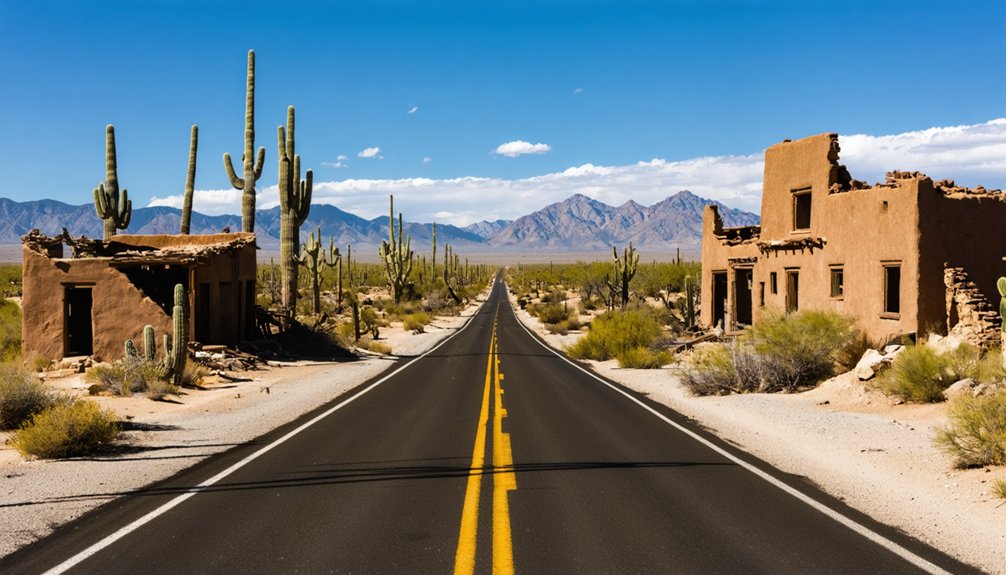
Once you’ve accepted that the site itself is more story than spectacle, the drive becomes the main event. From Safford, head southwest roughly 30 miles toward the Santa Teresa Mountains, passing through open ranch country that hasn’t changed much since the fraud collapsed in 1899.
Build your loop around three honest-to-goodness highlights:
- Black Rock formation – the distinctive landmark anchoring the Spenazuma site
- Geronimo – the old railroad stop where stagecoaches once shuttled enthusiastic investors
- Graham County backroads – raw desert landscape that rewards slow, curious driving
This route isn’t about polished tourist attractions or historical preservation signage. It’s about moving through a landscape that swallowed a con man’s empire whole.
Bring water, download offline maps, and treat every mile as part of the story.
Why Spenazuma Left Almost No Physical Trace
Most ghost towns fade slowly, leaving behind stone foundations, rusted equipment, and collapsed walls that reward patient explorers.
Spenazuma didn’t get that chance. Because the entire operation was a fraud, nobody invested seriously in historical preservation or permanent construction. The buildings were cheap, the mine shafts were shallow, and the moment the swindle collapsed in 1899, everyone left fast.
You won’t find modern remnants worth photographing here. The site sits on a working cattle ranch, and decades of weather, ranching activity, and neglect erased whatever little existed.
The Black Rock formation still stands nearby, but the townsite itself is fundamentally bare ground.
That absence tells its own story. Spenazuma was never built to last — it was built to convince, and once the convincing stopped, there was nothing real left behind.
Ghost Towns Near Spenazuma That Belong on the Same Drive
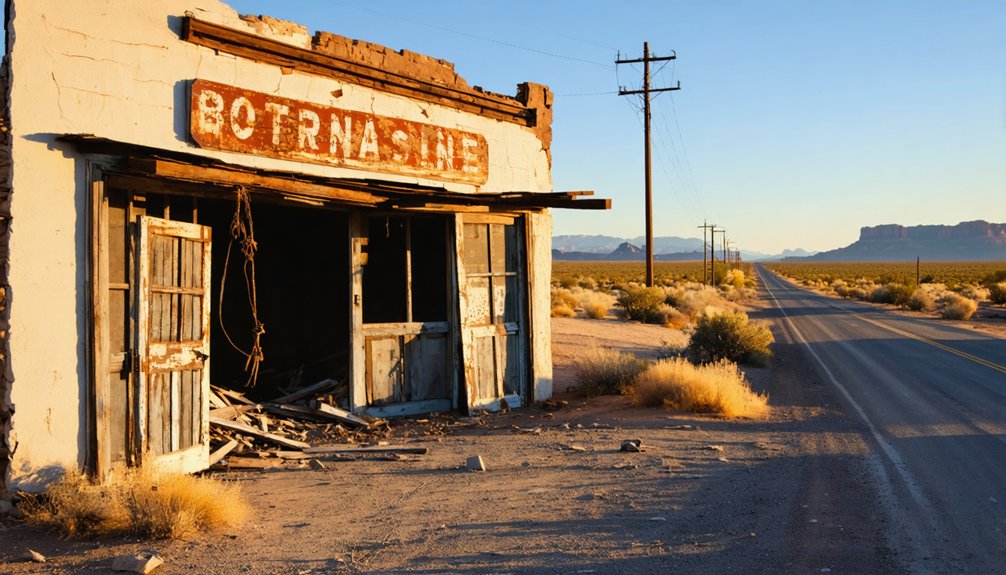
Southeastern Arizona rewards the kind of driver who treats the highway as a research tool rather than just a route. While Spenazuma anchors your trip, the surrounding region holds additional stops worth building into your itinerary:
- Aura – a nearby mining-era remnant connected to the same speculative boom that produced Spenazuma’s fraud
- Geronimo – the railroad stop that once funneled eastern investors directly into Flower’s scheme, still carrying local legends tied to the swindle
- Graham County mining sites – scattered locations where historical artifacts hint at the region’s short-lived extraction economy
Each stop deepens the same story. You’re not just collecting ghost towns; you’re tracing a connected landscape shaped by ambition, deception, and collapse.
Plan your route through southeastern Arizona accordingly.
Frequently Asked Questions
Was Richard C. Flower Ever Arrested or Charged for the Spenazuma Fraud?
Flower’s trail vanished like desert smoke! The knowledge doesn’t confirm he faced charges. You’ll find his story lives on as one of Arizona’s wildest local legends and historical landmarks of mining fraud infamy.
What Does the Word “Mazuma” Actually Mean as Slang?
You’ll love this historical slang gem — “mazuma” means money in financial terminology, borrowed from Yiddish. It’s straightforward cash, coins, currency. Swindlers literally named their fake town after “spending your money” — brilliantly audacious!
Are There Any Old Photographs of Spenazuma During Its Brief Existence?
Historical photographs of Spenazuma aren’t exactly abundant, but you’ll find scattered Spenazuma archives holding promotional images Flower’s crew used to lure investors. These visual breadcrumbs capture the town’s fleeting, fabricated glory before truth swept everything away.
Did Any Investors Ever Recover Money Lost in the Spenazuma Scheme?
No records show investors recovering their losses from the Spenazuma scheme. When you explore this ghost town history, you’ll find it’s one of Arizona’s most sobering tourist attractions, reminding you how ruthlessly Flower’s fraud stripped victims of everything.
What Other Mining Scams Did Richard C. Flower Run Before Spenazuma?
Like a wolf prowling new pastures, Flower’s earlier cons aren’t detailed in available mining history records. For your ghost town tourism research, you’ll want to dig into newspaper archives to uncover his full fraudulent trail.
References
- https://en.wikipedia.org/wiki/Spenazuma
- https://www.arizonahighways.com/classroom/spenazuma-swindle
- https://www.blm.gov/visit/swansea-historic-ghost-town
- https://www.arizonahighways.com/archive/issues/chapter/Doc.396.Chapter.4
- https://en.wikipedia.org/wiki/List_of_ghost_towns_in_Arizona
- https://rptimes.com/mike-bibb/2016/02/montezuma-and-the-spenazuma-gold-swindle/
- https://en.wikipedia.org/wiki/Category:Ghost_towns_in_Arizona
- https://www.arizonahighways.com/blog-category/history?page=3