When planning your ghost town road trip to Superior, Kansas, you’ll want to head to Osage County near U.S. Highway 56, where Dragoon Creek winds through a landscape steeped in forgotten history. This isn’t your typical ruin-filled ghost town — only a wooden schoolhouse from 1894 survives. Yet Superior nearly became Kansas’s state capital, losing to Topeka by just two votes. Grab a county map, do your research, and discover why this quiet field holds such an extraordinary story.
Key Takeaways
- Superior, Kansas, is located in Osage County near U.S. Highway 56, making it accessible for a ghost town road trip.
- The town nearly became Kansas’s state capital, losing to Topeka by just two votes, giving it significant historical appeal.
- The only remaining structure is an 1894 wooden schoolhouse, so expect an open landscape rather than visible ruins.
- Bringing a county map and conducting prior research will help you navigate the site and understand its history.
- Pairing your visit with nearby Osage County ghost towns maximizes the experience and makes the drive worthwhile.
How Superior, Kansas Almost Became the State Capital
Before Superior faded into an overgrown memory along Dragoon Creek, it nearly became the most powerful city in Kansas. When early settlers launched the capital contest, Superior entered as a serious contender — finishing just two votes behind Topeka. Two votes. That razor-thin margin defined the town’s trajectory.
The political rivalry driving that competition wasn’t just symbolic. Winning the capital meant economic dominance, population growth, and long-term relevance on the frontier. Superior’s founders understood that, which is why they built fast, recruited aggressively, and positioned the town as a civic hub worth backing.
When Topeka won, Superior lost more than a vote count. It lost momentum. Without that political anchor, the town’s purpose softened, and the forces that would eventually erase it entirely began quietly taking hold.
How to Find the Superior Ghost Town Site
Finding Superior’s ghost town site means traversing to Osage County, Kansas, where U.S. Highway 56 cuts through land once alive with frontier ambition.
Follow the highway near Dragoon Creek, and you’ll arrive at a landscape that whispers Kansas settlement stories from the 1850s.
Don’t expect standing storefronts or crumbling foundations. Superior’s ghost town history left behind something quieter — a wooden schoolhouse built in 1894, the last structure still marking where this once-promising town stood.
The original hotel, the mill, the shops — they’re long gone.
Come ready to read the land itself. Pair your visit with research into nearby Osage County ghost towns, and you’ll leave with a richer understanding of how quickly frontier dreams could rise, then vanish entirely.
What’s Left to See at the Superior Townsite Today
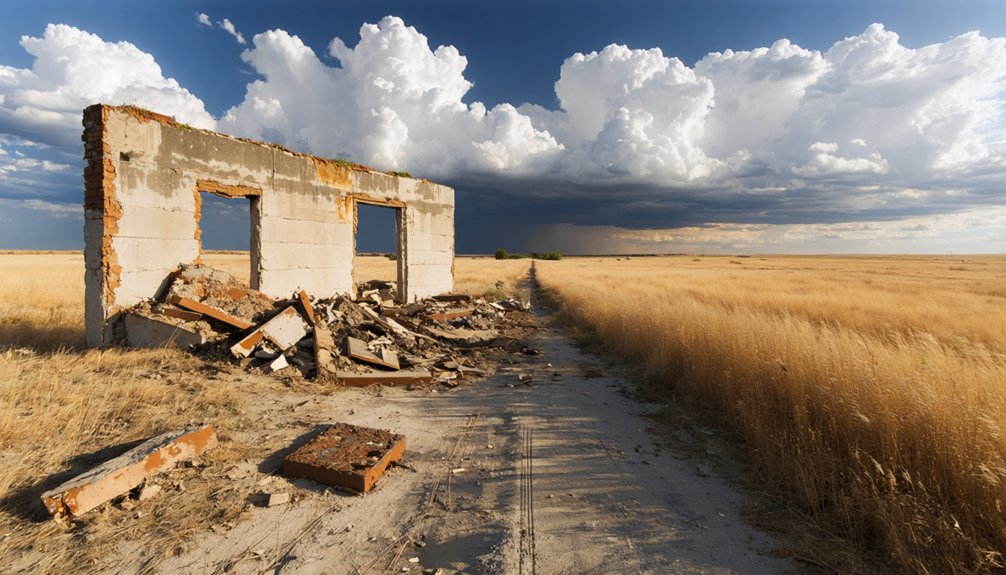
Once you’ve found the Superior townsite, the question becomes: what’s actually left to greet you? Honestly, don’t expect much in the way of historic remnants — Superior is a true ghost town in every sense.
The most significant of the surviving townsite features is the wooden schoolhouse, built in 1894, which stands as the last structure directly connected to Superior’s memory. An earlier brick school appeared on the same site in 1868, replacing what had long since crumbled away.
The hotel that once served as courthouse, church, and schoolhouse is completely gone — its materials recycled into a barn near U.S. Highway 56.
What remains is open landscape, quiet history, and that modest schoolhouse standing where a once-ambitious frontier town briefly dared to rival Topeka itself.
Is Superior Worth the Drive, and What Else Is Nearby?
Whether Superior is worth the drive depends entirely on what you’re chasing. If you want ghost town significance over spectacle, Superior delivers. You won’t find restored buildings or interpretive signs — just quiet land, a surviving 1894 schoolhouse, and the weight of a town that almost became the Kansas capital.
Pair the stop with other extinct Osage County settlements to build a fuller picture of early Kansas frontier life. The landscape along U.S. Highway 56 rewards those who appreciate open country and layered history over polished tourist stops.
Research the county-seat rivalries and failed town projects beforehand — that context transforms an otherwise empty field into something genuinely compelling. Superior isn’t a destination on its own, but woven into a broader road trip, it earns its place among Kansas historical landmarks.
What to Expect When Visiting Abandoned Townsites in Osage County
Abandoned townsites in Osage County don’t announce themselves — you’ll often arrive at what looks like an open field or a quiet stretch of highway with little to signal that a functioning town once stood there.
Ghost towns like Superior reward visitors who come prepared with context rather than expecting visible ruins. The historical significance of these sites lives in the landscape itself — a surviving school building, a repurposed barn, a creek crossing that once supported a mill.
Bring a county map, research the sites beforehand, and keep your expectations grounded. You’re not walking into a preserved museum; you’re reading a landscape.
That shift in perspective transforms an empty field into something far more compelling than any roadside attraction ever could.
Frequently Asked Questions
Who Was James Winchell, and Where Did He Come From Originally?
James Winchell’s heritage traces back to New York, where he originally came from. You’ll find Winchell’s legacy woven into Superior’s founding, as he boldly led the town’s creation with strong support from Wyandotte associates.
Why Was Superior Described as “A Child of Wyandotte”?
You might think it’s just a nickname, but Superior earned the “child of Wyandotte” label because Wyandotte men actively funded, built, and shaped it — making Wyandotte history inseparable from this ghost town culture.
When Exactly Did Superior’s Post Office Open and Permanently Close?
You’ll find Superior’s post office history fascinating: it opened on March 4, 1859, and permanently closed on September 9, 1862. Like many Kansas towns, it couldn’t survive the frontier’s unforgiving challenges that ultimately erased Superior from the map.
What Happened to the Materials From the Demolished Superior Hotel?
Once a proud landmark, now gone—after the Hotel Demolition, you’ll find its legacy lives on through Material Reuse: workers repurposed the salvaged wood and bricks, transforming them into a barn standing near U.S. Highway 56.
Was a College Ever Actually Built as Part of Superior’s Original Plans?
No, you’ll find that Superior’s college plans never materialized. Though founders boldly proposed it as part of this ghost town’s ambitious vision, the tornado, political losses, and population decline crushed those educational dreams before construction ever began.
References
- http://www.osagecountyonline.com/archives/44575
- https://legendsofkansas.com/superior-kansas/
- https://thewanderingpigeon.com/2015/10/03/day-of-kansas-ghost-towns/
- https://www.hhhistory.com/2019/05/ghost-towns-of-kansas.html
- https://www.youtube.com/watch?v=xCbFN_yLFrk
- https://www.youtube.com/watch?v=wocJ7F-jdrs
- https://www.visitgck.com/eminence-and-ravanna-the-story-of-finney-countys-ghost-towns/
- https://www.youtube.com/watch?v=Pf5n1PX1g3M
- https://legendsofkansas.com/osage-county-kansas-extinct-towns/
- https://en.wikipedia.org/wiki/List_of_ghost_towns_in_Kansas