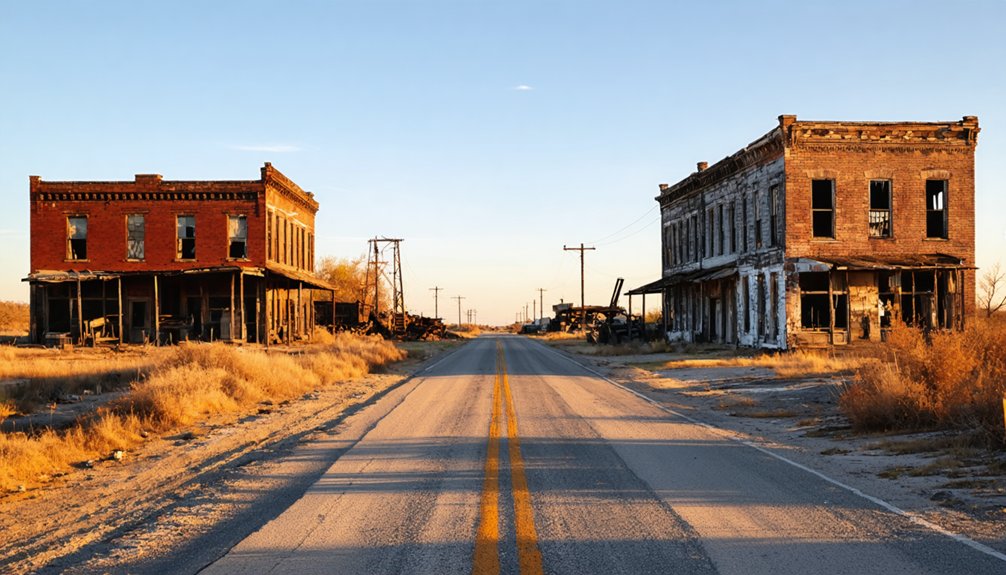
Thurber, Texas sits about 75 miles west of Fort Worth off I-20, making it an easy 90-minute drive for a fascinating ghost town adventure. Once a booming coal mining city of nearly 10,000 residents, it collapsed in the late 1920s when railroads switched from coal to oil. Today, you’ll find a towering smokestack, scattered ruins, and the W.K. Gordon Center museum preserving its remarkable story. Keep exploring to uncover everything this hauntingly compelling destination has to offer.
Key Takeaways
- Thurber is located 75 miles west of Fort Worth, accessible via I-20, with a drive time of approximately 90 minutes.
- Key remnants include the ice house smokestack, general mercantile, scattered foundations, a relocated miner’s residence, and the Catholic Church.
- The W.K. Gordon Center museum covers Thurber’s coal-mining history but opens primarily for special events, requiring advance scheduling.
- Nearby stops include Weatherford’s antique shops, Mineral Wells’ historic Baker Hotel, and scenic views through the Palo Pinto Mountains.
- Texas Historical Commission markers provide helpful context throughout the site, guiding visitors through Thurber’s industrial and labor heritage.
What Turned Thurber Into a Texas Ghost Town?
Once a booming company town of nearly 10,000 residents, Thurber’s dramatic collapse came down to one pivotal change: the Texas and Pacific Railroad‘s decision to switch its steam locomotives from coal to oil in the 1920s. That single alteration gutted Thurber’s entire purpose.
The decline factors hit fast and hard. Wage cuts followed the shift, sparking labor unrest among miners who’d already fought fiercely for their rights.
The collapse came swiftly: slashed wages ignited fierce unrest among miners who had never stopped fighting for dignity.
The community dynamics that once made Thurber self-sufficient — its fenced enclosure packed with schools, churches, hotels, and an opera house — couldn’t survive without coal demand driving the economy.
Businesses shuttered, families packed up, and by the late 1930s, Thurber had transformed from Texas’s principal bituminous coal-mining town into a near-empty ghost town. Freedom, it turned out, came from leaving.
How Far Is Thurber From Fort Worth?
You’ll find Thurber sitting about 75 miles west of Fort Worth, making it an easy day trip via I-20 through Weatherford and Mineral Wells.
From there, you can stretch the journey by stopping at Weatherford’s historic downtown or soaking in the mineral springs at Mineral Wells before pushing west into Erath County.
The drive puts you near Palo Pinto County, so you can loop through the scenic Palo Pinto Mountains for a fuller experience of this rugged Texas landscape.
Distance From Fort Worth
Thurber sits just 75 miles west of Fort Worth, making it an easy day trip from the city.
You’ll head west through the rolling Texas landscape, passing through Weatherford and Mineral Wells before reaching this fascinating piece of history in northwest Erath County.
The drive takes roughly 90 minutes, leaving you plenty of time to explore the site and absorb its historical significance.
Once a booming coal town of 8,000 to 10,000 residents, Thurber’s mining impact shaped an entire region’s economy and railroad infrastructure.
You can combine your visit with stops in nearby Weatherford or Mineral Wells, creating a fuller road trip experience.
Check current road conditions before heading out, and browse vintage photos online to preview what once stood here.
Best Route Options
Planning your drive out to Thurber is straightforward, with Interstate 20 serving as your main artery heading west from Fort Worth. This best route cuts efficiently through the rolling Texas landscape, delivering you to Thurber’s exit in roughly 75 miles.
For scenic views, consider detouring through Weatherford on US-180, where the terrain shifts into classic West Texas terrain with open skies and cedar-dotted hills that set the mood perfectly for a ghost town visit.
You’ll feel the landscape transforming as Fort Worth’s suburbs fade behind you.
Whether you stay on I-20 for speed or take the slower highway for atmosphere, you’ll arrive at the same haunting destination — a former boomtown that once housed nearly 10,000 souls now waiting quietly off the interstate.
Nearby Stops Along The Way
At just 75 miles west of Fort Worth, the drive to Thurber leaves plenty of room to build a fuller day trip by weaving in a few worthwhile stops along the way.
Start with Weatherford, roughly 30 miles out, where you’ll find charming local eateries and a lively courthouse square worth stretching your legs around.
Continue west toward Mineral Wells, a town with its own layered history and scenic viewpoints overlooking the Palo Pinto hills. From there, it’s a short push to Thurber itself.
You can also cut through Palo Pinto County backroads for a slower, more rewarding drive through rolling cross-timbers terrain. Each stop adds context to the region’s industrial and frontier past without adding much extra time to your route.
What Was Thurber Like at Its Peak?
Between the late 1910s and early 1920s, Thurber wasn’t just a mining camp — it was a thriving, self-contained city of up to 10,000 residents packed behind a fenced enclosure.
Coal mining culture shaped every corner of Thurber community life, creating something remarkably rare for rural Texas.
Coal mining didn’t just fuel Thurber’s economy — it shaped an entire way of life unlike anything else in rural Texas.
Here’s what made it extraordinary:
- Entertainment & Culture — An opera house seated over 650 people, and a 200-room hotel welcomed visitors from across the region.
- Essential Services — Residents enjoyed an ice and electric plant, schools, churches, saloons, and the county’s only library.
- Economic Engine — The Texas and Pacific Coal Company supplied railroad steam locomotives, driving massive regional demand.
You’d have found a fully functioning city — until the railroads switched to oil and everything unraveled.
What’s Still Standing at the Thurber Townsite Today?
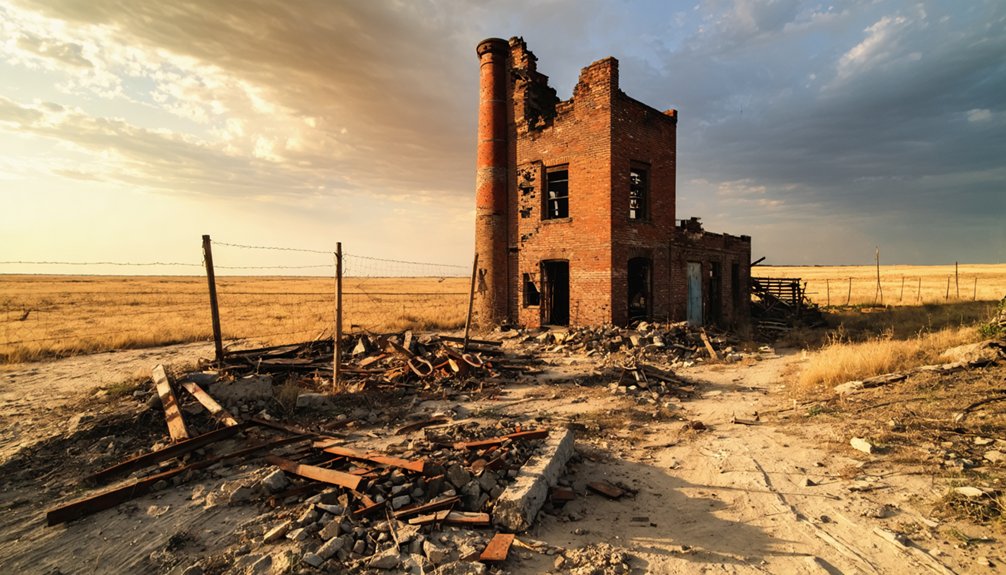
Decades of decline have left Thurber with only fragments of its once-bustling identity, but what remains still tells a compelling story.
You’ll spot the ice house smokestack standing defiantly against the Texas sky, alongside a surviving general mercantile and scattered foundations — all markers of historical preservation efforts keeping community memories alive.
Much of the original townsite sits on private property, so respect those boundaries during your visit.
The Thurber Historical Association relocated a miner’s residence, a Catholic Church, and a bandstand top, giving you tangible connections to the town’s vibrant past.
The W.K. Gordon Center museum opens for special events, offering deeper insights into Thurber’s coal-mining heritage.
Before you go, browse vintage photos online — they’ll make walking those grounds feel genuinely meaningful rather than just another roadside stop.
Inside the W.K. Gordon Center: Thurber’s History Museum
If you’re looking to piece together Thurber’s industrial story, the W.K. Gordon Center is your best starting point, though you’ll want to check ahead since the museum opens primarily for special events rather than regular hours.
Inside, you’ll find exhibits tracing Thurber’s rise as Texas’s principal bituminous coal-mining town, from its company town infrastructure to the Knights of Labor strikes that defined its working-class identity.
The museum captures how Thurber’s entire economy collapsed when Texas and Pacific Railroad locomotives switched from coal to oil in the 1920s, leaving an 8,000-person boomtown to quietly fade into foundations and smokestacks.
Museum Hours And Access
Although the W.K. Gordon Center isn’t open daily, it welcomes visitors during special events, making museum accessibility part of your planning process. Before heading out, confirm event schedules through the Thurber Historical Association to avoid an empty drive.
Keep these visitor guidelines in mind:
- Contact ahead – Reach out to the Thurber Historical Association to verify upcoming open dates and special event schedules.
- Respect boundaries – Remaining structures and foundations sit on private property, so stay within designated public areas.
- Arrive prepared – Bring water, comfortable shoes, and a camera, as the site offers outdoor exploration beyond the museum walls.
Planning around the center’s availability guarantees you experience Thurber’s layered history without missing its most compelling artifacts and relocated structures.
Notable Exhibits Inside
When you step inside the W.K. Gordon Center, you’ll discover Thurber exhibits that bring this forgotten coal town vividly back to life.
The historical artifacts on display tell the unfiltered story of miners, company bosses, and a community that thrived under corporate rule before disappearing almost entirely.
You’ll find authentic mining equipment, photographs capturing peak-era operations, and documents revealing the labor struggles that shaped Thurber’s identity.
The Knights of Labor exhibits highlight the union battles that made this town a stronghold for workers’ rights.
Each artifact connects you directly to the people who built something remarkable in northwest Erath County — and lost it when locomotive engines switched from coal to oil, erasing an entire way of life.
Thurber’s Industrial Legacy
Thurber’s industrial legacy stretches far beyond coal mines and labor strikes — the W.K. Gordon Center captures how one mining community shaped an entire region’s economy.
You’ll discover how Thurber’s industrial heritage influenced Texas in three distinct ways:
- Energy production — bituminous coal powered Texas and Pacific Railroad locomotives across the state.
- Manufacturing diversity — the brick plant operated independently until 1930, supplying construction materials regionally.
- Labor organization — Knights of Labor activity established worker protections that resonated statewide.
These exhibits don’t just display artifacts; they tell you how ordinary people built extraordinary systems under challenging conditions.
Walking through this section, you’ll understand why Thurber mattered beyond its borders and why preserving this industrial heritage remains essential for anyone serious about Texas history.
What to Know Before You Visit Thurber
Since Thurber sits on private property, you’ll want to do a bit of planning before making the drive out. Most remaining structures, including the ice house smokestack and building foundations, aren’t freely accessible, so respecting boundaries keeps the site preserved for future visitors.
The W.K. Gordon Center museum opens for special events and offers a deeper exploration into local legends and historical anecdotes surrounding the town’s mining days and labor struggles. Check their schedule before heading out.
Pair your trip with nearby Weatherford, Mineral Wells, or Palo Pinto for a fuller day on the road. Browse vintage photos online beforehand so you’ll recognize what once stood where only foundations remain.
Texas Historical Commission markers throughout the site give helpful context you won’t want to rush past.
Day Trips From Thurber: Weatherford, Mineral Wells, and Palo Pinto

Stretching your road trip beyond Thurber’s historical markers puts you within easy reach of three towns that round out the story of this corner of Texas.
Each destination offers distinct local attractions connected by scenic routes through rolling West Texas terrain.
- Weatherford – Known as the “Peach Capital of Texas,” it delivers antique shops, historic architecture, and a lively downtown square worth exploring.
- Mineral Wells – Famous for its mineral water history and the hauntingly beautiful Baker Hotel, this town rewards curious travelers who appreciate layered stories.
- Palo Pinto – A quiet county seat sitting near the coalfields that once fed Thurber’s mines, offering rugged scenery and a genuine off-the-beaten-path feel.
Together, these three stops transform a single-site visit into a full regional adventure.
Before You Go: Safety at Abandoned Sites
Ghost town structures have stood without maintenance for decades. Floors, stairs and roof timbers fail without warning, and a building that looks solid from outside may not hold your weight. Stay out of standing structures unless the site is actively maintained and open to visitors.
Mine workings are the more serious hazard. Vertical shafts can be hundreds of feet deep, are often unfenced, and may be hidden by brush or capped with rotted boards. Never enter an adit, tunnel or shaft: abandoned workings can hold oxygen-poor or toxic air that gives no warning before you lose consciousness.
Enclosed spaces with rodent droppings carry a risk of hantavirus, which is contracted by breathing contaminated dust. Do not sweep or stir up dust inside old cabins and outbuildings.
Cell coverage at these sites is usually poor or absent. Tell someone your route and expected return time, and carry more water than you think you need.
Frequently Asked Questions
Can You Photograph the Thurber Smokestack and Foundations During Your Visit?
You can photograph the smokestack and foundations, but they’re on private property, so respect boundaries. Capture their historical significance with great photography tips: shoot at golden hour for dramatic, freedom-evoking images of Thurber’s industrial past.
Are There Guided Tours Available at the Thurber Ghost Town Site?
Guided tours aren’t regularly available, but you can explore Thurber’s ghost town history through the W.K. Gordon Center museum during special events, where you’ll uncover its fascinating mining legacy firsthand through historical markers and relocated structures.
Was Thurber’s Opera House Ever Used for Professional Performances?
The opera house history suggests it likely hosted professional performances, seating over 650 guests. You’d have witnessed an impressive performance legacy in this remote Texas mining town that craved culture, entertainment, and freedom during its peak years.
Did Thurber Miners Ever Successfully Win Their Labor Strikes?
Thurber’s miners’ struggles shine brightly against their ultimate defeat. You’ll find their labor history inspiring — they won early concessions, yet technology crushed their power when locomotives switched to oil, stripping away hard-fought victories overnight.
Are Any Descendants of Thurber Miners Still Living in the Area?
The knowledge doesn’t confirm if miner families’ descendants still live nearby, but you’d likely find connections through Thurber history organizations and local communities in Erath County, where proud family legacies often run deep.
References
- https://www.tshaonline.org/handbook/entries/thurber-tx
- https://www.youtube.com/watch?v=phjUE19A8HM
- https://www.tarleton.edu/gordoncenter/thurber-history/
- https://en.wikipedia.org/wiki/Thurber
- https://www.texasescapes.com/TRIPS/Weatherford