Planning a ghost town road trip to Trident, Montana means stepping into the weathered shell of a once-thriving cement company town, just 8 miles from Three Forks. You’ll explore crumbling plant remnants, a working pump house, and a heritage center packed with immigrant history, all with no entry fees and open access year-round. Road conditions are generally manageable, but checking local reports beforehand keeps your trip on track. There’s far more to this forgotten town than first meets the eye.
Key Takeaways
- Trident, Montana, is a ghost town 8 miles from Three Forks, accessible via paved roads transitioning to gravel closer to the site.
- The site is open to the public anytime with no entry fees, featuring cement plant remnants and an operational pump house.
- The volunteer-maintained Railroad and Trident Heritage Center preserves artifacts from Trident’s peak years; confirm hours before visiting.
- Nearby ghost towns like Bannack, Granite Ghost Town State Park, and Copper City make Trident a perfect road trip hub.
- Check road conditions before visiting, and bring a reliable vehicle for navigating gravel stretches near the site.
What Makes Trident, Montana Worth the Drive?
Although Trident, Montana barely registers on most road trip itineraries, it punches well above its weight in historical depth.
You’ll find a place where cement history shaped an entire community from the ground up, beginning in 1908 when the Three Forks Portland Cement Company broke ground and built a full working village around its plant.
What makes Trident genuinely compelling is its immigrant culture. Italian and Austrian workers transformed a rough shanty town into a vibrant neighborhood they called Little Italy.
That human story runs deeper than any single artifact. Lewis and Clark even noted the area’s exceptional limestone deposits back in 1805, long before industry arrived.
The human story here runs deeper than concrete — it stretches back to Lewis and Clark themselves.
You’re not visiting an empty ruin here — you’re walking through layers of ambition, labor, and community that most travelers drive right past.
Hours, Road Conditions, and Entry Fees for Trident
Before you pack your bags and hit the road, you’ll want to know that Trident itself doesn’t charge entry fees, since it’s not an official state park like Bannack or Granite Ghost Town.
Road conditions near Three Forks are generally manageable, but you should check local Montana road reports before making the 8-mile drive from town, especially in winter or after heavy rain.
The Railroad and Trident Heritage Center, your best stop for artifacts and history, is volunteer-maintained, so confirming its hours ahead of your visit will save you a wasted trip.
Entry Fees And Hours
Visiting Trident won’t cost you a dime, since the site is open to the public without entry fees or formal operating hours. You’re free to explore the cement plant remnants and pump house on your own schedule, any time you choose.
However, if you’re planning to visit the Railroad and Trident Heritage Center in Three Forks, check with local volunteers about visitor hours, as availability can vary seasonally.
Road conditions near Three Forks are generally accessible, but Montana weather can shift quickly, so confirm conditions before heading out.
Nearby Bannack and Granite Ghost Town State Parks do charge entry fees and maintain specific visitor hours, so check Montana State Parks online before adding those stops to your road trip itinerary.
Road Conditions And Access
Getting to Trident is straightforward, since the site sits just a few miles from Three Forks in south-central Montana.
You’ll follow an 8-mile route that mirrors the path the Trident Depot traveled during its 2011 relocation. Access routes are generally paved near Three Forks, but expect gravel stretches as you approach the cement plant remnants and pump house.
Road conditions vary seasonally, so check local reports before heading out, especially in spring when Montana’s freeze-thaw cycles roughen rural roads.
You can reach the Railroad and Trident Heritage Center through the Headwaters Trail System near Milwaukee Park. No entry fees apply at the heritage center, though volunteer upkeep sustains it.
Arriving prepared with a reliable vehicle keeps your exploration hassle-free and rewarding.
How to Get to Trident From Three Forks
From Three Forks, you’ll follow the same 8-mile route that carried the Trident Depot to its current home at the Railroad and Trident Heritage Center in 2011.
Head north out of town, keeping an eye on the horizon for the cement plant remnants that signal your arrival in Trident.
Once there, the standing pump house — still feeding water to the plant — marks the heart of what remains of this once-thriving industrial village.
Starting Point: Three Forks
Three Forks sits just 8 miles from Trident, making it the perfect launching point for your ghost town adventure. This charming small town gives you easy access to Trident’s fascinating cement industry legacy, where the Three Forks Portland Cement Company once transformed raw limestone into a booming industrial operation.
Before hitting the road, stop at the Railroad and Trident Heritage Center near Milwaukee Park. The relocated Trident Depot now houses artifacts that bring Trident history to life, giving you essential context before you explore the remnants yourself.
From Three Forks, follow the same 8-mile route the depot traveled in 2011 when it was moved. You’ll also find yourself near the Missouri River headwaters, where Lewis and Clark first recognized the area’s exceptional limestone quality back in 1805.
Route Along Depot Path
Once you’ve soaked in the heritage center exhibits, you’ll retrace the same 8-mile path the Trident Depot traveled in 2011 when it made its final journey from the cement town to Three Forks.
This drive connects depot history to living landscape, carrying you through south-central Montana’s open terrain toward the Missouri River headwaters.
As you head north, scenic views of rolling hills and limestone formations unfold around you, the same geology Lewis and Clark documented on July 27, 1805.
The cement plant remnants appear as you approach Trident, signaling your arrival. The operational pump house still feeds water to the plant, standing as one of the last surviving structures.
Park near the site, step out, and let the industrial ruins tell their story directly.
Trident Arrival Landmarks
Pulling into Trident feels like stepping into a layered timeline where industrial ambition quietly surrendered to nature. The pump house greets you first — still operational, still feeding water to the remnant cement plant. It’s the most tangible symbol of Trident’s historical significance, standing where entire neighborhoods once buzzed with life.
Scan the landscape and you’ll notice absence telling the story. Cottages, a hotel, a theater, and a school once anchored this community. European immigrants transformed this ground into something vibrant, layering cultural heritage into every poured foundation.
The cement plant ruins rise against Montana’s open sky, demanding your attention. Walk the perimeter, read the silence, and let the pump house anchor your understanding of what Trident built — and what time ultimately reclaimed on its own terms.
The Rise and Fall of a Montana Cement Town
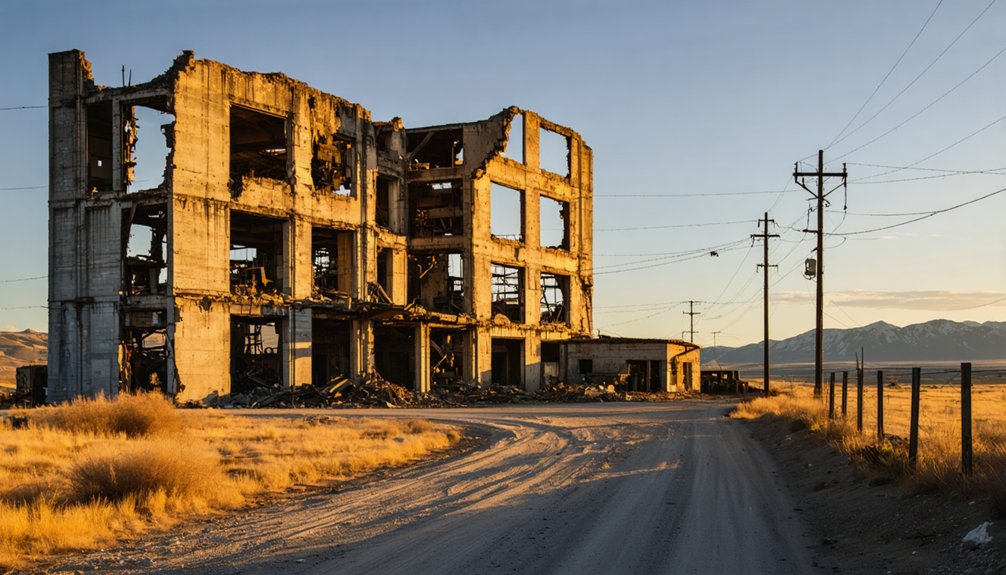
When Lewis and Clark passed through this stretch of south-central Montana on July 27, 1805, they noted the area’s high-quality limestone deposits — a geological detail that would quietly set the stage for an industrial boom a century later.
By 1908, the Three Forks Portland Cement Company had broken ground, and Trident emerged as a thriving company town carrying real historical significance within Montana’s cement industry. European immigrants, mostly Italian and Austrian, built tight-knit communities around the plant.
Trident rose as a true company town, where Italian and Austrian immigrants built community around Montana’s booming cement industry.
Ideal Cement Company took over in 1914, keeping Trident’s identity intact. But prosperity didn’t last — drought slashed production by two-thirds in 1919, and the town gradually emptied.
Today, only the pump house still stands, a quiet reminder of everything Trident once was.
What’s Left to See at the Trident Site Today?
What remains of Trident today is sparse but still worth the drive. You’ll find cement plant remnants standing as quiet monuments to the area’s cement industry roots, while the operational pump house still feeds water to the plant.
It’s a raw, unfiltered snapshot of Trident history that no museum can replicate.
The Trident Depot, relocated to Three Forks in 2011, now anchors the Railroad and Trident Heritage Center near Milwaukee Park. You can access it via the Headwaters Trail System, where volunteers preserve artifacts from the town’s peak years.
Cottages, schools, and the hotel are long gone, but the heritage center fills those gaps effectively.
Trident isn’t a ghost town yet, but it carries that hollow, forgotten energy that makes these stops genuinely compelling.
What’s Inside the Trident Heritage Center
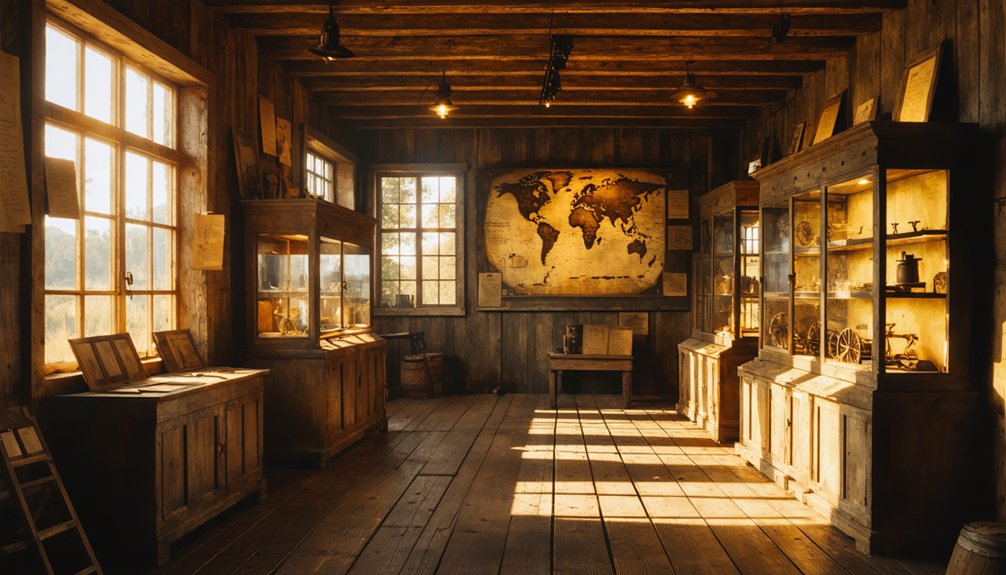
The heritage center picks up where the cement plant ruins leave off. When you step inside the Railroad and Trident Heritage Center in Three Forks, you’ll find Trident artifacts that tell the full story of this vanished company town. The depot itself traveled eight miles to get here in 2011, carrying its historical significance right along with it.
You’ll discover preserved remnants from the cottages, hotel, theater, and school that once surrounded the cement plant. Each piece connects you to the Italian and Austrian immigrant workers who built their lives around that operation.
Unlike a traditional ghost town, nothing here crumbles unattended — volunteers actively maintain the collection. You’re free to explore at your own pace, letting the artifacts speak for themselves.
Montana Ghost Towns Near Trident Worth the Detour
Four ghost towns within reasonable driving distance of Trident reward you with everything from well-preserved frontier buildings to crumbling mine ruins.
Bannack, founded during an 1862 gold strike on Grasshopper Creek, delivers Montana’s most intact ghost town exploration experience, with frontier buildings standing exactly as settlers left them.
Granite Ghost Town State Park takes you to an 1890s silver boomtown where miners pulled $40 million from the earth, and the Miners’ Union Hall shell still commands the hillside.
Highland City near Butte once housed 2,000 residents, and researchers have mapped 30,000 historical artifacts across the site.
Copper City sits just six miles north of Three Forks, a compact mining settlement that dried up when water scarcity made operations impossible.
Each destination adds genuine depth to your road trip.
Using Trident as a Base for Montana Ghost Town Exploration
Trident’s location in south-central Montana puts you within striking distance of some of the state’s most compelling ghost town destinations.
You’re just 6 miles from Copper City and within driving range of Bannack and Granite Ghost Town State Park.
After exploring Trident’s cement industry legacy and absorbing its fascinating Trident history at the Railroad and Trident Heritage Center, you’ve got a natural launching point for broader adventures.
Head southwest to walk Bannack’s preserved streets, where residents didn’t leave until the 1970s.
Push toward Granite to photograph the Miners’ Union Hall shell and intact company hospital.
Each destination rewards curious travelers who refuse to follow predictable tourist trails.
Trident’s central position means you’re never more than a half-day’s drive from Montana’s most remarkable abandoned settlements.
Before You Go: Safety at Abandoned Sites
Ghost town structures have stood without maintenance for decades. Floors, stairs and roof timbers fail without warning, and a building that looks solid from outside may not hold your weight. Stay out of standing structures unless the site is actively maintained and open to visitors.
Mine workings are the more serious hazard. Vertical shafts can be hundreds of feet deep, are often unfenced, and may be hidden by brush or capped with rotted boards. Never enter an adit, tunnel or shaft: abandoned workings can hold oxygen-poor or toxic air that gives no warning before you lose consciousness.
Enclosed spaces with rodent droppings carry a risk of hantavirus, which is contracted by breathing contaminated dust. Do not sweep or stir up dust inside old cabins and outbuildings.
Cell coverage at these sites is usually poor or absent. Tell someone your route and expected return time, and carry more water than you think you need.
Frequently Asked Questions
Did Lewis and Clark Actually Visit the Exact Trident Cement Plant Location?
No, but Lewis and Clark didn’t miss it by much! They noted the area’s high-quality limestone on July 27, 1805, giving Trident’s future cement plant its historical significance you’ll appreciate when you visit.
Why Did European Immigrants Specifically Choose Trident Over Other Montana Settlements?
Like moths to a flame, European immigrants chose Trident’s booming cement plant for its Economic Opportunities and Cultural Heritage. You’d find Italians and Austrians thriving together, building Little Italy where jobs were plentiful and community bonds ran deep.
Were Any Trident Residents Relocated When the Town Declined After 1919?
The records don’t confirm specific relocations during Trident’s town decline, but you can imagine the resident impact was significant — families who’d built lives there likely scattered freely as production collapsed to one-third after 1919’s devastating drought.
Can Visitors Legally Collect Limestone Samples From the Trident Area?
Like Lewis and Clark’s 1805 limestone discovery, you’d want to claim your own piece—but check limestone regulations and mineral rights first, as Montana’s laws may restrict collecting without proper permissions.
What Ethnic Traditions From Little Italy Still Influence the Three Forks Area?
You’ll find Italian Cuisine influences and Cultural Festivals echoing Little Italy’s immigrant roots in Three Forks. The European settlers who shaped Trident left lasting traditions you can still discover woven throughout the community’s vibrant local heritage today.
References
- https://www.youtube.com/watch?v=-jeveG5hDXU
- https://www.distinctlymontana.com/granite-ghost-town
- https://southwestmt.com/blog/ghost-towns/
- http://www.tfhistory.org/history Trident 01.html
- https://www.railstotrails.org/trailblog/trident-depot-saved-by-community-in-three-forks-encapsulates-the-regions-rich-history/
- https://historynet.com/copper-city-montana-ghost-town/
- https://www.goldensoftware.com/solutions/real-world/ghost-town-artifacts/
- https://fwp.mt.gov/stateparks/granite-ghost-town