Tuckertown, Texas exploded from empty prairie to a city of 6,000 people in just three months—then vanished almost as fast. To find the site, head south from Corsicana on US 287 for 2.9 miles, then east on FM 637 for 3 miles. Pack water, snacks, offline maps, and a full tank of gas before you go. There’s more to this fascinating ghost town story than you’d expect.
Key Takeaways
- Tuckertown is located 6 miles southeast of Corsicana; head south on US 287 for 2.9 miles, then east on FM 637 for 3 miles.
- Only a state historical marker remains at the site, set in open pasture with no structures or artifacts above ground.
- Pack water, snacks, a full gas tank, camera, and offline maps, as cell service and gas stations become sparse along FM 637.
- Visit during cooler parts of the day, as intense Texas heat requires proper hydration and weather monitoring for safe travel.
- Combine the trip with nearby Corsicana oil-era landmarks, museums, murals, and the Collin Street Bakery to enrich your experience.
What Was Tuckertown, Texas?
Once a thriving oil boomtown, Tuckertown sprang up in July 1923 in Navarro County, Texas, about 6 miles southeast of Corsicana. Promoter Harry L. Tucker established the settlement to house, feed, and entertain workers flooding into the Powell oil field.
Within two months, roughly 3,000 people called it home, and that number doubled to 6,000 shortly after.
The boom didn’t last. Fires in late 1923 and early 1924 tore through the settlement, and by November 1923, the Powell field was fully drilled.
Most structures came down by 1931, and the town vanished entirely by the mid-1960s.
Today, historical preservation exists only through a state marker — don’t expect tourist amenities. Pasture covers the site, and ghost-town directories bluntly list its remains as “Nothing.”
How Tuckertown Grew to 6,000 People in Three Months
Few boom towns in Texas history matched Tuckertown’s explosive growth. When Harry L. Tucker promoted the site during the Powell Field oil boom in July 1923, workers flooded in almost immediately.
Few boom towns matched Tuckertown’s explosive growth — a place where oil ambition turned open land into instant legend.
Within two months, roughly 3,000 people were living in tents, shanties, and hastily built houses. A month later, that number doubled to 6,000.
You can almost picture the chaos — supply wagons, roughnecks, and opportunists all converging on what was fundamentally open land southeast of Corsicana.
Local legends describe a settlement that felt more like a city overnight.
Historical landmarks now mark what was once the largest oil boomtown in the area.
That kind of raw, unplanned freedom defined Tuckertown — a place built entirely on ambition, oil, and the unstoppable momentum of boom-era Texas.
The Fires and Bust That Erased Tuckertown From the Map
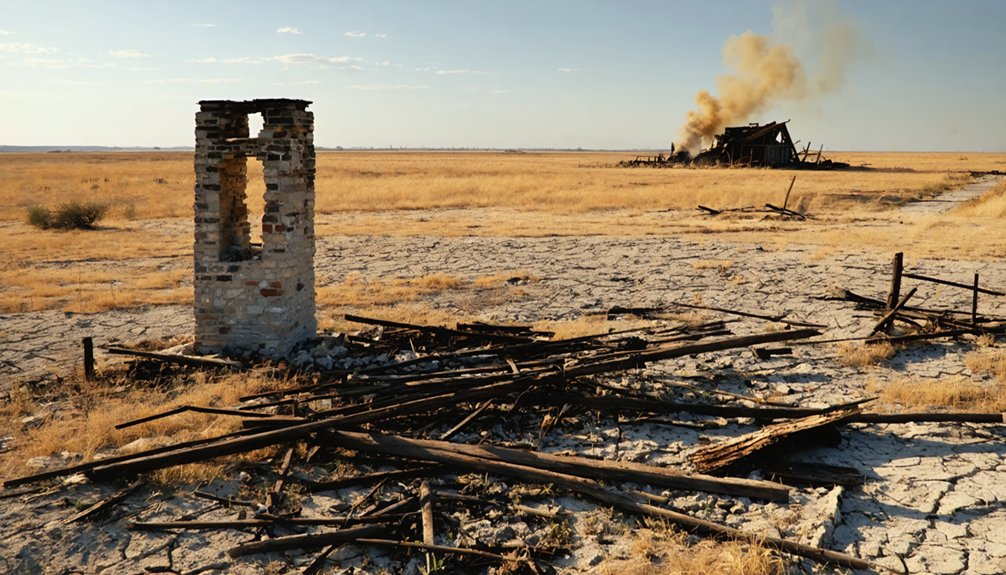
Tuckertown’s collapse came fast and hard. By late 1923, historical fires and an oil bust had already sealed the town’s fate. You’re looking at a place that went from 6,000 residents to rubble in under two years.
Here’s what brought Tuckertown down:
- October 1923: A fire tore through the north side of town, forcing hasty rebuilding.
- November 1923: Workers completely drilled out the Powell field, killing the reason Tuckertown existed.
- February 1924: A second fire struck, compounding the damage left by the oil bust.
How to Find the Tuckertown Ghost Town Site Today
Finding the Tuckertown site takes some navigation, but the directions are straightforward. Head south from Corsicana on US 287 for 2.9 miles, then turn east on FM 637 and drive another 3 miles. A state marker identifies the spot where 6,000 people once crowded into tents and shanties chasing oil money.
Don’t expect historical artifacts or visible preservation efforts — ghost-town directories bluntly list the remains as “Nothing.” Pasture has swallowed everything that fire and demolition didn’t claim.
You’re fundamentally standing on open land where an entire boomtown exploded into existence and vanished within a year.
Still, the marker makes the stop worthwhile. It grounds you in a remarkable, fast-burning chapter of Texas oil history that most travelers speed right past without knowing.
What You’ll Actually See at the Tuckertown Site
Once you pull off the road and step out, the reality of Tuckertown hits fast: there’s nothing here. No historical artifacts, no structures, no preservation efforts — just open pasture stretching across what was once a 6,000-person boomtown. Preservation challenges were never really fought here; the land simply swallowed everything whole.
There’s nothing here — no artifacts, no structures, no fight. Just pasture where 6,000 people once lived.
What you’ll find instead:
- Flat grassland covering the former townsite, unmarked by foundations or debris
- A state historical marker serving as the only physical acknowledgment of the town’s existence
- Quiet countryside that makes it nearly impossible to imagine the chaos of a 1923 oil boom
That contrast — boundless emptiness versus explosive history — is exactly what makes Tuckertown worth the detour.
While you’re already deep in Navarro County ghost town territory, it’d be a shame to stop at just Tuckertown. The broader Powell field area scattered several boomtown settlements across these plains, each collapsing just as quickly as they rose.
Corsicana itself rewards a stop — oil was discovered there on June 19, 1894, and the town retains genuine historical preservation efforts, including markers and museums that provide context for everything you’ve just seen in the pasture.
Unlike Tuckertown, Corsicana offers real tourist infrastructure: restaurants, lodging, and heritage sites worth your afternoon. Use it as your base camp.
From there, you can fan out across the county, connecting the dots between boomtown ambition and prairie silence — a road trip narrative that practically writes itself.
Start your Navarro County ghost town road trip by pulling up US 287 South out of Corsicana. Then heading east on FM 637 to reach Tuckertown’s historic marker before looping through nearby abandoned townsites.
Pack the essentials — water, snacks, a full tank of gas, and a reliable map or GPS, since rural county roads don’t always cooperate with cell service.
Once you’ve got your route locked in, you’ll find that pairing the Tuckertown site with other local ghost towns and Corsicana’s oil-era landmarks turns a single stop into a full day of exploration.
Mapping Your Route
Planning a Navarro County ghost town road trip is straightforward if you anchor your route around Corsicana, the regional hub that puts you within striking distance of Tuckertown’s former site. Head south on US 287 roughly 2.9 miles, then turn east on FM 637 for 3 miles. That marker signals a site of real cultural significance, even if pasture has swallowed every structure.
- Pack a paper map or offline GPS — cell coverage gets spotty on rural FM roads
- Stop at the state historical marker to absorb the historical preservation efforts that keep this story alive
- Budget extra time to explore nearby Powell field sites, adding deeper context to Tuckertown’s oil-boom arc
You’re driving into open Texas freedom, not a curated exhibit — and that’s exactly the point.
Nearby Attractions To Visit
Once you’ve stood at that roadside marker and let the silence of the pasture do its work, Corsicana pulls you back in with plenty worth your time. The Navarro County Historical Society holds historical artifacts that connect directly to the Powell field boom, giving Tuckertown’s story real texture.
Pioneer Village lets you walk through reconstructed structures and absorb local legends tied to the county’s oil and settlement eras.
Corsicana’s downtown district offers murals, architecture, and the famous Collin Street Bakery for a well-earned stop.
If you’re chasing more ghost towns, the surrounding county roads lead to other vanished communities worth hunting down.
This stretch of Texas rewards the curious traveler who moves at their own pace and asks their own questions.
Essential Road Trip Supplies
Before you head out to hunt down Tuckertown’s marker and the pastures that swallowed it whole, pack smart for a rural Navarro County run. There aren’t tourist amenities waiting at this site — no restrooms, no vendors, no shade structures. You’re rolling into open pasture country, so come prepared and self-sufficient.
- Water and snacks: Bring more than you think you’ll need; the Texas heat doesn’t negotiate.
- Camera and notebook: Document the marker and surrounding landscape since no historical artifacts survive above ground.
- Offline maps and fuel: Cell service gets spotty past Corsicana, and gas stations thin out fast on FM 637.
Travel light, stay flexible, and treat the open road itself as the destination.
Frequently Asked Questions
Was Tuckertown Ever Officially Incorporated as a Texas Municipality?
Tuckertown was never officially incorporated. It sprang up fast as an oil boomtown, then vanished just as quickly. You won’t find historic preservation efforts here—ghost town tourism reveals only pastureland where 6,000 people once lived.
Did Tuckertown Have a Post Office During Its Peak Population Years?
Like a campfire that burned bright but left no ashes, the records don’t confirm Tuckertown had a post office. Its ghost town preservation gaps highlight the historical significance of boomtowns you’d never fully trace today.
Are There Any Photographs of Tuckertown During the 1923 Oil Boom?
The knowledge base doesn’t confirm any historical photography of Tuckertown’s oil boom era, but you’d likely uncover fascinating images by digging through Navarro County historical archives, where rare visual records of boomtowns often hide.
Who Owns the Land Where Tuckertown Once Stood Today?
No records confirm who owns the land today, but you’ll find it’s private pasture hiding ghost town relics beneath the grass. Local legends live on, even if Tuckertown’s last structures vanished by the mid-1960s.
Did Harry L. Tucker Profit Financially From Promoting Tuckertown’s Development?
the records don’t confirm whether Tucker personally profited. Historic preservation efforts haven’t uncovered financial details, so you’re left wondering if he truly gained from Tuckertown’s fleeting, fiery rise.
References
- https://en.wikipedia.org/wiki/Tuckertown
- https://en.wikipedia.org/wiki/List_of_ghost_towns_in_Texas
- https://atlas.thc.texas.gov/Details/5349012341
- https://www.texasescapes.com/TOWNS/Texas_ghost_towns.htm
- https://www.ghosttowns.com/states/tx/tx_ghst_twns_sect1345.doc
- https://en.wikipedia.org/wiki/Alligator_School_House
- https://www.texasescapes.com/Texas-Ghost-Towns-A-to-Z.htm
- https://txnavarr.genealogyvillage.com/towns/tuckertown/index.htm
- https://authentictexas.com/texas-ghost-towns/
- https://en.wikipedia.org/?title=Category:Stub-Class_Ghost_town_articles&from=Q