You’ll find Utica’s scattered remnants across thirteen miles of northern Smith County farmland, accessible via Highway 155 or 69 north of Tyler. Foundation stones from three flour mills still mark where 100 residents once built a self-sufficient community that thrived for just two years before vanishing by 1905. The wagonmaker’s shop and druggist’s store have disappeared beneath overgrowth, their exact locations lost to time. Pack sturdy boots for exploring barely-discernible trails where trade routes once connected this ambitious frontier settlement to the wider world.
Key Takeaways
- Utica is located in northern Smith County at 32°27′N 95°23′W, accessible via State Highway 155 or Highway 69 north of Tyler.
- The ghost town thrived briefly from 1890 to 1892 with 100 residents, six businesses, three flour mills, and three cotton gins.
- Utica completely vanished from county maps by 1905 after its post office closed and residents relocated to urban centers.
- Only scattered remnants remain today, including foundation stones from mills and gins across 13 miles of northern Smith County.
- The town sits between Winona to the southeast and Red Springs to the northwest along former trade routes.
Where to Find Utica in Smith County
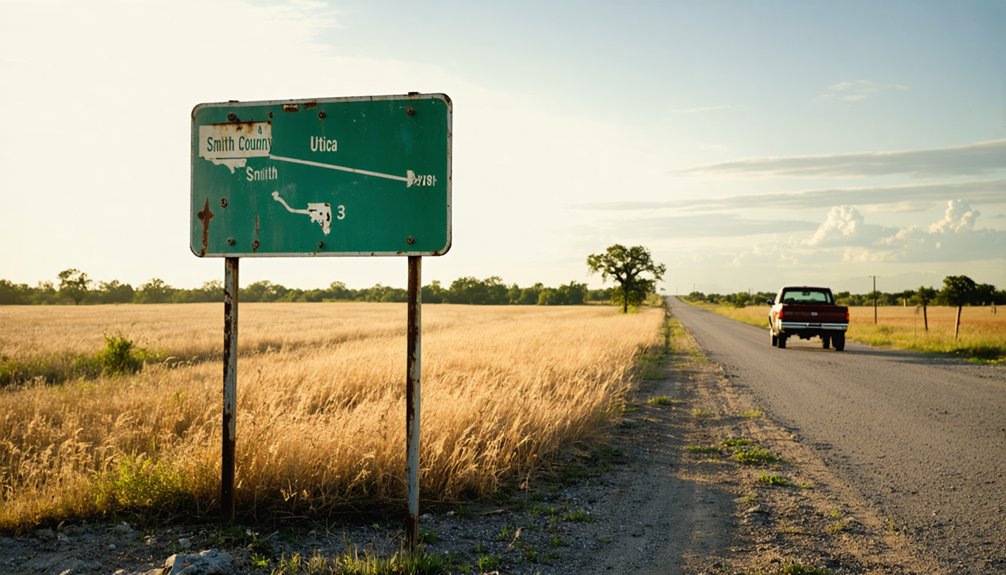
Tucked away in northern Smith County, Utica sits near the Wood County line—a whisper of a settlement that once thrived thirteen miles south of where the old Dallas-Shreveport road crossed the Tyler trade route. You’ll find it northwest of Winona and southeast of Red Springs, positioned at coordinates that place it squarely in the county’s northern reaches at approximately 32°27′N 95°23′W.
To reach this forgotten place, you’ll navigate beyond Tyler’s urban sprawl, using State Highway 155 or Highway 69 as your gateway north. The nearby landmarks that’ll guide your journey include the communities of Winona to your southeast and Red Springs to your northwest. This remote corner of Smith County rewards those who venture off beaten paths, where silence speaks louder than any bustling thoroughfare.
The Rise and Fall of a Turn-of-the-Century Settlement
Standing where Utica’s main street once bustled with wagon traffic and mill workers, you’ll find it hard to imagine this silent patch of East Texas woodland supported a hundred residents and six thriving businesses in 1892. The town’s meteoric rise lasted barely two years—from the post office’s opening in 1890 to its commercial peak—before an equally swift collapse erased it from county maps by 1905.
What remains are faint depressions in the earth where buildings stood and the haunting question of how a settlement could vanish so completely in just over a decade.
Boom Years: 1890-1892
While most of Texas still measured prosperity in cotton bales and wheat bushels, Utica carved out its brief moment of promise between 1890 and 1892. You’d have witnessed commercial prosperity as three flour mills and three cotton gins transformed raw harvest into profit. The rhythmic clatter of machinery filled air thick with grain dust and cotton fiber.
A hundred residents called this place home—farmers, millers, a druggist mixing remedies, a wagonmaker crafting vehicles from lumber yards nearby.
Population growth brought that intoxicating frontier energy where everyone believed tomorrow would eclipse today. But you’d have sensed the fragility too. Young folks already eyeing horizons beyond these mill towns, dreaming of cities where opportunity wasn’t measured in bushels. Utica’s peak barely lasted three years before that restless migration began.
Economic Decline and Abandonment
The post office doors locked for the final time in 1905, fifteen years after they’d first opened to serve Utica’s hopeful hundred residents. You’d have watched the population fluctuations accelerate—neighbors packing wagons, chasing work in larger towns where opportunity still beckoned.
The infrastructure changes sweeping Texas bypassed this quiet settlement entirely, leaving it stranded in economic isolation.
Without diversified industry, Utica couldn’t weather the cotton market shifts that reshaped regional economies. Businesses shuttered one by one. Families departed, leaving empty structures to weather and wind. By 1905, silence replaced commerce. No revival came, no second chance. The town you’re visiting today represents countless turn-of-the-century settlements that burned bright and fast, then vanished when circumstances shifted—a monument to both ambition and impermanence.
From Town to Wilderness
Southeast of Red Springs, where northern Smith County’s piney woods reclaim what humans once cultivated, Utica’s remains lie scattered across thirteen miles of wilderness north of Tyler. You’ll find vanishing community remnants where flour mills once ground grain and cotton gins processed harvests. The transforming farmland landscape has erased nearly every trace of the settlement that peaked at 100 souls in 1892.
What nature’s reclaimed:
- Three flour mills that fed families now reduced to foundation stones beneath undergrowth
- Cotton gins where farmers brought their harvest, swallowed by encroaching forest
- The wagonmaker’s shop and druggist’s store, their locations lost to time
- Roads that once connected to Dallas-Shreveport trade routes, barely discernible as trails
You’re witnessing complete wilderness restoration—a settlement erased.
What Made Utica Thrive in the 1890s
Small settlements like Utica don’t just appear overnight—they need catalysts to transform raw land into thriving communities. When that postal office opened its doors in 1890, it sparked genuine postal infrastructure growth that connected roughly 100 residents to the wider world. You’d have witnessed neighbors gathering to send letters, receive goods, and exchange news—basic freedoms we take for granted today.
The town’s agricultural community development centered on Texas’s rich soil potential and strategic location in Smith County. Farmers cleared land, planted crops, and traded their harvests while the postal service kept them linked to markets and family elsewhere.
This wasn’t glamorous frontier living—it was hard work driven by self-reliance. Those early residents built something real from nothing, chasing independence before circumstances changed everything.
Why This Texas Community Disappeared
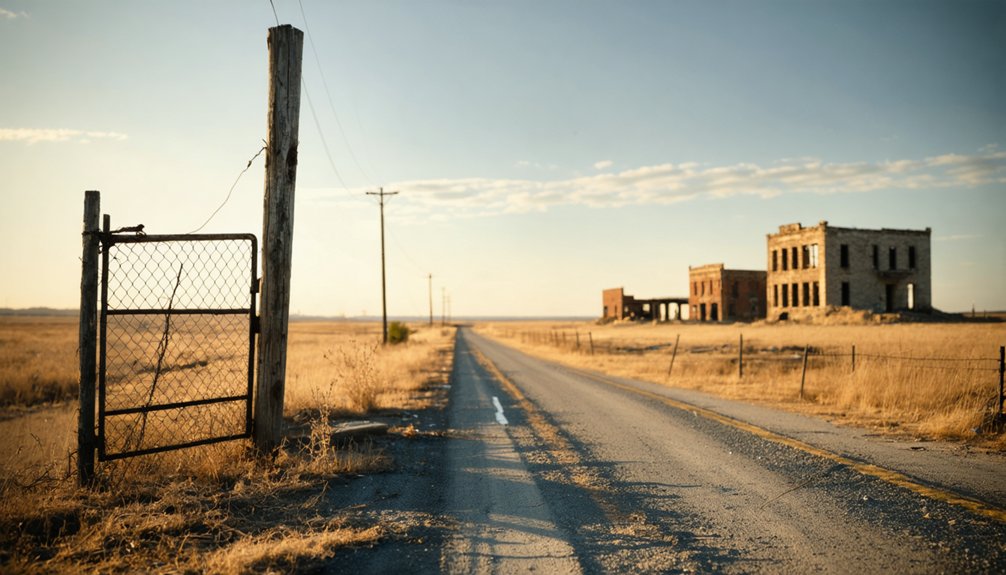
When the post office shuttered its doors in 1905, you can imagine the finality of that moment—the last thread connecting Utica to the outside world simply snapped.
You’d have watched your neighbors loading wagons with what they could carry, abandoning mills and shops that had hummed with activity just years before, drawn by the promise of steady work in Dallas, Tyler, and other cities experiencing Texas’s urban boom. The closure wasn’t just an administrative decision; it was the community’s death certificate, marking the point when staying in Utica meant isolation from the economic opportunities reshaping Texas at the turn of the century.
Post Office Closure Impact
The post office closure in 1905 delivered the critical blow to Utica’s survival as a functioning community. You’ll find that when basic services disappear, towns rarely recover.
Despite maintaining 100 residents, Utica had zero businesses by 1904—a telling sign of economic stagnation. The loss of basic services meant residents couldn’t conduct essential correspondence, forcing them to travel miles for mail pickup. This inconvenience triggered community depletion as families relocated to towns with functioning infrastructure.
What the closure meant for residents:
- No mail delivery forced dangerous trips to distant post offices
- Economic isolation prevented business development and trade opportunities
- Social disconnection severed pivotal communication links with distant relatives
- Future uncertainty drove young families toward thriving communities
You’re witnessing how one closure cascaded into total abandonment within years.
Economic Shift to Cities
Utica’s collapse mirrors a pattern you’ll recognize across abandoned Texas settlements—resources dried up, businesses shuttered, and residents packed wagons for cities promising steady paychecks. Rural urban migration accelerated after 1929 when the Depression crushed cotton prices and oil markets crashed. You’d have done the same—watching topsoil blow away during Dust Bowl storms while Dallas factories beckoned with assembly-line jobs.
Economic restructuring hit single-industry towns hardest. When railroads bypassed Utica for larger hubs, commerce evaporated overnight. By WWII, manufacturing centers pulled entire families from failing farms. Texas shifted from 67% rural in 1900 to chiefly urban by 1945. Stand in Utica’s remnants today and you’re witnessing America’s brutal efficiency—cities devoured small towns, leaving bleached foundations where general stores once anchored communities.
What Remains at the Site Today
Unlike many Texas ghost towns that leave behind crumbling facades or weathered foundations, Utica has vanished completely from the physical landscape. You won’t find scattered bricks, old fence posts, or cemetery markers—just open farmland and woods that have reclaimed every trace. This mysterious vanishing makes Utica particularly intriguing for those seeking Texas’s most elusive historical sites.
Where a Texas community once thrived, only fields and forests remain—no ruins, no markers, just the whisper of vanished history.
The lack of physical remnants means you’ll need imagination rather than a camera:
- No buildings, foundations, or structural evidence exist
- Historical maps are your only guide to the original location
- Surrounding terrain shows no boundary markers or town layout
- The site blends seamlessly into rural Smith County countryside
You’re fundamentally standing where a community thrived, yet nothing confirms its existence beyond archival records.
Getting There From Tyler and Beyond

Reaching Utica requires commitment—you’ll navigate roughly 150 miles of East Texas backroads where ghost town hunting transforms into genuine adventure. From Tyler, take US-69 N through piney woods and past Lake Fork Reservoir, then veer onto FM 14 N near Hawkins. Budget 2 hours 45 minutes and $20-25 fuel cost estimates for the journey.
Check traffic updates via Waze before departing—Tyler’s morning rush (7-9 AM) creates bottlenecks, and construction near Mineola surprises unsuspecting travelers. Watch for deer crossings on those dark two-lane stretches.
Want more? Extend north to Sulphur Springs for additional ghost town loops, or swing south via I-20 for faster interstate returns. Rain’s common here, so monitor weather forecasts. This isn’t a trip for the timid—it’s for seekers craving authentic exploration.
Tiger Creek Wildlife Refuge: New Life on Old Ground
Just ten miles north of Tyler on FM 14, where rescued tigers prowl through 173 acres of East Texas pine forest, Tiger Creek Wildlife Refuge breathes unexpected life into land that once knew only silence. Since 1996, this sanctuary has freed over 75 big cats from chains and cages—including Michael Jackson’s tiger Thriller—offering them wild space to reclaim their power.
Seventy-five big cats traded chains for pine forest freedom, prowling 173 acres where silence once reigned supreme.
What makes this detour worth your time:
- Animal care programs train the next generation of wildlife advocates, with 150+ professionals learning hands-on rescue protocols
- Guided tours (March-October) reveal each cat’s backstory, from surrendered pets to illegal zoo survivors
- Endangered species conservation efforts address the stark reality: fewer than 2,000 wild tigers remain
- Native wildlife rehabilitation runs alongside big cat rescue, with 1,200+ animals treated and released
Their roars echo across forgotten country roads, reminding you what freedom sounds like.
Other Abandoned Towns to Explore Nearby

East Texas hoards its ghost towns like secrets whispered between pine trees. You’ll find Burning Bush‘s abandoned pecan orchards just 20 minutes south—a community that vanished in the 1920s when political and religious tensions erased civic involvement.
Camden, Gregg County’s oldest settlement, sits 40 minutes away where malaria-carrying mosquitoes drove out an entire population by 1872. Only the cemetery remains in Easton. New Danville lasted from the 1840s until 1873, its church and graveyard still standing 35 minutes northeast via US 271.
North Chapel’s renovated church survives off FM 1252, a 15-minute drive northwest. These settlements once thrived with cultural diversity before circumstances—disease, drought, or discord—scattered their residents like dandelion seeds across Texas winds.
Frequently Asked Questions
Are There Any Historical Photographs or Documents of Utica Available?
You’ll find Utica’s story preserved in Texas historical archives and Smith County local records. The Portal to Texas History and UTSA Libraries hold precious photographs documenting vanished communities like this 1890s settlement that disappeared after 1905.
What Caused All Three Flour Mills to Close Simultaneously?
The mills didn’t drop like dominoes—records simply vanished. You’ll find no smoking gun, though excessive wheat production and supply chain disruptions likely strangled profits. Freedom-seeking farmers probably abandoned milling when bigger operations crushed small-town dreams.
Can You Camp Overnight at Tiger Creek Wildlife Refuge?
No overnight camping’s allowed at Tiger Creek Wildlife Refuge. You won’t find campground facilities here, but you’ll experience incredible wildlife viewing opportunities during daytime tours. Plan your visit accordingly, bringing water and sun protection for Texas heat.
Were There Any Cemeteries or Burial Grounds in Utica?
No documented cemeteries exist for Utica, though many Texas ghost towns retained burial grounds. You’ll find abandoned church cemeteries dot rural Smith County, and undiscovered burial plots often hide on private land where settlers once carved their freedom from wilderness.
What Happened to Residents After the Post Office Closed?
After the post office closed, you’ll find residents scattered to nearby towns like Tyler and Red Springs. The closure’s impact on community life was devastating—without mail service or businesses, there weren’t reasons for staying in isolated Utica.