Wagner’s Point isn’t your typical ghost town — there are no crumbling walls or rusted doorframes waiting for you. This former six-block Baltimore neighborhood once housed roughly 270 residents surrounded by ten chemical plants and oil refineries, until cancer rates and eminent domain erased it entirely by the late 1990s. Today, only an active industrial zone remains. If you’re planning a visit, you’ll want to know exactly what you’re walking into before you go.
Key Takeaways
- Wagner’s Point, a former Baltimore neighborhood of 270 residents, was abandoned after decades of toxic industrial pollution caused cancer rates far above national averages.
- Baltimore City used eminent domain to displace residents and expand the Patapsco Wastewater Treatment Plant, ending nearly 100 years of neighborhood life in the late 1990s.
- No houses, street signs, or sidewalks remain today; the site coordinates are 39°14′4″N 76°34′8″W, best accessed via Baltimore’s harbor shoreline.
- Essential protective gear includes a respirator mask, nitrile gloves, steel-toed boots, safety goggles, and a high-visibility vest due to ongoing industrial hazards.
- Visitors must respect restricted zones around the Patapsco Wastewater Treatment Plant, as trespassing carries legal consequences in this active industrial area.
What Wagners Point Looked Like Before the Buyout
Before Baltimore City bought out the last of its residents in the late 1990s, Wagner’s Point was a tight-knit six-block neighborhood of roughly 270 people wedged between some of the city’s most aggressively toxic industrial operations.
You’d have found modest row homes reflecting Baltimore’s characteristic historical architecture, surrounded by ten chemical plants, oil refineries, scrap metal dumps, and industrial waste recyclers.
The community dynamics were remarkable — neighbors had maintained ordinary lives amid smelly, smoky, oily conditions for nearly a century. That resilience came at a brutal cost, though.
Residents suffered cancer rates and other diseases exceeding national averages, all directly tied to their industrial surroundings.
The community paid dearly — cancer and disease rates far surpassing national averages, a direct toll of toxic industry.
What you’d have witnessed was a community stubbornly holding its ground in one of America’s most contaminated neighborhoods until the city finally forced the issue.
Why Baltimore Abandoned This Working-Class Neighborhood
When you look into why Baltimore walked away from Wagners Point, you’ll find a grim trifecta of industrial poison, political calculation, and bitter human cost.
The city’s 270 residents suffered cancer rates and diseases well above the national average, and officials quietly determined that buying out the neighborhood was cheaper than fighting the inevitable flood of medical lawsuits.
What followed were brutally contested negotiations, with residents so frustrated they walked out of the third session in September 1998, ultimately accepting above-market home values and relocation fees under the weight of eminent domain.
Industrial Pollution Health Crisis
The health consequences were devastating. Cancer rates and other serious diseases exceeded national averages, directly linked to decades of chemical exposure and industrial pollution.
You’re looking at a real environmental justice failure — a working-class community trapped between survival and slow poisoning.
Yet community resilience defined these residents. They stayed, raised families, and fought for fair treatment even as industries poisoned their air and soil.
Baltimore’s eventual buyout wasn’t generosity — city officials calculated that relocation was simply cheaper than future medical lawsuits.
City’s Strategic Buyout Plan
Baltimore City didn’t abandon Wagner’s Point out of compassion — officials ran the numbers and chose the cheaper option. The buyout strategy was straightforward: relocating 270 residents cost less than defending future medical lawsuits from pollution-related illnesses.
The city used eminent domain, offering above-market home values, relocation fees, and low-interest mortgages. Negotiations weren’t smooth — residents walked out of the third session on September 17, 1998, frustrated by disputed terms.
The community impact was permanent and irreversible. Families who’d lived amid chemical plants and refineries for nearly a century were scattered, their neighborhood ultimately bulldozed flat. No houses remain today.
You’re visiting a place where government economics, not empathy, erased an entire working-class community from Baltimore’s map.
Forced Relocation Bitter Negotiations
Negotiations between Baltimore City officials and Wagner’s Point residents didn’t just stall — they collapsed entirely. Residents pushed back hard against forced displacement, refusing to quietly surrender the neighborhood their families had occupied for generations.
Community resistance reached a breaking point on September 17, 1998, when frustrated residents walked out of the third negotiating session, rejecting what they felt were inadequate terms.
Baltimore City ultimately wielded eminent domain, leaving residents little legal ground to stand on. Yet the city didn’t arrive empty-handed — officials offered above-market home values, relocation fees, and low-interest mortgages.
The buyout wasn’t generosity; it was calculated. City accountants determined relocating 270 residents cost less than defending future medical lawsuits tied to decades of toxic industrial exposure surrounding the neighborhood.
The Health Crisis That Forced 270 Residents Out
Living in Wagner’s Point meant breathing air thick with chemical fumes, absorbing toxins from nearby waste sites, and watching your neighbors fall ill at alarming rates.
Cancer rates and other diseases exceeded national averages, directly tied to the surrounding chemical plants, oil refineries, and industrial waste recyclers poisoning everyday life.
The health impacts on these 270 residents weren’t abstract statistics — they were real people losing their freedom to simply live safely in their own homes.
Community resilience kept families rooted for nearly a century amid the smokestacks and contamination, but the body count eventually became undeniable.
Baltimore City ultimately recognized that buying out residents was cheaper than facing mounting medical lawsuits.
The neighborhood’s toxic legacy made relocation not just practical, but absolutely necessary for survival.
How Eminent Domain Ended Life at Wagners Point
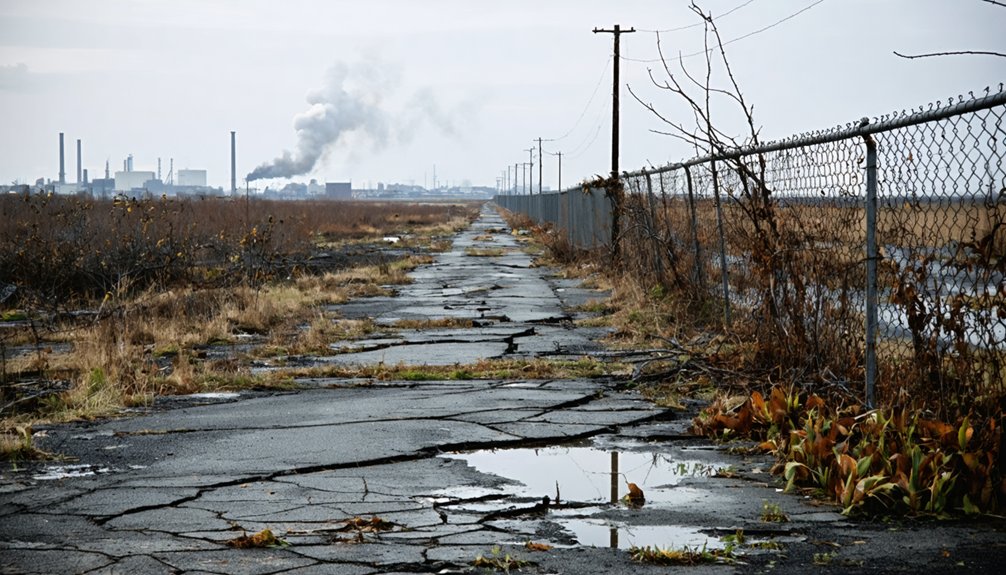
When Baltimore City decided it needed Wagner’s Point for wastewater treatment expansion, it didn’t ask — it took. Using eminent domain, the city displaced 270 residents from a six-block community, ending nearly 100 years of neighborhood life.
The community impact was profound, though negotiations were anything but smooth.
Key facts about the buyout:
- Residents received above-market home values plus relocation fees
- Low-interest mortgages helped families resettle elsewhere
- Negotiations grew bitter — residents walked out on September 17, 1998
- The city calculated buyout costs were cheaper than future medical lawsuits
- Every structure was eventually leveled, leaving zero visible traces
You won’t find a single standing wall today. What was once someone’s home is now industrial infrastructure, swallowed entirely by the toxic landscape that drove people away.
No Houses, No Markers: What the Wagners Point Site Looks Like Now
Today, if you drive out to the coordinates where Wagner’s Point once stood, you’ll find no houses, no street signs, no sidewalks — nothing that hints a six-block neighborhood ever existed here.
The city leveled everything after the buyout, leaving industrial machinery and the Patapsco Wastewater Treatment Plant as the only landmarks.
There’s a quiet brutality to it. Urban decay usually leaves ruins behind — crumbling walls, broken windows, overgrown lots.
Urban decay usually leaves ruins behind. Wagner’s Point leaves nothing — not even the ghost of what once stood here.
Wagner’s Point skips that entirely. It’s just gone. No historical markers acknowledge the 270 people who lived here or the environmental justice battle they fought against decades of toxic exposure.
If you’re visiting, bring the coordinates: 39°14′4″N 76°34′8″W. That’s all you’ve got. The land itself tells you nothing.
What to Read Before You Visit Wagners Point

Because the land gives you nothing, you’ll need to do your homework before you go.
Wagners Point’s environmental impacts, historical significance, and cultural narrative demand context before you set foot there. The industrial evolution that erased this community and the urban decay that followed tell a story of community resilience worth understanding deeply.
Research these sources before visiting:
- The 1998 publication documenting Fairfield and Wagner Point’s environmental history
- Baltimore City Paper archives covering the bitter 1998 buyout negotiations
- Video archives capturing the neighborhood’s final residential era
- Records detailing the 270 residents’ relocation and eminent domain dispute
- Historical accounts of the Martin Wagner Company beef packing plant fire of 1913
Knowledge transforms an empty industrial lot into something meaningful.
Getting to Wagners Point via Baltimore’s Harbor Shoreline
Baltimore’s harbor shoreline gives you the clearest route into what remains of Wagners Point, threading you past the industrial edge of the city where chemical plants, oil refineries, and scrap metal dumps crowd the waterfront.
Waterfront accessibility here is straightforward, but don’t expect a welcoming destination. The neighborhood’s been leveled, leaving no standing structures behind. You’re maneuvering through an active toxic industrial zone, so plan accordingly and take precautions.
Despite its stripped appearance, the site carries enormous historical significance. You’re walking ground where 270 residents endured a century of industrial pollution before Baltimore City forcibly bought them out in the late 1990s.
A community of 270 once called this toxic shoreline home before the city bought them out.
The Patapsco Wastewater Treatment Plant now dominates the area. Use the coordinates 39°14′4″N 76°34′8″W to pinpoint the former residential footprint before you arrive.
What to Know Before Walking Into an Active Industrial Zone
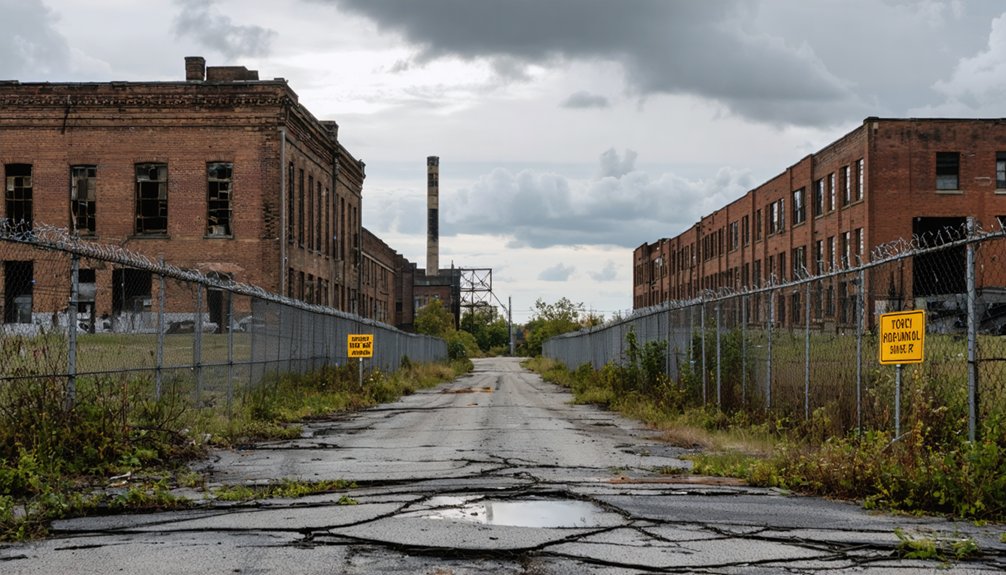
Before you set foot anywhere near Wagners Point’s active industrial zone, you’ll need proper protective gear — think respirator masks, chemical-resistant gloves, and steel-toed boots — because the air and ground carry real toxic hazards from decades of chemical plant operations.
You’re not walking into an abandoned neighborhood here; restricted zones around the Patapsco Wastewater Treatment Plant and surrounding facilities are actively enforced, with trespassers facing legal consequences.
Study the boundary lines before you go, stay on publicly accessible paths, and treat every unmarked perimeter fence as a hard stop.
Safety Gear Requirements
Walking into Wagner’s Point today means stepping into one of Baltimore’s most toxic industrial corridors, so you’ll want to take your gear seriously.
Active chemical plants and waste facilities create real environmental hazards, and proper safety gear isn’t optional here.
Pack these essentials before you go:
- Respirator mask — filters chemical fumes and airborne particulates from nearby refineries
- Nitrile gloves — protects skin from ground contamination and industrial residue
- Steel-toed boots — shields feet on debris-covered, uneven industrial terrain
- Safety goggles — guards eyes against airborne irritants and smoky conditions
- High-visibility vest — keeps you visible to active industrial vehicle traffic
Don’t treat this like a casual urban explore.
You’re moving through a working toxic zone, so gear up accordingly and stay alert.
Restricted Zone Boundaries
Gearing up handles the physical risks, but knowing where you’re legally allowed to stand matters just as much.
Wagner’s Point sits inside an active restricted zone anchored by the Patapsco Wastewater Treatment Plant, and trespassing carries real legal consequences. The industrial legacy here didn’t disappear when the last resident left — it intensified. Chemical plants, refineries, and storage depots still operate across this corridor, and their perimeters aren’t always clearly marked with obvious fencing.
Before you visit, pull Baltimore City’s industrial zoning maps and cross-reference the public access boundaries near the harbor shoreline.
You can legally observe the former neighborhood’s footprint from designated approach points without crossing into active facility grounds. Respect those lines — your freedom to explore depends on staying inside them.
Daniels Ghost Town: A Natural Add-On in Patapsco Valley
Since you’re already exploring Baltimore’s industrial ghost towns, Daniels Ghost Town in Patapsco Valley makes for a natural next stop—and it couldn’t be more different.
Unlike Wagner’s Point’s toxic flatlands, Daniels history unfolds through actual ruins you can walk among, making ghost town exploration here feel genuinely immersive.
You’ll discover:
- Standing church ruins that survived decades of abandonment
- Old cars scattered throughout the wooded valley
- Mill remnants echoing the town’s industrial past
- Natural Patapsco Valley trails connecting the entire site
- Photogenic decay contrasting sharply with Wagner’s Point’s erased landscape
Daniels offers the hands-on ghost town experience that Wagner’s Point simply can’t deliver anymore.
Pack sturdy boots, bring your camera, and give yourself several hours to roam freely through this hauntingly preserved valley.
Who Should Visit Wagners Point and Who Should Skip It
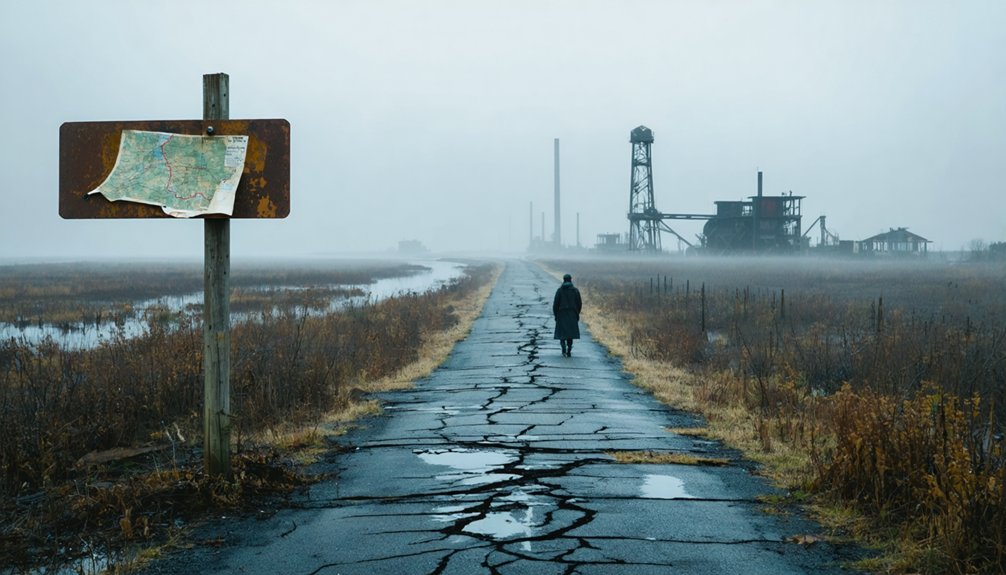
Wagner’s Point isn’t for everyone, and that’s perfectly fine to admit. If you’re drawn to ghost town history, industrial impact, and the raw stories of communities pushed out by pollution and corporate expansion, you’ll find this place quietly compelling.
There’s nothing pretty here — no crumbling facades or photogenic ruins — just flat, leveled land swallowed by industrial operations.
Skip it if you need visible structures to feel connected to a place. But if you’re someone who reads landscapes, who can stand on empty ground and imagine 270 residents maneuvering through toxic air and bitter negotiations, Wagner’s Point will hit differently.
You’re not sightseeing — you’re bearing witness. That distinction matters, and it separates the curious from those just checking locations off a list.
Frequently Asked Questions
Can Visitors Take Photographs at the Wagners Point Industrial Site Today?
You can capture photography at Wagner’s Point’s industrial site, but you’ll want to respect photography regulations. Explore the haunting remnants of this toxic industrial site freely, documenting Baltimore’s forgotten history through your lens with caution.
Are There Guided Tours Specifically Focused on Wagners Point’s History Available?
Like a ghost whispering through abandoned halls, Wagner’s Point’s historical significance lives in self-guided exploration. You won’t find formal tours, but local legends fuel Baltimore’s industrial history resources — craft your own free, independent journey through archives and city records.
What Time of Year Is Best for Visiting the Wagners Point Area?
Spring or fall offer you the best season to visit. You’ll enjoy milder weather considerations, avoiding summer’s humidity and winter’s chill, making your exploration of this hauntingly industrial ghost town far more comfortable and engaging.
Did Any Former Wagner’s Point Residents Document Their Experiences in Memoirs?
Like fading ink on old pages, memories live on — you won’t find formal memoir collections, but resident interviews and a 1998 publication capture Wagner’s Point voices, preserving their toxic industrial neighborhood’s story before relocation erased it forever.
Are There Any Annual Commemorative Events Held for Former Wagners Point Residents?
There’s no record of annual commemorative events for former Wagner’s Point residents. You’d find that community remembrance lives through video archives and historical significance preserved in 1998 publications, keeping their story alive for freedom-seeking explorers.
References
- https://www.ronaldtanner.com/baltimores-ghost-town/
- https://www.tripadvisor.com/Attraction_Review-g41131-d10035193-Reviews-Daniels_Ghost_Town-Ellicott_City_Maryland.html
- https://digitalcommons.law.umaryland.edu/mlh_pubs/31/
- https://www.ghosttowns.com/states/md/wagnerspoint.html
- https://www.youtube.com/watch?v=ShdpNwKVDBc