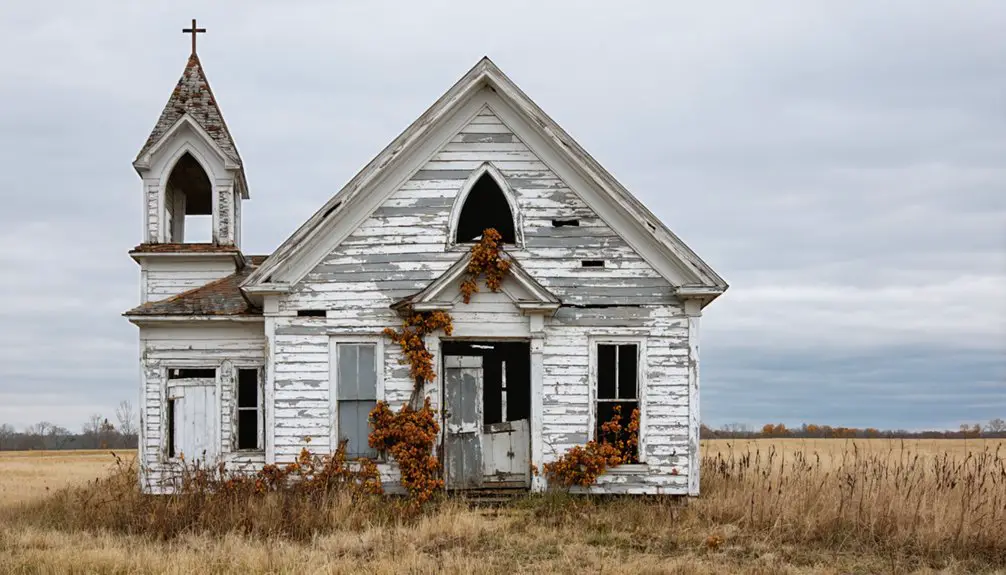
Planning a ghost town road trip to Wakenda, Missouri means chasing a town the Missouri River completely swallowed. Located in Carroll County, Wakenda vanished after devastating floods in 1993 and 1995 left nothing standing—no structures, no memorials, just raw land and river. You’ll want waterproof boots, a paper map, and a weather radio before you go. Visit late summer for the safest access conditions. Stick around, and you’ll uncover everything you need to make this haunting journey unforgettable.
Key Takeaways
- Wakenda, Missouri, once a thriving river town, was completely erased by catastrophic floods in 1993 and 1995, leaving no structures or memorials behind.
- Visit in late summer to early fall for the best access, as seasonal flooding from April to July makes roads dangerous and unreliable.
- Pack waterproof boots, a paper map, extra water, a first-aid kit, and a weather radio, as cell service is poor near the site.
- Combine your Wakenda visit with stops at nearby ghost towns like Times Beach, Pattonsburg, and Possum Trot for a richer historical road trip experience.
- Plan your route traveling north to south along the Missouri River, connecting ghost towns that each reflect unique stories of loss and resilience.
What Made Wakenda a Missouri River Ghost Town?
Tucked along the banks of the Missouri River in Carroll County, Wakenda once thrived as a river town that endured floods for years — until the river finally won.
Understanding Wakenda history means recognizing how river town dynamics shaped its entire existence — prosperity and vulnerability lived side by side.
River towns like Wakenda carried twin fates — prosperity and peril bound together by the same unpredictable current.
For decades, residents rebuilt and pushed forward after each inundation. But the catastrophic 1993 flood shattered whatever resilience remained.
Then, just two years later, the 1995 flood delivered the final blow. Two devastating floods within three years proved too much. Residents evacuated completely, leaving nothing behind.
Today, the land floods routinely, erasing every trace of the community that once stood there.
No structures, no markers, no memorials — just the same relentless river that both built and ultimately destroyed Wakenda.
Where Exactly Is Wakenda in Carroll County?
Knowing what ended Wakenda makes you want to find exactly where it stood — and that’s where Carroll County’s geography comes into play.
Wakenda sat directly along the Missouri River‘s banks in central Missouri, a placement that defined both its Wakenda history and its destruction. The river dynamics here are relentless — the Missouri constantly shifts, floods, and reclaims land, making pinpointing the original townsite challenging today.
You won’t find markers or memorials guiding you in. The land floods routinely, and seasonal water levels dictate whether you can even approach the area safely.
Carroll County sits in Missouri’s heartland, making it accessible from multiple directions, but respect the terrain. What you’re visiting isn’t preserved — it’s actively being erased by the same river that once gave Wakenda its reason to exist.
How the 1993 and 1995 Floods Erased Wakenda
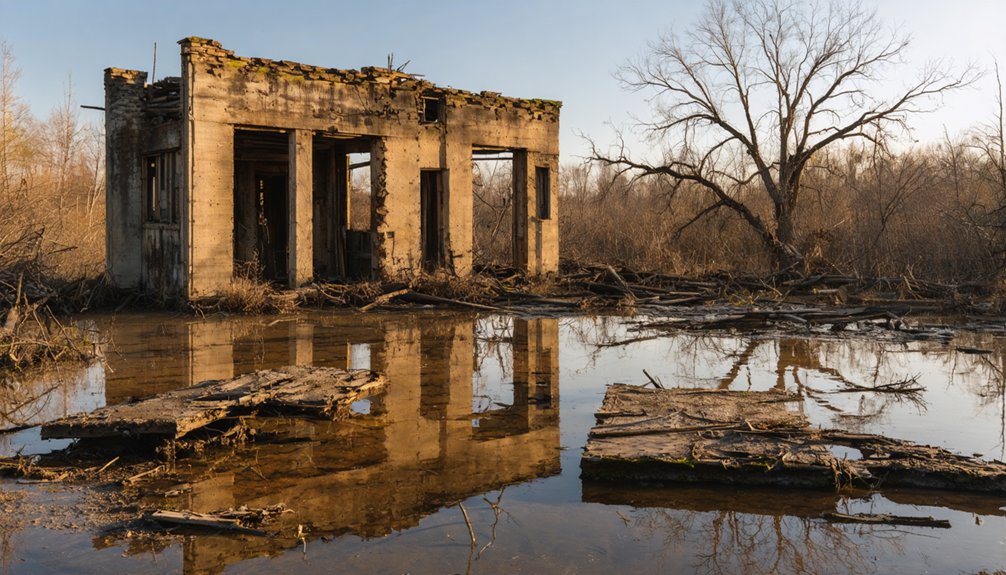
What the Missouri River started over generations, it finished decisively in two brutal strikes. Wakenda’s town history shows a community that demonstrated remarkable flood resilience, absorbing repeated Missouri River rises before the 1993 catastrophe overwhelmed everything.
That flood alone crippled the remaining infrastructure, leaving residents with little reason to rebuild. Then 1995 hit, delivering a second devastating inundation just two years later.
That one-two punch broke what resilience remained. Families who’d already questioned rebuilding stopped asking entirely. Businesses never reopened. Streets disappeared under sediment and water.
You won’t find foundations, chimneys, or fence posts marking where Wakenda stood. The river claimed every physical trace, transforming a lived-in community into open floodplain.
What you’re visiting today isn’t ruins — it’s an absence, and that absence tells the story completely.
What You’ll Actually Find When You Visit Today
Arriving at the site where Wakenda once stood, you’ll find nothing — and that’s precisely the point. The Missouri River claimed everything, leaving raw, flood-prone land that tells ghost town legends better than any monument could. This erasure is Wakenda’s truest monument — a reflection of river resilience against human permanence.
When you stand there, expect:
- Silence so complete it feels like the land is still grieving
- Floodwater-smoothed ground where streets and foundations once existed
- An unobstructed river view that swallowed an entire community
- Wind carrying the weight of lives completely uprooted twice in three years
- Absolute freedom from distraction — just you, the Missouri River, and history
Nothing here constrains your imagination. Wakenda exists now only in memory, maps, and the restless current flowing past.
When Is the Best Time to Visit Wakenda and Missouri River Ghost Towns?
You’ll want to plan your visit to Wakenda and nearby Missouri River ghost towns between late summer and early fall, when water levels typically drop and roads become more accessible.
Spring visits carry serious risks, as snowmelt and rain push the Missouri River into flood stage, swallowing the very ground you’re trying to explore.
Checking the U.S. Army Corps of Engineers’ river gauge data before you go can save you a wasted trip—or worse, a dangerous one.
Optimal Seasonal Visit Windows
Because Wakenda sits directly on the Missouri River’s flood-prone banks, timing your visit is everything. Late summer through early fall offers the most accessible seasonal weather windows, giving you drier roads and lower water levels perfect for ghost town photography.
- Spring floods can completely submerge the site, cutting off any access.
- Summer heat reveals the starkest, most haunting landscapes for dramatic shots.
- Early fall delivers golden light that transforms empty land into something achingly beautiful.
- Winter visits carry ice-road risks but offer eerily quiet, fog-draped atmospheres.
- Avoid late March through May entirely — the Missouri doesn’t negotiate.
You’re chasing something that barely exists anymore. Pick your window carefully, respect the river’s rhythm, and you’ll experience Wakenda on your own terms.
Flood Season Timing Considerations
The Missouri River doesn’t care about your road trip schedule — it floods when it wants, and Wakenda bears the full brunt of that indifference.
Understanding flood patterns here means respecting the river’s rhythm, not fighting it.
Spring snowmelt combined with heavy rainfall creates the most dangerous seasonal weather conditions, typically peaking between March and June.
Late summer and fall offer drier, more stable windows for exploration. August and September historically deliver lower water levels, giving you firmer ground and passable roads.
Check the USGS river gauge data before you go.
Wakenda’s land floods routinely, so even a modest rise changes everything.
Plan flexible itineraries — the river decides your schedule, not the calendar.
How Does Wakenda Compare to Other Abandoned Missouri River Towns?
When you compare Wakenda to other abandoned Missouri River towns, you’ll notice that flood-driven displacement is a recurring theme, but the degree of erasure sets Wakenda apart.
Unlike Pattonsburg in Daviess County, which relocated its residents and preserved some community identity, Wakenda left nothing behind — no structures, no markers, no trace.
As you plan your route, that stark contrast in remnants makes Wakenda one of the most extreme examples of a Missouri River town swallowed whole by natural disaster.
Flood-Driven Town Abandonment
Wakenda isn’t alone in its watery fate — Missouri’s river towns have a long, painful history of surrendering to floodwaters. Their flood history reveals communities that fought hard, tested their town resilience, yet ultimately couldn’t outrun nature’s relentless cycle.
- Times Beach dissolved under chemical-laced floodwaters, forcing every resident to abandon their homes permanently.
- Pattonsburg watched the river swallow it whole, prompting the entire town to physically relocate.
- Hamburg vanished when wartime decisions collided with uncontrollable flooding.
- Wakenda endured decades of resilience before 1993 and 1995 finally broke the community’s spirit.
- Melva faded quietly, leaving nothing behind for those who once called it home.
These towns remind you that freedom sometimes means walking away entirely.
Comparing River Town Remnants
Knowing why towns vanish is one thing — understanding what’s left behind tells an even sharper story. When you make ghost town comparisons across Missouri’s river landscapes, Wakenda stands apart for one brutal reason: there’s literally nothing left.
Most abandoned river towns offer you something — crumbling foundations, overgrown cemeteries, faded signage. Wakenda delivers only water-scarred earth.
Compare that to Pattonsburg, which relocated rather than disappeared entirely, leaving its original site with scattered traces you can actually examine. Even Times Beach, erased by chemical disaster, generated memorials and documentation.
Wakenda’s river town remnants don’t exist in any tangible form. Repeated flooding erased everything. That raw absence makes visiting feel less like sightseeing and more like bearing witness to complete erasure — a uniquely sobering road trip stop.
Missouri River Ghost Towns
Along Missouri’s volatile river corridor, abandoned towns tell vastly different stories depending on how they died — and Wakenda’s story is among the starkest. Unlike relocations or slow economic decline, Wakenda drowned twice. That brutal river town history sets it apart from nearly every other ghost town exploration destination in Missouri.
Other abandoned river towns left something behind — foundations, cemeteries, road signs. Wakenda left nothing.
- Times Beach died from chemical poisoning, yet remnants exist in memory and records.
- Pattonsburg relocated, preserving its identity in a new location.
- Hamburg and Toonerville disappeared through wartime displacement, not nature’s wrath.
- Possum Trot faded quietly through gradual population loss.
- Wakenda was erased completely — swallowed, silenced, and forgotten beneath floodwaters.
You’re not visiting ruins here. You’re standing where a community once breathed.
Which Ghost Towns Near Wakenda Are Worth the Drive?
Once you’ve made the drive to Wakenda’s flood-erased banks, you’d be missing out if you didn’t extend the trip to a few equally compelling ghost towns scattered across Missouri.
Nearby towns each carry their own historical significance worth exploring. Times Beach in St. Louis County vanished due to chemical contamination, offering a stark contrast to Wakenda’s flood story.
Each ghost town carries its own story — Times Beach, erased by contamination, stands apart from Wakenda’s flood-driven fate.
Pattonsburg in Daviess County was literally relocated, leaving its original site abandoned.
Hamburg, Howell, and Toonerville in St. Charles County disappeared when WWII ordnance manufacturing displaced entire communities.
Each destination adds a distinct layer to Missouri’s pattern of erased settlements. Together, they create a road trip that moves beyond curiosity into something genuinely educational about how geography, disaster, and human decisions permanently reshape communities.
Which Roads to Wakenda Flood and When?
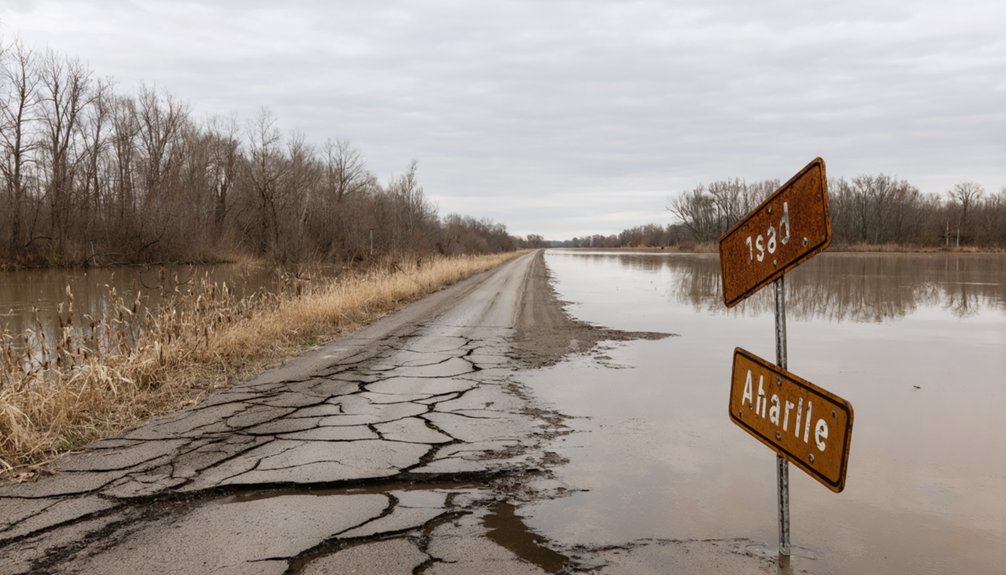
If you’re planning a trip to Wakenda, you need to respect the Missouri River’s seasonal mood, since spring snowmelt and summer storms regularly push floodwaters across the low-lying roads leading to the site.
Roads closest to the riverbank can disappear under several feet of water from April through July, making access not just difficult but genuinely dangerous.
You’ll want to check Carroll County road conditions in late summer or early fall, when water levels typically recede enough to get you closest to where Wakenda once stood.
Seasonal Missouri River Flooding
Seasonal flooding along the Missouri River makes reaching Wakenda’s former townsite genuinely unpredictable, and you’ll want to check current road conditions before committing to the drive.
The flood impact on Carroll County’s low-lying roads can shut down access for weeks, sometimes months. River ecology shapes this landscape constantly, reclaiming land that once supported an entire community.
Watch for these real conditions that hit travelers:
- Roads disappearing completely under murky Missouri River water
- Detours adding unexpected miles through unfamiliar rural terrain
- Mud-soaked surfaces turning passable roads into dangerous traps
- No warning signs alerting you to sudden water crossings ahead
- Bridges closing without notice during rapid water rises
Spring and early summer bring the highest risk.
Fall typically offers your best window for reaching this hauntingly erased place.
Roads Prone To Inundation
Knowing which specific roads flood helps you move from general awareness into actual route planning.
Carroll County’s low-lying roads nearest the Missouri River banks are your biggest concern. Routes running parallel to the river or dipping into floodplain terrain experience the most aggressive inundation patterns, sometimes becoming completely impassable within hours of heavy rainfall upstream.
You’ll want to check Missouri DOT’s traveler information system before you leave, since flood preparedness means having alternate routes already mapped. Highway 65 gives you a more elevated corridor approaching Carroll County, reducing your exposure.
Avoid unmarked county roads without checking local conditions first — they’re the first to disappear under water and the last to reopen. Flexibility isn’t optional here; it’s your most essential navigation tool.
Best Times To Visit
Late summer through early fall gives you the most reliable window for reaching Wakenda’s site, when river levels typically drop and Carroll County’s low-lying roads dry out enough to stay passable.
Spring visits risk flood impact that can strand you completely, erasing any trace of ghost town history you came to witness.
- Feel the quiet weight of a town the river swallowed twice
- Walk ground where neighbors once chose survival over staying
- Experience the raw freedom of a landscape reclaimed by nature
- Sense how 1993 and 1995 stripped away every last foundation
- Stand where a community existed, now marked only by water and sky
Avoid April through June entirely.
Check Carroll County road conditions before you leave home.
What Should You Bring on a Flood-Plain Ghost Town Drive?
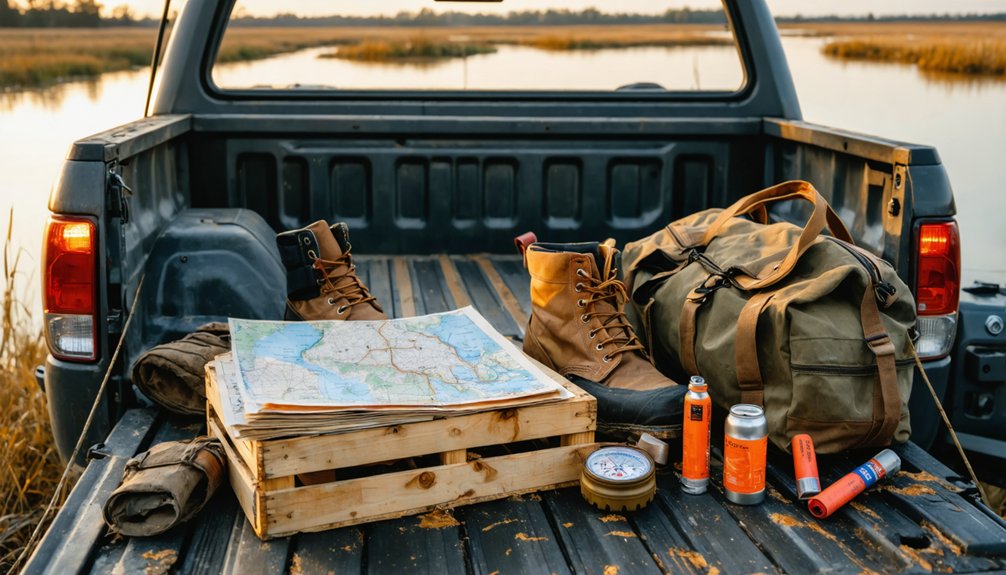
Packing 5 essential items can mean the difference between a memorable flood-plain adventure and a miserable one. Your flood preparedness kit should include waterproof boots, since standing water and soggy ground are practically guaranteed near Wakenda’s Missouri River banks.
Five essential items can mean the difference between a memorable flood-plain adventure and a miserable one.
Toss in a detailed paper map — cell service disappears fast in Carroll County’s rural stretches.
Round out your ghost town essentials with these three additions:
- Extra drinking water — remote roads offer zero amenities
- A first-aid kit — you’re miles from urgent care
- A weather radio or satellite communicator — river conditions shift without warning
Travel light, stay aware, and respect the land’s unpredictability. Wakenda doesn’t forgive the unprepared, but it rewards the curious.
How Do You Turn Wakenda Into a Full Ghost Town Road Trip?
Once your bag is packed and your boots are laced, it’s time to think bigger than a single stop. Wakenda anchors a compelling ghost town exploration route through central Missouri’s forgotten river town history.
String these stops together and feel each abandoned story hit differently:
- Possum Trot – where youth left and silence moved in
- Melva – a mining town swallowed by the Ozark hills
- Times Beach – erased by chemical contamination, not floodwater
- Pattonsburg – a town that literally relocated itself
- Hamburg – displaced by wartime necessity, never rebuilt
Plan your route north to south or trace the Missouri River’s edge. Each stop adds weight, context, and meaning. Together, they tell Missouri’s full story of loss.
Frequently Asked Questions
Did Wakenda Have a Post Office Before Flooding Made It Uninhabitable?
Like a heartbeat silenced, Wakenda’s post office history vanished under flooding impact. You’d find records confirming it once operated, but relentless Missouri River floods erased every trace, leaving nothing behind for you to discover today.
Were Wakenda Residents Compensated by Government Buyout Programs After 1993?
The knowledge doesn’t confirm government buyout details, but after 1993’s devastation, government policies likely shaped resident experiences. You’d find many Missouri flood victims received federal relocation assistance, helping them rebuild lives beyond Wakenda’s unforgiving, flood-ravaged banks.
Can You Legally Access the Wakenda Site on Private or Public Land?
Like a medieval commons dispute, legal access to Wakenda’s site hinges on land ownership—you’ll need to verify whether it’s private or public, as regular flooding makes the area largely inaccessible and unmarked today.
Are There Any Photographs or Maps Documenting Wakenda Before Its Abandonment?
You’ll find limited historical documentation of Wakenda, as abandonment impact erased much of its recorded past. Check county archives, Missouri historical societies, and old USGS maps — they’re your best chances of uncovering pre-flood photographs or detailed maps.
Did Any Wakenda Residents Relocate Together to Preserve Their Community Elsewhere?
You won’t find records of Wakenda’s residents relocating together to preserve community bonds. Unlike historical migration stories of tight-knit towns rebuilding elsewhere, Wakenda’s people scattered individually after flooding repeatedly erased their beloved Missouri River home.
References
- https://www.youtube.com/watch?v=alC1wDdSVvg
- https://www.youtube.com/watch?v=Tv7VLv68amY
- https://kids.kiddle.co/List_of_ghost_towns_in_Missouri
- https://en.wikipedia.org/wiki/List_of_ghost_towns_in_Missouri