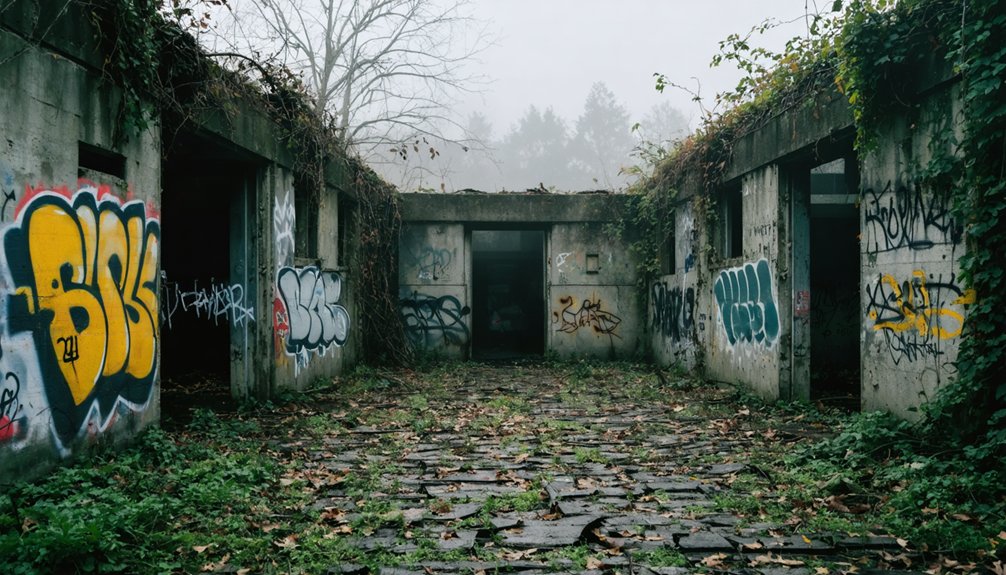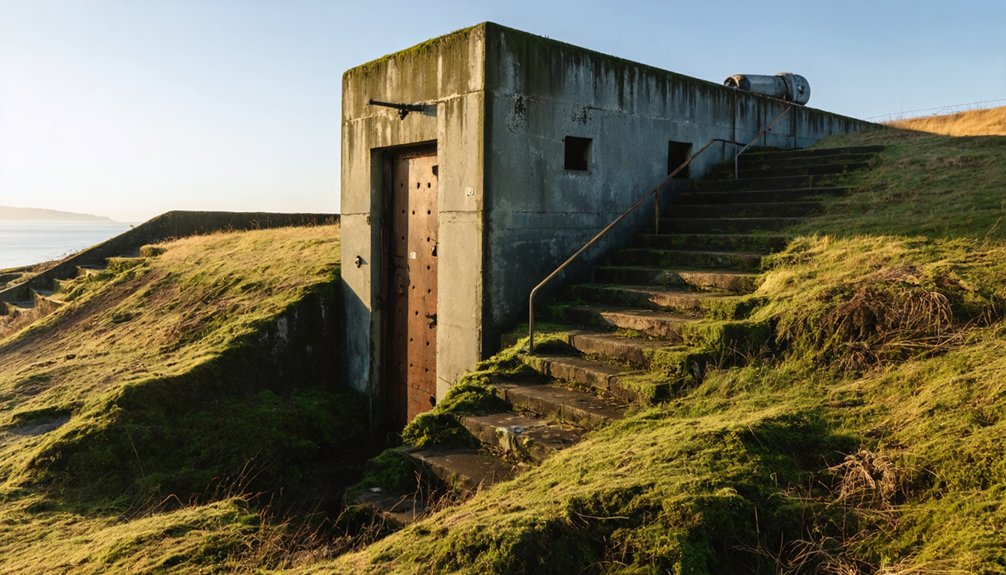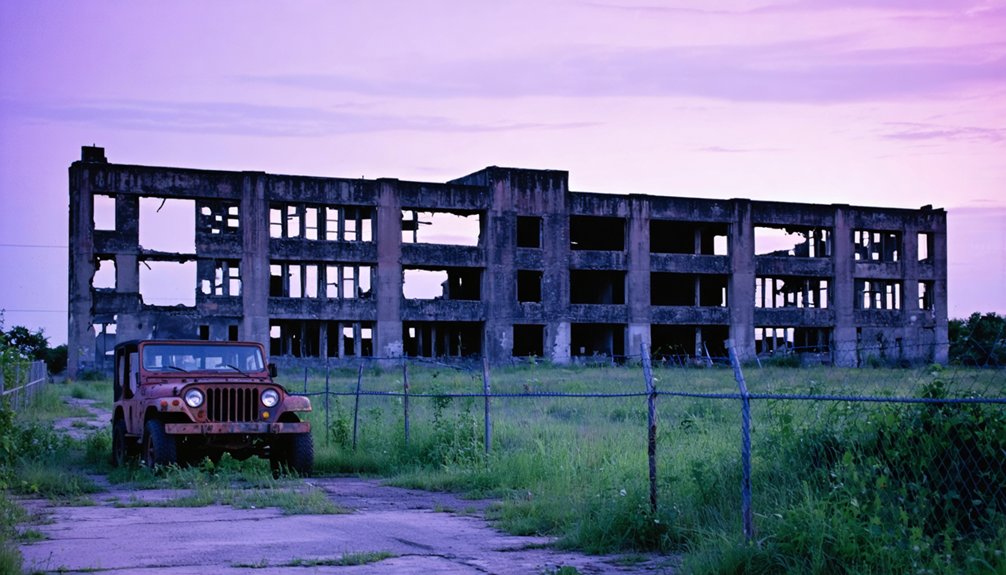
Military ghost towns across the US offer glimpses into America’s defensive past and supernatural present. You’ll find abandoned coastal fortifications slowly surrendering to nature, Cold War missile silos repurposed as museums, and Civil War prisons like Fort Jefferson harboring reported paranormal activity. These sites combine historical significance with eerie atmospheres, from Dr. Mudd’s prison cell to the “Faceless Man” at Fort Mifflin. The intersection of military history and ghostly encounters awaits your exploration.
Key Takeaways
- Fort Jefferson, America’s most isolated military prison, housed Civil War prisoners in brutal conditions and is rumored to be haunted.
- Abandoned military sites like Fort Mifflin feature paranormal phenomena including apparitions of soldiers and unexplained sounds.
- Cold War missile silos and bunkers dot the American landscape, with some repurposed as museums or survival condominiums.
- Natural forces have transformed abandoned military facilities into decaying structures that evoke an eerie, apocalyptic atmosphere.
- Military ghost towns like Virginia City and Castle Dome offer atmospheric historical tours showcasing America’s defensive past.
Fort Jefferson: America’s Most Isolated Military Prison
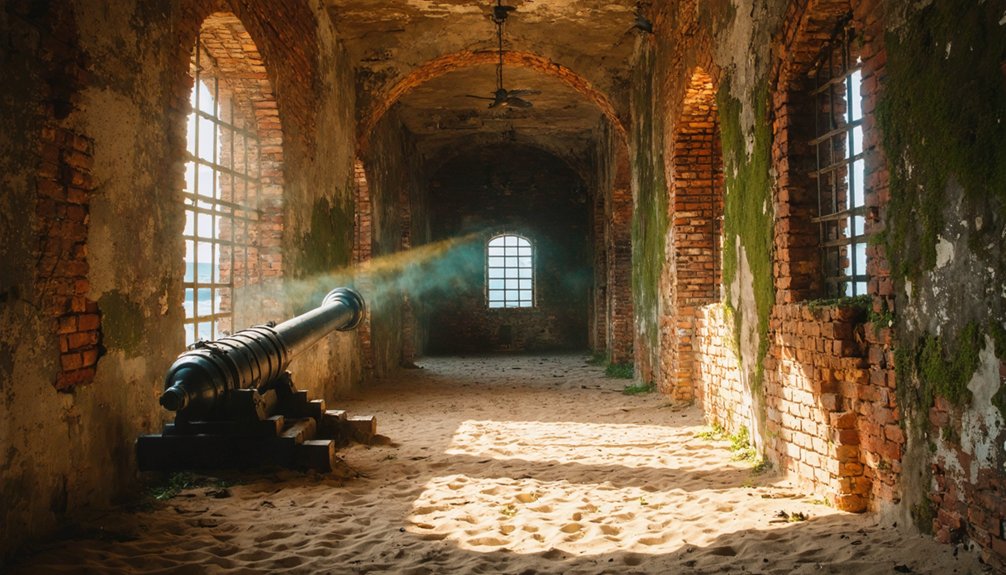
Hidden seventy miles west of Key West in the Gulf of Mexico, Fort Jefferson stands as the largest brick masonry fortification in the Western Hemisphere, encompassing 11 acres and composed of over 16 million bricks.
Constructed from 1846 but never completed, this strategic outpost controlled Gulf navigation routes before transforming into a notorious Civil War prison. The fort’s location on Garden Key, one of seven small islands in Dry Tortugas, made escape virtually impossible.
An unfinished giant, Fort Jefferson evolved from maritime guardian to America’s island hell.
You’d experience brutal prison conditions if incarcerated here: insufferable heat, disease outbreaks, hard labor, and ball-and-chain restraints. By 1864, nearly 900 prisoners were confined in this “Devil’s Island.”
Among notable inmates, Dr. Samuel Mudd gained infamy for treating John Wilkes Booth’s broken leg after Lincoln’s assassination.
Though designed for 450 guns across multiple tiers, the fort became obsolete with rifled cannon development, leading to its abandonment in 1874 and later conversion to a quarantine station. At its peak, the military installation housed a diverse community of nearly 2,000 total residents, including officers’ families and civilian workers.
Abandoned Coastal Fortifications Along America’s Shores
While America’s coastlines project an image of pristine beaches and bustling ports today, they’re dotted with the weathered remains of an extensive defensive network spanning centuries of military preparedness.
You’ll find Fort Pike and Fort Proctor in Louisiana’s swamplands—never-fired coastal defenses now surrendering to hurricanes and rising waters.
Maine’s Fort Popham stands as an unfinished semicircular monument to obsolescence, abandoned when artillery technology outpaced its granite walls.
Fort Tyler in New York represents a strategic miscalculation, built on unstable ground and quickly surrendered to nature.
Meanwhile, Mississippi’s Fort Massachusetts on Ship Island retains its historical significance as a Civil War-era prison that changed hands between Union and Confederate forces.
These abandoned sentinels reveal America’s evolving military priorities and the relentless forces of nature reclaiming man’s defensive ambitions. Many of these structures were part of the Third System of fortifications, characterized by massive masonry construction and multiple tiers of cannon emplacements.
Fort Michie in New York once required soldiers to alert nearby lighthouse before conducting cannon practice to prevent damage from the powerful concussions.
Cold War Relics: The Silent Sentinels
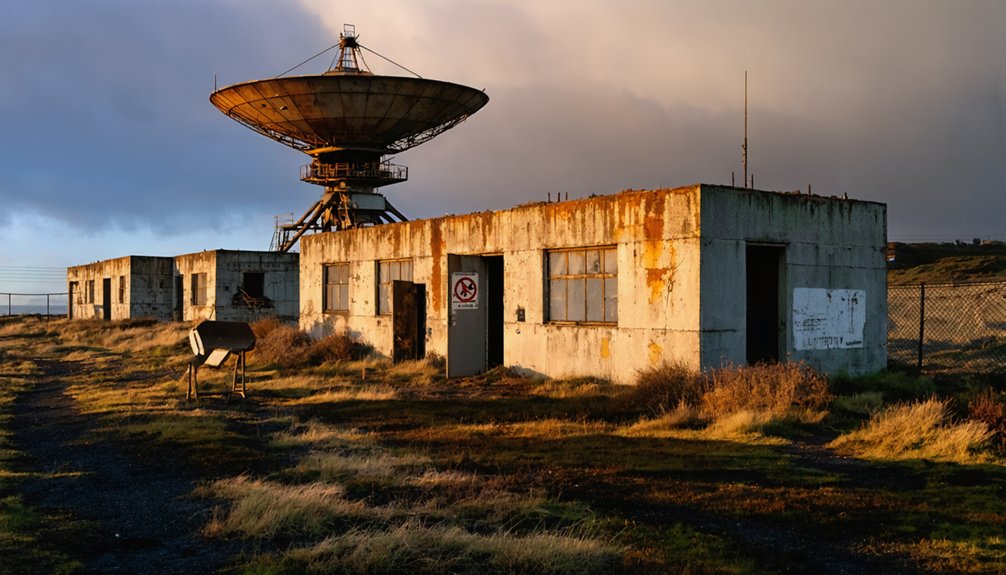
You’ll find hundreds of Cold War missile silos and bunkers scattered across the American landscape, their concrete shells and steel doors standing as eerie monuments to nuclear deterrence strategy.
These silent sentinels, once housing intercontinental ballistic missiles capable of delivering apocalyptic destruction, now serve as archaeological sites revealing mid-20th century military engineering and Cold War paranoia. Among these remnants are communities like St. Marie, which was established in the 1950s to support Glasgow Air Force Base before being largely abandoned following its decommissioning in 1976. Similar to Doom Town in Nevada, these abandoned military sites showcase the atomic testing era when America prepared for nuclear conflict.
Some facilities remain permanently sealed while others have been repurposed as museums, data centers, or even luxury survival condominiums for those with sufficient resources.
Missile Silos Reclaimed
Across America’s heartland lie hundreds of Cold War relics that once formed the backbone of the nation’s nuclear defense infrastructure.
These abandoned missile sites—from Wyoming to North Dakota—have undergone remarkable transformations since their decommissioning.
The underground architecture of these facilities, with 80-foot deep silos and 8-foot thick concrete walls, offers unique repurposing opportunities.
Some of these former silos were originally designed to house the Minuteman III missiles that have served as the cornerstone of America’s nuclear arsenal since the 1970s.
While most Minuteman III and Atlas complexes were stripped of classified equipment after their 3-5 year service lives, their sturdy structures remain intact.
Not all missile site repurposing efforts have been legitimate—complex 548-7 near Wamego, Kansas became an LSD manufacturing operation in 2000.
Yet many others serve educational purposes, like the Titan Missile Museum in Arizona, allowing you to experience these engineering marvels firsthand.
Several Cold War missile sites are now listed on the National Register of Historic Places, preserving their historical significance for future generations.
Bunkers Frozen in Time
Hidden beneath America’s landscape, Cold War bunkers remain as silent sentinels of a nuclear-anxious era. You’ll find these concrete fortresses built primarily during the 1950s-60s, their bunker architecture specifically engineered to withstand nuclear blasts and radiation.
Exploring these time capsules reveals a nation’s nuclear preparedness strategy—facilities like the Greenbrier’s 112,000 square foot congressional bunker remained secret until 1992. Many now sit abandoned, their survival supplies untouched for decades. The Oyster-Adams school bunker in Washington DC still contains original sanitation kits and emergency supplies from the 1960s.
The Titan II Silo in Arizona, once housing America’s largest land missile, stands decommissioned but with its entrance still carefully camouflaged.
These underground strongholds, designed to support up to 100 people for weeks, represent your government’s contingency plans for survival. The Greenbrier bunker, built in 1958, was secretly constructed as a relocation facility for Congress during the Cold War tensions. Today, they serve as tangible reminders of a time when nuclear annihilation seemed imminent.
Supernatural Encounters at Former Military Installations
Military installations across America harbor more than just historical significance; they serve as focal points for paranormal phenomena that defy conventional explanation.
When you visit Fort Mifflin, you’ll potentially encounter the “Faceless Man” in Civil War attire or hear the infamous “Screaming Woman.”
At Fort Leavenworth, America’s oldest active Army post, ghostly encounters include General Custer’s apparition and disembodied voices throughout The Rookery.
Jefferson Barracks presents particularly aggressive military hauntings, especially the specter of a guard shot during a munitions raid.
Warren Air Force Base’s troubled history with Native American massacres manifests through “Gus Quarters,” while Shiloh National Military Park’s mass graves of 3,000 fallen soldiers create paranormal hotspots at Bloody Pond and the National Cemetery.
These installations document America’s continuous dialogue between military history and supernatural occurrences.
When Nature Reclaims: Weather-Destroyed Military Bases

While abandoned military installations often succumb to human neglect, natural forces have proven to be the most devastating architects of destruction across America’s military ghost towns.
You’ll find catastrophic examples in Tyndall Air Force Base, where a Category 5 hurricane caused $5 billion in damages, destroying F-22 fighters and critical infrastructure.
At Offutt, one-third of the base submerged underwater when the Missouri River overflowed. Weather impacts extend beyond active bases—tornadic winds exceeding 100 mph have ripped roofs from hangars at Wright-Patterson and Lambert, while floodwaters render access roads impassable.
The military’s resilience is continually tested as abandoned mountain facilities crumble under decades of rain, snow, and temperature fluctuations.
What human engineering created, nature systematically deconstructs through relentless erosion, corrosion, and structural decay—transforming once-proud military installations into skeletal monuments of former might.
From Combat to Conservation: Preservation Challenges
Although abandoned military installations represent valuable historical assets, their transformation from combat facilities to conservation sites faces extraordinary challenges stemming from environmental contamination, structural deterioration, complex regulatory frameworks, and inadequate funding mechanisms.
Military ruins present a battleground between historical preservation and environmental cleanup, challenging our stewardship of America’s martial past.
You’ll find these sites caught between competing mandates—CERCLA’s contamination cleanup requirements often conflict with preservation objectives under the National Historic Preservation Act.
The accelerating decay of structures not designed for longevity complicates structural preservation efforts. Heavy metals, unexploded ordnance, and toxic residues require sophisticated remediation strategies that must account for climate change impacts like rising sea levels.
The jurisdictional maze involving DoD, EPA, and preservation agencies creates coordination obstacles that impede progress. Without early integration of restoration goals with remediation plans, these military ghost towns risk permanent loss of their historical significance while environmental hazards persist, threatening both heritage and public safety.
Exploring America’s Military Ghost Towns Today
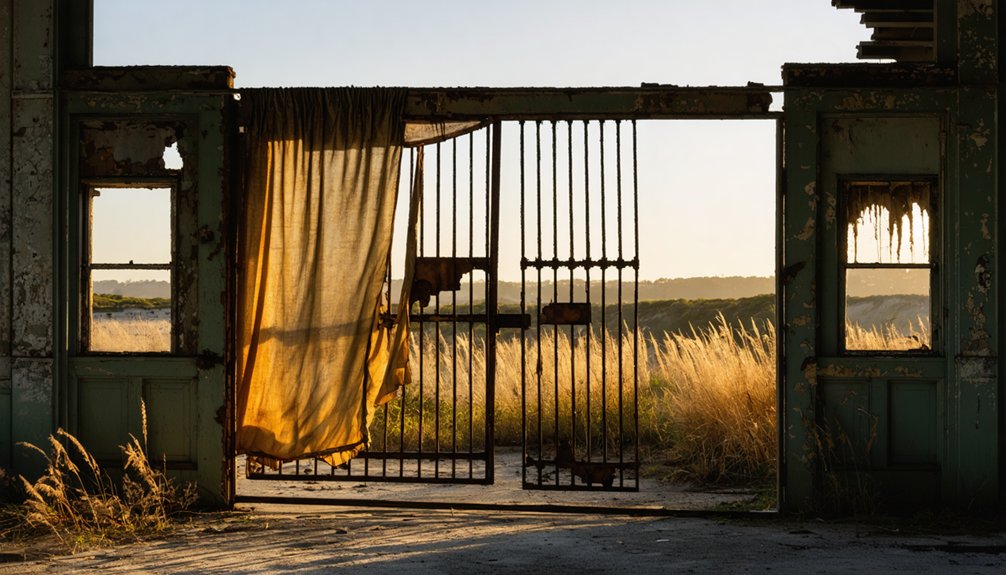
You’ll find numerous opportunities to visit abandoned military installations across the United States, with sites like Fort Jefferson in Florida and Fort Worden in Washington offering structured tours through historically significant structures.
As you embark on the adventure of exploring abandoned military bases safely, you’ll uncover not just remnants of the past but also stories that vividly illustrate the strategic importance of these locations. Many of these sites have been preserved, allowing visitors to engage in unique experiences while learning about the military history they once housed. Be sure to check for local regulations and tour availability to make the most of your visit.
These sites balance public access with preservation concerns, often requiring specialized transportation methods such as boats for Fort Carroll or seaplanes for more remote locations.
Fort facilities frequently incorporate educational components that explain their historical significance, from coastal defense systems to Cold War surveillance operations exemplified by Devil’s Slide Bunker in California.
Visiting Accessible Fortresses
Adventurous travelers seeking historical military sites can explore several accessible fortresses and compounds that once housed America’s defensive operations.
Fort Jefferson in Florida stands as America’s largest brick structure, offering fortress exploration opportunities after surviving its roles as a Civil War prison and naval station before its 1906 abandonment.
For those preferring western destinations, Fort Ord‘s partially accessible California coastal grounds showcase military infrastructure through preserved barracks and bunkers.
The historic preservation at Bodie State Historic Park maintains military-linked mining structures in “arrested decay,” while Castle Dome’s museum highlights the critical connection between mining operations and wartime supply chains.
Nevada’s Babbitt offers glimpses into military housing infrastructure near the world’s largest ammunition depot, providing context for America’s wartime logistics systems.
Tours Through History
Exploring America’s military ghost towns today offers a multi-layered journey through the nation’s defensive history, where abandoned fortifications and bases have transformed into compelling historical sites.
You’ll find many preserved as national or state parks, like Fort Jefferson or Cahawba Archaeological Park, providing structured access to their historical narratives.
When visiting “living ghost towns” such as Virginia City, Nevada, you can experience the architectural significance of military-connected sites firsthand through self-guided explorations or curated museum exhibits.
Castle Dome exemplifies this transformation, converting from a military mining operation into an educational attraction.
Throughout these abandoned outposts, you’ll discover distinct structural elements—from massive brick fortresses to coastal gun emplacements—now enhanced by natural reclamation that creates an atmospheric backdrop to America’s military past.
Frequently Asked Questions
Can Civilians Purchase Abandoned Military Installations?
Yes, you can acquire civilian ownership of military property through GSA auctions, sealed bids, or negotiations. You’ll need to navigate federal regulations, eligibility requirements, and potential environmental restrictions.
What Classified Information Remains Hidden in These Ghost Towns?
Like rusted safes in forgotten bunkers, these sites guard hidden secrets ranging from radiation exposure data to covert operation details. You’ll find classified archives of weapons testing and environmental contamination still locked away from public scrutiny.
How Dangerous Is Exploring Unmarked Abandoned Military Sites?
You’re risking exposure to carcinogens, radiation, and unexploded ordnance while potentially facing federal trespassing charges. Without proper safety precautions, these sites pose immediate and long-term health hazards. Legal implications include substantial penalties.
Do Military Ghost Towns Contain Unexploded Ordnance?
Yes, you’ll frequently encounter unexploded ordnance risks in military ghost towns. These sites contain dangerous UXO embedded underground, creating significant military site safety hazards requiring specialized detection and clearance expertise.
Which Abandoned Base Has Documented the Most Paranormal Activity?
With nearly 36 documented haunted buildings, Fort Leavenworth tops your list. While Fort Ord receives frequent paranormal investigations, it doesn’t match Leavenworth’s extensive record of spectral activity across its historic disciplinary barracks.
References
- https://www.geotab.com/ghost-towns/
- https://devblog.batchgeo.com/ghost-towns/
- https://www.mentalfloss.com/geography/american-ghost-towns-can-still-walk-through
- https://www.loveexploring.com/gallerylist/233478/americas-eeriest-abandoned-military-sites
- https://en.wikipedia.org/wiki/List_of_ghost_towns_by_country
- https://www.youtube.com/watch?v=c8cqQ-q7t9E
- https://daggerdefense.com/blogs/news/unveiling-the-mysteries-the-most-haunted-us-military-bases
- https://www.drytortugas.com/fort-jefferson-history/
- https://keywestseaplanecharters.com/amazing-history/
- https://lincolnconspirators.com/the-lincoln-conspirators-at-fort-jefferson/