Washington-on-the-Brazos is where Texas declared independence on March 2, 1836, yet the town itself barely survived the century. After railroads bypassed it in 1858 and steamboat traffic faded, the once-thriving commercial district vanished — its streets now buried underground. Today, you’re walking over archaeological remains on a 293-acre preserved site that honors what was lost and what was won. There’s more to this story than most visitors expect.
Key Takeaways
- Washington-on-the-Brazos was once a thriving town where Texas declared independence in 1836 but has since virtually disappeared.
- A railroad bypass in 1858 cut off essential commerce, triggering the town’s irreversible decline.
- Diminished steamboat traffic along the Brazos River further weakened the town’s economic foundation.
- By 1900, the physical town had essentially vanished, leaving archaeological remains buried underground.
- Today, marked streets trace the old commercial district, allowing visitors to walk over the buried ghost town.
The Town Where Texas Was Born
Washington-on-the-Brazos isn’t just another Texas ghost town—it’s the precise location where 59 delegates convened on March 2, 1836, to declare Texas independence from Mexico. They gathered in an unfinished frame building, representing municipalities across the region, and produced a constitution establishing the Republic of Texas—all while General Santa Anna actively besieged the Alamo.
On March 2, 1836, 59 delegates declared Texas independence—while Santa Anna actively besieged the Alamo.
The delegates worked 17 consecutive days and nights, organizing an ad interim government under extraordinary pressure. That urgency produced something lasting: a sovereign nation born from deliberate, documented action.
For you, visiting this site means standing where freedom wasn’t merely discussed—it was formally codified. Its cultural significance extends beyond Texas history into America’s broader democratic tradition.
Historical preservation here guarantees that founding moment remains accessible, understood, and honored by every generation that follows.
How Washington-on-the-Brazos Became a Ghost Town
After Texas declared its independence and the capital moved to Austin, the once-crucial settlement began a slow but steady decline. The railroad’s bypass of Washington-on-the-Brazos in 1858 proved devastating, cutting off commerce that the town depended upon.
Steamboat traffic along the Brazos River also diminished, stripping away what economic vitality remained.
By 1900, the physical town had essentially vanished. You’ll find that archaeological remains of Ferry Street’s entire commercial district now exist solely beneath the ground, invisible to the naked eye. That buried history makes historical preservation here especially critical.
What you’re visiting today isn’t a living town—it’s a recovered memory. The site’s documentation and layout allow you to understand precisely how freedom’s foundational moment ultimately couldn’t sustain the community that witnessed it.
What’s Still There After 190 Years
Despite nearly two centuries of abandonment, the site preserves more than you might expect. You’ll find a replica of Independence Hall standing where delegates forged a nation, alongside the Barrington Living History Farm, which recreates life from 1836 to 1846. Old streets of the vanished city remain marked, letting you walk pathways that once hummed with commerce. The museum and visitor center house authentic Texas artifacts and documents.
Unlike sites sustained by folklore legends or supernatural phenomena, Washington-on-the-Brazos earns its relevance through documented history. No verified ghost stories circulate here—the real story needs no embellishment.
Archaeological remains of Ferry Street’s commercial district survive below ground, while a small modern community with a post office exists just outside the park’s 293 acres.
Independence Hall, the Living History Farm, and What to Do on Site
Though it’s a replica, the reconstruction of Independence Hall stands on the original site where fifty-nine delegates drafted Texas’s founding documents across seventeen grueling days and nights in 1836, giving you a tangible connection to that specific moment of governance rather than a generalized museum recreation.
Adjacent to it, the Barrington Living History Farm anchors cultural preservation by focusing specifically on the 1836–1846 decade, demonstrating how Texans actually lived during the Republic era.
You’ll also find a well-documented museum, a visitor center, and marked streets tracing the vanished commercial district above its buried archaeological layer.
Together, these elements deliver serious historic education grounded in documented evidence rather than romanticized spectacle.
The park’s 293 acres reward methodical exploration, connecting you directly to the political and domestic realities of Texas’s foundational period.
Admission Prices, Hours, and What to Know Before You Go
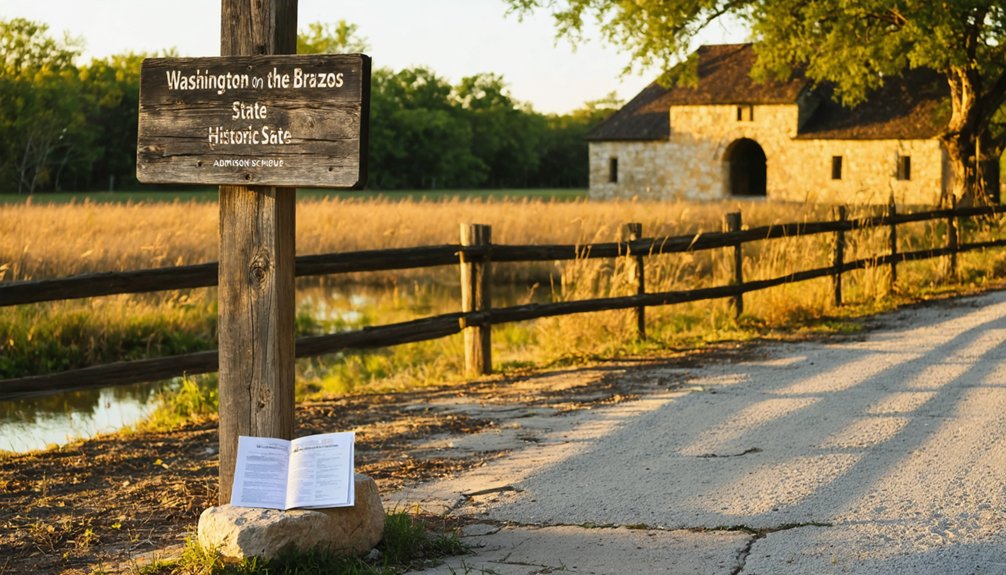
Planning your visit to Washington-on-the-Brazos requires knowing a few practical details before you arrive. Visitor amenities are accessible daily, though hours vary by area:
Washington-on-the-Brazos welcomes visitors daily, though hours shift depending on which area of the site you’re exploring.
- Visitor Center and Grounds: Open 9:30 a.m. to 5 p.m. daily
- Museum: Opens later, from 10 a.m. to 5 p.m.
- Admission: Adults pay $10; ticket discounts apply for seniors, veterans, teachers, and first responders at $8; children 6–17 pay $6; under 5 enter free
- Family Ticket: Two adults and one child enter for $22
You’ll find the site at 23400 Park Rd 12, Washington, TX 77880. Educational programming, living history demonstrations, and a thorough museum ensure your visit delivers substantive historical engagement beyond passive sightseeing.
Frequently Asked Questions
Is Washington-On-The-Brazos Considered an Official Ghost Town Today?
Yes, you’d barely recognize it as a ghost town! Historical preservation efforts have transformed it into one of Texas’s premier tourist attractions, yet its vanished commercial district technically qualifies it as an official ghost town.
Are There Any Ghost Stories or Paranormal Investigations at the Site?
You won’t find any verified paranormal sightings or ghostly legends documented at this site. Current evidence-based records don’t support such claims, so you can explore Washington-on-the-Brazos freely, guided strictly by its rich, documented historical significance.
Does Anyone Actually Still Live in Washington, Texas Currently?
Like Brigadoon’s fleeting existence, yes, people still live there! Outside the park’s historical preservation boundaries, you’ll find a small community with a post office, where tourist attractions thrive, and roughly 76 residents once called it home.
Where Exactly Is Washington-On-The-Brazos Located?
You’ll find this historical landmark at 23400 Park Rd 12, Washington, TX 77880, where the site’s river proximity to the Brazos originally established the town’s strategic ferry landing location.
Who Was Anson Jones and Why Is His Farm There?
Anson Jones, Texas’s last Republic president — because apparently someone had to hold that title — farmed here, preserving your Agricultural heritage and Historical significance. You’ll find his reconstructed residence adjacent to the park boundaries today.
References
- https://thc.texas.gov/historic-sites/washington-brazos
- https://www.youtube.com/watch?v=Jrq80R14XGQ
- https://texastimetravel.com/directory/washington-brazos-state-historic-site/
- https://wheretexasbecametexas.org
- https://www.ghosttowns.com/states/tx/washington-on-the-brazos.html
- https://www.saturdayeveningpost.com/2025/04/americas-forgotten-capital-city/
- https://www.youtube.com/watch?v=3Pj6U6sDAso
- https://www.texasescapes.com/CentralTexasTownsSouth/WashingtonOnTheBrazos/WashingtonOnTheBrazosStatePark.htm